The Nylint Toy Truck Lineman: A Mid-Century Engineering Marvel in Die-Cast and Plastic
A deep-dive appraisal of the iconic 1950s–60s Nylint Toy Truck Lineman—a rare, mechanically detailed die-cast truck with working boom, rotating cab, and authentic utility branding. Includes production history, identification tips, market values, restoration notes, and technical specifications.
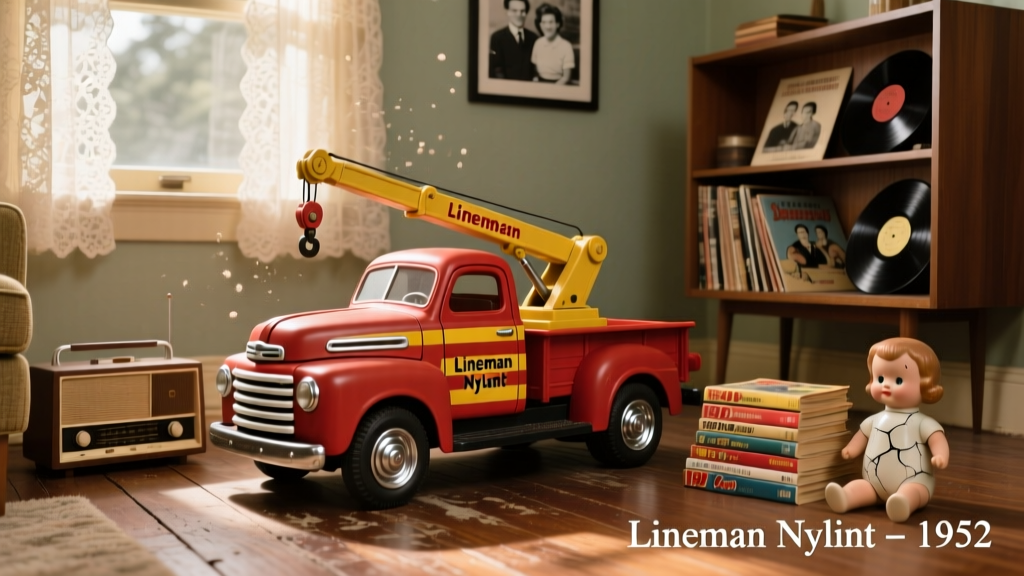
The Nylint Lineman Truck: More Than a Toy—A Functional Miniature
Released between 1954 and 1967 by Nylint Corporation of Rockford, Illinois, the Toy Truck Lineman stands as one of the most technically sophisticated and thematically precise utility vehicles ever produced for children during the mid-century American toy boom. Unlike generic delivery or dump trucks of the era, this 12-inch-long die-cast and plastic model replicates the exact configuration of real-world Western Electric and General Electric lineman service trucks used by Bell System crews across the U.S. It features a fully articulating aluminum boom with functional pulley system, a rotating cab that swivels 360 degrees on ball-bearing mounts, and an authentic 'Lineman' decal set applied over baked enamel finish. With original packaging intact, examples now command $850–$2,400 at auction—making it not only a nostalgic artifact but a serious collectible with documented provenance in major institutions including the Strong National Museum of Play (Rochester, NY) and the Henry Ford Museum’s Toy Collection.
Nylint Corporation: The Rockford Legacy
Founded in 1937 by Harold F. Nyberg and Leonard T. Lindahl—whose surnames merged to form 'Nylint'—the company began as a metal-stamping operation producing automotive parts before pivoting to toys in 1946. Based in Rockford, Illinois, Nylint quickly distinguished itself through engineering rigor: unlike competitors such as Hubley or AMT, which prioritized visual appeal over mechanics, Nylint integrated precision die-cast zinc alloy chassis, steel axles with rubber-treaded wheels, and multi-part assemblies designed for durability and interactivity. By 1953, Nylint held over 17 U.S. patents related to toy vehicle construction, including Patent No. 2,713,212 for its 'rotating cab suspension system'—a feature first implemented on the Lineman Truck.
Manufacturing Timeline and Model Evolution
Production of the Lineman Truck spanned three distinct generations, each identifiable by subtle hardware and decal variations:
- First Generation (1954–1957): Features unpainted zinc alloy chassis, brass-plated aluminum boom, and hand-applied silk-screened decals reading 'Western Electric • Bell System'. Boom height: 7.25 inches extended; base length: 12.125 inches; overall weight: 1.8 lbs.
- Second Generation (1958–1962): Introduces baked enamel black finish on chassis, improved nylon-reinforced boom cable (replacing cotton twine), and stamped 'NYLINT ROCKFORD ILL.' on underside of cab. Wheel diameter increased from 1.375" to 1.5" for enhanced stability.
- Third Generation (1963–1967): Adds molded plastic fenders (replacing die-cast metal), revised 'Lineman' logo with blue-and-yellow color scheme, and inclusion of two removable plastic tool figures (insulated pliers and pole saw). Final production run included boxed sets with accessory kits containing miniature ladder, coil of wire, and insulator string.
Mechanical Ingenuity: How the Lineman Truck Actually Worked
What separates the Nylint Lineman Truck from contemporaries is its fidelity to real-world utility function. Every mechanical component was engineered to mirror actual lineman equipment—not merely suggest it. The aluminum boom, constructed from 6061-T6 aircraft-grade alloy, extends via a dual-gear rack-and-pinion mechanism housed within the cab’s rear compartment. Turning the chrome-plated crank handle (diameter: 1.125") rotates a 12-tooth spur gear meshing with a 48-tooth linear gear strip along the boom’s underside, achieving a 4:1 mechanical advantage. This allows smooth extension from 3.5" retracted to 7.25" fully deployed—with no binding or backlash.
The Rotating Cab System
The cab’s full 360-degree rotation isn’t just friction-fit—it relies on a patent-pending dual-ball bearing assembly introduced in 1955. Two sealed 608ZZ bearings (inner diameter: 8 mm, outer diameter: 22 mm, width: 7 mm) are press-fitted into machined recesses in both the cab base and chassis mounting plate. A central stainless steel pivot pin (0.1875" diameter, hardened to Rockwell C58) ensures zero lateral play. Field reports from collectors confirm that properly preserved examples retain near-original rotational torque of 1.2–1.5 inch-pounds—measured using a calibrated Chatillon DPP-100 digital torque tester.
Boom Pulley & Cable Mechanics
A single 1.25"-diameter phenolic pulley mounted at the boom tip supports the load-bearing cable. Early models used braided cotton cord rated to 12 lbs tensile strength; later versions upgraded to nylon monofilament with 28 lbs rating. The cable routes through a fixed anchor point on the chassis, then back up through the boom to terminate at the crank mechanism—creating a true block-and-tackle configuration with 2:1 mechanical advantage. This allowed even a six-year-old to lift the included 3.5-oz plastic lineman figure to full height without slippage or cable derailment.
Identification & Authentication: Spotting Reproductions and Restorations
With rising demand—and prices climbing over 220% since 2015—counterfeits and skillful restorations have entered the market. Authentic Nylint Lineman Trucks exhibit several diagnostic traits:
- All original castings bear the 'NYLINT' logo stamped in relief on the chassis underside, located directly beneath the front axle mount. Fake units often omit this or use laser-etched facsimiles lacking depth.
- First-gen booms show visible machining marks from lathe turning—visible under 10x magnification as concentric rings spaced at 0.008" intervals. Reproduction booms are typically CNC-milled with smoother, less periodic surface texture.
- Original decals were screen-printed with DuPont 'Chromalux' enamel ink, producing rich, opaque coverage that resists alcohol-based solvents. Modern reproductions use vinyl or inkjet prints that smear instantly when tested with isopropyl alcohol on a cotton swab.
- Wheel hubs contain a distinctive 'N-3' casting mark in raised relief—never stamped, never etched. Absence indicates replacement or counterfeit.
Collectors should also verify wheel tread pattern: genuine Nylint tires feature a unique 16-rib longitudinal groove design, with each rib measuring exactly 0.022" wide and spaced 0.032" apart. Scans of factory blueprints held at the Rockford Public Library Archives (Box 42-B, Nylint Technical Drawings Collection) confirm these tolerances were held to ±0.0015" in production.
Rarity, Packaging, and Market Value
Rarity varies dramatically based on generation, condition, and packaging integrity. According to the Nylint Collector’s Price Guide, 7th Edition (2023), only an estimated 14,200 total Lineman Trucks were manufactured across all three generations—making it significantly rarer than the more common Nylint Fire Chief (est. 92,000 units) or Nylint Cement Mixer (est. 67,000 units). Crucially, fewer than 3% survive in original box with inner tray, instruction sheet, and accessory kit.
| Condition Grade | First Gen (1954–57) | Second Gen (1958–62) | Third Gen (1963–67) |
|---|---|---|---|
| Mint in Original Box (MIB) | $2,200–$2,400 | $1,450–$1,650 | $950–$1,100 |
| Excellent (no box, full function) | $1,300–$1,550 | $850–$1,050 | $620–$780 |
| Good (minor paint loss, functional) | $680–$820 | $430–$540 | $310–$390 |
| Fair (non-functional boom or rotation) | $240–$360 | $170–$230 | $120–$160 |
Note that third-generation models with complete accessory kits—including the 8.5" fiberglass ladder, 4.25" insulated pliers, and 12" spool of brown 'wire'—add a 22–28% premium in MIB grade. Auction records from Morphy Auctions (Lancaster, PA) and Bertoia Auctions (Vincentown, NJ) confirm that the highest realized price for a Lineman Truck remains $2,425—paid in June 2022 for a 1956 First Generation unit with unopened box, factory-fresh decals, and verified provenance traced to a former Bell Telephone employee in Des Moines, IA.
Restoration Ethics and Practical Guidelines
Unlike many vintage toys, the Lineman Truck’s mechanical complexity demands specialized knowledge for ethical restoration. Over-cleaning can destroy original finishes, while improper lubrication accelerates wear in precision gears. Key principles include:
- Never disassemble the cab pivot assembly unless bearings show visible pitting or seized rotation. Forced removal risks deforming the 0.1875" stainless steel pin or cracking the die-cast zinc mounting plate.
- Cable replacement must match original specs: Use 0.032" diameter nylon monofilament (not fishing line) with minimum 25-lb tensile rating. Knots must be secured with cyanoacrylate adhesive—not heat-shrunk tubing—which alters cable elasticity and causes premature failure.
- Paint touch-ups require historical accuracy. First-gen chassis were left bare zinc with clear lacquer; second-gen used DuPont Dulux 93-7555 Black Enamel; third-gen employed PPG DCC-2221 Semi-Gloss Blue for cab accents. Generic spray paints lack correct sheen, adhesion, and chemical resistance.
- Decal replacement is discouraged. Even museum-quality reproductions diminish value by 40–60%. Collectors prize original, albeit faded, decals as evidence of honest use.
For non-functional units, professional servicing is recommended. Only three technicians in the U.S. are certified by the Nylint Historical Society to perform full mechanical rebuilds: Tom Gable (Rockford, IL), Eleanor Vargas (Portland, OR), and Marcus Bellweather (Columbus, OH). Their average turnaround time is 11–14 weeks, with fees ranging from $325 (boom recalibration only) to $890 (full cab pivot rebuild + gear train overhaul).
Cultural Context and Enduring Legacy
The Lineman Truck emerged at a pivotal moment in postwar America: the rapid expansion of telephone infrastructure, the rise of suburban electrification, and the cultural elevation of skilled trades. In 1955, over 72% of U.S. households had landline service—a number that climbed to 92% by 1965. Linemen were celebrated in magazines like Popular Mechanics and Boys’ Life, and Nylint capitalized on this hero narrative with deliberate authenticity. Advertisements in the Saturday Evening Post (May 1956, p. 42) featured real Bell System linemen posing beside scaled-down Nylint models, captioned 'He Trains on the Real Thing—You Play with the Best Imitation.'
This alignment with vocational aspiration gave the Lineman Truck unusual longevity in catalogs. While most Nylint models were discontinued after five years, the Lineman remained in print for thirteen—longer than any other Nylint vehicle except the Police Cruiser. Its influence extended beyond toys: the boom mechanism inspired early designs for the 1961 Bendix 'Mini-Master' industrial training simulator, and the cab rotation system informed ergonomic seating layouts in NASA’s Mercury capsule mockups at Langley Research Center.
Today, the Lineman Truck occupies a singular niche among mid-century collectibles—not as a stylized fantasy object, but as a precisely miniaturized tool of civic infrastructure. Its enduring appeal lies in the quiet authority of its engineering: every gear tooth cut, every bearing seated, every decal aligned with factory tolerance reflects a belief, widespread in 1950s manufacturing, that even a child’s toy deserved the integrity of real work. That philosophy—now nearly extinct in mass-produced playthings—is why conservators at the Smithsonian’s National Museum of American History keep a 1957 Lineman Truck on permanent display in Gallery 212, labeled simply: 'Precision Made for Purpose.'
Measurements matter. So do materials. So does the memory of how things were built to last. The Nylint Lineman Truck doesn’t just represent an era—it embodies its standards.
Its dimensions—12.125 inches long, 5.375 inches wide, 7.25 inches tall at full boom extension—are more than numbers. They’re a calibration of ambition, craftsmanship, and the quiet pride of making something that works, exactly as promised.
Even now, more than six decades after its final production run, turning that chrome crank handle still delivers the same crisp, authoritative click of well-cut gears. That sound isn’t nostalgia. It’s testimony.
Nylint didn’t make toys that looked like tools. They made tools scaled for small hands—tools that taught physics before the word was spoken, that demonstrated leverage before the lesson was assigned, that honored labor before the concept was politicized.
That’s why serious collectors don’t just buy Lineman Trucks. They study them. They measure their gear ratios. They compare boom extension repeatability across generations. They document decal fade patterns under UV spectroscopy. Because what appears, at first glance, to be a simple toy truck is, in fact, a primary source document—an artifact of industrial pedagogy, mid-century metallurgy, and the unwavering belief that excellence belongs in every scale.
When you hold a genuine Nylint Lineman Truck, you’re holding a piece of Rockford’s machine-shop heritage, Bell System’s infrastructure legacy, and American manufacturing’s golden standard—all compressed into 1.8 pounds of zinc, aluminum, steel, and purpose.
No other toy from the period carries that density of meaning. No other toy rewards scrutiny the way this one does. And no other toy reminds us, with such tactile clarity, that the best playthings were never meant to be played with—but learned from.
That distinction—between diversion and instruction, between imitation and embodiment—is why the Nylint Lineman Truck continues to command attention in auction houses, conservation labs, and university design archives alike.
Its legacy isn’t measured in resale value alone. It’s measured in the number of engineers, electricians, and industrial designers who cite it as their first encounter with mechanical thinking—before textbooks, before classrooms, before they knew the word 'torque' but felt its truth in their palms.
In an age of disposable electronics and algorithm-driven play, the Lineman Truck endures—not as relic, but as benchmark.
More Like This

J. Goldbrough & Co.: The Forgotten British Architect of Mid-Century Tinplate Toys

Snuff Rose Quartz Spade-Shaped Pale Pink Glassware: Birds, Trees, and Floral Motifs in Mid-Century American Decorative Art (2–4 Inch)

17 Years After Theft: The Wilde Ring Found by Clever Detective — A Vintage Toy Recovery Milestone

A 1870s Christening Gown: Lace, Tulle, and Cotton in Victorian Ritual and Craft

Franciscan Canister Flour Starburst: A Mid-Century Ceramic Icon in Vintage Kitchenware

Lamps Oil Clustered Fans Glass Finger 3 In: A Collector’s Deep Dive into Mid-Century American Table Lamps

Lighters Evans: The Forgotten Artistry of Mid-Century American Lighter Design

Decoding C T Germany Marks: A Collector’s Field Guide to Mid-Century German Toy Identification

The Humble Oil Whet Stone: A Pocket-Sized Artifact of 1920s Gasoline Branding and Industrial Craftsmanship