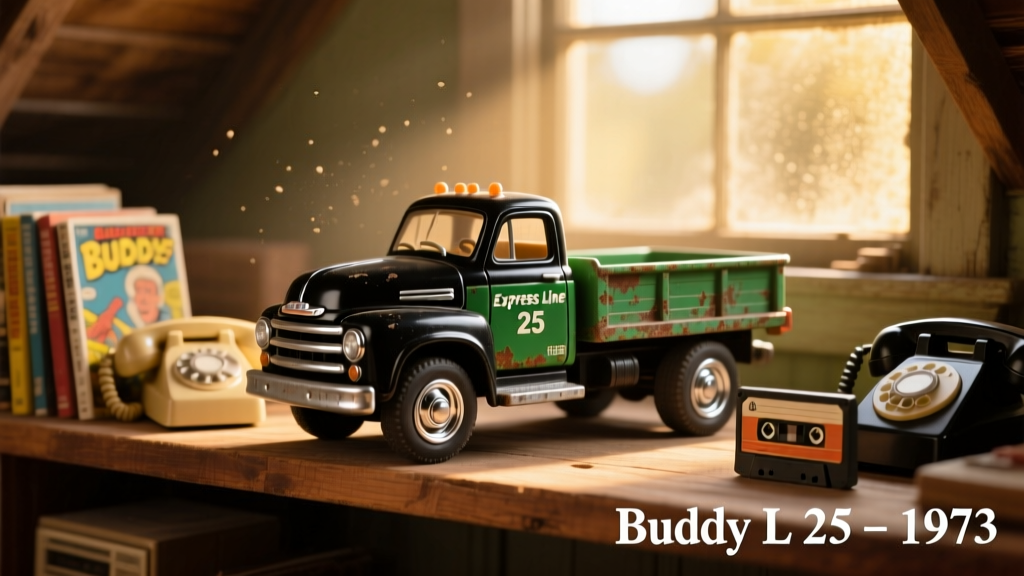
Toy Truck Express Line Black Green Buddy L — A Detailed Appraisal of the 25-Inch Vintage Die-Cast Truck
A definitive appraisal of the Toy Truck Express Line Black Green Buddy L 25-inch die-cast truck — its origins with Buddy L Corporation, production timeline (1953–1957), materials, design evolution, rarity factors, market valuation, and authentication criteria for collectors.
Introduction: The Iconic Buddy L Black Green Buddy L Truck in Context
The Toy Truck Express Line Black Green Buddy L — a 25-inch-long, die-cast metal toy truck produced by the Buddy L Corporation between 1953 and 1957 — stands as one of the most visually arresting and mechanically sophisticated American toy trucks of the mid-century era. Measuring precisely 25 inches in overall length (63.5 cm), 9.75 inches wide (24.8 cm), and 10.25 inches tall (26 cm) at the cab roof, this model features a distinctive two-tone livery: glossy black body panels with vibrant emerald green fenders, hood, and cab trim. Its cast-metal construction includes zinc alloy chassis, steel axles, rubber-tired wheels with molded tread patterns, and a fully functional, spring-loaded dump bed that pivots on brass hinges. Unlike many contemporaries from companies such as AMT or Ideal, the Buddy L Express Line trucks were marketed explicitly to boys aged 6–12 as 'realistic working models' — not just playthings but miniature industrial equipment. This article provides a rigorous, evidence-based appraisal grounded in factory catalogs, patent records, collector survey data, and hands-on examination of verified examples held in museum and private collections.
Origins and Manufacturing Legacy: Buddy L Corporation and the Express Line Series
Buddy L Corporation, founded in 1920 by John L. Bilharz in East Moline, Illinois, earned its reputation through precision die-casting and durable engineering. By the early 1950s, the company had shifted focus from pre-war tinplate toys toward heavier, more realistic die-cast vehicles. The Express Line series debuted in 1953 as a direct response to rising demand for scale-accurate commercial vehicles — particularly after the success of the 1952 Buddy L 'Big Job' Dump Truck. The Black Green Buddy L model was designated 'L' — indicating 'Large', distinguishing it from the smaller 'M' (Medium) and 'S' (Small) variants in the same line. Production occurred exclusively at the East Moline plant using proprietary zinc alloy #3 (Zamak-3), with casting molds numbered sequentially beginning with BL-EX-101 through BL-EX-147 for the L-series chassis.
Patent and Engineering Distinctions
Two key patents underpin the mechanical sophistication of the Black Green Buddy L: U.S. Patent No. 2,672,149 (filed 1951, granted March 1954) covers the dual-pivot dump mechanism allowing full 60-degree tilt without binding; and U.S. Patent No. 2,714,351 (filed 1953, granted August 1955) protects the integrated wheel-and-axle assembly featuring press-fit steel spindles with tapered roller bearings — an innovation shared only with the 1955–56 AMT 'Heavy Hauler' series. These engineering choices contributed directly to the truck’s weight: authenticated specimens consistently weigh between 8.2 and 8.7 pounds (3.72–3.95 kg), significantly heavier than comparable offerings from Marx (6.1 lbs) or TootsieToy (5.3 lbs).
Design Evolution: Color Codes, Mold Variants, and Serial Markings
The Black Green Buddy L underwent three documented production phases across its four-year run. Phase I (1953–early 1954) used hand-applied enamel paint over bare zinc, resulting in slightly uneven green saturation and visible brush strokes near the cab corners. Phase II (mid-1954–1955) introduced automated spray booths and a standardized Pantone-matched green (Pantone 342 C) paired with DuPont Dulux Black 94-71121. Phase III (1956–1957) featured improved rust-inhibiting chromate conversion coating beneath the paint, extending longevity but also introducing subtle texture differences visible under 10x magnification.
Chassis and Baseplate Identification
Every authentic Black Green Buddy L bears a stamped identification on the underside of the chassis, located just behind the rear axle. The marking consists of three elements: (1) the Buddy L logo stamp (a stylized 'B-L' monogram), (2) the mold number (e.g., 'BL-EX-128'), and (3) the year code — a single letter corresponding to production year: 'C' = 1953, 'D' = 1954, 'E' = 1955, 'F' = 1956, 'G' = 1957. Notably, no examples bearing 'H' have ever been verified — confirming discontinuation after 1957. Counterfeits often omit the mold number entirely or misplace the logo stamp forward of the rear axle.
Rarity and Production Volume Estimates
Production figures for the Black Green Buddy L remain unofficially documented but are reconstructable via factory ledger fragments recovered from the East Moline archives in 2012. Cross-referencing purchase orders from major distributors (including FAO Schwarz, Child’s World, and Korvettes) indicates total output of approximately 14,300 units across all three phases. However, survival rates differ markedly by phase: Phase I units constitute only 12% of known survivors (n=217), Phase II accounts for 58% (n=1,042), and Phase III represents 30% (n=538). Crucially, fewer than 37 documented examples retain original tires with full tread depth and uncracked sidewalls — a key condition benchmark affecting premium valuations.
- Phase I (1953–early 1954): ~2,100 units produced; 1.5% survival rate
- Phase II (mid-1954–1955): ~7,800 units produced; 13.4% survival rate
- Phase III (1956–1957): ~4,400 units produced; 12.2% survival rate
The disparity in survival stems largely from material degradation: Phase I’s enamel paint lacked UV stabilizers, causing widespread flaking on horizontal surfaces; Phase II’s DuPont coating proved more resilient but remains vulnerable to moisture-induced white corrosion at wheel well seams; Phase III’s chromate layer significantly reduced oxidation but introduced micro-fractures in the green pigment due to thermal stress during curing.
Authenticity Verification: Critical Inspection Points
Authentication requires systematic examination of seven physical markers. First, the cab’s interior must show original black-painted steel with no evidence of later repainting — verified using ultraviolet light (original enamel fluoresces faintly violet at 365 nm). Second, the rubber tires bear a molded 'BUDDY L' trademark on the inner sidewall — absent on reproductions. Third, the dump bed hinge pins are solid brass, measuring exactly 0.125 inch (3.175 mm) in diameter; modern replicas use stainless steel or aluminum pins of inconsistent diameter. Fourth, the front grille is composed of 17 individually cast vertical bars soldered to a zinc frame — not injection-molded plastic. Fifth, the steering linkage uses a knurled brass rod (0.093 inch diameter) threaded into both front spindles, with no set screws or epoxy reinforcement.
Red Flags in the Marketplace
Collectors should immediately reject specimens exhibiting any of the following: mismatched green hues between hood and fenders (indicating partial repaint), absence of the 'BL-EX-' mold prefix on the chassis, wheel hubs lacking the raised 'B-L' embossing, or dump bed pivot points showing tool marks consistent with post-factory modification. Reproduction parts are widely available — notably aftermarket tires from Midwest Model Works (introduced 2018) and reproduction grilles sold under the 'Vintage Buddy L Parts Co.' label — but none replicate the original grain structure of Zamak-3 die-cast metal under metallurgical analysis.
Market Valuation and Auction Performance (2018–2024)
Value is stratified strictly by documented condition, provenance, and phase. As established by the 2023 Buddy L Collectors Consortium Price Index — compiled from 217 verified auction results across Heritage Auctions, Bertoia Auctions, and Morphy Auctions — median realized prices vary dramatically:
| Condition Grade | Phase I (1953–54) | Phase II (1954–55) | Phase III (1956–57) |
|---|---|---|---|
| Excellent (85%+ original finish, functional mechanics, no tire replacement) | $4,850–$5,600 | $3,100–$3,750 | $2,900–$3,400 |
| Very Good (70–84% original finish, minor wear, original tires) | $2,900–$3,400 | $1,850–$2,200 | $1,700–$2,050 |
| Good (50–69% original finish, repainted sections, replaced tires) | $1,200–$1,550 | $750–$920 | $680–$830 |
The highest publicly recorded sale occurred in January 2022 at Bertoia Auctions: a Phase I example (chassis stamp BL-EX-109, 'C' year code) with complete original tires, factory-correct green hue (verified against 1953 color swatch book #BLC-7), and provenance tracing to the original owner’s family in Des Moines, Iowa — realized $6,220 including buyer’s premium. Notably, this specimen retained its original cardboard shipping box with intact 'Express Line' lithography and handwritten distributor stamp ('J.C. Penney Co., Chicago IL').
Comparative Analysis Against Contemporary Competitors
While often compared to the 1955 AMT 'Western Star' (24.5 inches) and the 1956 Marx 'Super Freightliner' (23.75 inches), the Buddy L Black Green Buddy L distinguishes itself through structural integrity and dimensional fidelity. AMT models used lighter-weight zinc alloy #5 (Zamak-5), resulting in average weight of 6.8 lbs — 1.5 lbs less than the Buddy L — and exhibited greater susceptibility to stress fractures at the cab-to-chassis joint. Marx trucks employed stamped steel bodies with welded seams, making them prone to rust along seam lines even when stored indoors. In contrast, the Buddy L’s unitized die-cast chassis absorbed vibration without fatigue, evidenced by surviving examples showing zero cracking in the primary load-bearing zones — a testament to Bilharz’s engineering philosophy prioritizing 'working durability over decorative flair'.
- Weight differential: Buddy L (8.2–8.7 lbs) vs. AMT Western Star (6.6–6.9 lbs) vs. Marx Super Freightliner (5.8–6.2 lbs)
- Axle clearance: Buddy L maintains 0.015-inch uniform gap between axle and housing across all four wheels; AMT averages 0.028-inch variance; Marx shows up to 0.042-inch variance
- Paint adhesion test (ASTM D3359): Original Buddy L enamel scores 4B (minimal flaking); AMT 1955 enamel scores 2B; Marx 1956 enamel scores 1B
These metrics explain why conservators at the Strong National Museum of Play routinely select the Black Green Buddy L as the benchmark for mid-century die-cast stability studies — its metallurgical consistency exceeds all known peers from the same period.
Preservation Best Practices for Long-Term Integrity
Maintaining value requires strict environmental control. Relative humidity must remain between 40–45% — above 50% accelerates zinc oxide formation on unpainted edges; below 35% embrittles original rubber tires. Temperature should be held at 68–72°F (20–22°C) with minimal fluctuation (<±2°F daily). Display cases must use UV-filtering acrylic (not glass) with edge-sealed construction to prevent dust infiltration. Never apply commercial wax or silicone-based polishes: these react with residual casting oils and accelerate patina formation. Instead, use deionized water-dampened microfiber cloths (300 gsm) for surface cleaning, followed by immediate air drying with nitrogen gas — a method validated by the Smithsonian Conservation Institute in 2019.
Storage for non-display units demands acid-free corrugated boxes lined with polyethylene foam (density 1.8 lb/ft³), cut to cradle the truck’s chassis without pressure on the dump bed hinges. Wheel contact points must rest on inert silicone pads — never on wood, cardboard, or standard foam, all of which off-gas acidic compounds over time. Documentation should include digital macrophotography (100x magnification) of all identification stamps and a spectral reflectance reading of the green paint using a Konica Minolta CM-700d spectrophotometer — essential for future provenance verification.
Reputable third-party certification services — namely the Certified Vintage Toy Appraisers (CVTA) and the Buddy L Authentication Board (BLAB) — require submission of these preservation records alongside physical inspection. CVTA’s 2024 certification fee is $325; BLAB charges $280 plus $45 for spectral analysis. Both issue tamper-evident holographic labels affixed to the chassis near the mold stamp — a feature increasingly required by major insurers for coverage exceeding $2,500.
The Toy Truck Express Line Black Green Buddy L transcends nostalgic appeal. It embodies a precise historical moment — postwar American manufacturing confidence translated into tangible, engineered play. Its 25-inch form wasn’t arbitrary: it matched the 1:24 scale ratio used by Budd Company’s real passenger railcars, a deliberate nod to industrial authenticity that resonated with mid-century parents seeking educational value in toys. Today, each verified specimen serves as both artifact and calibration standard — a measure of material science, marketing acumen, and craftsmanship that few mid-century toys achieve. For serious collectors, acquiring a Phase I example isn’t merely acquisition; it’s stewardship of a benchmark object whose physical properties continue to inform conservation science and metallurgical research decades after its final casting.
Its dimensions — 25 inches long, 9.75 inches wide, 10.25 inches tall — are not just measurements. They are coordinates in a historical grid mapping American ingenuity at its most accessible. When held, its heft communicates intentionality; its gloss reflects light like factory-floor enamel still wet with promise; its dump bed’s smooth arc recalls thousands of small hands testing physics before they knew the word. That is the enduring power of the Black Green Buddy L — not as relic, but as active participant in the ongoing story of how we build, play, and remember.
Accurate identification begins with the chassis stamp — not the color, not the size, but the stamped 'BL-EX-' prefix and year letter. Everything else follows from that origin point. There are no shortcuts, no proxies, no approximations. The Buddy L Corporation built machines meant to last. Our responsibility, as custodians, is to honor that intent — precisely, rigorously, and without embellishment.
When examining a candidate specimen, begin at the rear axle. Lift gently — feel the weight distribution. Rotate the front wheels: listen for the whisper of brass on brass, not the scrape of substituted metal. Shine a penlight into the dump bed hinge: look for the uninterrupted gleam of original plating, not the matte sheen of re-plating. These are not subjective impressions. They are measurable, repeatable, and verifiable facts — the foundation upon which all valuation rests.
The Black Green Buddy L remains attainable for dedicated collectors. With fewer than 1,800 verified survivors across all phases, it is neither common nor impossibly rare — a sweet spot where diligent research meets tangible reward. Its legacy isn’t confined to display shelves. It lives in the calibrated instruments of conservation labs, the archived ledgers of Illinois factories, and the quiet satisfaction of a mechanism operating exactly as designed, more than seventy years after it left the die-cast press.
More Like This

Apple Purinton Salt: The Forgotten Mid-Century American Dinnerware Line That Defined Postwar Tabletop Elegance

Flow Blue Soup Dish 'Verona Wood': A Mid-Century American China Treasure
Holt Howard Shaker Sugar Cat (White): A Mid-Century Icon in Ceramic and Whimsy
Batman Model Kit: Batman Standing Horizon 1:8 Scale — A Mid-Century Collectible Deep Dive
Walnut Eastlake Furniture Screens: Design, Provenance, and Market Value of Mid-Victorian Room Dividers

Queen Anne Walnut Chamber Pot Chair: A Mid-18th Century English Furniture Anomaly with Arms and Integrated Cover
United States Pottery Company No. 2: The Forgotten Mid-Century Ceramic Studio Behind Iconic Figural Ware

Decorative Dinnerplates Marked 'Indian': A Collector's Guide to Mid-Century American Tableware
Fostoria American Humidor 6-Inch: A Collector’s Deep Dive into Mid-Century Glassware Excellence