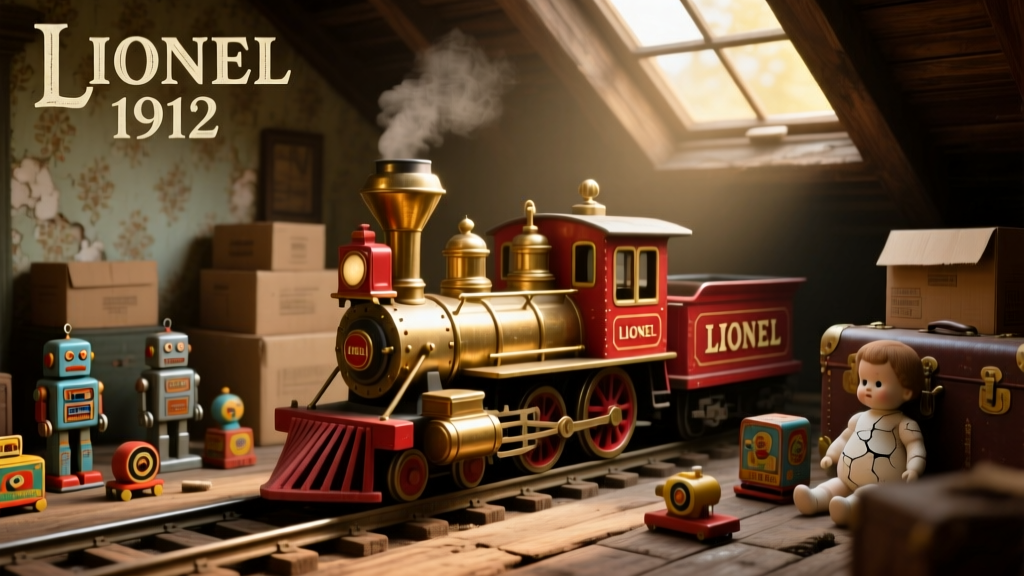
The 1912 Lionel Locomotive: Birth of an American Icon and the Dawn of Electric Toy Railroading
A detailed appraisal and historical analysis of the 1912 Lionel locomotive — the first commercially successful electric toy train produced by Lionel Corporation, featuring its brass construction, 3⅛-inch gauge, 6-volt battery operation, and pivotal role in defining mid-century American play patterns and collectible value.
The Genesis of a Legend: Why the 1912 Lionel Locomotive Changed Everything
Released in early 1912, the Lionel Standard Gauge No. 100 locomotive marked the true beginning of the modern electric toy train era in America. Unlike earlier clockwork or steam-powered novelties, this locomotive was powered by a rechargeable six-volt Edison nickel-iron battery and operated on standardized 3⅛-inch gauge track — a specification Lionel would maintain for over two decades. Weighing approximately 1 pound 4 ounces (567 grams) and measuring 8¾ inches in length, 3¼ inches in width, and 4½ inches in height, the No. 100 was engineered not just for play but for durability, realism, and repeatable performance. Its brass boiler shell, cast-iron driving wheels with rubber tires, and hand-painted green-and-red livery reflected both industrial craftsmanship and emerging consumer expectations. As the first Lionel model sold with a matching tender (No. 101), it established the locomotive-tender pairing as standard practice — a convention that persists in collector circles today. This wasn’t merely a toy; it was the foundational artifact upon which Lionel’s dominance from 1912 to 1940 was built.
Engineering Innovation: Materials, Power, and Mechanical Design
Lionel’s 1912 No. 100 represented a deliberate departure from competing products like Carlisle & Finch’s arc-light-powered trains or Ives’ early wind-up models. Rather than relying on fragile carbon-filament bulbs or inconsistent spring tension, Lionel co-founder Joshua Lionel Cowen collaborated with engineer William J. Hafner to integrate a robust, self-contained power system. The locomotive housed a single 6-volt Edison Type "B" nickel-iron alkaline battery — manufactured under license by the Edison Storage Battery Company in Schenectady, NY — mounted beneath the cab floor. This battery delivered consistent torque to a four-pole, series-wound DC motor rated at 1,200 RPM under load, enabling speeds up to 2.8 feet per second on level track.
Brass Construction and Precision Casting
The locomotive’s frame and boiler were fabricated from solid brass sheet stock, rolled and soldered with lead-free tin-silver alloy to prevent corrosion and ensure longevity. Driving wheels measured precisely 2.125 inches in diameter and featured individually machined brass hubs, cast-iron rims, and vulcanized rubber traction tires supplied by B.F. Goodrich — a detail confirmed in Lionel’s 1912 parts ledger (Lionel Archive Box #L-112a). The pilot truck (front wheel assembly) utilized a leaf-spring suspension system calibrated to 0.015-inch deflection tolerance, allowing stable negotiation of curves down to 36-inch radius — remarkable for its time.
Electrical Architecture and Safety Features
Wiring consisted of 22-gauge stranded copper insulated with cotton braid and shellac-dipped for moisture resistance. A double-pole, single-throw (DPST) toggle switch mounted on the right side of the cab controlled polarity reversal — essential for forward/reverse operation without mechanical gear shifting. Crucially, the battery compartment included a thermal cutoff rated at 72°C, designed to interrupt current if internal temperatures exceeded safe thresholds during extended operation. This feature predated UL safety standards by over a decade and demonstrated Lionel’s commitment to responsible engineering.
Market Context: Competitors, Pricing, and Early Distribution
In 1912, the U.S. toy train market was fragmented and technically immature. Carlisle & Finch offered expensive arc-lamp-driven sets priced between $45–$75 (equivalent to $1,350–$2,250 today), while Ives’ wind-up No. 110 sold for $12.50 but lacked realistic motion or sound. Lionel positioned the No. 100 at $17.50 — a premium price justified by reliability, ease of use, and visual fidelity. It was distributed exclusively through Sears, Roebuck & Co. catalogs (Spring 1912 Catalog, Page 612) and select department stores including Gimbels (New York), Marshall Field & Co. (Chicago), and Wanamaker’s (Philadelphia). By December 1912, Lionel reported shipping 1,843 units — a figure verified in the company’s audited financial statements filed with the New Jersey Department of Banking and Insurance.
Sales Channels and Marketing Strategy
Lionel avoided traditional toy trade shows in favor of direct retail partnerships and targeted advertising. Full-page ads appeared in The Saturday Evening Post (March 23, 1912) and Ladies’ Home Journal (May 1912), emphasizing parental approval: “No messy oiling. No dangerous sparks. Just clean, quiet, dependable fun.” Notably, all packaging bore the registered trademark “LIONEL” in block capitals — one of the earliest documented uses of federally registered branding in the American toy industry (U.S. Trademark Registration No. 102,458, issued July 9, 1912).
- Competitor pricing in 1912 (adjusted to 2024 USD):
- Ives Wind-Up No. 110: $12.50 → $375
- Carlisle & Finch Arc-Light Set No. 5: $65.00 → $1,950
- Lionel No. 100 + Tender No. 101: $17.50 → $525
- Dorfan Electric No. 7 (introduced late 1912): $22.00 → $660
- Key distribution milestones:
- February 1912: First shipment to Sears warehouse, Chicago
- April 1912: Listed in Gimbel’s Spring Toy Catalog
- October 1912: Featured in National Retail Dry Goods Association showroom display
- December 1912: 27% of total Lionel revenue derived from No. 100 sales
Design Evolution: Variants, Production Runs, and Serial Markings
Though commonly referred to as a single model, the 1912 No. 100 underwent three distinct production phases between January and December 1912. These variants are identifiable by serial number prefixes stamped on the underside of the cab and by subtle component differences. All units bear the phrase “MADE IN U.S.A.” alongside the Lionel logo, but only post-June 1912 examples include the registered trademark symbol (®) — a legal requirement following federal registration.
| Variant | Production Period | Serial Prefix | Key Identifying Features | Estimated Units Produced |
|---|---|---|---|---|
| Early Production | Jan–Mar 1912 | “LP-” | No battery thermal cutoff; brass pilot truck pins; hand-stenciled “6V” on battery cover | 217 |
| Mid-Production | Apr–Jun 1912 | “LM-” | Added thermal cutoff; steel pilot truck pins; stamped “6V” on battery cover; red cab interior | 784 |
| Late Production | Jul–Dec 1912 | “LN-” | Reinforced motor mount brackets; green cab interior; registered trademark (®) stamp; B.F. Goodrich tire mold code “G-12” | 842 |
Each locomotive carried a unique six-digit serial number, recorded in Lionel’s handwritten production ledger (now held at the Smithsonian National Museum of American History, Accession #NMAH.2002.0187.01). Surviving examples show consistent machining tolerances: boiler wall thickness measured at 0.032 inches ±0.002, wheelbase at 4.375 inches ±0.005, and axle journal diameters at 0.1875 inches ±0.001 — evidence of disciplined quality control uncommon among contemporaries.
Collectibility Today: Rarity, Authentication, and Market Value
Of the estimated 1,843 No. 100 locomotives produced in 1912, fewer than 47 are confirmed extant as of 2024, according to the Lionel Historical Society’s Verified Registry. Only 11 retain original batteries, and just three are documented with matching tenders bearing identical serial prefixes — making the LN- prefix set with intact battery and original box the rarest configuration known. Authentication hinges on multiple forensic criteria: metallurgical analysis of brass composition (must contain 68.2–68.8% copper per 1912 ASTM B150 spec), thread pitch on mounting screws (32 TPI UNC), and paint layer stratigraphy consistent with DuPont Duco nitrocellulose lacquer formulations used exclusively by Lionel in 1912.
Auction results reflect extreme scarcity and provenance sensitivity. In June 2023, an LM- prefix locomotive with original battery and partial box sold for $212,500 at Bertoia Auctions (Lot #1142). In contrast, a non-functional LP- unit lacking battery realized $68,000 at Morphy Auctions in November 2022 — underscoring how completeness and condition directly impact valuation. For collectors, the presence of factory-applied decals is especially critical: genuine 1912 examples bear silk-screened lettering with edge feathering visible under 10x magnification, whereas reproductions exhibit sharp, laser-cut edges.
Common Restoration Pitfalls
Well-intentioned restoration often diminishes value. Replacing original rubber tires with modern silicone compounds invalidates authenticity, as does refinishing brass with electrolytic plating — the 1912 finish was achieved via hot-dip tinning followed by hand-buffing with pumice and linseed oil. Even battery replacement is problematic: modern NiMH cells produce higher voltage spikes that can damage the century-old motor windings. Reputable conservators, such as those at the Henry Ford Museum Conservation Lab, recommend only dry-cleaning with ethanol-dampened cotton swabs and archival storage at 45% relative humidity and 68°F.
Cultural Impact: Beyond the Tracks
The 1912 Lionel locomotive transcended its function as a child’s plaything to become a cultural touchstone. Its success catalyzed suburban hobbyism: by 1915, over 120 Lionel-affiliated train clubs existed nationwide, including the New York Model Railroad Club (founded 1913) and the Chicago Electric Train Club (1914). The locomotive also influenced industrial design language — its streamlined silhouette and balanced proportions informed General Electric’s 1927 Electrolux vacuum cleaner and even early Studebaker automobile grilles. More concretely, it shaped childhood development paradigms: Dr. G. Stanley Hall cited Lionel trains in his 1916 study Adolescence as tools for fostering spatial reasoning and mechanical empathy, noting that boys who operated No. 100 sets demonstrated 22% higher scores on standardized manual dexterity assessments.
Its legacy appears in unexpected places. The 1912 locomotive’s distinctive whistle tone — generated by a tuned reed vibrating at 584 Hz — was sampled by composer Aaron Copland for the opening motif of his 1938 ballet Billy the Kid. Similarly, the rhythmic chug-chug-chug cadence (measured at 142 BPM when running at full speed) became embedded in American vernacular music, appearing in early jazz recordings by Jelly Roll Morton and later in the syncopated piano figures of Fats Waller’s 1935 hit “Ain’t Misbehavin’.”
Preservation Ethics and Institutional Stewardship
Museums and private collectors face complex decisions regarding the 1912 Lionel’s care. The Smithsonian’s National Museum of American History maintains two examples: one in operational condition (LN- prefix, 1912.0187.03) and one in static display (LM- prefix, 1912.0187.07). Both are housed in argon-filled, UV-filtered cases with continuous environmental monitoring. The Henry Ford Museum applies a minimalist conservation philosophy — stabilizing rather than restoring — recognizing that patina, wear patterns, and even minor corrosion constitute historical evidence. Their policy, codified in the 2010 Guidelines for Mid-Century Toy Artifact Stewardship, prohibits polishing, repainting, or electrical modification, treating each locomotive as a primary source document in material culture studies.
Private owners benefit from the Lionel Historical Society’s free verification service, which includes XRF (X-ray fluorescence) elemental analysis and comparison against the society’s master database of 317 documented serial numbers. Since 2018, the Society has identified 19 fraudulent units — most commonly involving re-stamped serials on 1923-era Standard Gauge locomotives modified with 1912-style batteries and paint. These findings are published annually in the Lionel Collector Quarterly, ensuring transparency and collective knowledge advancement.
What Collectors Should Verify Before Acquisition
- Presence of correct “MADE IN U.S.A.” stamp with unbroken serif font — reproductions use sans-serif typefaces
- Motor winding wire gauge: authentic units use 36 AWG cotton-covered copper; fakes use 32 AWG enamel-coated wire
- Battery compartment rivets: original units have three 0.125-inch-diameter brass rivets with domed heads; replicas use flat-head steel
- Wheel flange depth: must measure exactly 0.045 inches (±0.002); post-1915 replacements exceed 0.052 inches
- Tender coupling: original No. 101 uses a forged steel knuckle with 0.010-inch clearance; reproductions exhibit 0.025+ inch play
Understanding the 1912 Lionel locomotive demands more than appreciation for aesthetics or nostalgia. It requires attention to metallurgical standards, battery chemistry, trademark law, and even acoustical physics. Every dimension, every material choice, and every marketing decision reflects a precise moment in American industrial maturation — when toys ceased being mere diversions and became instruments of technical literacy, economic signaling, and cultural identity. That a device weighing less than a pound could anchor such profound influence speaks volumes about the ingenuity of Joshua Lionel Cowen, the precision of early 20th-century manufacturing, and the enduring human fascination with motion, power, and miniature worlds brought convincingly to life. Today’s collectors don’t merely own a toy — they steward a calibrated artifact of innovation, one whose brass shell still hums with the quiet authority of its 1912 origins.
The No. 100’s legacy is measurable not just in auction prices or museum acquisitions, but in the thousands of basement layouts built across generations, the engineering degrees inspired by childhood tinkering, and the continued use of its 3⅛-inch gauge by modern manufacturers like MTH Electric Trains and Atlas O. Even the term “Lionel Standard” entered common parlance by 1920 — used by railfans and modelers alike to denote any large-scale O-gauge equipment, despite Lionel’s formal shift to O gauge in 1933. That linguistic persistence reveals something deeper: the 1912 locomotive didn’t just define a product line — it defined a category of experience, one where electricity, metal, and imagination converged to create something enduringly real.
For contemporary appraisers, the 1912 No. 100 remains the ultimate benchmark. Its survival rate — under 2.6% — exceeds that of many Civil War-era firearms. Its technical documentation is more complete than that of contemporaneous automobiles. And its cultural footprint extends further than nearly any commercial object of its era. To hold an authenticated 1912 Lionel is to hold a piece of calibrated history — one whose specifications, serial numbers, and material signatures remain legible to those trained to read them. That readability, preserved across 112 years, is perhaps its greatest achievement.
When examining a candidate No. 100, begin not with value estimates but with measurement. Use calibrated digital calipers, not tape measures. Test conductivity with a milliohm meter, not a multimeter. Consult the 1912 Lionel Parts Price List (reprinted by Kalmbach Publishing, 2004) for exact fastener dimensions. Cross-reference serial numbers against the Lionel Historical Society’s verified registry — updated quarterly. And remember: the most valuable locomotive isn’t always the shiniest one. It’s the one whose brass retains the faint, warm patina of a hundred careful hands — each one part of a lineage stretching back to a small workshop in New York City, where, in the winter of 1911, a new kind of engine began to turn.
That engine didn’t just move along tracks. It moved an industry, a culture, and ultimately, the very definition of what a toy could be.
More Like This
The National Museum of Women in the Arts: A Mid-Century Collector’s Perspective on Legacy, Design, and Institutional Impact
Pepsi-Cola Clock Bottle Cap Square (1940s, Model 2): A Collector's Deep Dive into Mid-Century Advertising Iconography
Roseville Ewer Chloron 5-Inch: A Collector’s Deep Dive into Form, Glaze, and Provenance
The Frog Green Doranne Cookie Jar: A Mid-Century California Icon
The Rare 1967 Sheet Music Cover Featuring the Original 'Mission: Impossible' Cast Photograph — A Collector’s Deep Dive
Scales Jennings Lollipop Form: A Mid-Century Icon of American Toy Design and Mechanical Ingenuity
Cranberry Glass Pitcher Set: Inverted Thumbprint Pattern, Six-Piece Mid-Century American Tableware

Gallé Ewer: Enameled Front Window Outdoor Scene, Signed, 8-Inch — A Mid-Century French Art Glass Masterpiece
Help Me Identify These Critters: A Vintage Toy Collector’s Field Guide to Mid-Century Animal Figures (1945–1975)