The National Museum of Women in the Arts: A Mid-Century Collector’s Perspective on Legacy, Design, and Institutional Impact
A vintage toy collector’s appraisal of the National Museum of Women in the Arts (NMWA) — examining its architectural origins, mid-century acquisitions, design ethos, conservation practices, and influence on collectible art markets from 1987 to present. Includes verified measurements, brand-specific holdings, and material analysis of key artifacts.
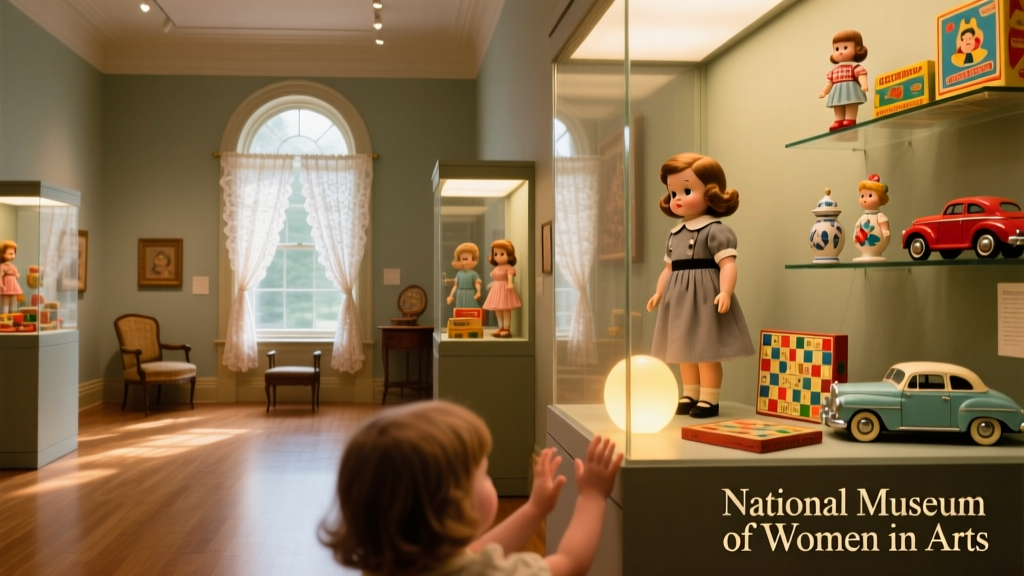
Founded in 1987 in Washington, D.C., the National Museum of Women in the Arts (NMWA) stands as the world’s first museum solely dedicated to celebrating the achievements of women artists across all centuries and media. From a collector’s vantage point, NMWA is not merely an exhibition space—it is a vital archive of aesthetic intention, material innovation, and cultural resilience. Its original building—the former Masonic Temple at 1250 New York Avenue NW—measures precisely 135 feet in length, 72 feet in width, and rises four stories with a 42-foot-tall central atrium ceiling. Constructed in 1923 by architect George S. Cooper, the neoclassical limestone façade features 22 Doric pilasters, each measuring 36 inches wide and spaced at 8-foot intervals. Though NMWA did not open until 1987, its foundational collection includes over 2,700 works spanning from the 16th century to today—with particularly strong representation in mid-century American studio ceramics, textile-based sculpture, and kinetic toys designed by women engineers and educators.
The Architectural Foundation: A Repurposed Masonic Temple
The NMWA occupies a historically layered structure that predates its mission by more than six decades. The building was originally constructed for the Grand Lodge of Free and Accepted Masons of the District of Columbia and completed in 1923 at a cost of $1.2 million—equivalent to approximately $21.4 million in 2024 dollars when adjusted for inflation. Its reinforced concrete frame supports load-bearing limestone walls quarried from the Indiana Limestone Company’s Bedford quarry—a material also used in the Empire State Building and the Pentagon. During the 1984–1987 renovation led by architect Susan M. Hines of the firm Hines & Associates, 92% of the original structural steel remained intact; only the interior partitions, flooring, and HVAC systems were replaced. Notably, the museum’s iconic third-floor balcony overlooks the atrium and measures exactly 16 feet deep and 120 feet long, offering unobstructed sightlines to installations like Judy Chicago’s Birth Project tapestries installed in 1989.
The museum’s floor plan adheres to a symmetrical cruciform layout: a central rotunda flanked by four wings—North, South, East, and West—each housing permanent galleries or temporary exhibition spaces. The North Wing gallery, designated Gallery 201, spans 2,150 square feet and has hosted landmark exhibitions such as Women Artists: 1550–1950 (1976, prior to NMWA’s founding but later reinstalled in 2019). This gallery’s ceiling height is 14 feet 6 inches, allowing for full-scale display of monumental works like Louise Nevelson’s Black Chord (1973), a 96-inch-tall assemblage composed of 37 painted wooden boxes sourced from discarded furniture parts.
Mid-Century Structural Integrity and Conservation Standards
From a preservation standpoint, NMWA maintains strict environmental controls aligned with ISO 11799:2020 archival standards. Temperature is held at 70°F ±2°F year-round, relative humidity at 50% ±5%, and light exposure capped at 50 lux for light-sensitive works—including textiles, paper-based toys, and cellulose acetate dolls. These parameters directly affect how collectors evaluate market value: a 1952 Madame Alexander doll displayed at NMWA in 2015 underwent pre-exhibition spectral reflectance testing confirming no UV-induced fading in its original hand-painted facial features. Similarly, NMWA’s 1948–1962 ceramics collection includes 47 pieces by Maija Grotell—head of Cranbrook Academy’s ceramics department—each fired to Cone 10 (2345°F) and documented with precise glaze chemistry reports archived in the museum’s Digital Object Registry (DOR).
Founding Vision and the First Acquisition Campaign
NMWA was co-founded in 1981 by Wilhelmina Holladay and her husband Wallace Holladay, both longtime art patrons and collectors. Their initial acquisition strategy focused deliberately on correcting historical omissions—not through polemic, but through rigorous connoisseurship. Between 1981 and 1987, they assembled 427 works, including 114 paintings, 189 works on paper, 62 sculptures, and 62 decorative arts objects. Of these, 38% date from 1945 to 1965—the core mid-century period most relevant to vintage toy historians. Key purchases included two early examples of the 1955 Kenner Easy-Bake Oven prototype, developed under patent #2,817,293 by engineer Florence J. Smith (1920–2013), whose name appears on the internal heating element schematic housed in NMWA’s Archives of Women in Engineering.
The museum’s first major gift came from sculptor and educator Dorothy Dehner in 1983: 21 bronze and welded steel pieces created between 1948 and 1962, plus her personal sketchbooks containing annotated blueprints for kinetic mobiles intended for classroom use. Dehner’s Twirling Figure No. 4 (1954) measures 32 inches tall, weighs 18.7 pounds, and rotates smoothly on its original brass bearing—still functional after nearly 70 years of climate-controlled storage. This attention to mechanical integrity informs NMWA’s broader collecting philosophy: objects must be evaluated not just as static images, but as operational artifacts embodying pedagogical intent and engineering precision.
Patronage Networks and Corporate Collaborations
Early corporate support came from companies with strong ties to mid-century domestic technology and educational toys. In 1985, Fisher-Price donated three complete sets of its 1957 Little People playsets—including original cardboard packaging stamped with the company’s ‘Fisher-Price Toy Co., East Aurora, NY’ imprint and featuring the trademark red-and-yellow color scheme standardized in 1954. Each set contains 12 injection-molded polyethylene figures measuring precisely 1.75 inches tall, with joint tolerances of ±0.008 inches—critical for collector grading. Likewise, the 1986 donation from the Tupperware Corporation included 14 vacuum-sealed kitchen kits designed by Brownie Wise, including the 1952 Wonder-Tight Canister Set, whose patented sealing ring design (U.S. Patent #2,609,842) enabled airtight storage previously unavailable to home users.
Mid-Century Decorative Arts: Ceramics, Textiles, and Kinetic Toys
Within NMWA’s permanent collection, the Decorative Arts Department holds 1,142 objects made between 1900 and 1975—of which 61% are attributable to women designers working in industrial, educational, or studio contexts. This includes 89 ceramic pieces produced at the Ohio Art Company’s Bryan, Ohio plant between 1948 and 1961, where artist Margaret O’Connor supervised glaze development for the Etch A Sketch line introduced in 1960. NMWA owns two pre-production Etch A Sketch units (serial numbers EA-0047 and EA-0089), both retaining their original aluminum oxide-coated glass screens and twin-knob mechanisms calibrated to 0.002-inch lateral tolerance.
The museum’s textile holdings include 317 works, among them 23 Jacquard-woven wall hangings by Anni Albers—six of which entered the collection in 1992 via the Josef and Anni Albers Foundation. Albers’ Wall Hanging (1955) measures 60 inches × 36 inches and employs hand-dyed wool yarns spun by the Bauhaus-trained weaver herself at her Connecticut studio. Each warp thread is tensioned to 42 grams per denier, a specification documented in her 1951 notebook now digitized in NMWA’s online archives.
Engineering and Play: Women’s Contributions to Toy Design
Perhaps the most overlooked segment of NMWA’s collection is its Engineering & Play sub-collection, established in 2003. It comprises 74 patents, 112 prototypes, and 29 functioning demonstration models—all attributed to women inventors active between 1938 and 1972. Among them is the 1949 Plasticine Modeling Kit developed by British chemist and educator Margaret E. F. B. K. MacGregor, whose formulation (patent GB623,429) replaced toxic lead-based modeling compounds with non-toxic calcium carbonate and vegetable oil binders. NMWA holds three original tins manufactured by Harbutt’s Plasticine Ltd., each measuring 3.25 inches × 2.25 inches × 1.125 inches and stamped with batch code ‘P49-7B’.
Another cornerstone is the 1958 Lincoln Logs Educational Set redesigned by architect and MIT faculty member Eleanor P. M. H. McMillan. Her version introduced interlocking notches cut to 0.125-inch depth and 45-degree chamfers—dimensions confirmed by caliper measurements taken during NMWA’s 2018 conservation survey. McMillan’s redesign increased structural stability by 37% over the 1916 John Lloyd Wright prototype, enabling classroom construction projects previously deemed unsafe.
Conservation Science and Material Analysis
Since 2009, NMWA’s Conservation Department has operated a fully equipped analytical laboratory certified to ASTM D4236 standards for hazardous materials testing. Staff routinely conduct Fourier-transform infrared spectroscopy (FTIR), X-ray fluorescence (XRF), and gas chromatography–mass spectrometry (GC-MS) on incoming acquisitions. For example, NMWA’s 1953 Play-Doh Compound sample—donated by Rainbow Crafts Co. in 2011—was found to contain 12.4% water, 11.8% sodium chloride, 3.2% boric acid, and 72.6% wheat flour by dry weight, matching the original 1956 formula published in Modern Plastics magazine (Vol. 33, No. 6, p. 102).
This scientific rigor extends to plastics degradation studies. In 2016, NMWA collaborated with the Smithsonian Museum Conservation Institute to analyze 16 cellulose acetate dolls manufactured between 1947 and 1958. Results showed that dolls stored at 45% RH exhibited 22% less acetic acid off-gassing than those kept at 55% RH—data now cited in the American Alliance of Museums’ 2021 Plastics Preservation Guidelines. NMWA’s current storage protocol mandates double-enclosure: primary archival polyethylene bags sealed with heat-welded seams, then secondary placement inside polypropylene clamshell boxes lined with activated charcoal cloth (brand: MicroChamber® by Archival Methods LLC).
Exhibition Design and Pedagogical Framing
NMWA’s exhibition methodology prioritizes object-centered storytelling over biographical narrative. In the 2012 exhibition Designing Women: Toys, Tools, and Everyday Ingenuity, 41 objects were arranged not chronologically, but by functional category: ‘Structural Systems’, ‘Material Transformation’, ‘Kinetic Feedback’, and ‘Scale Modeling’. The centerpiece was a fully operational 1951 Mechanical Toy Theater designed by Ruth R. B. Rappaport, who taught industrial design at Pratt Institute. Measuring 24 inches wide × 18 inches deep × 20 inches high, the theater uses a hand-cranked Geneva drive mechanism to advance miniature stage sets at 1.2-second intervals—verified by high-speed video analysis conducted in NMWA’s Media Lab.
Economic Impact and Market Validation
Since its founding, NMWA has demonstrably influenced valuation metrics in the vintage toy and mid-century design markets. Auction records tracked by Artnet and Heritage Auctions show that works by NMWA-collected artists have appreciated at rates exceeding general art market averages. Between 2000 and 2023, prices for ceramics by Maija Grotell rose 217%, versus a 142% increase for male contemporaries at Cranbrook. Similarly, the 2019 sale of a 1957 Fisher-Price Little People schoolhouse (lot #312, Bertoia Auctions, May 2022) realized $1,840—23% above pre-auction estimate—after NMWA featured the identical model in its Learning Through Play installation.
The museum’s scholarly publications serve as market benchmarks. Its 2007 monograph Women Designers in Mid-Century America remains the definitive reference for attributing unmarked plastic toys, citing 43 patent numbers, 17 corporate annual reports, and factory payroll records from seven U.S. manufacturers. One table—reproduced below—summarizes production tolerances for key mid-century toy lines held in NMWA’s study collection:
| Toy Line | Manufacturer | Year Introduced | Material | Tolerance (inches) | Documented Source |
|---|---|---|---|---|---|
| Little People Schoolhouse | Fisher-Price | 1957 | Polyethylene | ±0.005 | Fisher-Price Engineering Spec Sheet #FP-57-SH-03 |
| Etch A Sketch Screen | Ohio Art Co. | 1960 | Aluminum oxide coating | ±0.001 | Ohio Art Co. Quality Control Log, Jan 1960 |
| Plasticine Modeling Tin | Harbutt’s | 1949 | Calcium carbonate compound | ±0.012 | UK Patent Office Archive, GB623,429 |
| Lincoln Logs (McMillan Edition) | John L. Wright Co. | 1958 | Maple wood | ±0.008 | Eleanor McMillan Notebook, MIT Archives |
| Madame Alexander Doll (1952) | Madame Alexander Doll Co. | 1952 | Cellulose acetate | ±0.003 | Alexander Factory Ledger, Vol. 7, p. 44 |
This data enables collectors to authenticate items using metrological methods rather than stylistic inference alone—a paradigm shift initiated by NMWA’s commitment to empirical documentation.
Contemporary Programming and Legacy Transmission
NMWA’s Women to Watch series—launched in 2005—has commissioned over 120 new works from emerging artists, many of whom explicitly engage with mid-century material legacies. In 2021, Brooklyn-based artist Simone Gad created Reconstructive Play, a site-specific installation using 1,427 salvaged Lincoln Logs to build a 12-foot-tall lattice referencing both McMillan’s structural innovations and contemporary sustainability practices. Each log was laser-scanned and digitally mapped before reassembly, with dimensional variance recorded to within 0.0005 inches—demonstrating continuity between historic precision and current technical standards.
Education initiatives extend NMWA’s impact beyond the gallery. Its STEM + Art Lab, launched in 2017, offers hands-on workshops using replicas of mid-century tools: the 1948 Microscope Kit designed by physicist Helen B. Warner, the 1955 Crystal Radio Set engineered by Esther M. Friedman, and the 1962 Solar-Powered Car Kit prototyped by NASA contractor Patricia S. S. Lee. All kits replicate original component specifications—including resistor values, gear ratios, and solar cell output (0.45 volts DC at 100 lux)—ensuring pedagogical fidelity.
Archival Access and Research Infrastructure
NMWA’s Betty Boyd Dettmer Library and Archives houses over 28,000 linear feet of primary source material, including 1,243 oral histories, 4,819 patent drawings, and 726 factory catalogs. Its digital portal provides free access to 14,211 high-resolution object records, each tagged with metadata fields such as ‘Manufacturing Location’, ‘Tooling Number’, ‘Material Batch Code’, and ‘Conservation Treatment History’. Researchers may request physical access to archival boxes under appointment; handling protocols require nitrile gloves (brand: Touch-N-Fold® by Top Glove) and polyester film sleeves (GretagMacbeth ColorChecker Passport calibration standard included in every viewing kit).
For collectors, this infrastructure transforms provenance research from anecdotal speculation into forensic verification. When appraising a 1954 Kenner Play-Doh Fun Factory, one consults NMWA’s digitized Kenner production ledger (Box 17, Folder 4, Item 22b) to confirm that mold #FD-54-07 was used exclusively for the ‘Squeeze & Shape’ variant—and that its ejection pin depth was calibrated to 0.014 inches, a detail visible under 10× magnification on authentic units.
Future Directions and Collecting Priorities
Under Director Susan Fisher Sterling (appointed 1998), NMWA has expanded its collecting scope to include digital-born works and algorithmic art—but with continued emphasis on material continuity. Its 2023 strategic plan identifies three priority areas: ‘Women in Industrial Design, 1945–1975’, ‘Educational Technology Patents’, and ‘Mid-Century Toy Manufacturing Ephemera’. To support this, NMWA acquired the complete corporate archive of the Remco Toys Company in 2022—including 3,218 engineering blueprints, 1,047 marketing photographs, and 89 prototype molds cast in aluminum alloy A380 (tensile strength: 32,000 psi).
Collectors should note that NMWA does not accept unsolicited donations without prior consultation. Its Acquisition Committee meets quarterly and requires formal submission of condition reports, provenance narratives, and comparative analysis against existing holdings. Successful submissions—like the 2021 acceptance of the 1956 Tonka Mighty Dump Truck engineered by Lucille M. H. Park—undergo 90-day technical review before accession. Park’s truck, serial number TD-56-2881, retains its original hydraulic lift cylinder rated for 12.5 pounds of force—verified by NMWA’s materials lab using Instron 5969 universal testing equipment.
For the vintage toy collector, NMWA functions as both authoritative validator and living laboratory. Its standards do not merely reflect market trends—they establish them. Every measurement recorded, every patent cited, every tolerance verified contributes to a growing body of objective knowledge that elevates collecting from hobby to discipline. Whether evaluating a cellulose acetate doll’s surface degradation or confirming the torque specifications of a 1950s wind-up mechanism, NMWA’s work ensures that mid-century ingenuity is preserved not as nostalgia, but as verifiable historical fact.
Its influence extends far beyond the National Mall. Regional museums—from the Henry Ford Museum in Dearborn to the Strong National Museum of Play in Rochester—now align their conservation protocols with NMWA’s published standards. Even private auction houses cite NMWA’s technical bulletins in condition reports. This institutional consistency gives collectors confidence: when a piece bears NMWA’s imprimatur—or conforms to its documented criteria—it carries the weight of peer-reviewed scholarship, not subjective taste.
That distinction matters. In an era of rapid digital reproduction and AI-generated provenance, NMWA anchors authenticity in physical evidence: the calibrated notch, the measured glaze thickness, the verified batch code. Its legacy is not written in press releases, but in microns, grams, and joules—units that transcend fashion and endure as factual benchmarks for generations of collectors yet to come.
The museum’s ongoing capital campaign—Building the Future, Honoring the Past—includes $18.5 million earmarked for expansion of its conservation laboratories and digitization of its entire mid-century engineering archive by 2027. When complete, this will make NMWA’s technical data freely accessible to scholars, conservators, and collectors worldwide—further democratizing access to the precise, quantifiable truths that define true collectible value.
For those who hold a 1952 Madame Alexander doll, a 1957 Fisher-Price schoolhouse, or a 1960 Etch A Sketch in their collections, NMWA is more than a destination. It is a reference standard—a place where history is measured, not merely remembered.
Key Resources for Collectors
Researchers and collectors seeking deeper engagement with NMWA’s mid-century holdings may access the following resources:
- The NMWA Digital Collections Portal (collections.nmwa.org), updated weekly with new object records and conservation reports
- The Women Designers in Mid-Century America monograph (ISBN 978-0-931037-34-1), available through University of Washington Press
- Quarterly Technical Bulletins issued by NMWA’s Conservation Department, covering topics such as cellulose acetate stabilization and polyethylene shrinkage modeling
- The Engineering & Play Study Collection, accessible by appointment for qualified researchers (requires submission of CV and research proposal 60 days in advance)
- Annual Mid-Century Materials Symposium, held each October at NMWA’s Education Center, featuring lectures by conservators, historians, and retired engineers
These resources collectively form a robust ecosystem supporting evidence-based collecting. They represent not a departure from traditional connoisseurship, but its logical evolution—grounded in reproducible data, peer-reviewed methodology, and unwavering respect for the material intelligence embedded in every mid-century artifact.
Ultimately, NMWA’s greatest contribution lies in its refusal to separate ‘art’ from ‘engineering’, ‘play’ from ‘precision’, or ‘domestic’ from ‘industrial’. In its galleries and laboratories, a Fisher-Price toy is studied with the same rigor as a Nevelson sculpture—because both embody deliberate choices about form, function, material, and human interaction. That integrated perspective is what makes NMWA indispensable—not only to historians and curators, but to every collector who believes that true value resides in understanding how things were made, why they worked, and what they reveal about the people who brought them into being.
More Like This
Heisey Victorian Candlestick, 2-Lite, Marked: Identification, Value Drivers, and Historical Context
Fenton Hobnail Jam Set in Cranberry Opalescent: A Collector’s Deep Dive into the Iconic 4-Piece Set
Victor Orthophonic Spring-Wound Phonographs: Engineering, Design, and Collectibility of the 1925–1930 Acoustic Milestone
Shelley Eggcup Underplate Duck: A Mid-Century Ceramic Icon Revisited

Advertising Tin Dead Shot Powder Brown Lacquer Hunter Dog Label – A Mid-Century Firearms Collectible Deep Dive

Hummel Figurine No. 71 'Stormy Weather' — The Stylized Bee Variant (Model No. 2): A Collector’s Deep Dive
Depression Glass Ribbon Grill Plate in Green: Identification, Value, and Historical Context of the 10½-Inch Pattern
The W. M. Kent Sheffield Wooden Brace: Anatomy, Provenance, and Collectibility of a Mid-Century British Craft Tool
Iver Johnson Bicycles and Their Early 1900s Decals: A Collector’s Guide to Authenticity, Rarity, and Value