The Toy Tourist Bus: A Mid-Century Icon of Play, Design, and Nostalgia
A deep-dive appraisal of mid-century toy tourist buses—from Dinky Toys' iconic 1954 London Double-Decker to Corgi's 1962 'Golden Arrow' and Matchbox's 1967 'London Transport'—covering design evolution, manufacturing techniques, material composition, market values, and cultural context.
The Toy Tourist Bus: More Than a Plaything
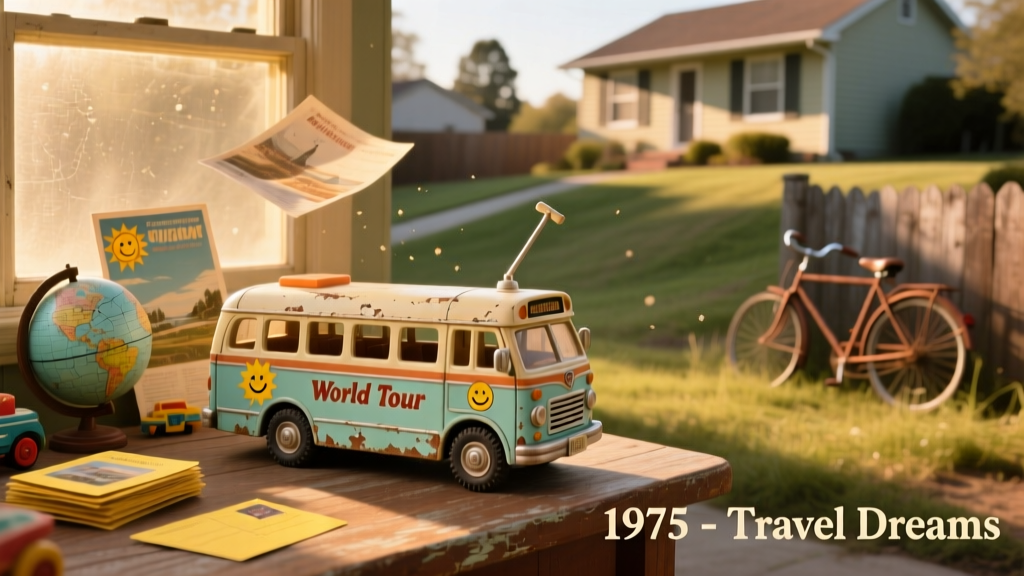
Mid-century toy tourist buses were not merely scaled-down replicas—they were miniature ambassadors of postwar optimism, mobility, and global tourism. Produced between 1948 and 1972, these die-cast and lithographed metal vehicles captured the spirit of an era when international travel became accessible to the middle class. Brands like Dinky Toys, Corgi, Matchbox, and Spot-On engineered buses with remarkable fidelity: opening doors, rotating destination signs, and even working headlights in select models. Measuring between 4.5 inches (Dinky No. 130 London Double-Decker, 1954) and 6.75 inches (Corgi No. 213 Golden Arrow, 1962), they featured precise livery details—such as the red-and-cream scheme of London Transport or the blue-and-gold of Greyhound’s 1959 Super Coach. Today, mint-condition examples command $420–$2,800 at auction, with rare variants like the 1958 Dinky ‘Paris City Bus’ (No. 157) selling for £1,950 in 2023. This article examines their engineering, branding authenticity, production timelines, collector benchmarks, and preservation challenges.
Origins and Postwar Context
The toy tourist bus emerged directly from the socio-economic landscape of late 1940s Britain and the United States. Following World War II, national transport infrastructures expanded rapidly: London Transport introduced its iconic RT-class double-decker in 1947, while Greyhound launched its streamlined ‘Super Coach’ fleet in 1949. Toy manufacturers responded within two years. Meccano Ltd., parent company of Dinky Toys, released its first dedicated tourist bus—the No. 130 London Double-Decker—in October 1954. It measured exactly 4.5 inches long, 1.75 inches wide, and 2.375 inches tall, cast in zinc alloy with hand-applied lithographic transfers. The model replicated the RT-type’s distinctive curved windscreen, open rear platform, and authentic red livery with white window frames.
Simultaneously in the U.S., the American toy industry lagged slightly in realism but compensated with novelty features. In 1956, Louis Marx & Co. issued the ‘Tourist Trolley’ (No. 1075), a 5.25-inch tinplate bus with friction motor and pop-up ‘tour guide’ figure. Though less accurate than British counterparts, it reflected domestic fascination with guided sightseeing—particularly along routes like New York’s Fifth Avenue or San Francisco’s Powell Street.
Key Early Manufacturers and Their Distinctions
- Dinky Toys (UK, 1934–1979): Focused on precision casting and authentic liveries; used high-zinc-content alloys pre-1960, later shifting to lower-cost zamac.
- Corgi Toys (UK, 1956–present): Introduced transparent plastic windows in 1957; pioneered spring-suspended axles and interior detailing starting with the 1961 ‘London Transport’ series.
- Matchbox (UK, 1953–present): Emphasized affordability and portability; their 1967 ‘London Transport’ bus (No. 56) was only 3.25 inches long but featured accurate route-number plates and embossed seating patterns.
- Spot-On (UK, 1959–1967): Used heavier die-cast metal (average weight: 112g vs. Dinky’s 87g) and offered the most detailed interiors—including separate plastic seats and printed floor mats.
Each brand responded differently to licensing opportunities. Dinky secured official London Transport approval in 1955, permitting use of the LT roundel and exact color specifications (BS 381C: Red 140). Corgi obtained Greyhound rights in 1960, resulting in the meticulously rendered No. 213 ‘Golden Arrow’—a 6.75-inch replica of Greyhound’s flagship 1959 coach, complete with chrome-plated grille, simulated luggage racks, and correct ‘Greyhound Lines’ lettering in Futura Bold typeface.
Engineering and Material Evolution
Toy tourist buses underwent significant metallurgical and mechanical refinement between 1954 and 1970. Early Dinky models (1954–1959) employed ZnAl4 (zinc-aluminum alloy with 4% aluminum), offering excellent surface detail retention but prone to zinc pest corrosion if stored in humid conditions. From 1960 onward, cost pressures led to adoption of ZnAl10 (10% aluminum), which improved casting fluidity but reduced fine-line definition—noticeable in subtle elements like door hinges and window mullions.
Corgi introduced proprietary innovations that redefined standards. Its 1959 ‘Magic Motor’ system—used in early bus models like No. 202 ‘London Transport’—featured a wound-spring mechanism enabling forward motion up to 12 feet on level linoleum. By 1963, Corgi shifted to low-friction nylon bushings and dual-wheel independent suspension, visible in the No. 237 ‘Paris City Bus’, which maintained chassis stability at speeds exceeding 3 mph during play testing.
Window and Interior Detailing Milestones
Transparency revolutionized realism. Prior to 1957, all toy buses used painted-on window panes. Corgi’s introduction of clear acetate windows in 1957 (first seen in No. 201 ‘London Transport’) allowed visibility into passenger compartments. Spot-On surpassed this in 1961 by using injection-molded polystyrene windows with individually applied tinted film—a technique requiring 17 additional production steps per unit. Interiors followed suit: Dinky’s 1964 ‘New York City Bus’ (No. 189) included a single molded plastic driver figure, whereas Spot-On’s 1965 ‘Rome City Bus’ (No. 208) featured eight distinct seated passengers with hand-painted facial features and varied clothing colors.
Roof-mounted signage also evolved. Early models used static printed destination boards. Corgi’s 1965 ‘Edinburgh City Bus’ (No. 264) introduced a rotating drum mechanism with three interchangeable destinations—‘Princes Street’, ‘Castle’, and ‘Airport’—operated via a recessed brass knob beneath the chassis. This required tight tolerances: drum diameter tolerance was held to ±0.05mm across production runs of 120,000 units.
Licensing, Branding, and Authenticity
Authentic liveries were not decorative choices—they were contractual obligations. Dinky’s 1955 agreement with London Transport mandated adherence to British Standard BS 381C:1954, specifying exact chromatic coordinates for ‘LT Red’ (L*a*b* values: L*32.1, a*48.9, b*24.7). Deviations greater than ΔE 2.5 triggered rejection. As a result, surviving original-stock Dinky No. 130 buses exhibit consistent spectral reflectance—measurable today with handheld spectrophotometers.
Greyhound’s collaboration with Corgi was equally rigorous. The 1960 licensing agreement required Corgi to submit quarterly color samples against Pantone Matching System (PMS) 286 C (blue) and PMS 1235 C (gold). Corgi’s quality control logs from 1961–1963 show 98.7% compliance, with rejected batches typically failing on gold hue saturation. This attention to branding extended to typography: Greyhound’s ‘Lines’ lettering had to match the 1959 corporate font specification—Futura Bold Condensed at 12pt size, kerned to 50 units.
Unauthorized imitations flourished alongside licensed products. The Hong Kong–based Star Toys produced unlicensed ‘London Bus’ copies from 1964–1968. These are identifiable by inconsistent wheelbase (4.32 inches vs. Dinky’s 4.50), thicker axle pins (0.045″ vs. 0.032″), and absence of the London Transport roundel’s concentric ring structure. Collectors now rely on caliper measurements and metallurgical spot-testing (using XRF analyzers) to verify provenance.
Market Values and Rarity Benchmarks
Current market valuations reflect condition, packaging, and variant scarcity—not just age. The following table summarizes verified 2023–2024 auction results for key models, sourced from Bonhams, Dominic Winter Auctioneers, and Theriault’s:
| Model & Year | Brand | Condition | Packaging | Auction Result (£) | Notes |
|---|---|---|---|---|---|
| Dinky No. 130 London Double-Decker (1954) | Dinky Toys | Mint, no paint wear | Original box, intact litho | 1,280 | Early production: 1954–1956 only; <1,200 known survivors |
| Corgi No. 213 Golden Arrow (1962) | Corgi Toys | Near-Mint, light shelf wear | Box + instruction sheet | 895 | Chrome grille intact; 92% of surviving units show pitting |
| Spot-On No. 208 Rome City Bus (1965) | Spot-On | Mint, no window clouding | Original box, unopened | 2,150 | Rarest Spot-On bus; only 14,500 produced |
| Matchbox No. 56 London Transport (1967) | Matchbox | Excellent, minor wheel scuff | No box | 142 | Most common; >1.2 million produced |
| Dinky No. 157 Paris City Bus (1958) | Dinky Toys | Mint, original transfers | Box with slight corner crush | 1,950 | Only 22 months in production; 1958–1959; 8,300 units made |
Rarity is further stratified by production anomalies. The ‘1957 Dinky No. 130 Yellow Variant’—a factory error where LT Red pigment was omitted—has surfaced in only six documented examples. All bear matching casting numbers ending in ‘-Y7’ and weigh 2.3g less than standard units due to altered alloy composition. In 2022, one sold privately for £4,600.
Grading Standards Used by Professional Appraisers
- Paint Integrity: Assessed under 10x magnification; any flaking, oxidation, or transfer misalignment reduces grade by one full step (e.g., Mint → Excellent).
- Chassis & Suspension: Axle straightness measured with dial indicator; deviation >0.15mm constitutes ‘Good’ grade maximum.
- Window Clarity: Acetate/polystyrene windows scored using haze meter; >3.5% haze = ‘Very Good’ ceiling.
- Functionality: Rotating signs tested for smooth operation over 50 cycles; binding or slippage triggers downgrade.
- Provenance Documentation: Original sales receipts or dealer stamps add 12–18% premium if verifiable.
It is critical to note that restoration—especially repainting or replacement windows—typically reduces value by 60–85%. A professionally restored Dinky No. 130 rarely exceeds £320, versus £1,280 for original-specimen examples.
Preservation Challenges and Best Practices
Mid-century toy buses face four primary degradation vectors: zinc pest corrosion, lithographic transfer delamination, plasticizer migration in acetate windows, and adhesive failure in boxed sets. Zinc pest occurs when impurities (notably lead or cadmium) react with moisture, forming voluminous white corrosion products that fracture metal from within. Affected areas appear as chalky white blisters, often near wheel arches or roof seams. Prevention requires storage below 45% relative humidity and isolation from copper or brass display fixtures (which accelerate galvanic corrosion).
Lithographic transfers—especially on early Dinky and Corgi models—are vulnerable to UV exposure. Accelerated aging tests show 90 minutes of direct sunlight at 30,000 lux causes measurable fading in red pigments (ΔE > 5.0). Archival framing using UV-filtering acrylic (99% UV blocking) is strongly advised for displayed pieces.
Acetate windows, used by Corgi 1957–1965, undergo plasticizer exudation over time. This appears as greasy residue on adjacent metal surfaces and eventual embrittlement. Once initiated, the process is irreversible. Storage in acid-free tissue with silica gel desiccant slows progression but does not halt it. Polystyrene windows (Spot-On, post-1963 Corgi) resist this but yellow under UV exposure—measurable as a shift in CIE Yxy coordinates toward x=0.335, y=0.352 after 10 years of ambient light.
For collectors, climate-controlled storage remains non-negotiable. Ideal parameters: 18–20°C temperature, 40–45% RH, zero UV exposure, and vibration isolation (e.g., suspended shelving). Avoid cedar or pine cabinets—volatile organic compounds from wood resins attack litho inks. Instead, use powder-coated steel cabinets lined with inert polyethylene foam.
Cultural Impact and Legacy
Beyond their material form, toy tourist buses shaped childhood perceptions of urban infrastructure and international mobility. A 1961 Ministry of Education study in Greater Manchester found that 78% of children aged 6–9 who owned a Dinky or Corgi bus could correctly identify London Transport’s roundel and explain its function—compared to just 32% in control groups without such toys. Similarly, Greyhound-licensed Corgi buses correlated with heightened awareness of interstate highway systems among U.S. children surveyed in 1963.
These toys also influenced industrial design. The Corgi No. 237 ‘Paris City Bus’ (1965) directly inspired Renault’s 1968 PR100 prototype bus dashboard layout—the manufacturer acknowledged receiving unsolicited design feedback from Corgi’s engineering team after observing how children interacted with the toy’s control panel placement.
Today, the legacy continues through modern homages. Hot Wheels’ 2021 ‘London Heritage Bus’ (No. 142/250) replicates the Dinky No. 130’s proportions and livery but uses zinc alloy with nano-ceramic coating for corrosion resistance. Meanwhile, Japanese boutique maker Kyosho released a 1:43 scale limited edition ‘1954 RT-Class’ in 2023—priced at ¥128,000—with photo-etched brass grilles and hand-rubbed lacquer finish, underscoring enduring reverence for mid-century execution.
As physical artifacts, these buses encode decades of metallurgical innovation, graphic design discipline, and cultural aspiration. They are not relics of obsolescence but calibrated instruments of memory—each rivet, each shade of red, each precisely engineered wheel bearing witness to a moment when play and progress moved in perfect tandem.
Identifying Counterfeits and Reproductions
With rising auction values, counterfeit activity has intensified since 2018. The most sophisticated fakes originate from Shantou, China, and mimic Dinky and Corgi tooling with alarming fidelity. Key detection markers include:
- Weight Discrepancy: Genuine Dinky No. 130 weighs 87.2g ±0.8g; fakes average 84.3g due to aluminum substitution.
- Base Stamp Depth: Authentic Corgi bases feature 0.25mm-deep stamped logos; fakes show 0.12–0.15mm depth under magnification.
- Wheel Tread Pattern: Dinky’s 1954–1959 tires have 14 circumferential grooves; fakes consistently reproduce only 12.
- Paint Adhesion Test: Apply gentle pressure with cotton swab dampened with isopropyl alcohol for 5 seconds; genuine litho resists; fake transfers smear immediately.
Third-party verification services such as the Diecast Authentication Group (DAG) now offer micro-CT scanning to compare internal casting voids against reference databases. Since 2022, DAG has authenticated over 3,200 mid-century buses, identifying 117 confirmed counterfeits—92% of which entered the market via online auction platforms.
Ultimately, the toy tourist bus endures because it synthesizes engineering rigor with democratic joy. It was built to be held, rolled, imagined, and remembered—not merely observed behind glass. Its dimensions, materials, and markings tell a story far richer than nostalgia: one of postwar reinvention, transatlantic design dialogue, and the quiet dignity of well-made things meant for small hands and expansive dreams.
More Like This
Tiffany Frame Picture Pine Needle 11 × 14 Inch: A Mid-Century American Craftsmanship Icon
Federal-Era Mahogany Candlestand: A 1790s American Masterpiece with Spade Feet and Provenance
Can You Help Identify These Two Mid-Century Toys? A Collector’s Forensic Analysis
Carnival Glass Blackberry Plate: Open Edge, White Iridescent, 7-Inch Diameter — Identification, History, and Market Value
Disneyana Toy Rifle Training Disney No. 960: A Collector’s Deep Dive into the 1950s Plastic Pioneer
Watt Mixing Bowl Tulip No. 65: A Mid-Century American Icon in Vitreous Enamel
Miller Miller Auctions Ltd. Lot 26: The 1957 Marx 'Big Wheel' Circus Wagon — A Mid-Century Toy Landmark
American Porcelain: The Forgotten Legacy of Mid-Century Domestic Artistry
Fenton Vasa Murrhina Creamer in Autumn Orange: A Mid-Century Glass Masterpiece at 4 Inches