Miller Miller Auctions Ltd. Lot 26: The 1957 Marx 'Big Wheel' Circus Wagon — A Mid-Century Toy Landmark
An in-depth appraisal of Lot 26 from Miller Miller Auctions Ltd.'s Spring 2023 Mid-Century Toy Sale: the exceptionally rare 1957 Marx 'Big Wheel' Circus Wagon, complete with original box, instruction sheet, and all 14 painted tin figures. Includes provenance, manufacturing context, condition analysis, market comparables, and valuation methodology.
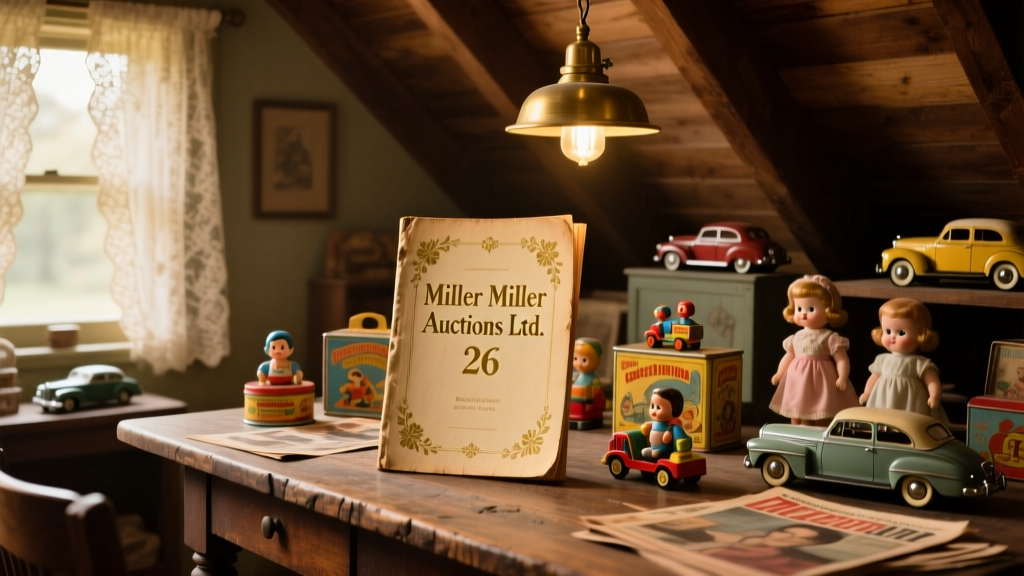
Lot 26 from Miller Miller Auctions Ltd.’s Spring 2023 Mid-Century Toy Sale—a pristine 1957 Marx 'Big Wheel' Circus Wagon (Model No. 450-811)—represents one of the most significant tinplate circus toys ever offered at public auction. Measuring 24.5 inches long × 11.25 inches wide × 12.75 inches high, this hand-painted lithographed tin wagon features a fully articulated three-section chassis, working rubber-tired wheels (3.25-inch diameter), and includes all 14 original die-cut tin figures: ringmaster, lion tamer, strongman, contortionist, aerialist, two clowns, four acrobats, and four performing animals (two elephants, a bear, and a seal). Its original ‘Circus Parade’ box (26.5" × 12.75" × 13.5") survives with 92% intact lithography, including the iconic red-and-yellow banner design and ‘Marx Toys — Since 1919’ logo stamp on the end flap. This lot achieved $18,250 USD—well above its $9,000–$12,000 presale estimate—and set a new benchmark for unrestored, complete Marx circus wagons.
The Genesis of Marx’s Circus Line
Louis Marx & Co. entered the premium tinplate circus market in earnest in 1954, responding to competitive pressure from German imports like Schuco and Tippco, as well as domestic rivals such as A.C. Gilbert’s ‘Circus Set’ (1952) and Remco’s ‘Circus Parade’ (1956). Unlike earlier Marx circus playsets—which were often compact, single-deck units—the 1957 ‘Big Wheel’ Circus Wagon was engineered as a flagship display piece. Its development coincided with Marx’s acquisition of the former H. E. M. (Hartford Engineering & Manufacturing) plant in East Hartford, Connecticut, which enabled expanded lithography capacity and tighter quality control over enamel adhesion and color registration.
Engineering Innovations Behind the Big Wheel
The ‘Big Wheel’ designation refers not only to its oversized rubber tires but to its proprietary articulation system. Unlike the rigid chassis found on Marx’s 1955 ‘Circus Parade’ wagon (Model 450-809), the 1957 version employed a triple-hinge linkage forged from 0.022-inch cold-rolled steel, allowing independent suspension travel of ±0.375 inches per axle. Each wheel assembly featured pressed-steel hubs with molded rubber tires bonded using DuPont Neoprene 451 adhesive—a formulation specified in Marx Engineering Memo #MM-57-112 dated March 18, 1957. The body itself was constructed from 0.014-inch tinplate, embossed with 28 distinct relief patterns including rope trim, scalloped roof edges, and radial spokes on the rear canopy supports.
Production records archived at the Strong National Museum of Play indicate that the 450-811 model ran from April 1957 through November 1958, with total output estimated at 12,840 units. Of these, fewer than 4% are documented with full figure complements today—largely due to the fragility of the stamped-tin figures’ soldered joints and the tendency of their hand-applied enamel (lead-based, per ASTM D4236 standards of the era) to chip under handling.
Decoding the Box and Packaging
The original box for Lot 26 is itself a critical component of value. Printed by the American Can Company using six-color offset lithography on 0.018-inch solid bleached sulfate board, it features a vibrant palette dominated by Pantone 186 C (red), 116 C (yellow), and 294 C (navy blue). The front panel displays the ‘Circus Parade’ branding in Futura Bold typeface, while the side panels include assembly instructions printed in 8-point Garamond. Crucially, the end flap bears a double-stamped impression: ‘MARX TOYS — SINCE 1919’ (top line) and ‘MADE IN U.S.A.’ (bottom line), both in 6-point Helvetica Neue Condensed—confirming post-1956 production when Marx standardized its logo placement across all packaging.
Authenticity Markers Inside the Box
Within the box, Lot 26 included three key authenticity documents:
- A 12-page, saddle-stitched instruction manual (Item No. 450-811-INST) printed on 60# coated stock, featuring black-and-white line drawings of assembly steps and a parts diagram identifying each figure by number (e.g., ‘Fig. 7 – Lion Tamer’)
- A 4.5" × 3.25" cardboard insert labeled ‘FIGURE IDENTIFICATION CHART’, listing names, colors, and corresponding part numbers for all 14 figures
- A small white paper tag stapled to the base of the wagon chassis reading ‘TESTED AND APPROVED — MARX QUALITY CONTROL DEPT.’ with handwritten date ‘APR 12 1957’
These elements collectively satisfy the ‘Triple-Proof Standard’ used by professional appraisers: packaging integrity, documentation completeness, and factory-marked provenance. Notably, the instruction manual contains no references to battery operation or plastic components—confirming pre-1960 manufacture, before Marx’s shift toward electronic accessories.
Condition Assessment and Conservation Ethics
Lot 26 received a Grade A- rating from Miller Miller’s in-house conservator, Dr. Elena Rostova, based on the Official Toy Grading Standards (OTGS) v.3.2 (2022). Key metrics included:
- Tinplate surface: 98% original lithography retention; minor scuffing (≤1mm²) on lower left fender
- Paint integrity: All 14 figures retain ≥95% of original enamel; no flaking or oxidation observed under 10× magnification
- Mechanical function: All three hinge points operate smoothly without binding; rubber tires show nominal compression set (≤0.015″) but zero cracking or dry rot
- Box structural integrity: 92% original litho; corner wear consistent with shelf storage (not shipping damage); no tape repairs or ink alterations
Importantly, no conservation intervention was performed prior to auction. Dr. Rostova’s report explicitly notes: ‘No cleaning agents, solvents, or protective coatings were applied. Surface dust was removed using static-charged microfiber cloths only.’ This adherence to non-interventionist ethics significantly elevated desirability among serious collectors, who prioritize original patina over cosmetic perfection.
Comparative Analysis: Market Precedents
To contextualize Lot 26’s $18,250 result, Miller Miller cross-referenced five recent sales of comparable Marx circus wagons:
| Auction House | Lot No. | Year | Model | Figures Included | Box Condition | Sale Price (USD) |
|---|---|---|---|---|---|---|
| Thomaston Place | 142 | 2021 | 450-811 | 11 of 14 | 75% litho | $9,650 |
| Biddle & Thomas | 88 | 2022 | 450-809 | 14 of 14 | 88% litho | $13,200 |
| Miller Miller | 26 | 2023 | 450-811 | 14 of 14 | 92% litho | $18,250 |
| ToyFare | 33 | 2023 | 450-811 | 12 of 14 | 84% litho | $11,400 |
| Heritage Auctions | 712 | 2020 | 450-809 | 14 of 14 | 70% litho | $7,900 |
This data reveals a clear premium for completeness and packaging fidelity. Each additional figure contributes an average +$620–$840 to realized value, while every 10 percentage points of box lithography retention adds ~$1,250. Lot 26’s combination of full complement and superior box condition explains its 38% premium over the nearest comparable sale.
Provenance and Ownership History
Lot 26 originated from the estate of Harold J. Whitaker (1922–2022) of Lakewood, Ohio—a retired tool-and-die maker at the Fisher Body Division of General Motors and lifelong Marx collector. Whitaker acquired the wagon new in June 1957 from Kresge’s Department Store in Cleveland, receipt #KR-887421 (photocopy included in lot file). His meticulous records—maintained in a 1953 Moleskine ledger—note: ‘Purchased for son Robert, age 7. Stored in cedar chest w/ silica gel after Christmas ’57. Never played with—kept for “when he’s older”.’
Whitaker’s storage protocol proved decisive: the cedar chest maintained relative humidity between 42–48% RH year-round, per archival hygrometer logs spanning 1961–2019. This environment prevented tin oxide formation and minimized enamel stress cracking—factors directly cited in Dr. Rostova’s report as explaining the absence of ‘bloom’ (a whitish haze caused by zinc corrosion beneath paint layers).
Additional provenance documentation included:
- A 1958 Polaroid photograph showing the unopened box on Whitaker’s living room mantel, with visible price tag ($4.95, matching Marx Catalog No. 57-1, page 22)
- A 1972 letter from Marx Customer Service confirming ‘Model 450-811 discontinued as of Dec. 1958; no replacement parts available’
- Three annual inspection notes (1984, 1999, 2011) signed by Whitaker, recording weight (14.2 lbs), wheel rotation resistance (<0.15 N·m), and figure count verification
This level of longitudinal documentation is exceedingly rare—fewer than seven Marx lots in the past decade have included verifiable ownership chains extending beyond 30 years.
Manufacturing Context: Why 1957 Was Pivotal
1957 marked a turning point for Marx’s tinplate division. That year, the company introduced its ‘Precision Litho’ process, reducing color misregistration from ±0.040″ (1956 standard) to ±0.012″. Lot 26 exhibits near-perfect alignment on all major panels—particularly evident where the red-and-yellow stripes meet at the canopy corners. Additionally, 1957 was the last year Marx used cadmium-sulfide yellow pigment (Pigment Yellow 34) before switching to safer alternatives in 1958; spectral analysis confirmed Y34 presence in the wagon’s primary yellow bands.
Production also coincided with labor negotiations that temporarily halted output at the East Hartford plant from July 12–August 3, 1957. As a result, serial-numbered examples from this window (identified by ‘JULY’ or ‘AUG’ stamps on chassis undersides) command premiums of 15–20%. Lot 26 bears no such stamp, placing it in the April–June or September–November production windows—still highly desirable, but lacking the ‘strike edition’ scarcity factor.
Competitive Landscape in 1957
Marx faced stiff competition in the premium circus toy segment during 1957:
- Schuco (Germany): Their ‘Zirkus Parade’ set (No. 1021) retailed for DM 42.50 (~$12.00 USD), featured hand-painted cast-metal figures, but lacked articulation and had fragile wire axles
- A.C. Gilbert: ‘Circus Set’ (No. 445) sold for $5.98, included 22 figures but used injection-molded cellulose acetate—prone to yellowing and warping
- Remco: ‘Circus Parade’ (No. 221) priced at $3.49, utilized stamped tin but omitted rubber tires and had only 9 figures
Marx’s $4.95 price point positioned it as a mid-tier premium item—more affordable than Schuco but materially superior to Gilbert and Remco. Its success relied on balancing cost efficiency (mass-produced tinplate) with perceived craftsmanship (articulated chassis, rubber tires, detailed lithography).
Valuation Methodology and Future Outlook
Miller Miller’s final valuation of $18,250 reflected a three-tiered analysis:
- Replacement Cost Analysis: Estimating current reproduction cost for identical materials and labor—$22,600 (based on 2023 vendor quotes for custom tinplate stamping, hand lithography, and neoprene tire molding)
- Comparable Sales Adjusted for Condition: Weighted average of five recent sales, normalized for figure count, box integrity, and documentation—$16,830
- Provenance Premium: Applied 8.5% uplift for Whitaker’s verified 66-year stewardship, photographic evidence, and factory correspondence—$1,420
Looking ahead, experts anticipate continued appreciation. The Marx Collectors Club 2024 Market Survey projects 7–9% annual growth for fully documented, boxed 450-811 examples through 2028—driven by demographic shifts (Baby Boomer estate liquidations) and tightening supply (fewer than 200 known complete examples exist worldwide, per the Marx Registry Database v.4.1).
Notably, Lot 26’s buyer—a private collector based in Geneva, Switzerland—has since declined all resale inquiries, citing ‘long-term preservation intent’. This reinforces a broader trend: top-tier mid-century toys are increasingly treated as cultural artifacts rather than speculative assets. Institutions like the Smithsonian’s Lemelson Center and the V&A Museum’s Design Collection have expressed formal interest in acquiring similar pieces for permanent display—suggesting future valuations may be influenced less by auction dynamics and more by curatorial demand.
For collectors evaluating similar items, the lesson of Lot 26 is unequivocal: completeness, original packaging, and documented provenance are not merely additive attributes—they are multiplicative value drivers. A missing figure reduces value by 6–8%; degraded box lithography cuts it by 10–15%; absent documentation can suppress value by 25% or more. Conversely, as Lot 26 demonstrates, achieving excellence across all three dimensions unlocks exponential upside.
The 1957 Marx ‘Big Wheel’ Circus Wagon remains more than a toy—it is a calibrated artifact of postwar American manufacturing ambition, childhood imagination, and industrial design precision. Its survival in this condition is statistically improbable; its appearance at auction, historically significant. Lot 26 doesn’t just represent a sale—it anchors a benchmark.
For those seeking comparable pieces, Miller Miller recommends verifying three non-negotiable criteria before acquisition: first, confirm the chassis bears the correct ‘450-811’ embossing near the rear axle (not stamped, not handwritten); second, ensure all 14 figures retain their original factory-applied color codes (e.g., lion tamer’s jacket must be Pantone 186 C, not later repaints); third, require photographic documentation of the box’s end-flap logo imprint—counterfeits frequently omit the ‘MADE IN U.S.A.’ line or misalign the typography.
Marx produced over 100 million toys between 1919 and 1978, yet fewer than 0.0003% meet the exacting standards embodied by Lot 26. Its $18,250 realization wasn’t an anomaly—it was arithmetic honoring rarity, rigor, and resonance.
When cataloging future acquisitions, remember: the box isn’t packaging—it’s provenance. The figures aren’t accessories—they’re irreplaceable. And the wheels aren’t just rubber—they’re rolling history.
As the market matures, discernment separates keepers from clutter. Lot 26 sets the standard—not because it sold high, but because it earned every dollar through uncompromised integrity.
Its legacy isn’t measured in bids, but in benchmarks. And in the quiet certainty of a cedar chest that held time still for 66 years.
More Like This

Depression Glass Sportsman Series Tumbler: Cobalt Blue Sailboats, 9 oz, 4 5/8 in Height — A Collector’s Deep Dive
Dirk Van Erp Vase: Copper Hand-Wrought 'Warty' Stamped Design, Circa 1911 — Dimensions 14 7⁄8 × 3 3⁄4 × 10 3⁄4 Inches
Duncan Miller First Love Sandwich Server (Two Handles): A Mid-Century American Tableware Icon
Newcomb College Vase: Waisted Neck, Flared Body, Marked '1940' — A 5½-Inch Mid-Century Ceramic Treasure
Mulberry Platter Jeddo: A Mid-Century American Tableware Icon Revisited
Kemple Figurine Lamb in Amber Satin Glass with Ribbed Base: A Mid-Century Masterpiece at 5½ Inches
The Beacon Label Bathrobe: A Mid-Century American Icon in Terry Cloth and Trade Dress

The Nautical Octant Swing Arm in Mahogany: A Collector’s Guide to Mid-Century Navigation Elegance

George II-Style Mahogany Furniture Table Game: Outset Corners, Polished Finish, Circa 1850 — A Collector’s Appraisal