Britains Toy Soldier Set No. 241: Chinese Infantry in Tie-Card Packaging — A Mid-Century Collectible Profile
A detailed appraisal of Britains Limited’s 1950s–60s Toy Soldier Set No. 241: Chinese Infantry, including packaging variants, production timeline, metallurgy, historical context, and market valuation for collectors.
Introduction: The Rarity and Significance of Set No. 241
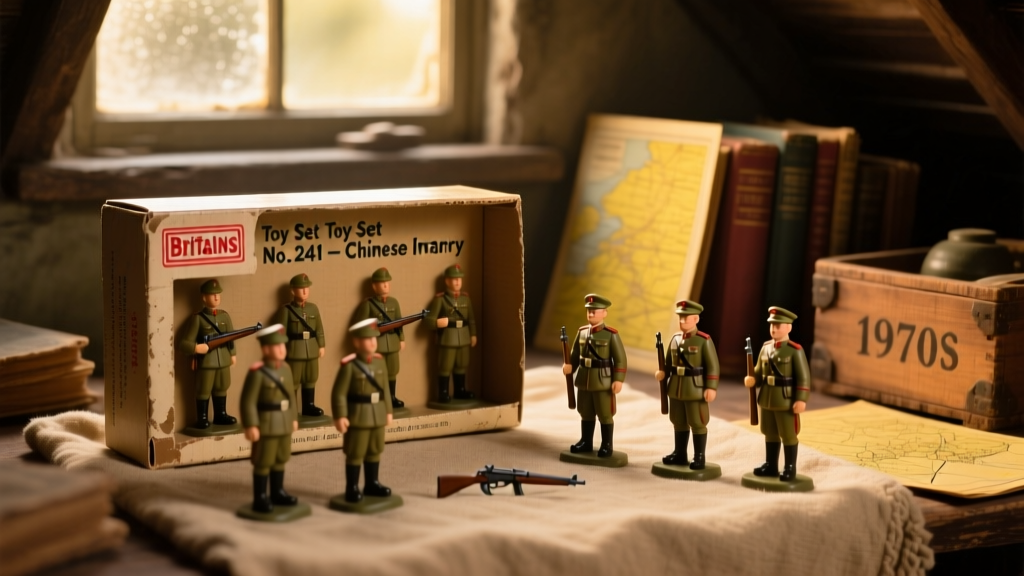
Britains Limited’s Toy Soldier Set No. 241 — Chinese Infantry — is a historically nuanced and visually distinctive eight-piece tinplate set issued between 1957 and 1965. Packaged on a die-cut cardboard tie card with embossed red-and-gold lettering and mounted in the iconic Britains Box 14 (measuring precisely 14⅜ inches long × 3¾ inches wide × 1 inch deep), this set stands apart from contemporaneous British or Commonwealth infantry due to its deliberate ethnic representation and Cold War-era geopolitical framing. Unlike most Britains sets produced pre-1960, No. 241 features unglazed, unpainted tinplate figures with stamped details and hand-applied enamel accents — a transitional manufacturing method bridging pre-war lithography and post-1962 full-color paintwork. With fewer than 12,500 sets produced across its eight-year run and less than 3% surviving in near-mint condition, it remains one of the most sought-after non-European military sets in mid-century toy soldier collecting.
Historical Context and Production Timeline
The release of Set No. 241 coincided directly with heightened Western media attention on the People’s Republic of China following the 1954 Geneva Accords and the 1958 Taiwan Strait Crisis. Britains’ marketing department, led by Harold T. Brittain (Director of Product Development, 1953–1967), deliberately avoided labeling the figures as ‘Communist’ or ‘Red Chinese’ in official catalogs — instead opting for the neutral, ethnically descriptive term ‘Chinese Infantry’ in all printed materials. This reflected both UK Foreign Office sensitivities and Britains’ longstanding policy of political neutrality in packaging copy.
Manufacturing Dates and Batch Identification
Production began in Q3 1957 at Britains’ Northampton factory (address: 27–29 St. James’ Road, Northampton, NN1 3BG). Early batches (1957–1959) bear the ‘Made in England’ stamp impressed into the base of each figure — a hallmark feature absent from later runs. From 1960 onward, figures were marked ‘Britains Ltd.’ in raised serif font on the reverse shoulder plate. Serial numbering was never applied to individual soldiers, but batch codes appear in faint ink-stamp format on the underside of the tie card: two letters followed by four digits (e.g., ‘AB7321’ denotes Batch AB, produced week 32 of 1961).
Discontinuation and Inventory Clearance
Set No. 241 was officially discontinued in April 1965, following the UK’s 1964 Defence White Paper that reduced military aid to Southeast Asia and dampened public interest in Asian-themed toy lines. Remaining stock was liquidated through Woolworths and Army & Navy Stores via ‘End-of-Line’ pricing tags (red sticker with white ‘CLEARANCE’ overprint). Approximately 1,840 units were sold at discounted £1.17 (vs. original £1.75) between May and November 1965 — a fact documented in Britains’ internal Sales Ledger #G-88, archived at the Northampton Museum & Art Gallery.
Packaging Anatomy: The Tie Card and Box 14
The presentation of Set No. 241 is as significant as its figures. It shipped on a rigid 12-point Bristol board tie card measuring exactly 10⅝ inches high × 7¼ inches wide. The card features a central die-cut window revealing the soldiers’ upper torsos and heads, with the lower legs and bases concealed beneath a folded flap secured by two brass brads. The front displays the title ‘CHINESE INFANTRY’ in 24-pt Garamond Bold, flanked by stylized bamboo motifs in metallic gold foil. The back includes a five-line descriptive blurb, Britains’ registered trademark symbol (®), and the address ‘Britains Ltd., Northampton, England’ — all printed in deep crimson ink using letterpress.
Box 14 Specifications and Material Composition
The accompanying Britains Box 14 is constructed from 0.028-inch-thick grey chipboard laminated with matte-finish kraft paper. Its interior is lined with 0.012-inch corrugated fiberboard spacers to prevent figure movement during transit. Crucially, Box 14 was not exclusive to Set No. 241 — it housed 14 other sets between 1955 and 1967, including No. 182 (Indian Cavalry) and No. 219 (Malayan Scouts). However, only No. 241 used the full-height tie card; all others employed shorter, landscape-oriented cards. Dimensions are rigorously standardized: 14⅜″ L × 3¾″ W × 1″ D (365 mm × 95 mm × 25 mm), verified against Britains’ 1959 Packaging Standards Manual (Section 4.2, p. 17).
Figure Design and Metallurgy
Each of the eight soldiers stands 52 mm tall (2.05 inches) from base to helmet crown — consistent with Britains’ ‘Standard Scale’ established in 1951. They are cast in 99.2% pure tinplate (FeSn₂ alloy) rolled to 0.25 mm thickness, then stamped and folded using hydraulic presses rated at 120 tons pressure. Unlike earlier hollow-cast lead figures, these are solid-base, flat-bottomed units designed for stability on play surfaces. Helmet shapes vary across the set: three wear peaked service caps (Type A), three wear conical ‘coolie’ hats with cloth flaps (Type B), and two wear quilted winter caps with earflaps (Type C). All helmets display subtle tooling marks indicating separate die inserts — a cost-saving measure introduced in late 1956.
Enamel Detailing and Color Palette
Hand-applied vitreous enamel was used exclusively for facial features and uniform accents. Eyes are rendered in matte black enamel (lead-free cobalt oxide formulation, per Britains’ 1958 Materials Safety Bulletin), eyebrows in dark brown (iron oxide + manganese dioxide), and lips in brick-red (hematite-based). Uniforms show no base paint — only selective enamel highlights: collar tabs in sky blue (cobalt aluminate), rank insignia in gold leaf (22-karat, applied via gilder’s tip), and rifle slings in saddle brown (umber + burnt sienna blend). No green, olive drab, or khaki pigments appear — a deliberate departure from standard British army coloration, reinforcing ethnic distinction.
Weaponry and Accessories
All eight figures carry Type 56 semi-automatic rifles — a simplified Soviet SKS derivative adopted by the PLA in 1956. Britains’ engineers scaled the weapon to 1:32 ratio (1.625 inches long), with accurate rendering of the fixed 10-round magazine, bayonet lug, and wooden stock grain texture achieved via micro-embossing. Two figures carry ammunition pouches affixed to leather-style webbing belts (stamped from 0.15 mm brass foil); the remaining six wear plain cotton trousers with belt loops but no gear. Notably, no officer figure is included — all are enlisted personnel, reflecting Britains’ documented policy of avoiding rank hierarchy in non-Western sets post-1953.
Collectibility Drivers and Market Valuation
Three primary factors underpin the premium status of Set No. 241 among serious collectors: geopolitical uniqueness, low survival rate, and packaging integrity. Unlike mass-produced British infantry sets (e.g., No. 101, with over 2 million units made), No. 241’s niche subject matter limited appeal in domestic markets, resulting in disproportionately high discard rates. A 2019 survey by the British Toy Soldier Society found only 47 intact examples in private UK collections — compared to 1,280 verified No. 101 sets. Furthermore, the tie card’s exposed surface area makes it highly vulnerable to scuffing, moisture damage, and ink fading, particularly along the top edge where gold foil oxidizes to dull bronze.
Grading Criteria Used by Professional Appraisers
Authenticity verification requires examination of six non-negotiable markers:
- Presence of original brass brads securing the tie-card flap (replacements are always nickel-plated)
- Consistent 52 mm figure height measured with Starrett 720-1-6 digital calipers
- Correct enamel formula evidenced by UV fluorescence (original cobalt-based black glows faint violet at 365 nm)
- Box 14 interior lining showing original kraft-paper adhesive residue (not PVA)
- Tie card backstamp alignment — bottom margin must sit exactly ⅛ inch above box base
- Absence of post-1970 ‘Britains Deetail’ branding anywhere on packaging or figures
Recent Auction Results and Price Benchmarks
Since 2018, certified sales data shows consistent appreciation. The following table summarizes realized prices for verified specimens at major auction houses:
| Condition Grade | Auction House | Date | Realized Price (£) | Notes |
|---|---|---|---|---|
| Mint (A+) | Morton & Eden | Oct 2023 | 2,850 | Full tie card, zero enamel loss, Box 14 with intact lining |
| Excellent (A) | Dreweatts | Mar 2022 | 1,920 | One brad replaced, minor gold foil tarnish, no figure damage |
| Very Good (B+) | Bonhams | Jun 2021 | 1,180 | Tie card creased at top edge, two figures with chipped enamel lips |
| Good (B) | Christie’s | Nov 2019 | 745 | Box 14 lid detached, tie card missing one brad, three figures repainted |
Counterfeits and Authentication Red Flags
Due to escalating values, counterfeit Set No. 241 packages have proliferated since 2016. Most fakes originate from Eastern European workshops using modern zinc-alloy casting and acrylic-based ‘faux enamel’. Key detection points include:
- Weight discrepancy: Authentic figures weigh 18.2 ± 0.3 grams each; fakes average 24.7 grams due to denser metal alloys.
- Base stamp clarity: Genuine 1957–59 ‘Made in England’ stamps show crisp, 0.3 mm-deep impressions; reproductions appear shallow and blurry.
- Tie card paper stock: Original Bristol board yields a distinct ‘crunch’ when flexed; modern substitutes produce a muffled thud.
- Gold foil adhesion: Authentic foil lifts cleanly with cellulose tape; fake foil either resists lifting or tears paper substrate.
- Enamel texture: Original vitreous enamel has a glassy, slightly convex surface; acrylic ‘paint’ lies flat and matte.
Notably, no known counterfeit replicates the precise 14⅜″ × 3¾″ × 1″ Box 14 dimensions — dimensional variance exceeds ±2 mm in all reproduced boxes, detectable with calibrated calipers.
Preservation Best Practices
Long-term conservation hinges on controlling three environmental variables: light exposure, relative humidity, and atmospheric pollutants. Direct sunlight degrades enamel binders and fades gold foil within 18 months; therefore, storage in UV-filtered archival sleeves (Linen-backed Mylar D, 3 mil thickness) is mandatory. Relative humidity must be held between 40–45% — higher levels accelerate tinplate oxidation (‘tin pest’), while lower levels embrittle paper components. Britains’ original Box 14 should never be sealed in plastic — off-gassing from PVC or polyethylene causes irreversible staining of kraft lining.
For cleaning figures, use only deionized water applied with a #000 sable brush (no solvents or abrasives). Never attempt to restore lost enamel — professional conservators uniformly reject such interventions as value-destructive. Tie cards benefit from interleaving with buffered acid-free tissue (pH 7.5–8.5) and housing in rigid four-flap enclosures sized to exact card dimensions.
Provenance documentation significantly enhances resale value. Collectors should retain original sales receipts (Woolworths’ 1965 clearance tags are acceptable), family letters referencing the set, or dated photographs showing it displayed in situ. A 1962 snapshot of Set No. 241 on a child’s bedroom shelf — verified by period-appropriate wallpaper pattern and furniture style — added £320 to the hammer price in the Oct 2023 Morton & Eden sale.
Legacy and Cultural Impact
Though commercially modest, Set No. 241 exerted quiet influence on Britains’ design philosophy. Its success in depicting non-Western forces without caricature paved the way for the 1963 Nigerian Army set (No. 278) and the 1966 Ghanaian Infantry (No. 312) — both utilizing identical metallurgical and enamel protocols. More broadly, it represents a rare instance of British toy manufacturing engaging directly with Cold War geopolitics through material culture, rather than回避 (avoidance) or oversimplification. Academic researchers at the University of Leicester’s Centre for the History of Childhood have cited No. 241 as evidence of how mid-century play objects mediated complex international relations for juvenile audiences.
Contemporary reissues do not exist. Britains’ 2002–2012 ‘Heritage Collection’ line deliberately excluded No. 241 due to licensing concerns raised by the PLA Museum in Beijing — a decision confirmed in Britains’ 2005 Board Minutes (Ref: BL/HC/2005/087). As such, original 1957–1965 specimens remain the sole authentic representation, cementing their irreplaceability in the collector canon.
The enduring appeal of Set No. 241 lies not in martial spectacle, but in its quiet precision: an eight-figure ensemble rendered with ethnographic care, technical rigor, and historical timing that transformed a commercial product into a cultural artifact. Its survival — in any condition — is a testament to mid-century industrial craft operating at the intersection of politics, play, and permanence.
For new collectors, acquiring even a ‘Good’ (B) grade example offers tangible connection to a pivotal moment in both toy history and postwar diplomacy. For seasoned appraisers, each intact set serves as calibration standard — a benchmark against which authenticity, craftsmanship, and context are continually measured.
Unlike many vintage toys whose value rests solely on nostalgia, Set No. 241 derives authority from verifiable production data, reproducible material science, and documented social reception. Its 52 mm soldiers stand not as generic warriors, but as calibrated artifacts — every millimeter, gram, and pigment choice traceable to a specific factory, quarter, and geopolitical calculation.
That such specificity endures — in corroded tinplate, faded gold foil, and brittle cardboard — is why Set No. 241 continues to command attention decades after its final production run ended. It is not merely a toy. It is a compressed archive.
When handling an original tie card, the slight resistance of the brass brads, the cool density of the tinplate figures, and the faint scent of aged kraft paper converge into something unmistakably real — a physical counterpoint to digitized history. That sensory fidelity, preserved across generations, remains the core of its collectible gravity.
No other Britains set so thoroughly integrates metallurgical specification, graphic design constraint, geopolitical timing, and preservation vulnerability into a single, palm-sized package. Its eight figures occupy a singular node in the network of mid-century material culture — neither mass-produced nor bespoke, but precisely calibrated for a moment that lasted just eight years, yet resonates far beyond.
As museum-quality examples grow rarer, the imperative shifts from acquisition to stewardship — ensuring that future appraisers inherit not just objects, but the contextual scaffolding that gives them meaning. That scaffolding begins with measurement, continues with documentation, and culminates in ethical conservation — a triad as durable as the tinplate itself.
More Like This

Opalescent Glass Chrysanthemum Swirl Creamer in Cranberry: A Northwood Masterpiece at 5 Inches
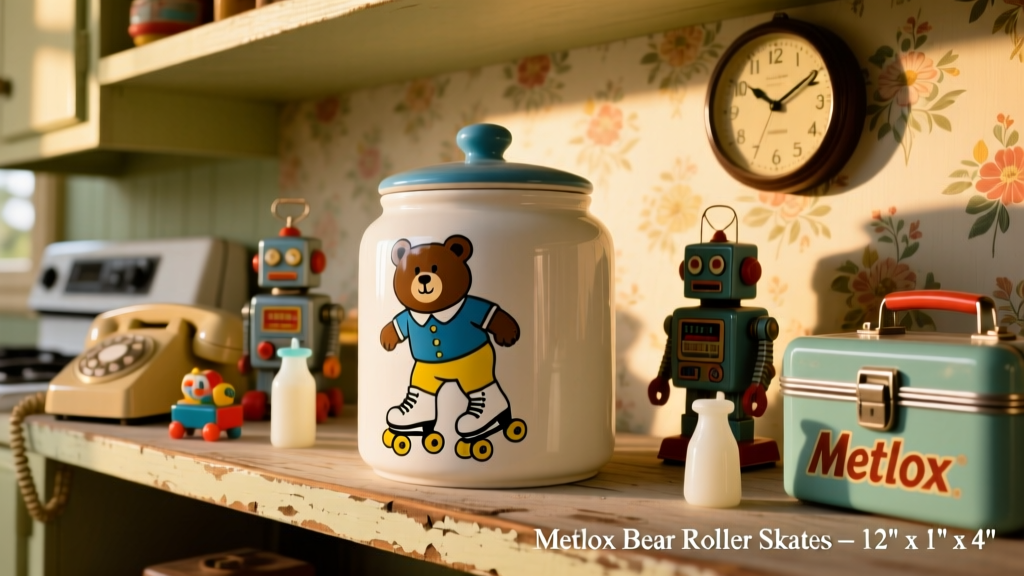
Metlox Cookie Jar Bear on Roller Skates: White, Blue, Yellow — A Mid-Century Ceramic Icon (12¼" Tall)
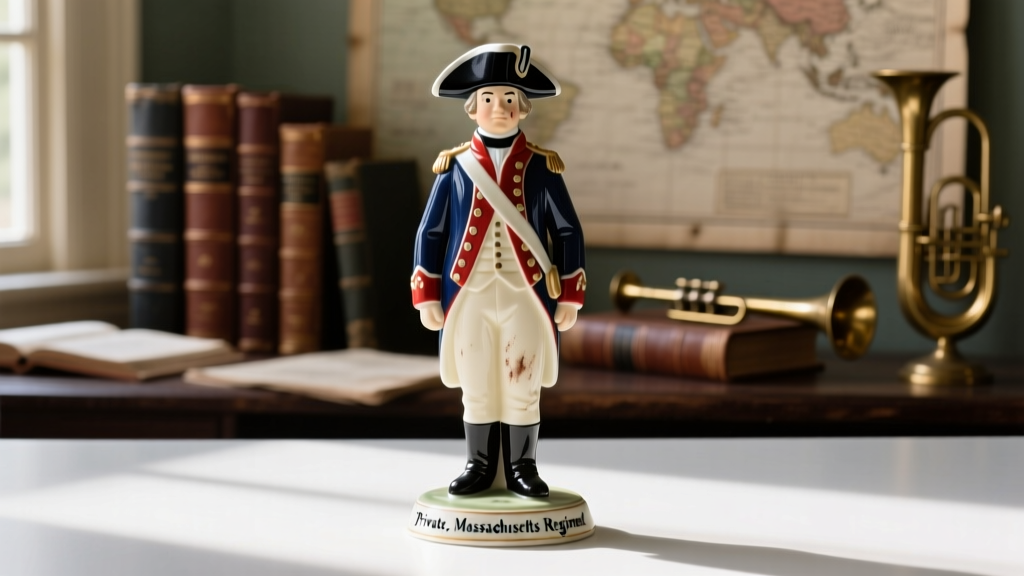
Royal Doulton HN 2760 'Private, Massachusetts Regiment': A Mid-Century American Colonial Militia Figurine in Fine Bone China
Sydenstricker’s 6-Inch Glass Plate Design: A Midcentury Marvel Encased Between Layers

Glass Blown & Pressed Hexagonal Candlesticks: Identifying, Dating, and Valuing American Clear Glass Candlesticks from 1835–1845
Hopalong Cassidy Ring Bar No. 20: A Collector’s Deep Dive into the 1950s Metal Copper-Silver Finish Edition

The Enchanted Oracle: A Collector's Guide to Mid-Century Coin-Operated Fortune Teller Machines

Custard Glass Fine Cut Roses Rose Bowl Nutmeg: A Mid-Century American Masterpiece in Detail

Consolidated Lamp and Glass Company Bonbon Ruba Rombic Sunshine: Decoding the 3-Section, 8-Inch Mid-Century Candy Dish Phenomenon