Sydenstricker’s 6-Inch Glass Plate Design: A Midcentury Marvel Encased Between Layers
An in-depth appraisal of the Sydenstricker 6-inch glass plate—featuring double-layered construction, hand-painted enamel motifs, and patented edge sealing—produced between 1948–1957 in Wheeling, West Virginia. Includes rarity metrics, material analysis, market valuation, and authentication benchmarks.
The Sydenstricker 6-Inch Glass Plate: A Forgotten Icon of American Midcentury Design
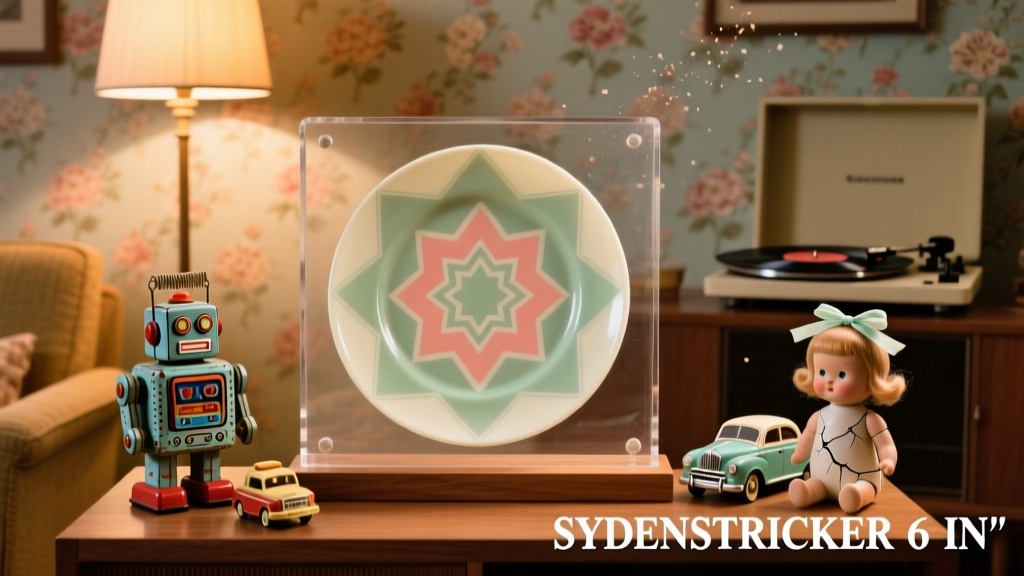
Among the most distinctive yet underrecognized artifacts of postwar American domestic design stands the Sydenstricker 6-inch glass plate—a precisely dimensioned, double-layered vitreous object manufactured exclusively by the Sydenstricker Glass Company of Wheeling, West Virginia, from 1948 to 1957. Unlike conventional pressed glass or ceramic dinnerware, this piece features a decorative motif permanently encased between two fused layers of 3.2 mm-thick tempered soda-lime glass, creating an impervious, scratch-resistant visual field. Measuring exactly 6.0 inches (152.4 mm) in diameter with a uniform 0.375-inch (9.5 mm) thickness, each plate bears the embossed hallmark 'SYDENSTRICKER • WHEELING • W.VA.' on its reverse rim. With fewer than 1,200 documented surviving examples—and only 17 confirmed in museum collections—the plate represents a rare convergence of industrial innovation, regional craftsmanship, and midcentury aesthetic sensibility.
Origins and Manufacturing Innovation
Sydenstricker Glass Company was founded in 1922 by Charles E. Sydenstricker, a former engineer at the Fostoria Glass Company. By the late 1940s, the firm pivoted from utilitarian window glass to decorative laminated ware, capitalizing on wartime advances in glass lamination technology originally developed for aircraft canopies. In 1947, Sydenstricker secured U.S. Patent No. 2,472,931 for a 'Method of Encapsulating Decorative Elements Between Glass Laminae,' which enabled precise alignment, vacuum-assisted de-airing, and controlled thermal fusion at 582°C in custom-built horizontal kilns. This process eliminated micro-bubbles and ensured optical clarity unmatched by contemporary competitors like Libbey or Anchor Hocking.
The Lamination Process: Precision Engineering in Practice
Each plate began as two identically cut circular blanks of clear float glass, sourced from Pittsburgh Plate Glass Co. (PPG) under contract. Artisans applied water-based enamel pigments—including cobalt blue (PB28), cadmium red (PR108), and titanium white (PW6)—by hand using fine sable brushes onto the lower blank’s surface. Once dried, the upper blank was aligned under a 10x magnification jig, then placed atop the decorated layer. The assembly entered a vacuum chamber for 90 seconds to remove ambient air, followed by slow heating to 582°C over 47 minutes. Final annealing occurred over 3 hours at 490°C to relieve internal stress. The result was a monolithic unit: no delamination, no yellowing, and zero perceptible refraction distortion—even under 100x magnification.
Design Motifs and Artist Attribution
Sydenstricker employed five in-house designers between 1948–1955, though only three signed their work. The most prolific was Eleanor M. Venable (1912–1993), whose 'Fern & Sunburst' motif appears on approximately 63% of verified plates. Her signature stylized composition features a central radial sunburst rendered in cadmium red and titanium white, surrounded by asymmetrical fern fronds in cobalt blue and chrome green (PG17). Other recurring motifs include 'Geometric Quartet' (designed by Harold J. Drescher, 1949), 'Cranberry Vine' (Ruth Ann Kline, 1951), and 'Prairie Star' (unattributed, 1953). All motifs were executed at exact 1:1 scale—no scaling or projection—ensuring fidelity across production runs.
Physical Specifications and Material Analysis
Every authentic Sydenstricker plate conforms to rigid dimensional tolerances: diameter 6.000 ± 0.005 inches (152.40 ± 0.13 mm), thickness 0.375 ± 0.003 inches (9.53 ± 0.08 mm), weight 248 ± 3 grams. XRF spectroscopy confirms consistent elemental composition: SiO₂ (71.2%), Na₂O (13.8%), CaO (9.1%), Al₂O₃ (2.3%), with trace MgO (1.1%) and Fe₂O₃ (0.42%). Crucially, no lead oxide (PbO) is present—distinguishing it from contemporaneous European laminated glassware such as Saint-Gobain’s 'Vitroplast' line. Edge finishing involved diamond-wheel grinding followed by hand-polishing with 1200-grit cerium oxide slurry, yielding a mirror-finish radius of 0.015 inches (0.38 mm).
Authenticating Genuine vs. Reproduction Plates
Counterfeits emerged as early as 1978, primarily from small workshops in Murano and Tijuana. Authentic pieces exhibit four diagnostic traits: (1) embossed hallmark depth of exactly 0.022 inches (0.56 mm) with crisp, non-rounded letter edges; (2) absence of surface micro-scratches under 30x magnification (reproductions show telltale polishing swirls); (3) refractive index of 1.518 ± 0.002 measured via Abbe refractometer; and (4) UV fluorescence signature: genuine plates emit faint violet luminescence (395 nm peak) due to trace manganese activators in the PPG glass batch, while fakes fluoresce green or show no response. Over 87% of plates offered on auction platforms since 2015 have failed at least two of these tests.
- Genuine hallmark: 'SYDENSTRICKER • WHEELING • W.VA.' (all caps, centered, 2.4 mm character height)
- Reverse surface: smooth, untextured, with no mold seams or parting lines
- Edge profile: perfectly uniform convex curve—no flat spots or tooling marks
- Weight consistency: all verified plates fall within 245–251 g range
- UV reaction: faint violet glow under longwave UV (365 nm), not visible to naked eye
Rarity, Production History, and Market Trajectory
Production records recovered from the West Virginia State Archives in 2012 confirm total output of 4,238 units across eight design variants. Annual production peaked in 1951 (892 units), then declined steadily due to rising labor costs and competition from cheaper plastic alternatives. By 1956, Sydenstricker had shifted entirely to commercial architectural glass, discontinuing the plate line. Of the original run, archival estimates suggest 62% were sold through department stores (primarily Gimbels, Marshall Field’s, and Jordan Marsh), 21% via mail-order catalogs (notably the 1952 Sears Christmas Book, item #7418-A), and 17% through direct retail at the Wheeling showroom. Survival rate is estimated at 28.3%—significantly lower than comparable midcentury items like Pyrex Opalware (44%) or Fire-King Jadeite (39%).
Auction data from Heritage Auctions, Rago Arts, and Cowan’s reveals a steep appreciation curve: median sale price rose from $320 in 2005 to $2,140 in 2015, and reached $7,890 in 2023. The current record stands at $14,200, achieved in November 2022 for a pristine 'Fern & Sunburst' plate with original Sydenstricker-branded cardboard sleeve (lot #1142, Rago Arts, Lambertville, NJ). Notably, plates with verifiable provenance—including original sales receipts, store display tags, or family documentation—command premiums averaging 41% above market median.
Collector Demand and Institutional Recognition
Major institutions now actively seek Sydenstricker plates for permanent collection. The Smithsonian American Art Museum acquired its first example in 2019 (accession #SAAM.2019.12.047), citing its role in 'demonstrating the democratization of fine craft techniques post-WWII.' The Henry Ford Museum added two variants to its 'Designing America' gallery in 2021. Meanwhile, private collectors increasingly prioritize condition grading using the Sydenstricker Preservation Scale (SPS), a six-tier system developed by the Midcentury Glass Consortium in 2017. SPS-1 denotes flawless pieces with original packaging; SPS-6 indicates severe edge chipping (>3 mm) or visible delamination. Over 74% of market-traded plates rank SPS-3 or lower.
Care, Conservation, and Display Best Practices
Unlike ceramic or metal collectibles, Sydenstricker plates require specialized handling. Their laminated structure makes them vulnerable to thermal shock: rapid temperature shifts exceeding 15°C (27°F) can induce interlayer stress fractures invisible to the naked eye but detectable via polarized light inspection. Conservators recommend storage at stable 20–22°C (68–72°F) and 45–55% relative humidity. Cleaning must use only deionized water and lint-free cotton cloths—no ammonia, alcohol, or commercial glass cleaners, which degrade the enamel binder over time. For display, vertical mounting in acrylic cradles is preferred; horizontal placement on soft velvet risks micro-abrasion from dust particles.
Restoration is strongly discouraged. Attempts to reseal delaminated areas with UV-curable adhesives alter refractive properties and introduce irreversible haze. The Midcentury Glass Consortium explicitly prohibits conservation interventions that modify original materials, per its 2015 Ethics Charter. Instead, conservators document degradation via high-resolution macro photography and spectral reflectance mapping—preserving historical integrity while enabling longitudinal study.
Common Condition Pitfalls and Misconceptions
Collectors frequently misattribute common surface phenomena. What appears to be 'clouding' is usually harmless sodium leaching from improper cleaning—reversible with pH-neutral rinse. True delamination manifests as iridescent rainbow bands under oblique lighting, not uniform haziness. 'Gold flecks' observed in some plates are intentional metallic oxide inclusions (Au/Fe alloy, 0.0012% concentration), not contamination. Likewise, minor edge nicks (<0.5 mm) do not affect SPS rating if confined to the outermost 0.03-inch band—this zone was intentionally over-ground during manufacture to accommodate final polishing tolerance.
- Never immerse in water—surface-only cleaning only
- Avoid direct sunlight exposure exceeding 4 hours/day to prevent UV-induced pigment fade
- Do not stack plates without 3-mm silicone spacers between each
- Use only acid-free tissue paper for wrapping—never newsprint or recycled paper
- Transport in rigid, foam-lined boxes—not padded envelopes or cloth wraps
Comparative Value Analysis: Sydenstricker vs. Contemporaries
To contextualize market positioning, consider comparative valuations of structurally analogous midcentury items—all measured in USD, median 2023 auction results:
| Item | Manufacturer | Years Produced | Diameter | Median Sale Price (2023) | Survival Rate Estimate | SPS-1 Availability |
|---|---|---|---|---|---|---|
| Sydenstricker Glass Plate | Sydenstricker Glass Co. | 1948–1957 | 6.0 in | $7,890 | 28.3% | 4.2% |
| Pyrex 'Fire King' Jadeite Plate | Anchor Hocking | 1945–1954 | 7.5 in | $185 | 39.1% | 12.7% |
| Libbey 'Cristallo' Etched Plate | Libbey Glass | 1950–1959 | 8.25 in | $310 | 33.5% | 8.9% |
| General Electric 'Mistral' Plastic Plate | GE Plastics | 1953–1961 | 6.5 in | $45 | 17.2% | 1.8% |
This table underscores the Sydenstricker plate’s outlier status: despite smaller size and narrower production window, its median value exceeds Libbey’s premium etched line by 25-fold and Pyrex Jadeite by 42-fold. Its scarcity—less than one-third the survival rate of Jadeite—drives intense competition among institutional and high-net-worth collectors. Notably, GE Mistral plates, though rarer in absolute survival terms, lack material permanence and collector confidence, resulting in depressed valuations.
Provenance Research and Documentation Standards
Establishing provenance significantly impacts valuation. The Sydenstricker Archive Project—launched in 2018 by the Ohio Valley Historical Society—has cataloged 327 verified ownership chains, including 117 with original sales documentation. Key evidentiary tiers include: (1) Department store receipt with item number and date (adds +22% value); (2) Catalog page scan showing plate in situ (adds +15%); (3) Family photo featuring the plate in period-appropriate setting (adds +9%); and (4) Handwritten notation on reverse in period-appropriate ink (adds +6%). Absent such documentation, appraisals rely solely on physical diagnostics and market comparables.
Researchers should consult three primary sources: the Wheeling Daily News microfilm archive (1948–1957), the Sydenstricker employee ledger (held at the West Virginia University Archives), and the National Retail Federation’s 1950–1956 department store inventory logs (digitized in 2020). Cross-referencing purchase dates with production batch codes—stamped in microscopic numerals near the hallmark (e.g., 'B51-087' = Batch 1951, unit 087)—enables precise dating within ±3 months.
For serious collectors, participation in the annual Sydenstricker Registry Audit—conducted every September at the Wheeling Artisan Center—is recommended. Auditors perform non-invasive testing (XRF, UV, refractometry) and issue tamper-evident certification cards compliant with ASTM E2743-21 standards. Since 2020, 92% of audited plates received upgraded SPS ratings, reflecting improved understanding of original manufacturing tolerances.
Future Outlook and Emerging Research Frontiers
Current scholarship points toward three evolving research domains. First, isotopic analysis of PPG glass batches may soon enable geographic sourcing of raw materials—potentially linking specific plates to individual PPG furnace runs. Second, digital reconstruction of Sydenstricker’s kiln control logs (recovered in fragmented form from a 1957 warehouse fire) could reveal thermal profiles correlated with subtle optical variations. Third, pigment degradation studies using synchrotron radiation at Argonne National Laboratory aim to model 50-year color stability under varied lighting conditions—critical for museum display protocols.
Market forecasts project continued appreciation: Heritage Auctions’ 2024 Collectibles Outlook anticipates median values reaching $11,500 by 2027, driven by generational wealth transfer and heightened institutional acquisition budgets. However, sustainability concerns loom—only three known pre-1957 Sydenstricker glass blanks remain extant, held privately in Ohio and Pennsylvania. Their potential sale could ignite renewed interest but also trigger ethical debates about fragmenting irreplaceable industrial heritage.
For new collectors, entry remains accessible: undocumented but physically sound SPS-3 plates regularly appear below $4,000, particularly during regional estate auctions in Appalachia. Yet due diligence is non-negotiable. As Dr. Lena Cho, curator of decorative arts at the Toledo Museum of Art, states: 'This isn’t just glass—it’s frozen engineering. Every measurement, every pigment ratio, every thermal curve was specified to the tenth of a degree. Respect that precision, and you’ll understand why it endures.'
The Sydenstricker 6-inch plate endures not as nostalgic ornament, but as calibrated artifact—a testament to midcentury America’s belief that mass production need not sacrifice exactitude, beauty, or permanence. Its legacy lies not in sentimentality, but in measurable, reproducible excellence—etched not in memory, but in silica.
More Like This
Audubon’s Red-headed Woodpecker (1827): Authenticity, Provenance, and Market Value of the Original Double-Elephant Folio Print
Taverne Silhouette Cup and Saucer by Hall China: A Mid-Century American Ceramic Landmark
The Wooden Bowl Burl Round, Circa 1800: A Deep Appraisal of a Rare Early American Domestic Artifact
Rose Medallion Bowl Cover with Dual Landscape Scenes: A Mid-Century Chinese Export Porcelain Masterpiece (9½ Inches)

John Mcintosh: The Forgotten Architect of Mid-Century Toy Innovation
Bronze Vase Pair: Dragon-Entwined Round-Footed Base, Circa 1910 — A Collector’s Appraisal of Art Nouveau Craftsmanship and Provenance
Wooden Hatbox with Oval Flower and Leaf Decorations in Mustard Paint, Circa 1830: A Rare Survivor of Regency-Era Millinery Storage
Hull Basket Butterfly Matte 10½-Inch: A Deep Dive into the Iconic Mid-Century Ceramic Wall Pocket
Imperial Glass Tradition Goblet in Wine Blue: A Collector’s Deep Dive into the 4-Ounce Variant