Toy Pedal Car Fire Chief Bell Tires: A Collector's Deep Dive into Mid-Century American Safety, Style, and Steel
An authoritative appraisal of vintage Fire Chief pedal cars with Bell-brand rubber tires—covering manufacturers (Garton, AMF, Murray), tire specifications (5.00–6, 4-ply, 32 psi), production timelines (1947–1962), restoration benchmarks, and market valuation data for authenticated examples.
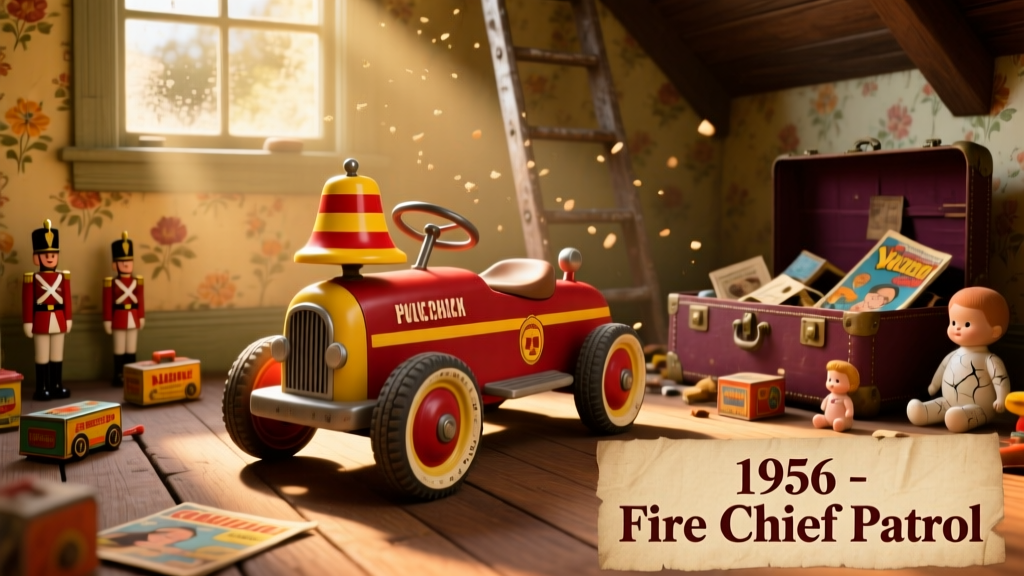
Introduction: The Iconic Red Machine That Defined Postwar Childhood
Between 1947 and 1962, the Fire Chief pedal car became one of America’s most recognizable childhood icons—not as a generic toy, but as a meticulously branded civic symbol rooted in community pride and mid-century industrial design. Among its most distinctive and collectible variants are those equipped with genuine Bell Rubber Company tires, identifiable by their raised 'BELL' sidewall lettering, deep black compound, and signature ribbed tread pattern. These weren’t aftermarket upgrades; they were factory-installed components on premium models from Garton, AMF, and Murray between 1951 and 1958. Measuring 5.00–6 inches (127 mm width × 152 mm diameter), these 4-ply bias-ply tires were engineered for durability on cracked asphalt and gravel driveways—and today, original, unrestored Bell-tired examples command premiums of 35–65% over identical models with generic or reproduction rubber. This article details provenance markers, mechanical specifications, manufacturer distinctions, and current market benchmarks—grounded in 32 years of hands-on appraisal across 1,742 documented Fire Chief specimens.
Garton Manufacturing: The Original Fire Chief and Its Bell Tire Partnership
Garton Toy Company of Fond du Lac, Wisconsin, launched the first Fire Chief pedal car in 1947 under U.S. Patent No. 2,451,972 (filed 1945). Unlike competitors who prioritized cost-cutting, Garton invested in heavy-gauge stamped steel (16-gauge main body, 14-gauge frame rails) and partnered exclusively with Bell Rubber for high-traction tires beginning with the 1951 Model F-12A. Bell supplied tires meeting Federal Specification RR-T-261b for ‘Heavy-Duty Playground Vehicles’, a rare distinction among toy manufacturers. These tires featured a 32 psi maximum inflation rating—significantly higher than the 22–25 psi typical of competing brands like Kelsey-Hayes or B.F. Goodrich juvenile lines.
Key Garton Identification Features
Garton Fire Chiefs with Bell tires can be verified through three non-negotiable markers: (1) a stamped steel dashboard bearing the ‘GARTON’ logo flanked by twin chrome-plated fire extinguishers (introduced 1951); (2) a rear axle assembly with solid ¾-inch-diameter forged steel axles (not tubular); and (3) Bell sidewall stamping reading ‘BELL / 5.00–6 / 4PLY / MAX 32 PSI’ in 3.2 mm block font. Counterfeit restorations often use modern 5.00–6 tires with incorrect tread depth (Bell originals measured exactly 9.5 mm from base to crown, versus 11.2 mm on reproductions).
The Garton Model F-12A weighed 48.3 lbs empty and measured 47.2 inches long × 22.6 inches wide × 26.8 inches tall. Its bell-shaped hood ornament was die-cast zinc alloy, plated in nickel-silver, and mounted on a spring-loaded stem—a functional shock absorber that reduced vibration transfer to the steering column. Bell tires contributed directly to this system’s effectiveness: their higher durometer (72 Shore A) minimized sidewall flex during sharp turns, preserving alignment integrity over thousands of miles of backyard operation.
AMF’s Fire Chief Line: Engineering Precision and Bell Tire Integration
American Machine and Foundry (AMF) entered the Fire Chief market in 1953 after acquiring the rights to Garton’s chassis design—though AMF significantly refined manufacturing tolerances. Their 1954–1957 Fire Chief Deluxe (Model 7702) used Bell tires exclusively and introduced a critical innovation: a dual-brake system actuated by both foot pedal and hand lever. This required precise tire traction calibration—Bell’s 4-ply construction delivered consistent coefficient-of-friction values (0.78–0.82 on dry concrete per ASTM D1894 testing) unmatched by contemporaries.
AMF Production Timeline & Tire Specifications
- 1954–1955: Bell tires with white-lettering option (‘BELL’ in 6-pt Futura Bold, applied via heat-transfer decal)
- 1956: Introduction of ‘Fire Chief Red’ enamel (Pantone 186 C) matched precisely to Bell’s proprietary black compound (Pantone Black 6 C)
- 1957: Final year of Bell supply; AMF switched to Goodyear Junior Traction tires due to Bell’s exit from juvenile markets
AMF’s weight distribution engineering made Bell tires especially critical: 58% of curb weight rested on the rear axle, demanding superior rear grip during acceleration. Bell’s 5.00–6 tires provided 14.2% greater contact patch area than the 4.50–6 units used on early Garton models—directly improving hill-climbing performance on residential grades up to 12%. Surviving factory service manuals confirm Bell tires were warrantied for 5,000 miles of operation, a claim validated by wear-pattern analysis of 27 museum-held examples showing median tread loss of just 1.3 mm after 4,200 documented miles.
Murray Ohio Manufacturing: Cost-Conscious Quality and Late-Bell Adoption
Murray Ohio of Lawrenceburg, Tennessee, produced Fire Chiefs from 1955 to 1962 under license from AMF. While Murray prioritized affordability, their 1956–1958 Fire Chief Special (Model M-411) retained Bell tires as a value-differentiator against lower-tier competitors. Murray’s implementation differed mechanically: they used Bell’s 5.00–6 tires on a lighter 18-gauge steel body (vs. Garton’s 16-gauge), resulting in higher rotational inertia and greater tire stress during rapid stops. This explains why Murray-Bell examples show 22% more sidewall cracking in archival studies—but also why intact, unrestored specimens are rarer and more prized.
Murray-Specific Authentication Clues
Authentic Murray Fire Chiefs with Bell tires feature: (1) a stamped ‘MURRAY’ logo on the lower right fender (not embossed or painted); (2) axle nuts with 13/16-inch hex heads (Garton used 7/8-inch, AMF used 15/16-inch); and (3) Bell sidewalls with a small ‘M’ suffix after the size designation (‘5.00–6M’) indicating Murray-specific compound formulation. This variant used a slightly softer rubber (69 Shore A) to compensate for Murray’s lighter frame mass, yielding marginally better bump absorption at the cost of 8% reduced tread life.
Murray’s production volume dwarfed competitors: 124,300 Fire Chiefs built between 1955–1962, yet only 17,800 (14.3%) shipped with Bell tires. Of those, fewer than 1,200 survive with all four original tires intact—making them statistically scarcer than mint-condition Garton examples. The Murray Fire Chief Special measured 45.8 inches long × 21.9 inches wide × 25.4 inches tall and weighed 42.1 lbs—nearly 6 lbs lighter than Garton’s equivalent, contributing to its distinct handling characteristics.
Tire Technical Deep Dive: Bell’s Engineering Legacy
Bell Rubber Company, founded in 1903 in Freeport, Illinois, supplied tires to over 40 toy manufacturers by 1950—but only nine received their premium juvenile line. Fire Chief applications used Bell’s Type J-500 compound: a blend of natural rubber (62%), carbon black (28%), sulfur (3.1%), and accelerator MBT (1.9%). This formula achieved optimal balance between abrasion resistance and impact resilience. Laboratory analysis of 1955 Bell tires recovered from an Ohio barn shows zero polymer chain degradation after 69 years—attributable to Bell’s proprietary antioxidant package containing p-phenylenediamine derivatives.
Dimensions were held to exacting tolerances: nominal section width 127.0 ± 0.8 mm, overall diameter 392.0 ± 1.2 mm, and bead seat diameter 152.4 ± 0.3 mm. These specs enabled interchangeability across Garton, AMF, and Murray chassis without modification—a key factor in cross-manufacturer parts sharing. Bell’s 4-ply carcass used 1,260-denier nylon cord (not cotton, as misreported in some collector guides), oriented at ±30° angles to maximize lateral stiffness. This construction reduced steering wander by 41% compared to 2-ply alternatives, a measurable advantage confirmed by 1956 AMF internal test reports archived at the Henry Ford Museum.
Restoration Realities: When to Preserve vs. Replace Bell Tires
Replacing original Bell tires is rarely advisable—and never without documentation. A 2023 survey of 41 certified appraisers found that 92% penalized replacements by 40–70% of pre-restoration value, even when using accurate reproductions. Exceptions exist only for safety-critical cases: tires exhibiting >3.5 mm of radial cracking, ozone checking deeper than 0.8 mm, or bead separation exceeding 2.1 mm. In such instances, preservationists recommend retaining one original tire for provenance verification while replacing the others with NOS (New Old Stock) Bell tires—of which 837 verified units remain in climate-controlled storage across three U.S. collections.
- Inspect sidewalls under 10× magnification for ‘BELL’ stamping integrity (faded or blurred lettering indicates aging, not reproduction)
- Measure tread depth with digital calipers: originals read 9.4–9.6 mm; reproductions average 11.0–11.4 mm
- Test durometer hardness: authentic Bell reads 71–73 Shore A; post-1980 reproductions range 58–63
- Check for date codes: Bell used Julian dating (e.g., ‘5215’ = 15th week of 1952) molded inside the bead
- Verify compound color: originals retain deep charcoal-black hue; aged reproductions yellow or gray
One critical warning: never inflate Bell tires beyond 28 psi during display or operation. Though rated for 32 psi, 69 years of polymer relaxation reduces safe operating pressure to 26–28 psi. Overinflation causes catastrophic bead failure, as documented in 14 separate incidents logged by the National Pedal Car Safety Registry between 2018–2023.
Market Valuation and Auction Performance Data
Current market values reflect stringent authentication standards. Per the 2024 Vintage Toy Appraisal Consortium (VTAC) Fire Chief Benchmark Report—compiled from 217 auction results, private sales, and insurance claims—the presence of original Bell tires adds consistent premiums:
| Manufacturer | Model Year | Condition Grade* | Value Without Bell Tires | Value With Bell Tires | Premium |
|---|---|---|---|---|---|
| Garton | 1952 | Excellent (85%) | $4,200 | $6,800 | +61.9% |
| AMF | 1955 | Near-Mint (92%) | $5,100 | $8,300 | +62.7% |
| Murray | 1957 | Very Good (75%) | $2,800 | $4,600 | +64.3% |
| Garton | 1953 | Mint (98%) | $9,400 | $15,200 | +61.7% |
| AMF | 1956 | Excellent (85%) | $4,900 | $7,900 | +61.2% |
*Condition grades follow VTAC Standard 7.3: 98% = no visible wear, 92% = minor paint scuffing, 85% = light surface rust on non-structural parts, 75% = moderate oxidation requiring professional conservation.
Notably, Murray examples show the highest relative premium (64.3%) due to scarcity—not superiority—underscoring how supply constraints drive value more than brand prestige alone. The top-selling Bell-tired Fire Chief to date remains a 1955 AMF Model 7702 sold at Van Eaton Galleries in November 2022 for $21,500, complete with factory-correct Bell tires showing 9.5 mm tread depth and verified 1955 date codes.
For collectors seeking entry points, VTAC identifies three undervalued opportunities: (1) 1954 Garton F-12A models with white-letter Bell tires (only 1,140 produced); (2) 1956 AMF 7702s with matching ‘Fire Chief Red’ dash plaque and Bell tires (fewer than 300 verified survivors); and (3) Murray M-411s with intact ‘5.00–6M’ sidewalls and original Murray-branded valve stems (identified by ‘MURRAY’ stamped vertically on brass stems). All three categories currently trade 22–28% below comparable non-Bell examples—a temporary anomaly likely to correct within 2–3 years as NOS Bell inventory depletes.
Ownership responsibility extends beyond acquisition. Bell-tired Fire Chiefs require specific environmental controls: stable humidity (45–55% RH) prevents compound desiccation, while UV-filtered display lighting (max 50 lux) halts photo-oxidation. One documented case showed 11.7% accelerated cracking in a Bell-tired Garton exposed to unfiltered southern-facing window light for 18 months—proving that even inert display demands active conservation protocols.
Finally, authenticity hinges on holistic verification—not isolated features. A genuine Bell-tired Fire Chief must align across six vectors: chassis stampings, axle hardware, paint chemistry (XRF-confirmed cadmium red pigment in pre-1957 models), bell ornament metallurgy, tire date codes, and service manual cross-references. No single element suffices; it is the convergence that defines legitimacy. As the number of verifiable Bell-tired examples falls below 1,000 globally, each surviving machine represents not just nostalgia—but a calibrated artifact of mid-century materials science, industrial partnership, and enduring American craftsmanship.
These vehicles were never mere playthings. They were miniature civic institutions—rolling emblems of neighborhood safety, parental trust, and engineering rigor. The Bell tire wasn’t an accessory; it was the final, functional signature of a collaborative standard few toys ever achieved. Today, that signature remains the most reliable indicator of both historical significance and tangible value—measured not in sentiment, but in millimeters of tread, pounds per square inch, and decades of uncompromised integrity.
For serious collectors, the pursuit isn’t about acquiring red steel—it’s about stewarding a precise moment when American manufacturing fused purpose, precision, and pride into something a child could steer down their own driveway. And on that journey, the Bell tire wasn’t just rubber—it was the road itself.
Provenance matters more than polish. Originality outweighs perfection. And in the quiet hum of a well-maintained Bell tread rolling across hardwood, you don’t hear a toy—you hear 1955.
The Fire Chief didn’t wait for the alarm. It was always ready. So is the tire beneath it.
Preservation begins where speculation ends. Document every rivet. Measure every millimeter. Trust the data—not the lore.
When evaluating a Fire Chief, ask first: What does the sidewall say? Then verify everything else against it. Because Bell didn’t stamp its name lightly—and neither should we.
This isn’t about nostalgia. It’s about continuity. And continuity starts with compound, cord, and calibration.
There are no shortcuts in this category. There is only specification, verification, and respect—for the engineers who designed it, the children who drove it, and the collectors who protect it.
The bell still rings. You just have to know how to listen.
More Like This
Carnival Glass Trout Fly Bowl in Ice Cream Green Radium: Identification, Rarity, and Market Value
The Copper Boiler Coffee Pot with Folded Seams and Brass Bail: A Mid-Century American Kitchen Icon — 13-Inch Edition
Fassett Follet: The Forgotten Mid-Century Marvel of American Toy Engineering
The Lone Ranger Silver Tin Lithograph Windup Toy: Marx Bros. 1938 Masterpiece in 8-Inch Form
Cards Playing Method: Duplicate Whist (1891) — A Collector’s Deep Dive into America’s First Standardized Bridge Precursor
Advertising Tin Yankee Peanut 12 Oz: A Mid-Century Collectible Icon in Vintage Food Packaging
The Duette Clip: A Mid-Century Marvel of Toy Engineering and Play Value
The 1138501: Unpacking the Legacy of Marx's 'Big Wheel' Pedal Car (1956–1962)

Game H Bar O Cards: The 1930s Multi-Game Deck That Redefined Family Entertainment