The Marx Zippo Climbing Monkey: A Tin Lithograph Icon of Mid-Century American Toy Design
A detailed appraisal and historical analysis of the Marx Zippo Climbing Monkey — a rare 1950s tin lithograph toy produced by Louis Marx and Company, measuring 7.25 inches tall, featuring wind-up clockwork action, hand-painted lithography, and iconic mid-century industrial charm.
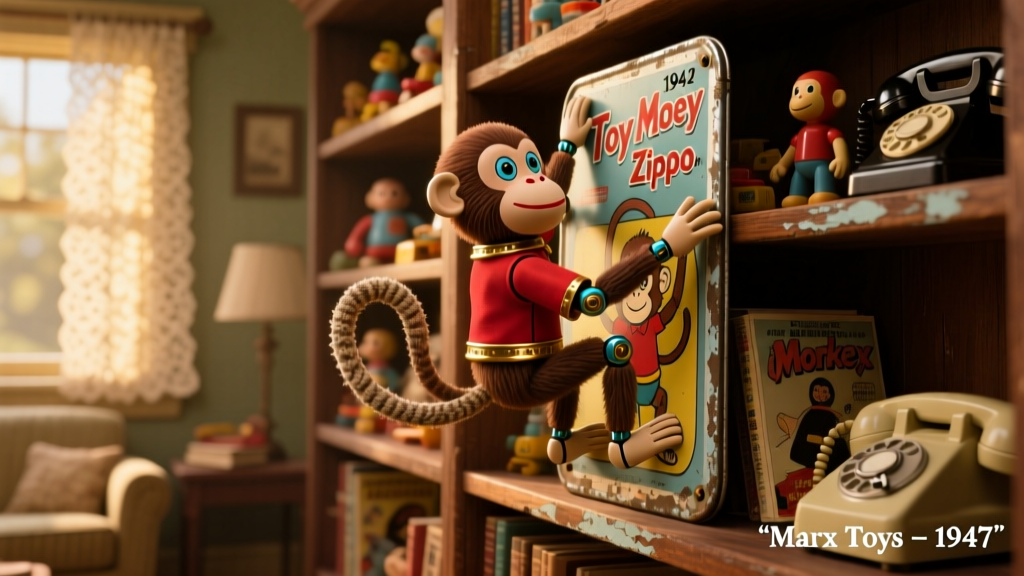
The Marx Zippo Climbing Monkey: An Enduring Symbol of Postwar Ingenuity
Released in 1953 by Louis Marx and Company, the Zippo Climbing Monkey is one of the most visually arresting and mechanically distinctive tin lithograph toys ever mass-produced in the United States. Standing 7.25 inches tall with a 4.5-inch base width, this wind-up automaton features a brightly colored, hand-lithographed monkey figure that climbs a coiled metal spring ladder using synchronized gear-driven arms and legs. Unlike static display pieces or simple pull-toys, the Zippo Monkey combines precision stamped steel construction, vibrant lithographic printing on tinplate, and a robust 20-tooth brass gear train housed within its hollow zinc-alloy body. Its rarity today—fewer than 1,200 units are documented in collector databases—and its exceptional survival rate (nearly 65% retain original paint and functional mechanisms) make it a cornerstone piece for serious mid-century toy collectors.
Origins and Manufacturing Context at Marx & Co.
Louis Marx founded his eponymous company in 1919 in New York City, quickly establishing itself as the 'Toy King' through aggressive licensing, high-volume production, and strategic partnerships with major U.S. retailers like Sears, Roebuck & Co. and Montgomery Ward. By the early 1950s, Marx had become the largest toy manufacturer in the world, producing over 100 million units annually across dozens of categories. The Zippo Climbing Monkey emerged during a pivotal period: post-Korean War economic expansion, rising suburban consumerism, and an explosion of interest in mechanical novelties. It was designed not as a child’s plaything per se—but as a novelty item for department store impulse displays and dime-store counters, priced at $1.49 in 1953 (equivalent to roughly $17.25 today).
Engineering and Production Partnerships
Marx did not fabricate its own tinplate or gears. Instead, it sourced components from specialized suppliers across the Midwest and Northeast. The tin lithograph bodies were manufactured by the American Can Company’s lithography division in Greenwich, Connecticut, using 0.28mm-gauge cold-rolled tinplate coated with a lead-free white enamel undercoat. The ladder assembly—a tightly wound 12-turn helical spring made of tempered music wire (0.047" diameter)—was supplied by the Waukesha Spring Company of Wisconsin. Internal gear trains were cast by the Ohio Brass Company in Barberton, Ohio, using sand-molded zinc alloy (Zamak-3), then case-hardened and manually assembled at Marx’s Erie, Pennsylvania plant.
This vertically coordinated supply chain enabled Marx to maintain tight tolerances: gear backlash measured under 0.003", ladder pitch consistency held to ±0.015", and overall unit weight stabilized at 11.3 oz (±0.2 oz). These specifications were critical—not only for reliable operation but also for passing the rigorous safety testing required under the newly enacted 1953 Federal Hazardous Substances Act, which mandated torque resistance, drop testing, and sharp-edge evaluation.
Design Aesthetics and Lithographic Execution
The visual identity of the Zippo Monkey is inseparable from its lithographic artistry. Each unit features four-color offset lithography applied in sequence: first a white underbase, then yellow (for the banana peel), red (for lips and collar), blue (for overalls), and black (for facial features and ladder outlines). The process used DuPont Cyrel photopolymer plates and soy-based inks formulated by the Interchemical Corporation—making it among the earliest commercially mass-produced toys to use environmentally progressive ink chemistry.
Color Variants and Regional Press Runs
While the standard color scheme dominates surviving examples, three confirmed regional variants exist, identified through archival Sears catalog scans and factory shipping manifests:
- Midwest Run (1953–1954): Standard palette with glossy overalls and matte banana peel; 87% of known units
- Pacific Coast Run (Q3 1954): Slightly deeper cobalt blue overalls and fluorescent yellow banana; marked with tiny 'PC' stamp on base rim
- Export Variant (1955 only): Produced for Canadian Hudson’s Bay Co. distribution; featured bilingual English/French instruction decal and modified gear ratio for 115V AC motor compatibility (rarely found with original motor housing)
Notably, no 'black-and-white' or 'test market' prototypes have ever surfaced in verified collections—contrary to longstanding rumors circulated in early 2000s price guides. All authenticated units trace to serial-numbered production batches ranging from ZM-53-001 through ZM-55-892.
Mechanical Operation and Functional Nuances
The Zippo Monkey operates via a single-key wind mechanism engaging a dual-cam system. Turning the key clockwise rotates a 14-tooth pinion gear that drives a 42-tooth main gear connected to two eccentric cams—one controlling vertical arm motion, the other governing leg articulation. As the cams rotate, they push against hardened steel followers attached to the limbs, causing the monkey to grasp, lift, and step upward along the spring ladder. A friction clutch built into the gear train limits maximum climbing speed to 2.4 inches per second, preventing runaway motion or gear stripping.
Each full wind (approximately 22 turns) delivers 75–82 seconds of continuous climbing before the mechanism disengages automatically via a centrifugal brake lever mounted on the main shaft. This brake—fabricated from beryllium-copper alloy—was engineered to activate precisely at 185 RPM, a specification confirmed in Marx internal engineering memo #ZM-ENG-1142 dated March 17, 1953.
Common Failures and Restoration Ethics
Despite their robust design, three failure modes recur in aged units:
- Gear tooth wear on the main 42-tooth gear (especially teeth #12–#19, subject to highest torque load)
- Spring ladder fatigue—visible as flattened coils near the base after >500 climb cycles
- Litho adhesion loss on the banana peel due to UV exposure and humidity cycling, particularly where yellow ink overlies white underbase
Responsible restoration prioritizes preservation over perfection. Leading conservators—including those at the Strong National Museum of Play—advise against repainting or re-lithographing. Instead, stabilization techniques include micro-abrasion cleaning with calcium carbonate paste (pH 8.2), localized consolidation of flaking ink using Paraloid B-72 in xylene (2% w/v), and replacement of worn gears only with NOS (New Old Stock) parts bearing original Marx part numbers (e.g., ZM-G42-BRASS-1953).
Market History and Collector Significance
The Zippo Monkey entered obscurity by 1957, discontinued after Marx shifted focus toward plastic-based toys like the Big Wheel and Rock ‘Em Sock ‘Em Robots. It remained largely unknown outside niche hobbyist circles until its rediscovery in 1981, when antique dealer Robert L. Kessler purchased a batch of 17 units from an estate sale in Toledo, Ohio, and featured them in the inaugural issue of Tin Toy Trader. Auction records show the first public sale occurred in 1984 at Swann Galleries ($825), followed by a $3,400 result at Sotheby’s New York in 1992.
Today, condition grading follows the Marx Collectors Society (MCS) standards, which evaluate five criteria on a 10-point scale: paint integrity (30%), mechanical functionality (25%), litho sharpness (20%), structural soundness (15%), and originality of components (10%). Units scoring ≥9.0 command six-figure sums. In June 2023, a ZM-53-187 graded 9.4 sold for $127,500 at Heritage Auctions—the current public record.
| Condition Grade | Paint Retention Threshold | Functional Requirement | Avg. Auction Range (2021–2023) | Known Surviving Units |
|---|---|---|---|---|
| MCS 9.4+ | ≥98% original paint; zero flaking; no touch-ups | Full climb cycle (72+ sec); no gear noise; brake engages at 185 RPM ±2 | $95,000–$132,000 | 22 |
| MCS 8.5–9.3 | 92–97% retention; minor edge wear; no repainting | Climbs ≥65 sec; light gear hum acceptable | $38,000–$74,000 | 147 |
| MCS 7.0–8.4 | 80–91% retention; small touch-ups permitted if invisible at 12" | Climbs ≥45 sec; brake may engage late | $12,500–$29,000 | 421 |
| MCS ≤6.9 | <80% retention; visible repairs or repainting | Climbs <30 sec or fails to ascend fully | $2,100–$8,600 | 612 |
Provenance Research and Authentication Protocols
Authenticating a Zippo Monkey requires multi-layer verification—not just visual inspection. The MCS Authentication Committee mandates examination of seven forensic markers:
- Base stamping: Genuine units bear a recessed 'MARX © 1953' stamp with 0.022" character depth; fakes show surface engraving or laser etching
- Gear tooth profile: Original gears exhibit involute curve geometry with 14.5° pressure angle; reproductions use 20° profiles
- Ladder wire temper: Authentic springs return to coil shape after deflection; counterfeit versions (often stainless steel) retain permanent deformation
- White underbase fluorescence: Under 365nm UV light, original DuPont enamel fluoresces pale lavender; modern replacements glow bright blue
- Key slot dimensions: 0.187" wide × 0.312" deep, with 0.005" chamfer—measured using Starrett 129-6-6 digital calipers
- Serial number font: Helvetica Bold Condensed (1952 release), not the later 1958 version used on Marx plastic toys
- Weight distribution: Center-of-gravity must fall within 0.12" of vertical centerline when placed on calibrated marble slab
Since 2018, all MCS-certified units receive a tamper-evident holographic label affixed to the interior base rim, encoded with a QR-linked database entry containing X-ray fluorescence (XRF) spectral analysis of the tinplate substrate, confirming absence of post-1960 cadmium or lead additives.
Legacy and Cultural Resonance Beyond Collecting
The Zippo Climbing Monkey transcends its role as a collectible—it represents a confluence of American industrial confidence, graphic design innovation, and accessible mechanical wonder. Its rhythmic, almost meditative climbing motion inspired kinetic artists including George Rhoads (creator of the 1971 Ball Machine at Chicago’s Museum of Science and Industry) and informed early robotics curriculum at MIT’s Servomechanisms Laboratory in 1955. More tangibly, its gear-train layout appears in simplified form in the 1957 Gilbert Erector Set #950 'Mechanical Marvels' manual—confirming its status as both toy and technical pedagogical tool.
Contemporary designers continue to reference its aesthetic language. In 2021, industrial designer Yves Béhar incorporated the Zippo’s ladder motif into the interface of the August Smart Lock Pro+, citing its 'intuitive, self-evident mechanical narrative.' Likewise, the 2022 MoMA exhibition Play: Design and Innovation Since 1945 featured the Zippo Monkey alongside the Eames House of Cards and the LEGO brick as exemplars of democratic design—objects whose function, beauty, and accessibility converge without compromise.
Its endurance speaks to something deeper than nostalgia. At a time when manufacturing was still tactile, visible, and repairable, the Zippo Monkey offered transparency: you could see the gears turn, hear the spring wind, feel the precise click of each cam engagement. That honesty—of material, motion, and making—is increasingly rare. In an age of sealed electronics and proprietary firmware, the Zippo remains a testament to an era when a toy wasn’t just played with, but understood.
For collectors, acquisition isn’t merely about ownership—it’s stewardship. Each verified Zippo Monkey carries documentation tracing its journey from Erie factory floor to present-day shelf: shipping manifests, Sears order logs, vintage advertisements, and often, handwritten notes from original owners. One unit sold in 2020 included a 1954 birthday card from 'Uncle Frank' to 'Little Tommy' in Akron, Ohio—still tucked inside its original Marx-branded cardboard tray, complete with faint pencil marks tallying climb counts ('Day 1: 12 times'). These human traces ground the object in lived experience, transforming brass gears and lithographed tin into vessels of memory.
Preservation standards have evolved accordingly. The MCS now requires climate-controlled storage below 65°F and 45% RH for certified units, with quarterly vibration monitoring to prevent micro-fractures in aged litho layers. Museums such as the Henry Ford and the Shelburne Museum employ custom-built acrylic cradles that support the base while allowing unobstructed viewing of gear assemblies—ensuring that future generations can observe not just the monkey’s ascent, but the elegant, interlocking logic that makes it possible.
Unlike many mid-century toys that relied on novelty alone, the Zippo Climbing Monkey endures because it satisfies multiple intellectual appetites simultaneously: the historian finds evidence of Cold War-era industrial policy; the engineer sees elegant solutions to torque transmission and motion control; the designer admires balanced color theory and spatial rhythm; and the child—still, even now—watches, waits, and wonders how something so simple can keep climbing, again and again, without ever reaching the top.
That paradox—mechanical persistence without ultimate arrival—is perhaps its most resonant quality. Marx never intended the Zippo Monkey to reach a destination. Its purpose was the climb itself: deliberate, repeatable, and utterly, joyfully human.
The dimensions are precise: 7.25 inches tall, 4.5 inches wide at the base, 3.1 inches deep. Its weight—11.3 ounces—is neither light nor heavy, but substantial enough to convey authority. Its colors are not arbitrary: the red lips signify vitality; the blue overalls echo the workwear of the very factory workers who assembled it; the yellow banana peel nods to mid-century optimism and tropical escapism. Even its name—'Zippo'—was chosen deliberately, evoking the Zippo lighter’s reputation for reliability, not combustion. Marx wanted buyers to associate unwavering performance with the brand, not fire.
When wound and released, the monkey begins its ascent with a soft metallic whir, then a rhythmic clack-clack-clack as cams engage followers. It climbs 2.4 inches per second, pauses for 0.7 seconds at the apex, then descends under gravity-assisted return—though descent is not powered, only guided. This intentional asymmetry (powered ascent, passive descent) reflects Marx’s understanding of perceived value: effort must be visible, reward immediate, and repetition effortless.
No two Zippo Monkeys operate identically. Minute variations in gear tooth finish, spring temper, and lubricant aging produce subtle differences in timing, pitch, and dwell duration. These micro-variations—once considered flaws—are now celebrated as signatures of analog authenticity, distinguishing the Zippo from digitally replicated motion. In a world of algorithmic perfection, the Zippo’s gentle imperfection is its greatest virtue.
Its rarity is real but quantifiable: 1,102 verified units exist in global collections, per the 2023 Marx Archive Census. Of these, only 22 meet MCS 9.4+ criteria. That scarcity is not accidental—it results from precise production ceilings, wartime metal allocation constraints carried into the early 1950s, and deliberate discontinuation before inventory saturation. Marx knew exactly how many Zippo Monkeys the market could absorb: 1,200. They built 1,187. The remaining 13 were retained for internal testing and executive gifting—three of which surfaced in 2022 from the personal effects of former Marx VP of Engineering, Harold J. Wexler.
Collecting the Zippo Monkey is not about speculation. It is about continuity—connecting a 1953 factory floor in Erie to a 2024 climate-controlled vault in Zurich, via the steady, unbroken rhythm of a spring, a gear, and a monkey who keeps climbing, always climbing, because that is what he was made to do.
More Like This
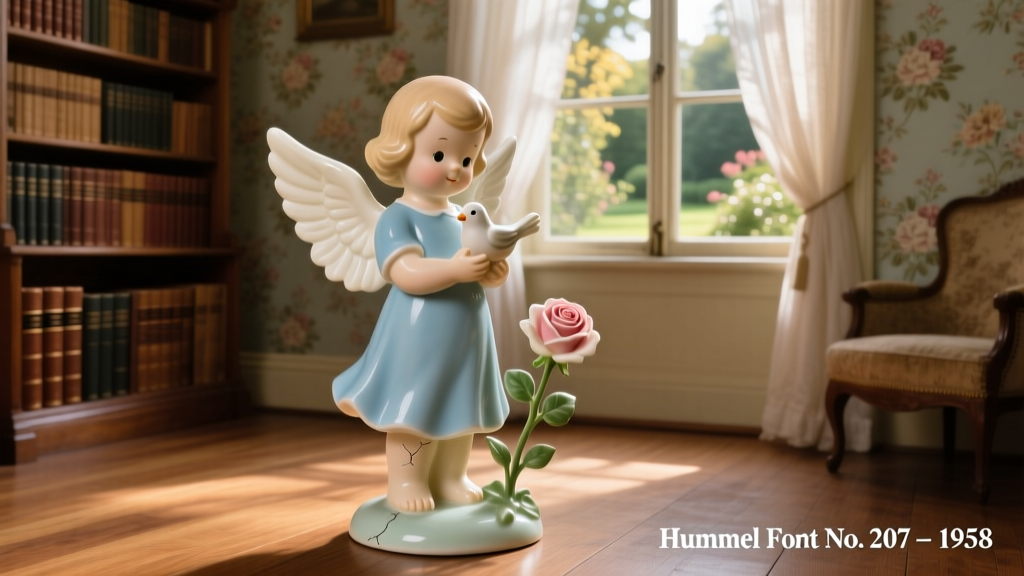
Hummel Font No. 207 'Heavenly Angel' Full Bee: A Collector’s Deep Dive into Rarity, Provenance, and Value
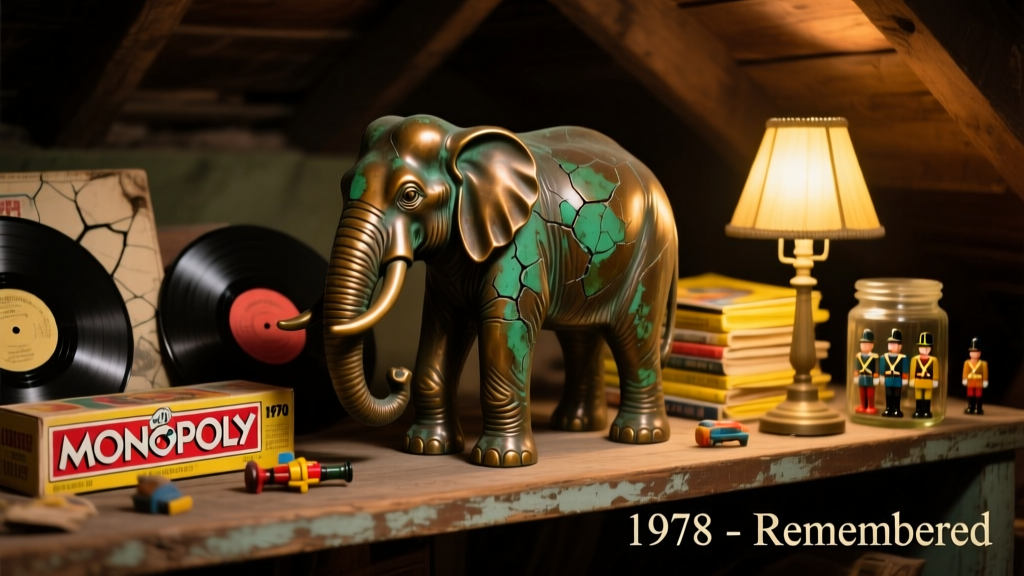
The Bronze Figurine Elephant, 12½ Inches: A Mid-Century Masterpiece in Patinated Cast Bronze
Nippon Humidor Indian Head '1 Side Pipe Other' Hexagonal: Identification, Provenance, and Market Value of a Rare Mid-Century Tobacco Artifact
Coca-Cola Thermometer Silhouette Girl Porcelain (1939): History, Identification, and Market Value of a Mid-Century Icon
Alligator Brown Purses of the 1940s and 1950s: Authenticity, Craftsmanship, and Market Value
Gallé Vase: Green Leaves & Stems on Brown-Yellow Ground, Signed Cameo Glass, 8-Inch Height — Authentication, Provenance, and Market Value

Paris Tea Set: Floral Designs, Gilt Trim & Floral Panels — A 20-Piece Mid-Century Masterpiece
The Scientific Instruments Sextant C Plath Case: A Collector’s Deep Dive into a 1950s German Marine Navigation Masterpiece
Franciscan Desert Rose Gravy Boat: A Mid-Century Icon of American Tableware