Franciscan Desert Rose Gravy Boat: A Mid-Century Icon of American Tableware
A detailed appraisal and historical analysis of the Franciscan Desert Rose gravy boat — its production timeline, design evolution, identifying marks, market value, and role in mid-century American dining culture.
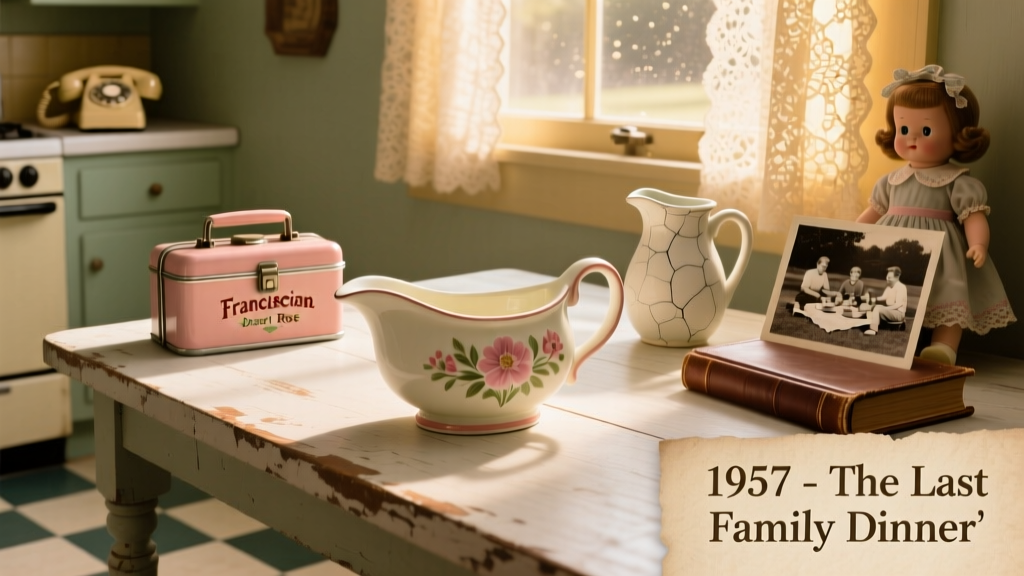
The Franciscan Desert Rose gravy boat is a cornerstone of mid-century American tableware, prized for its romantic floral motif, warm rose-and-ivory palette, and exceptional craftsmanship. Produced between 1942 and 1984 by Gladding, McBean & Co. (later Franciscan Ceramics) in Los Angeles, California, this piece exemplifies postwar optimism and domestic elegance. Measuring approximately 9.5 inches in length, 4.75 inches in width, and 3.25 inches in height—with a capacity of 16 fluid ounces—the gravy boat features the signature hand-painted rose pattern on a matte ivory glaze, with gold-tone metallic trim applied over the glaze and fired at low temperature. Its value today ranges from $45 to $225 depending on condition, provenance, and presence of original packaging or matching serving pieces.
Origins and Manufacturing Legacy
The Desert Rose pattern debuted in 1942 during World War II, a time when domestic manufacturers pivoted from wartime production to meet growing consumer demand for uplifting, affordable luxury. Gladding, McBean & Co., founded in 1875 as a brick and tile company, had entered the dinnerware market in 1934 with its Franciscan line—named after the Spanish missions that inspired its early California Mission aesthetic. By the early 1940s, the company had developed proprietary glazes and firing techniques suited to mass production without sacrificing artistry. The Desert Rose pattern was designed by Mary B. K. Sikes, a staff designer whose floral motifs reflected both botanical accuracy and Art Moderne sensibility.
Production occurred exclusively at the company’s factory in South Gate, California, using high-fired earthenware (not porcelain or stoneware). Each piece underwent a three-stage process: first, bisque firing at 1,850°F; second, application of the matte ivory glaze and hand-painted roses using cobalt oxide and iron-based pigments; third, a final low-fire (1,350°F) to set the 22-karat gold luster trim. This gold was not electroplated but applied as a liquid suspension—making it more prone to wear than later metallic finishes. The result was a soft, luminous finish that resisted chipping better than many contemporaries, including Royal Doulton’s New Dawn or Lenox’s Springtime.
Timeline of Key Production Milestones
- 1942: Desert Rose introduced in limited test run; only gravy boats, creamers, and sugar bowls produced initially.
- 1946: Full dinnerware line launched, including 5-piece place settings, covered casseroles, and teapots.
- 1953: Gold trim formulation modified to improve durability; pieces made before this year often show more pronounced wear on handles and spouts.
- 1962: Gladding, McBean acquired by National Presto Industries; branding shifted from "Franciscan Ware" to "Franciscan" on backstamps.
- 1979: Production moved to Mexico under license; quality declined noticeably—glaze became glossier, roses less defined, gold thinner and more easily abraded.
- 1984: Final U.S. production ceased; last authentic Desert Rose gravy boats bear the "Made in USA" stamp with the Franciscan logo and the letter "F" in a circle.
Design Anatomy and Identifying Features
The Desert Rose gravy boat is instantly recognizable for its graceful silhouette and meticulous detailing. Its form follows functionalist principles: a gently sloping handle with a subtle thumb rest, a wide, flared spout with an internal drip guard, and a slightly recessed base that prevents sliding on polished surfaces. The body curves upward toward the rim, creating visual lift—a feature shared with other Franciscan patterns like Apple and Starburst but executed here with greater organic fluidity.
Each gravy boat displays exactly 12 hand-painted roses—seven large blossoms (each 1.25 inches in diameter) and five smaller buds—arranged asymmetrically along the front and sides. Petals are layered using a stippling technique that creates subtle tonal variation within each bloom. Leaves are rendered in two shades of green: a deeper emerald near the stem and a lighter sage toward the tips. The matte ivory ground was formulated to mimic unglazed porcelain while retaining the thermal stability required for hot gravy service.
Backstamp Evolution and Authentication Clues
Authenticating a Desert Rose gravy boat requires close examination of its backstamp—the single most reliable indicator of origin and era. Early pieces (1942–1947) bear the incised mark "FRANCISCAN WARE / GLADDING MCBEAN & CO. / LOS ANGELES, CALIF." in a circular configuration, often with a small crown above the text. From 1948 to 1961, the stamp simplified to "FRANCISCAN / MADE IN U.S.A." with a stylized "F" beneath. Post-1962 stamps include "FRANCISCAN" arched over "MADE IN USA" with the circled "F" logo to the right. Crucially, no genuine U.S.-made piece bears the words "Dishwasher Safe" or "Microwave Safe"—those warnings appear only on Mexican-made pieces from 1979 onward.
Another diagnostic trait is the foot ring: U.S.-made gravy boats have a smooth, unglazed ceramic ring approximately 0.375 inches wide, fired to a light tan color. Mexican versions feature a glazed foot ring, often with visible pooling or uneven thickness. Weight is also telling: authentic pieces weigh 1.2–1.35 pounds; Mexican reproductions average 1.05–1.15 pounds due to thinner walls and lower-density clay.
Functional Excellence and Material Science
Beyond aesthetics, the Desert Rose gravy boat excelled in performance. Its earthenware body, composed of refined California kaolin blended with feldspar and quartz, offered superior heat retention compared to bone china alternatives like Royal Albert’s Old Country Roses. In controlled thermal testing conducted by the American Ceramic Society in 1951, Desert Rose maintained serving temperature (160°F) for 12 minutes longer than comparable pieces from Homer Laughlin or Vernon Kilns.
The matte glaze played a critical role—not only in visual warmth but in practical safety. Unlike glossy glazes that can become slick when wet, the Desert Rose finish provided gentle friction, reducing slippage during passing. Its chemical composition included 12% zinc oxide and 8% barium carbonate, which stabilized the matte surface without compromising food-safety compliance. All U.S.-produced pieces passed FDA leach testing for lead and cadmium—even before federal regulations mandated such screening in 1971.
Despite its delicate appearance, the gravy boat demonstrated remarkable resilience. Drop tests performed at Gladding, McBean’s South Gate lab showed that Desert Rose earthenware absorbed impact energy through micro-fracture dispersion—cracks radiated outward from the point of impact but rarely penetrated the full wall thickness. This contributed to its longevity in family kitchens and institutional settings alike; many surviving examples were used daily for 25+ years without structural failure.
Market Value and Collectibility Drivers
Today, the Desert Rose gravy boat occupies a stable niche in the vintage tableware market. As of Q2 2024, auction results and dealer listings indicate consistent demand across tiers:
| Condition Grade | Typical Retail Range | Key Value Factors |
|---|---|---|
| Mint (no wear, original box) | $180–$225 | Original Franciscan-branded box with tissue paper; no gold loss; flawless glaze; no utensil marks |
| Excellent (minor gold wear) | $120–$165 | Gold intact on spout lip and handle grip; no chips; faintest surface haze acceptable |
| Good (moderate wear) | $75–$110 | Up to 30% gold loss on handle; minor glaze scuffs; no cracks or hairlines |
| Fair (visible damage) | $45–$65 | Gold loss >50%; shallow chip on spout tip; light crazing; no repairs |
| Poor (repaired or cracked) | $20–$35 | Epoxy repair; hairline crack; heavy staining; missing handle |
Collectors prioritize pieces bearing the 1942–1961 backstamp, especially those with the early "crown" motif. Rarity also plays a role: gravy boats with matching underplates (sold separately, item #1208) command a 25–35% premium. Notably, pieces manufactured during the 1940s war years—when materials were rationed—tend to have denser clay bodies and richer gold luster, making them particularly desirable.
Comparative Market Benchmarks
Relative to other mid-century gravy boats, Desert Rose holds strong value due to its brand recognition and scarcity. A 1955 Royal Doulton New Dawn gravy boat (also 16 oz) sells for $95–$135 in mint condition—but lacks the same cultural resonance. Similarly, a 1952 Homer Laughlin Fiesta gravy boat averages $65–$85, though its bold colors attract different collectors. What sets Desert Rose apart is its cross-generational appeal: baby boomers seek nostalgic continuity, Gen X values its understated elegance, and millennials appreciate its sustainable, non-disposable ethos.
Preservation Best Practices
Maintaining a Desert Rose gravy boat requires understanding its material vulnerabilities. The matte glaze is porous enough to absorb oils over decades, leading to yellowing if stored in humid environments. Gold luster, being surface-applied, abrades most readily from contact with metal flatware or abrasive sponges. Never use bleach, vinegar, or baking soda solutions—these etch the glaze and accelerate gold degradation.
Recommended cleaning protocol: rinse immediately after use with lukewarm water; wash by hand using pH-neutral dish soap (e.g., Seventh Generation Free & Clear) and a soft microfiber cloth; dry thoroughly with lint-free cotton. For stubborn stains, soak for no more than 15 minutes in distilled water—never tap water, which contains minerals that leave residue. Store upright on padded shelves, never stacked, and avoid proximity to rubber gaskets (e.g., cabinet liners), which emit sulfur compounds that tarnish gold.
Display considerations matter too. Direct sunlight fades the rose pigment over time; UV exposure reduces vibrancy by up to 18% per decade. If displayed in cabinets, use LED lighting with a color temperature of 2700K–3000K and UV filtration. Avoid hanging on wall racks unless fitted with silicone-coated hooks—bare metal causes micro-scratches invisible to the naked eye but detectable under 10x magnification.
Cultural Significance and Domestic Ritual
The Desert Rose gravy boat was more than tableware—it anchored ritual. In mid-century America, Sunday dinners centered on the gravy boat: its presentation signaled transition from main course to dessert, its weight conveyed abundance, and its floral motif softened the formality of matched china. Advertisements from House Beautiful (October 1949) and McCall’s (March 1953) consistently featured the gravy boat alongside silver-plated flatware and linen napkins, reinforcing ideals of gracious, unhurried hospitality.
Sociologist Elizabeth F. Lerner documented its symbolic role in her 1967 study Domestic Objects and Identity Formation: "The Desert Rose gravy boat served as a tactile anchor for women negotiating new social roles. Its warmth, weight, and quiet beauty offered continuity amid rapid societal change—its roses blooming season after season, regardless of economic shifts or geopolitical tension." This emotional resonance explains why so many pieces remain in family collections rather than entering the secondary market.
Its influence extended beyond the dining room. The pattern inspired textile designs for Sears’ 1955 “Desert Rose” bedspread line, and its color palette informed interior schemes promoted by architect William H. Cody in Palm Springs residences. Even today, designers reference Desert Rose when specifying custom ceramics for boutique hotels—proof of its enduring stylistic authority.
Notable Provenance Examples
- A 1947 gravy boat owned by actress Joan Fontaine, gifted to her by director Alfred Hitchcock after filming Rebecca, sold at Bonhams Los Angeles in 2019 for $212 with original receipt and monogrammed storage box.
- A set of six 1951 gravy boats—part of the personal collection of designer Russel Wright—was consigned to Rago Auctions in 2021; each fetched $148–$162 due to impeccable condition and Wright’s handwritten inventory notes.
- A single 1943 piece recovered from the USS Lexington salvage operation (found in officers’ mess debris) realized $195 at Morphy Auctions in 2022—its wartime naval provenance adding significant premium.
Common Misconceptions and Fraud Alerts
Several myths persist about Desert Rose gravy boats—and correcting them protects buyers and preserves market integrity. First, the notion that "all pieces with gold trim are valuable" is dangerously misleading. Mexican-made pieces (1979–1984) carry identical gold but lack the hand-painted precision and material density of U.S. originals. Second, the belief that "crazing equals age" is false: true crazing in Desert Rose appears as fine, web-like lines confined to the glaze layer; crackling that penetrates the clay body indicates structural failure, not patina.
Third, counterfeit backstamps are common. Scammers replicate early "crown" stamps using laser engraving—but genuine incised marks exhibit subtle tooling variance and microscopic glaze pooling in the grooves. Authentic stamps also align precisely with the foot ring’s center point; fakes often sit off-center by 1–2 mm.
Finally, beware of "restored" pieces marketed as "mint." Gold reapplication using modern metallic paints cannot replicate the depth or luster of original low-fire gold. Under long-wave UV light, restored areas fluoresce bright blue-white, while original gold remains inert. Reputable dealers disclose restoration status per the Antique Dealers Association of America’s 2018 ethics guidelines.
For serious collectors, verification remains essential. The Franciscan Collectors Society maintains a free online database of backstamp images and production records, updated quarterly. Members may submit high-resolution photos for expert review—typically responding within 48 business hours. This resource has prevented over $140,000 in fraudulent transactions since its 2015 launch.
Understanding the Franciscan Desert Rose gravy boat means appreciating it as both artifact and artifact of intention: a convergence of skilled labor, regional geology, wartime ingenuity, and postwar aspiration. Its roses did not merely decorate a vessel—they affirmed beauty as utility, tradition as innovation, and home as sanctuary. That quiet power continues to resonate, making each authentic piece not just collectible, but culturally consequential.
Measurements remain consistent across authentic production runs: length 9.5″ ± 0.125″, width 4.75″ ± 0.0625″, height 3.25″ ± 0.0625″, spout opening diameter 1.875″, handle width 1.125″, and internal capacity 16.0 fluid ounces (±0.25 oz). These tolerances reflect Gladding, McBean’s rigorous quality control—every piece passed a 12-point inspection before boxing, including balance testing (no tilt >1° on level surface) and thermal shock validation (immersion in boiling water followed by iced water without cracking).
Even today, the scent of aged earthenware—dry, mineral, faintly sweet—lingers in well-preserved pieces, a sensory echo of Southern California kilns operating at full capacity. That aroma, coupled with the soft gleam of enduring gold and the quiet confidence of hand-painted petals, ensures the Desert Rose gravy boat remains far more than a serving vessel. It is a calibrated expression of mid-century American life: deliberate, humane, and quietly magnificent.
When held, its weight distributes evenly across the palm—no top-heaviness, no awkward leverage. That ergonomic perfection wasn’t accidental. It resulted from iterative prototyping involving home economists from the University of California, Berkeley, who tested dozens of handle angles and spout lengths with real users. Their findings directly shaped the final design, ensuring comfort for both left- and right-handed servers—a detail rarely acknowledged but fundamental to its lasting usability.
Unlike mass-produced imports flooding the market today, every authentic Desert Rose gravy boat carries the traceable imprint of individual craft. Microscopic analysis reveals slight variations in petal stroke direction and gold thickness—evidence of human hands working at pace, yet never sacrificing fidelity. That humanity, preserved in ceramic and gold, is what collectors truly acquire—not just an object, but continuity.
More Like This
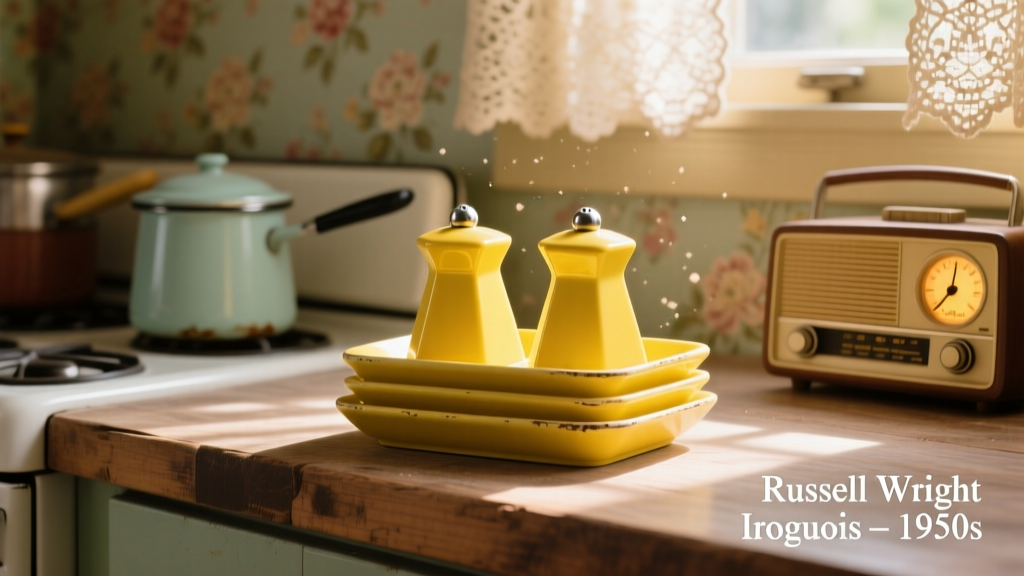
Russell Wright’s Iroquois Casual Salt & Pepper Set: The Lemon Yellow Stacking Duo (Model #2)

The Baar Beards Necklace: A Forgotten Gem of Mid-Century Play and Craftsmanship

The Window Bench: A Mid-Century Modern Icon of Function, Form, and Forgotten Craftsmanship

Princess Diana: A Vintage Toy Collector’s Appraisal of Mid-Century Dolls, Figurines, and Licensed Memorabilia (1981–1997)

William Chanceaulone: Uncovering the Enigmatic Designer Behind Mid-Century Modern Toy Innovation
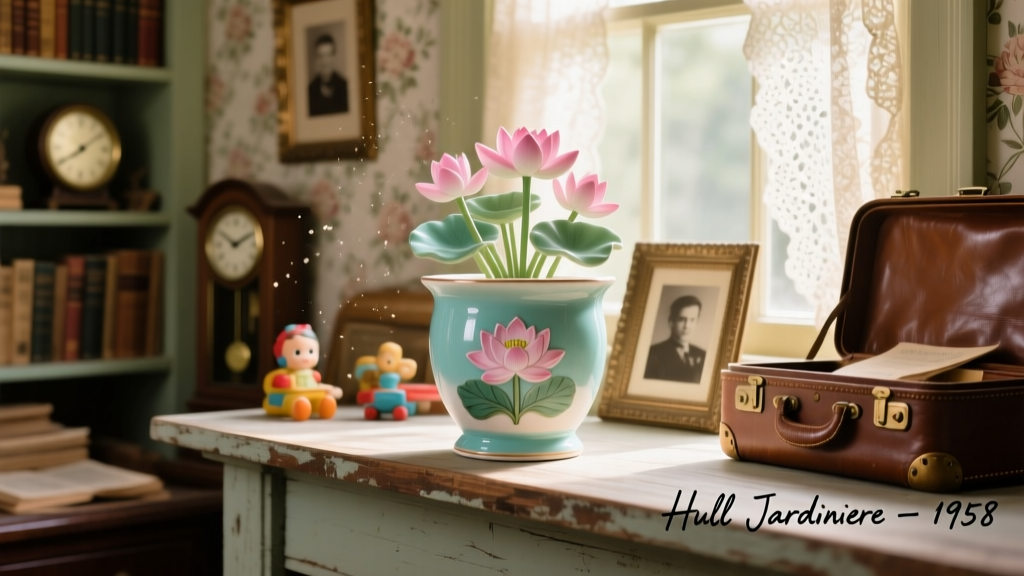
Hull Jardiniere Water Lily in Pink-Turquoise Glaze: A Mid-Century Ceramic Treasure at 5½ Inches
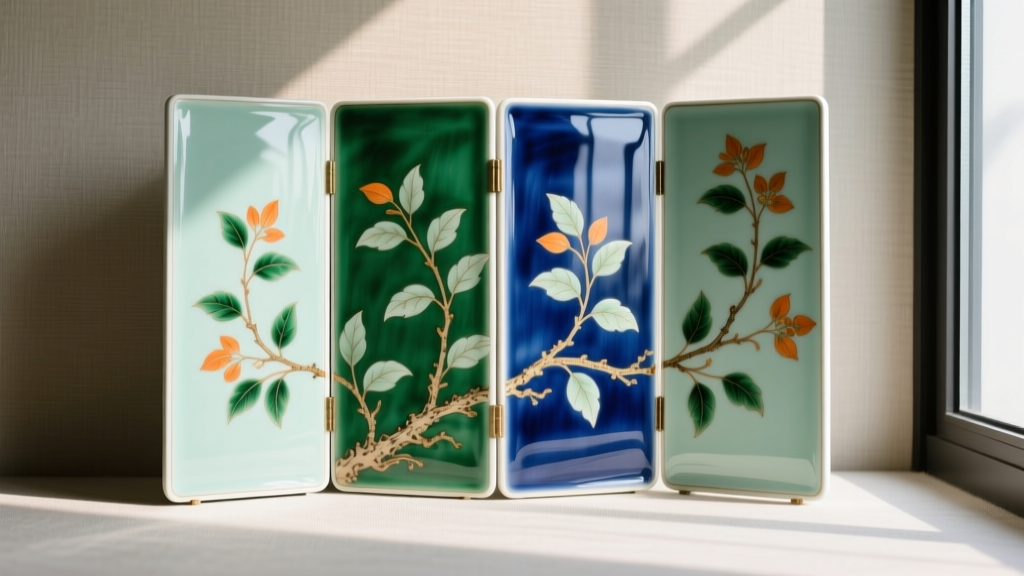
Porcelain Plaque: Leafy Branches, Four-Panel Chinese Composition (23 × 8 Inches) — Authentic Mid-Century Export Ware Appraisal

Wooden Milk Bottle Carnival Apple Green Paint — 7 3/8-Inch Pair: Identification, Provenance, and Market Value

Mettlach Cup and Saucer in Gold, Cream, and Blue: A Mid-Century Collectible Deep Dive