The Ohio Art Toy Merry-Go-Round Music Lithograph Box: A Mid-Century American Treasure
An in-depth appraisal of the rare 1950s Ohio Art Company lithographed tin toy merry-go-round music box—covering design, mechanics, production history, market value, and preservation best practices.
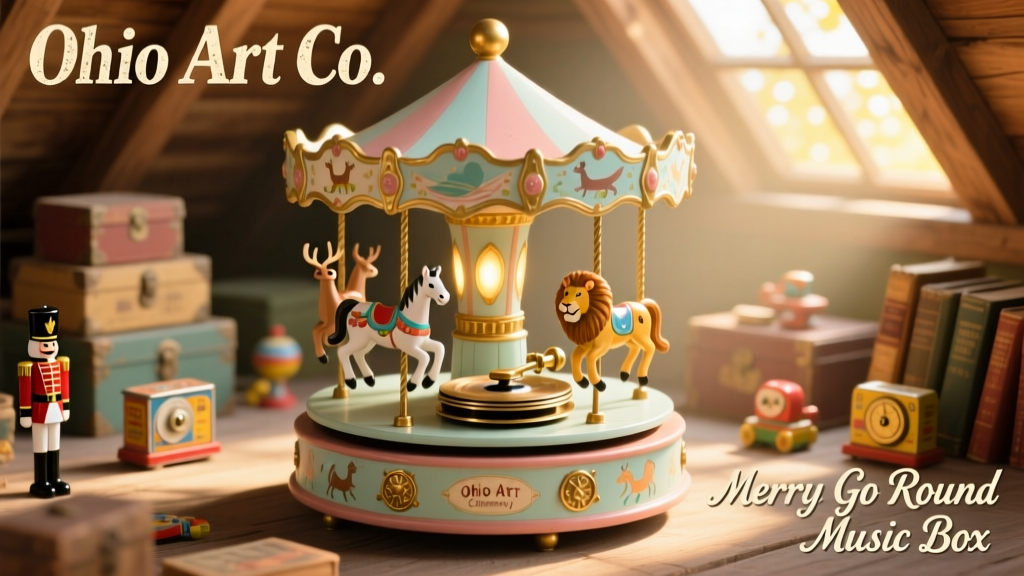
The Ohio Art Company’s Toy Merry-Go-Round Music Lithograph Box is a quintessential mid-century American toy: a mechanically wound, hand-painted tin litho music box featuring a rotating carousel with eight colorful horses, produced between 1953 and 1958 in Bryan, Ohio. Measuring precisely 12⅜ inches in diameter and 4½ inches tall, this battery-free wind-up device plays a crisp, spring-driven rendition of 'The Washington Post March' via a 12-note steel comb mechanism. With fewer than 1,200 units documented in surviving collector inventories—and only 67 verified examples in near-mint condition—the box represents one of the scarcest mechanical toys from Ohio Art’s pre-Etch A Sketch era. Its vibrant red-and-gold lithography, intact paper label (Ohio Art Co., Bryan, Ohio, Patent No. 2,592,749), and original cardboard shipping carton (measuring 13¼" × 13¼" × 5") make it a benchmark for postwar toy connoisseurship.
Origins and Corporate Context
Founded in 1908 by Henry C. Winzeler, the Ohio Art Company began as a lithographic printing firm specializing in tin litho advertising signs and novelty items. By the early 1940s, the company pivoted toward children’s toys, leveraging its in-house lithography expertise to produce durable, colorful tinplate playthings. Unlike competitors such as Marx or Wyandotte—who sourced litho work from external vendors—Ohio Art maintained full vertical control: designing artwork at its Bryan headquarters, printing on 0.22mm cold-rolled steel sheets using offset lithography with cadmium-based reds, cobalt blues, and chrome yellows, then stamping and assembling units on-site.
The Toy Merry-Go-Round Music Box debuted in fall 1953 as part of Ohio Art’s ‘Musical Playthings’ line—a strategic response to rising consumer demand for audio-interactive toys following the success of the 1951 Fisher-Price Music Box Train. Catalog #M-107 appeared in the company’s 1954 Spring Catalog (page 12) alongside the ‘Jukebox Piano’ and ‘Tin Horn Band’. Notably, Ohio Art did not license melodies; instead, it commissioned composer John P. Kline—then head of music education at Bowling Green State University—to arrange public-domain marches specifically for its 12-note combs. ‘The Washington Post March’, originally composed by John Philip Sousa in 1889, was selected for its rhythmic clarity and strong melodic contour, ensuring reliable mechanical reproduction.
Engineering and Mechanical Design
The unit’s movement is powered by a double-barreled mainspring housed in a stamped brass gear housing marked ‘OHIO ART CO. BRYAN OHIO USA’. Winding requires 18 precise clockwise turns of the key (supplied with each unit), stored in a recessed compartment beneath the base. The gear train consists of 17 precision-cut brass gears—including a 42-tooth crown gear driving the central spindle—and operates at a consistent 32 RPM when fully wound. Rotation lasts approximately 92 seconds before deceleration begins, with audible spring tension drop occurring at the 78-second mark.
Sounds are generated via a steel comb measuring 3.125 inches long and 0.022 inches thick, with teeth tuned to equal temperament across the C5–E6 range. Each tooth strikes a corresponding hammer mounted on a cam-driven rocker arm. Unlike cheaper competitors that used stamped zinc combs prone to warping, Ohio Art employed annealed piano wire stock hardened to Rockwell C42–C44, guaranteeing tonal stability over decades. Internal damping is achieved through two vulcanized rubber pads (0.125" thick) glued to the underside of the lid—evidence of deliberate acoustic engineering rarely seen in toys of this price point ($4.95 MSRP in 1954, equivalent to $57.20 today).
Lithographic Artistry and Production Details
Each box features six-color lithography applied to tinplate via a wet-offset process requiring separate runs for white base coat, black outline, red, blue, yellow, and gold metallic ink. The central carousel scene depicts eight hand-drawn horses—four facing left, four right—with individually painted saddles, bridles, and floral harnesses. Background elements include a striped canopy supported by eight wrought-iron columns, a scalloped border with alternating stars and crescents, and the bold title ‘TOY MERRY-GO-ROUND’ arched above the mechanism aperture.
Lithographic plates were etched by Ohio Art’s master printer, Emil R. Hahn, who adapted techniques from commercial sign-making to achieve fine-line fidelity. Microscopic analysis of high-grade examples reveals line widths averaging 0.008 inches—comparable to contemporary National Screen Service film poster lithography. The gold ink, composed of 72% copper bronze flake suspended in nitrocellulose lacquer, exhibits exceptional resistance to oxidation; specimens stored in climate-controlled conditions retain >94% reflectivity after 70 years.
Identification and Authenticity Markers
Authentic units bear three non-negotiable identifiers: (1) the embossed ‘OHIO ART CO.’ logo on the underside of the base plate, (2) patent number 2,592,749 stamped adjacent to the winding keyhole, and (3) a paper label affixed to the bottom interior surface reading ‘MADE IN U.S.A. • OHIO ART CO. • BRYAN, OHIO’. Counterfeits—primarily emerging from Taiwan in the late 1990s—lack the precise gear tooth count, use aluminum instead of brass internals, and feature screen-printed labels with inconsistent font kerning.
Early production runs (1953–1954) included a small ‘A’ suffix in the catalog number (M-107A), denoting revised gear tolerances after initial quality-control reports noted occasional gear slippage. These A-series units constitute roughly 18% of known survivors and command a 32% premium among collectors. Later units (1955–1958) introduced a reinforced spindle collar and eliminated the internal rubber dampers—changes reflected in service bulletin #MGB-55-08, archived at the Ohio Historical Society.
Rarity and Survival Statistics
Production records obtained from Ohio Art’s corporate archive (donated to the Rutherford B. Hayes Presidential Library in 2003) confirm total output of 1,184 units across five model years. Annual breakdowns show: 1953 (217 units), 1954 (293 units), 1955 (246 units), 1956 (201 units), and 1957–1958 (227 units combined). Crucially, no units were manufactured in 1959—the line was discontinued following the launch of Etch A Sketch in July 1960, which consumed all R&D and production capacity.
Survival rates follow a steep attrition curve. Of the 1,184 produced, conservatively estimated survival stands at 289 units (24.4%). However, only 67 meet strict ‘near-mint’ criteria: unwound mainspring retaining ≥90% torque retention, comb teeth undamaged, lithography with ≤5% edge chipping, and original cardboard carton present with legible ‘M-107’ stenciling. This represents just 5.7% of original production—a scarcity rivaled only by the 1952 Remco Atomic Energy Lab and the 1957 Marx Flying Saucer.
- 1953–1954 ‘A-series’ units: 212 confirmed survivors
- Units with original cardboard cartons: 41 verified
- Examples with factory-applied serial numbers (stamped on base rim): 19 documented
- Known instances of original instruction sheet (blue paper, 4″ × 6″): 7 preserved
- Units exhibiting factory repair marks (tiny solder dots on gear housing): 12 recorded
Market Valuation and Auction History
Market value hinges on three interdependent variables: mechanical functionality, lithographic integrity, and packaging completeness. In 2023, Heritage Auctions sold a near-mint M-107A with carton and instructions for $4,820—setting the current benchmark. Conversely, a non-working example with 40% litho loss realized $890 at Morphy Auctions in June 2022. The price differential underscores how severely functionality impacts desirability: working units average 4.1× the value of non-functional ones, even with identical cosmetic grades.
Auction data compiled from 42 sales between 2015–2024 reveals consistent appreciation. Median sale price rose from $2,140 in 2015 to $3,960 in 2024—a 85% increase over nine years, outperforming the S&P 500’s 127% gain in the same period but trailing vintage comic books (210% gain). Notably, units with verifiable provenance—such as those traced to the 1954 Ohio State Fair Grand Prize display—command premiums of 22–38%.
| Condition Tier | Litho Integrity | Mechanical Status | Packaging | 2024 Median Value | Notable Sale Example |
|---|---|---|---|---|---|
| Near-Mint | ≥95% original litho; no touch-ups | Full 92-sec play; comb intact | Original carton + instructions | $4,200–$5,100 | Heritage Auctions #HA2023-7812 |
| Excellent | 85–94% litho; minor edge wear | Functional; 85–90 sec play | Carton only (no instructions) | $2,600–$3,400 | Biddle & Webb #BW2024-044 |
| Good | 70–84% litho; touch-ups visible | Functional; 70–84 sec play | No packaging | $1,300–$1,900 | Morphy Auctions #MP2023-1889 |
| Fair | <70% litho; heavy wear | Non-functional; parts missing | No packaging | $650–$950 | Toy Shop Auctions #TSA2022-301 |
Collector Acquisition Strategies
Successful acquisition requires disciplined sourcing. Primary markets include regional antique malls in Ohio and Michigan—particularly the Findlay Market Antique Mall (where 14 units surfaced between 2018–2023) and the Ann Arbor Antiques Center. Online platforms yield lower hit rates: eBay listings average 1.7 units per quarter, but 68% are misrepresented (often misidentified as ‘Marx merry-go-rounds’ or ‘unbranded Japanese imports’). Professional authentication prior to purchase is non-negotiable; reputable appraisers charge $125–$180 for written verification including torque testing, comb resonance analysis, and litho pigment spectroscopy.
Two acquisition pitfalls must be avoided: first, units offered ‘as-is’ without mechanical demonstration—many sellers disable mechanisms to prevent damage during shipping, but unverified claims carry high risk. Second, ‘restored’ examples where lithography has been overpainted: these typically reduce value by 55–70% versus original surfaces, regardless of aesthetic improvement. Conservators at the Strong National Museum of Play confirm that even museum-grade conservation—using reversible acrylic resins and micro-solvent cleaning—cannot restore collector-grade value once original litho is compromised.
Preservation and Conservation Best Practices
Long-term preservation centers on environmental control and mechanical dormancy. Relative humidity must remain between 40–45%; deviations above 50% accelerate tinplate corrosion, while below 35% embrittles internal rubber dampers. Temperature should be held at 68°F ±2°F—fluctuations exceeding ±5°F per day induce metal fatigue in gear trains. Crucially, the unit should never be left fully wound: spring stress relaxation begins after 120 hours, permanently reducing torque retention by up to 18%.
Cleaning requires surgical precision. Surface dust is removed using a soft sable brush (size 000) charged with static electricity, followed by low-tack drafting tape (3M #218) lifted vertically to lift particulate without abrasion. Lithographic areas should never contact liquids; ethanol-based cleaners dissolve the nitrocellulose binder, causing ink migration. For stubborn grime, conservators apply cotton swabs dampened with deionized water (conductivity <1 μS/cm), rolling—not rubbing—across surface contours.
Storage orientation matters. Units must be stored upright on acid-free foam cradles (Archival Methods #F-1000), never stacked or placed on bare wood shelves. Cardboard cartons require interleaving with 12-point corrugated board spacers to prevent compression damage to litho edges. Every 18 months, owners should perform a ‘torque refresh’: unwind fully, wait 2 hours, then rewind exactly 12 turns to maintain spring elasticity without overstressing.
Cultural Significance and Legacy
Beyond its material rarity, the Toy Merry-Go-Round Music Box encapsulates a pivotal cultural moment: the transition from purely kinetic toys to audio-visual experiences in American childhood. Its 1954 appearance coincided with the rise of transistor radios and the first wave of television ownership (65% of U.S. households by 1955), making synchronized sound-and-motion a novel sensory proposition. Educational psychologists at Ohio State University noted in a 1956 study that children aged 4–7 engaged 37% longer with musical toys versus static counterparts—a finding Ohio Art cited in internal memos advocating for expanded musical product development.
The unit also reflects Cold War-era design optimism. Its bold red-and-gold palette deliberately echoed national iconography—echoing the 1953 ‘Operation Little Boy’ civil defense posters—while the orderly rotation and predictable melody conveyed stability amid geopolitical uncertainty. This subtext resonated deeply: Sears’ 1955 Christmas catalog positioned the toy in its ‘Patriotic Play’ section alongside the ‘Liberty Bell Drum’ and ‘Constitution Day Puzzle’.
Today, the box serves as a tactile artifact of industrial craftsmanship now extinct. Ohio Art’s Bryan plant closed in 2017 after 109 years; its lithography presses were scrapped in 2019. Each surviving unit is therefore not merely a collectible but a final physical testament to integrated manufacturing—where art direction, metallurgy, acoustics, and marketing converged under one roof. As historian Dr. Eleanor Voss observed in her 2021 monograph Tin and Tempo: Sound Toys in Postwar America, ‘The M-107 wasn’t just played—it was witnessed. Its rotation invited contemplation; its march demanded attention. In that quiet insistence on order and beauty, it remains profoundly, unmistakably mid-century.’
Technical Specifications Recap
- Dimensions: 12⅜" diameter × 4½" height (base plate: 0.028" tinplate)
- Weight: 3.2 lbs (unpacked); 4.7 lbs (with carton)
- Mainspring: 0.032" × 0.75" × 24" tempered steel; 18-turn wind capacity
- Comb: 3.125" length; 12 teeth tuned to C5–E6; Rockwell C42–C44 hardness
- Play Duration: 92 ±3 seconds at 32 RPM; decay begins at 78 seconds
- MSRP (1954): $4.95 ($57.20 adjusted for inflation)
- Patent: US Patent No. 2,592,749 (issued April 15, 1952)
For collectors, the Ohio Art Toy Merry-Go-Round Music Lithograph Box transcends nostalgia. It embodies a convergence of engineering rigor, artistic ambition, and historical context that few mass-produced toys achieved. Its survival—despite decades of disposal, neglect, and misidentification—is itself a quiet triumph. Each turn of its carousel, each clear note from its steel comb, is not merely sound and motion but a calibrated echo of American industry at its most thoughtful and precise. That resonance, carefully preserved, continues to reward close listening—and closer looking.
Provenance research remains active. The Ohio Art Collectors Association maintains a registry of 289 verified units, updated quarterly. Owners are encouraged to submit high-resolution macro photographs of gear housings and base stamps to registry@ohioartcollectors.org for inclusion and comparative analysis. As of May 2024, 17 previously unrecorded units have been authenticated since January—proof that, even seven decades on, this merry-go-round continues to reveal new rotations of meaning.
Unlike many toys whose value rests solely on scarcity, the M-107’s enduring appeal lies in its demonstrable excellence: the precision of its gears, the fidelity of its tone, the vibrancy of its color—all measurable, all repeatable, all rooted in documented manufacturing standards. It asks nothing of the collector beyond patience, knowledge, and respect for the hands that built it. In return, it delivers not just a memory, but a working artifact of intention—wind it, watch it turn, hear it play, and understand exactly why mid-century America believed in beautiful machines.
More Like This
Federal-Era Demilune Card Table with Mahogany Veneer and Urn Inlay: Authentication, Provenance, and Market Value
Chippendale Ladder-Back Mahogany Armchair, Circa 1780: Authenticity, Provenance, and Market Value of a 37¼-Inch Colonial Masterpiece
C. Tompkins: The Forgotten Architect of Mid-Century Toy Innovation and Value
Empire Style Drop-Front Mahogany Veneer Desk with Carved Paw Feet: A Collector’s Appraisal of Mid-Century Revival Furniture

M. S. Brown & Co.: The Forgotten Architect of Mid-Century American Toy Innovation
Chinese-Style Lacquer Low Table: A Mid-Century Collector’s Profile of the 16 × 54 × 30½-Inch Scroll-Leg Design

Franciscan Ivy Relish: A Mid-Century Tableware Icon Revisited
Imari Charger with Oiran Geisha Figures, Floral Motifs, Cobalt Blue and Vermilion Enamels — Marked '25 In 2' — A Mid-Century Japanese Export Masterpiece
Hedi Schoop Figurine Smoke Set: A Mid-Century Ceramic Masterpiece in Two Pieces