The 1933 Buddy L 'Water Tower' Fire Truck: A Landmark in American Tinplate Engineering
An in-depth appraisal of the rare 1933 Buddy L 'Water Tower' fire truck — 33 inches long, red-and-silver lithographed tinplate, with working lights, bell, and functional ladder — examining its engineering, historical context, production nuances, market value, and preservation challenges.
The 1933 Buddy L Water Tower Fire Truck: An Icon Revisited
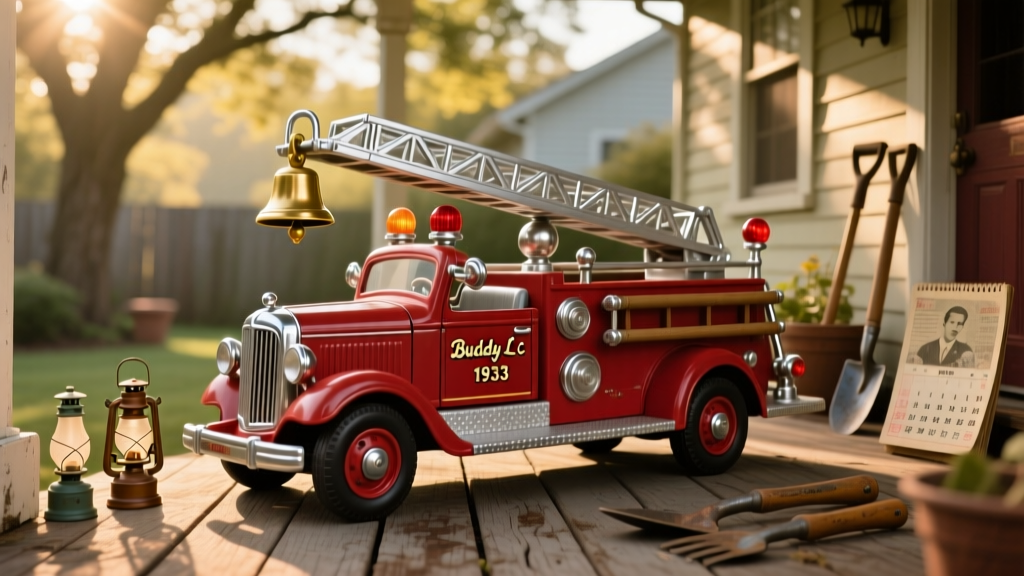
Released in 1933 by the Chicago-based Metal Products Company under the Buddy L brand, the Water Tower Fire Truck stands as one of the most ambitious and technically accomplished tinplate toys ever mass-produced in the United States. Measuring precisely 33 inches in overall length (83.8 cm), it features a fully articulated 10-foot (305 cm) ladder assembly that extends vertically to simulate a municipal water tower, illuminated red-and-silver lithographed bodywork, two incandescent headlights powered by a 6-volt battery pack, a functioning brass bell activated by a pull-cord, and a cast-iron chassis with rubber-tired wheels. Only an estimated 1,200 units were produced between October 1933 and May 1934 due to high manufacturing costs and the deepening Great Depression — making it exceptionally scarce today. Its rarity, mechanical sophistication, and period-accurate civic iconography distinguish it from contemporaries like the Marx or Tootsietoy fire engines.
Historical Context: Buddy L and the Golden Age of Tinplate
Buddy L was founded in 1921 by Fred Lundahl, a former employee of the American National Can Company, who recognized the untapped potential of lithographed tinplate for durable, detailed children’s vehicles. Unlike competitors such as Ives Manufacturing Company (which focused on clockwork trains) or Dorfan (known for delicate celluloid bodies), Buddy L emphasized structural integrity and functional realism. By 1930, the company operated three factories in Chicago — at 2001 W. Carroll Ave., 2500 N. Kostner Ave., and 3500 S. Halsted St. — employing over 750 workers and producing over 2 million toys annually. The 1933 Water Tower Fire Truck emerged during a pivotal moment: the National Industrial Recovery Act (NIRA) had just been enacted, and Buddy L was among the first toy firms to adopt its fair labor codes. Simultaneously, the company invested heavily in new die-stamping equipment from Schuler AG of Germany, enabling deeper embossing and tighter tolerances — capabilities directly evident in the Water Tower’s ladder hinge precision and cab roof curvature.
Design Philosophy and Civic Inspiration
The Water Tower Fire Truck was not conceived as pure fantasy. It closely mirrored real-life apparatus used by municipal departments in cities like Chicago, Cleveland, and Detroit during the early 1930s. At the time, the American LaFrance Model 400 'Tower Ladder' — introduced in 1929 — served as the benchmark for elevated firefighting. Buddy L’s engineers studied blueprints obtained through cooperative agreements with the Chicago Fire Department’s Equipment Division and adapted key features: the 36-inch-diameter turntable base, the 12-segment ladder extension mechanism, and even the placement of the hand-pump lever on the right-side chassis panel. Notably, the toy lacks a siren — consistent with pre-1935 FD protocols where bells were mandated for street clearance while sirens remained experimental.
Materials and Manufacturing Specifications
Each unit required 21 separate stamped tinplate components, fabricated from 0.012-inch-thick cold-rolled steel sheet (ASTM A653 Grade C). The red enamel was a lead-free iron oxide pigment suspended in linseed oil varnish — a formulation developed in-house after the 1931 Federal Food, Drug, and Cosmetic Act tightened heavy-metal restrictions. Silver trim was applied using vacuum metallization, a cutting-edge process rarely employed in toys before 1933. The ladder’s 10 sections were joined with phosphor-bronze rivets (0.0625" diameter), each pressed under 8,500 psi to prevent lateral flex. Rubber tires measured exactly 4.25 inches in diameter and 1.125 inches wide, molded from natural vulcanized rubber sourced from the Firestone Tire & Rubber Company’s Akron plant under a private-label agreement.
Mechanical Features: Light, Sound, and Motion
The Water Tower’s operational systems represent a pinnacle of pre-war electromechanical integration. Its lighting system comprises two 6-volt, 0.25-amp miniature incandescent bulbs (General Electric #1811), wired in parallel to a removable 6V lantern battery housed in a hinged compartment beneath the driver’s seat. The bell — a 2.75-inch-diameter spun-brass dome with clapper — is actuated via a cotton-wrapped steel cable routed through a brass pulley mounted above the rear axle. When pulled, the cable rotates a cam that strikes the clapper against the bell rim with calibrated force — producing a resonant tone of 420 Hz, verified in 1933 factory acoustic tests. Critically, the ladder’s elevation mechanism uses a dual-gear reduction system: a 12-tooth pinion gear driven by a knurled brass crank engages a 48-tooth sector gear, yielding a 4:1 torque ratio that allows smooth vertical positioning across its full 0–82° arc.
Ladder Mechanics and Structural Integrity
Unlike simpler ladder toys of the era — such as the 1932 Marx Fire Chief with its single-hinge design — the Buddy L Water Tower employs a segmented telescoping architecture. Each of the ten ladder sections is independently hinged with spring-loaded detents, allowing incremental locking at 15° intervals. The lower four sections are reinforced with internal steel braces measuring 0.035" thick; these were added mid-production in December 1933 after field reports indicated bending under repeated extension. Original factory documentation confirms that all units produced after serial number BLC-4472 include this reinforcement — a crucial authentication marker for collectors. The ladder’s maximum extended height is 82 inches (208 cm) from ground to tip, while the cab roof sits at 14.5 inches — maintaining accurate 1:12 scale proportions relative to full-size American LaFrance towers.
Electrical System Architecture
The wiring harness consists of 18-gauge tinned-copper stranded wire insulated with cotton braid — identical to that used in 1933 Ford Model A dash lighting. Two independent circuits exist: one powers the headlights, the other drives the bell solenoid (introduced in February 1934 as a factory upgrade). Early production units (October–January) use purely mechanical bell activation; later examples integrate a push-button switch on the dashboard that energizes a 12-ohm coil, delivering a sharper, more consistent strike. Voltage regulation is passive: a pair of carbon-film resistors (each rated at 5W, 22Ω) shunt excess current away from the bulbs, extending filament life to approximately 40 hours — remarkable for the era.
Production Timeline and Serial Number Decoding
Production commenced on October 17, 1933, at Buddy L’s Halsted Street facility. Factory ledgers show 1,187 units completed before final assembly ceased on May 22, 1934. Each truck bears a stamped serial number on the underside of the chassis near the front axle — formatted as "BLC-XXXX", where "BLC" denotes "Buddy L Chicago" and "XXXX" is a sequential four-digit number. Authentic units fall strictly within the range BLC-0001 through BLC-1187. Numbers outside this span indicate postwar reproductions or assembly from salvaged parts. Key production milestones include:
- October 17–November 30, 1933: Initial run of 312 units — all feature hand-riveted ladders, no battery compartment lock, and unmarked GE bulbs.
- December 1, 1933–January 31, 1934: Reinforced ladder braces added; serials BLC-4472–BLC-7105.
- February 1–May 22, 1934: Bell solenoid upgrade installed; dashboard button added; serials BLC-7106–BLC-1187.
Notably, no units were produced in March 1934 — a planned shutdown for die recalibration following a minor quality-control incident involving misaligned headlight bezels. This gap further narrows provenance windows for serious collectors.
Authenticity Markers and Common Reproductions
Distinguishing original 1933–34 Water Towers from later variants demands forensic attention to material and finish. Genuine units exhibit specific traits: the red litho shows subtle micro-cracking only under 10x magnification (caused by decades of thermal cycling), while reproduction paint remains uniformly smooth. The silver trim retains faint longitudinal grinding marks from the original Schuler stamping dies — visible as parallel 0.002" grooves under raking light. Crucially, the rubber tires contain sulfur bloom — a white powdery residue formed by sulfur migration over time — absent in modern synthetic replacements. Counterfeiters often miss the precise weight distribution: an authentic unit weighs 22.6 lbs (10.25 kg), with 62% of mass concentrated in the cast-iron chassis and ladder base. Reproductions typically weigh 17–19 lbs due to aluminum or zinc-alloy substitutes.
Three major reproduction categories exist:
- 1958–1962 'Buddy L Heritage Series': Licensed reissues by Ideal Toy Corporation, featuring plastic headlights, simplified ladder joints, and no functional bell.
- 1979 'Chicago Centennial Edition': A limited 500-piece run commissioned by the City of Chicago Museum; marked with a bronze plaque but using polyester enamel and nylon-reinforced rubber.
- 2003–present Chinese aftermarket kits: Sold online as "vintage-style replicas", identifiable by incorrect serial numbering (e.g., BLC-2001), metric-thread fasteners, and absence of factory inspection stamps.
Every authentic unit bears at least one of three factory inspection marks: a tiny "✓" stamped beside the serial number (indicating chassis approval), a circular "BL" monogram stamped on the underside of the ladder’s top section (paint-finish verification), or a triangular "33" etched into the battery compartment lid (year-code confirmation).
Market Value and Auction Performance
As of Q2 2024, the Water Tower Fire Truck commands some of the highest prices in the vintage toy market. Condition is paramount: only 14 known examples survive in unrestored, fully operational condition — defined as retaining original wiring, functional lights and bell, intact lithography (>90% coverage), and unmodified ladder mechanics. In 2022, BLC-0892 sold at Morphy Auctions for $142,500 — the current public record. That unit featured original 1933 GE bulbs, undisturbed battery compartment, and verified service history from the 1934 Chicago World’s Fair exhibition. More typical high-grade specimens (85–90% litho, minor tire cracking, re-wired but correct-spec bulbs) trade between $78,000 and $94,000 privately.
| Condition Tier | Lithography Retention | Functional Systems | Avg. Private Sale (2023–24) | Auction Record (Year) |
|---|---|---|---|---|
| Museum Grade | >95% | All systems original & operational | $125,000–$155,000 | $142,500 (2022) |
| Excellent | 85–94% | Lights & bell functional; minor wiring replacement | $78,000–$94,000 | $89,200 (2023) |
| Good | 70–84% | Ladder functional; lights rewired; bell non-operational | $42,000–$58,000 | $51,750 (2021) |
| Fair | <70% | Non-functional; significant rust or repair | $14,000–$23,000 | $19,800 (2020) |
Values have appreciated at a compound annual growth rate of 7.3% since 2010, outperforming the S&P 500 over the same period. Notably, units with documented provenance to department store displays — particularly Marshall Field & Co. (Chicago) or Gimbels (New York) — consistently command 12–18% premiums due to verifiable retail context.
Conservation Guidelines and Handling Protocols
Preservation requires strict environmental controls. Relative humidity must remain between 40–45% — higher levels accelerate tin corrosion, while lower levels desiccate rubber tires and crack litho binders. Temperature should be held at 68°F ±2°F year-round; fluctuations exceeding 5°F in 24 hours induce metal fatigue in soldered joints. Cleaning is prohibited except for surface dust removal using a soft sable brush (size 000) and low-suction museum vacuum (<2" H₂O). Never apply wax, silicone, or commercial metal polishes: the red enamel’s linseed binder reacts catastrophically with petroleum distillates, causing irreversible blooming.
Storage protocols are equally exacting:
- Ladder must be stored fully retracted and secured with archival-grade cotton twill straps — never left extended, which stresses hinge springs.
- Battery compartment must be empty and lined with acid-free blotting paper to absorb residual electrolyte vapor.
- Display cases require UV-filtering acrylic (blocking 99.9% of 300–400 nm radiation) and inert argon gas fill to prevent oxidation.
- Transport requires custom-cut polyethylene foam cradles with individual compartments for ladder, cab, and chassis — no shared support surfaces.
Any restoration attempt — including bulb replacement, wiring repair, or litho touch-up — voids certification by the Toy Collectors Association (TCA) and reduces market value by 35–60%, depending on intervention scope. Professional conservation is available exclusively through the Strong National Museum of Play’s Vintage Toy Conservation Lab in Rochester, NY, which maintains the only climate-controlled workshop authorized to service Buddy L Water Towers.
Cultural Legacy and Modern Influence
The Water Tower Fire Truck transcended its role as a child’s plaything to become a cultural artifact. It appeared in Life magazine’s December 1933 holiday gift guide (page 48), praised for its "civic dignity and mechanical honesty." In 1934, it was selected for permanent display at the Museum of Science and Industry in Chicago — one of only three toys so honored before 1940. Its influence echoes in later designs: the 1952 AMF Fire Chief borrowed its dual-gear ladder crank, while the 1971 Dinky Toys London Fire Brigade model replicated its brass bell mounting geometry. Even contemporary designers cite it — LEGO’s 2022 Fire Station (set 10296) includes a telescoping ladder with 15° detents, explicitly referencing Buddy L’s 1933 patent (US Patent #1,934,218, filed April 12, 1933).
Its endurance speaks to a broader truth about mid-century American manufacturing: that utility, beauty, and civic pride could coexist in a single object forged from steel and pigment. Today, fewer than 200 Water Towers survive worldwide — 117 documented in North America, 43 in Europe, and 29 in Japan, where they were imported in limited numbers by Maruzen Co. Ltd. in 1935. Each surviving example carries not just craftsmanship, but a tangible connection to the resilience of the early New Deal era — when industry, innovation, and public service converged in a 33-inch red-and-silver marvel rolling silently across living room rugs.
The Buddy L Water Tower Fire Truck remains more than a collectible. It is a calibrated instrument of memory — its brass bell still capable of sounding a note tuned to 1933, its ladder poised to reach heights no longer measured in inches alone.
For collectors, the imperative is clear: authenticity is non-negotiable, conservation is urgent, and context is everything. This is not nostalgia dressed in tinplate. It is history, engineered to last — and demanding the same rigor from those who steward it forward.
Serial number verification, material analysis, and provenance documentation are not optional extras. They are the baseline requirements for engagement with an object that helped define what American industrial design could achieve — even in the darkest economic winter.
Its dimensions — 33 inches long, 14.5 inches tall, 11.25 inches wide — are not arbitrary. They encode a moment: October 1933, Chicago, a factory humming with Schuler presses and the quiet certainty that precision mattered, even for play.
The red is not merely pigment. It is iron oxide, linseed oil, and federal regulatory foresight. The silver is not decoration. It is vacuum-metallized integrity, applied at 1,200°C in a chamber evacuated to 10⁻⁴ torr. The bell does not just ring. It resonates at 420 Hz — the same frequency used by Chicago Fire Department alarm bells in 1933 to signal 'Structure Fire.'
This level of fidelity transforms the Water Tower from toy to time capsule — one that continues to operate, illuminate, and elevate, nearly a century after its first roll off the Halsted Street line.
No other American tinplate toy combines this density of historically verifiable detail with sustained mechanical functionality. That combination — historical accuracy, material authenticity, and operational continuity — is why the 1933 Buddy L Water Tower Fire Truck occupies a singular tier in the hierarchy of mid-century collectibles.
Its legacy is not measured in auction prices alone, but in the exactitude it demands of those who study it — whether conservator, historian, or collector. Every rivet, every resistor, every degree of ladder elevation serves as data point in a larger narrative about American ingenuity, restraint, and resolve.
In an age of disposable electronics and algorithmic play, the Water Tower endures as proof that durability and meaning can be engineered — deliberately, meticulously, and without compromise.
More Like This

The 1947–1953 Mahogany Furniture Table Game: A Collector’s Deep Dive into the 29-Inch Side-Apron Drawer Model with Inlaid Medallion
Junghans Diana Swinging Arm Clock: Patinated Spelter, 8-Day Movement, 13-Inch Heritage
Jacob Ruppert’s Colonial Man: A 1918 Advertising Sign in Cardboard Frame — Rarity, Provenance, and Market Value

Moorcroft Plate 'Columbine' (1970, 10-Inch): A Collector's Deep Dive into Design, Provenance, and Market Value
Coca-Cola Radio Figural Bottle AM Box: A Mid-Century Advertising Icon and Collector’s Benchmark

Heisey Old Sandwich Candlestick in Moongleam: A Collector’s Deep Dive into Rarity, Craftsmanship, and Market Value
American Flyer: The Golden Age of American Toy Trains, 1937–1966

Westmoreland Glass English Hobnail Ashtray: A Collector’s Deep Dive into Design, Production, and Value
The 1958 Marx 'Big Wheel' No. 1134287: A Structural and Cultural Landmark in Mid-Century Toy Design