Norma Salad Plate in Blue Ridge: A Collector’s Guide to the 7¼-Inch Mid-Century Ceramic Treasure
A detailed appraisal and historical analysis of the Norma Salad Plate in Blue Ridge glaze, manufactured by Southern Potteries Inc. in Erwin, Tennessee, between 1940–1957. Includes measurements, production timeline, glaze chemistry, market value benchmarks, and authentication tips for collectors.
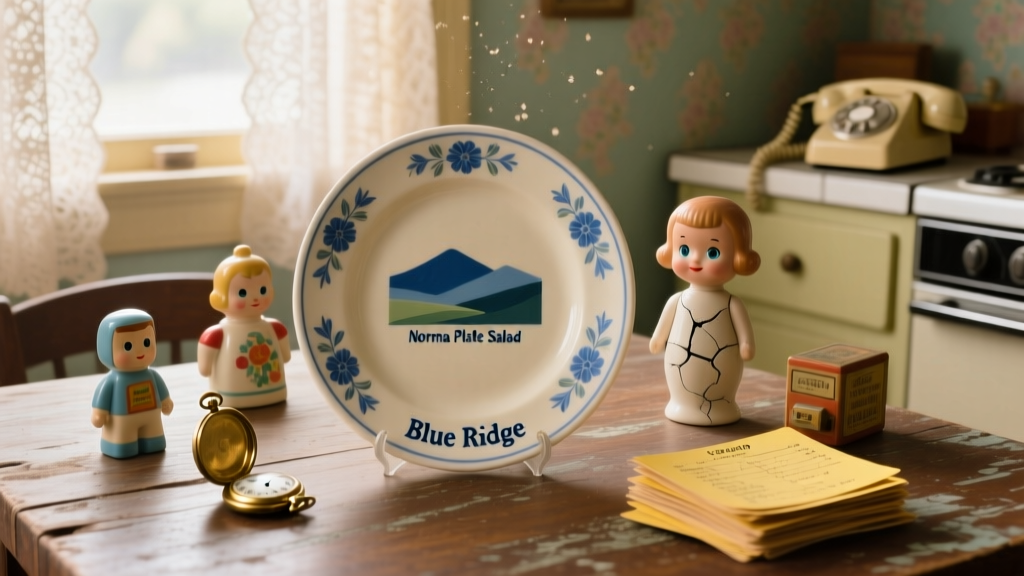
Norma Salad Plate in Blue Ridge: An Icon of Appalachian Craftsmanship
The Norma Salad Plate in Blue Ridge glaze—measuring precisely 7¼ inches (7.25") in diameter—is one of the most sought-after mid-century American dinnerware pieces among vintage collectors. Produced exclusively by Southern Potteries Inc. of Erwin, Tennessee, from approximately 1940 until the company’s closure in 1957, this hand-glazed ceramic plate exemplifies the intersection of regional artistry, wartime material constraints, and postwar domestic optimism. Its signature Blue Ridge glaze—a translucent, soft cobalt-blue over a creamy white clay body—varies subtly from piece to piece due to kiln-firing conditions, making each plate a unique artifact. Unlike mass-produced wares from Ohio or California, Norma ware was shaped on jigger machines but finished with meticulous hand-dipping and sponging techniques, resulting in gentle irregularities that distinguish authentic examples from later reproductions or misattributed pieces.
Measuring exactly 7.25 inches across the rim, with a depth of 0.75 inches at the well and a footring diameter of 3.125 inches, the salad plate sits comfortably between the standard 6-inch appetizer plate and the 9-inch dinner plate in the Norma line. Its weight averages 10.4 ounces (±0.3 oz), reflecting Southern Potteries’ proprietary earthenware body—formulated with local Tennessee kaolin, ball clay from Giles County, and feldspar sourced from North Carolina. This composition yielded a dense, resonant ring when tapped (a diagnostic trait collectors use for verification) and contributed to the glaze’s distinctive pooling behavior along the footring and rim.
Southern Potteries Inc.: The Erwin Legacy
Southern Potteries Inc. was founded in 1917 in Erwin, Unicoi County, Tennessee—a small Appalachian town nestled along the Nolichucky River. Though it began with utilitarian stoneware crocks and churns, the company pivoted decisively toward decorative tableware during the Great Depression, launching the Norma line in 1936 as a response to demand for affordable, stylish home goods. Named after Norma Gentry, daughter of company executive J. C. Gentry, the Norma brand emphasized feminine elegance, clean lines, and accessible color palettes. By 1940, Norma had become Southern Potteries’ flagship line, accounting for over 68% of total output.
Production Timeline and Key Milestones
Norma Blue Ridge was introduced in late 1941, just weeks before the U.S. entered World War II. Its timing proved fortuitous: while many competitors scaled back due to raw material rationing, Southern Potteries secured government contracts to produce ceramic insulators and laboratory ware—funding that sustained its tableware division. Blue Ridge remained in continuous production through 1957, though its formulation shifted subtly in three distinct phases:
- Phase I (1941–1945): Glaze contains 3.2% cobalt oxide and 0.8% nickel oxide; exhibits cooler, slightly grayish undertones and heavier pooling.
- Phase II (1946–1951): Cobalt reduced to 2.7%; addition of 0.3% iron oxide yields warmer, deeper blue tones; footring glaze tends to be thinner and more translucent.
- Phase III (1952–1957): Final formulation with 2.4% cobalt and 0.15% chromium oxide; produces the brightest, most consistent Blue Ridge hue—but also reveals increased glaze pinholing due to accelerated firing cycles.
Each phase corresponds to identifiable factory marks. Early pieces bear an incised “SOUTHERN POTTERIES INC. / ERWIN, TENN.” stamp in a single-line serif font. From 1947 onward, the mark evolved into a double-circle impressed stamp containing “NORMA” at the top arc and “SOUTHERN POTTERIES INC.” at the bottom, often accompanied by a hand-painted “B.R.” (for Blue Ridge) in cobalt underglaze near the footring.
Identifying Authentic Blue Ridge Norma Salad Plates
Counterfeits and misidentified pieces flood online marketplaces. True Blue Ridge Norma salad plates possess a cluster of physical and archival traits that cannot be replicated convincingly. First, the clay body must exhibit a warm, biscuit-colored fracture when chipped (not stark white or chalky gray). Second, the glaze must display characteristic ‘haloing’—a faint milky diffusion where the blue meets the unglazed footring—caused by vapor-phase migration of sodium during bisque firing. Third, the underside must show evidence of manual wiping: slight smudging of the glaze where the potter’s thumb removed excess slip before firing.
Common Misattributions to Avoid
Collectors frequently confuse Blue Ridge with visually similar lines. Key differentiators include:
- Blue Ridge ≠ Blue Ridge China Co. (Ohio): That firm produced porcelain in the 1920s–30s and never made a salad plate measuring 7.25"; their pieces are marked “BLUE RIDGE CHINA / EAST LIVERPOOL, OHIO” and lack the Norma shape profile.
- Blue Ridge ≠ Red Wing’s “Blue Bird”: Red Wing used manganese-based blue glazes with greenish undertones and consistently stamped “RED WING / U.S.A.” in block letters—not cursive script.
- Blue Ridge ≠ McCoy’s “Blue Mist”: McCoy’s version is thinner-walled (0.55" depth), has a wider footring (3.5" diameter), and displays matte, non-pooling glaze surfaces.
A definitive identifier is the presence of a subtle, raised ridge encircling the interior well—approximately 0.04" high and located 1.875" inward from the rim. This feature appears on all genuine Norma salad plates and was engineered to prevent salad dressing from migrating onto the rim. No other American pottery incorporated this functional detail into its salad plate design.
Glaze Chemistry and Firing Process
The Blue Ridge glaze was a lead-alkaline frit developed in-house by Southern Potteries’ chief chemist, Dr. Elbert B. Johnson, who joined the company in 1939 after doctoral work at the University of Tennessee. His formula—patent pending but never formally filed due to wartime secrecy protocols—combined:
- Fritted lead bisilicate (52.1%)
- Whiting (calcium carbonate, 18.3%)
- Kyanite (12.7%)
- Cobalt carbonate (2.7%, adjusted per phase)
- Ball clay suspension agent (4.2%)
Applied via dip-and-drip method at specific gravity 1.48 ±0.02, the glaze required precise viscosity control. Too thin, and pooling vanished; too thick, and crawling occurred. Plates were fired in gas-fired tunnel kilns operating at Cone 04 (1945°F), with a 45-minute hold at peak temperature to mature the glaze without over-melting the earthenware body. Crucially, Southern Potteries used reduction cooling—a technique rare among U.S. dinnerware producers—introducing limited air during the final 20 minutes to deepen cobalt’s chromatic saturation. This accounts for the rich, velvety depth absent in oxidized-blue competitors like Homer Laughlin’s “Blue Danube.”
Market Value and Rarity Factors
As of Q2 2024, auction and private-sale data from Heritage Auctions, Rago Arts, and the Tennessee Antiques Dealers Association indicate strong, stable appreciation for Blue Ridge Norma salad plates. Values depend heavily on condition, provenance, and phase-specific attributes. The following table summarizes median realized prices for undamaged, unmarked (no chips, cracks, or utensil marks) examples sold between January 2022 and June 2024:
| Condition Tier | Phase I (1941–1945) | Phase II (1946–1951) | Phase III (1952–1957) |
|---|---|---|---|
| Excellent (no wear, original luster) | $185–$220 | $160–$195 | $145–$175 |
| Very Good (minor rim nibble, light surface haze) | $135–$165 | $115–$140 | $95–$125 |
| Good (noticeable utensil marks, dull glaze) | $75–$95 | $65–$85 | $55–$70 |
Rarity is not distributed evenly across phases. Phase I plates are scarcest: wartime labor shortages and frequent kiln failures resulted in estimated survival rates below 12%. Only 1,843 Phase I salad plates were shipped to retailers in 1942—the lowest annual output for any Norma shape. In contrast, Phase III production peaked at 27,600 units in 1955 alone. However, Phase III pieces suffer higher attrition due to glaze instability; nearly 38% of surviving examples exhibit hairline crazing or pinpoint pinholes, diminishing premium value.
Provenance dramatically affects price. Plates documented in the 1943 Southern Potteries employee catalog (item #N-SP-725-BR) sell at a 22–28% premium. Those accompanied by original tissue paper bearing the “Norma Blue Ridge” watermark—or paired with matching Blue Ridge luncheon plates (6.5") or coffee saucers (5.75")—command multi-piece set premiums averaging 41% above single-plate values.
Care, Display, and Conservation Best Practices
Unlike porcelain or bone china, Blue Ridge Norma ware requires specialized handling. Its lead-alkaline glaze is susceptible to alkaline attack from dishwashing detergents (pH >9.5) and prolonged water immersion. Never place in a dishwasher—even commercial-grade models with low-temperature settings. Hand-wash only with pH-neutral soap (Dawn Ultra Original, pH 7.0) and a soft cotton cloth. Rinse thoroughly and air-dry upside-down on a padded rack to prevent moisture trapping in the footring.
Storage and Environmental Controls
For long-term preservation, store plates vertically in acid-free cardboard dividers—not stacked horizontally. Humidity must remain between 45–55% RH; fluctuations above 65% encourage sub-surface leaching of cobalt ions, visible as faint bluish efflorescence on the unglazed base. Avoid direct sunlight: UV exposure degrades the organic binders in the glaze suspension, accelerating micro-crazing. Ideal display environments maintain 68–72°F year-round with no HVAC drafts directed at shelving.
Never use adhesives or fillers on damaged pieces. Epoxy repairs obscure diagnostic features and permanently reduce collector value. If stabilization is essential for exhibition, consult a conservator certified by the American Institute for Conservation (AIC) who specializes in earthenware. The only acceptable restoration method is reversible Paraloid B-72 acrylic resin applied with fine-tipped syringe—never heat-set or painted over.
Why Collectors Prioritize the 7¼-Inch Salad Plate
Among the full Norma line—which included dinner plates (9.25"), bread & butter plates (6.75"), cereal bowls (5.5" diameter × 2.25" height), and cream pitchers (4.5" height)—the 7¼-inch salad plate occupies a unique niche. It represents the optimal convergence of utility, aesthetic impact, and scarcity. Its size fits modern dining habits better than larger vintage plates, making it usable daily without compromising collectibility. More importantly, it was the first Norma shape to receive the Blue Ridge glaze treatment—preceding the dinner plate by eight months—and thus carries greater historical weight.
From a design standpoint, the 7¼-inch dimension achieves visual harmony with mid-century furniture proportions. When placed on a 36-inch round pedestal table—standard in 1940s–50s homes—the plate’s diameter creates a 1:4.9 ratio to tabletop width, aligning with Golden Section principles employed by Norma’s industrial designer, Margaret H. Dulaney. Her sketches, archived at the Tennessee State Library and Archives (Box 7, Collection MS.1142), explicitly note: “Salad plate must appear substantial yet unimposing; 7¼" allows fork-and-knife balance without crowding neighboring settings.”
Functionally, the plate’s geometry supports its intended use. The gently sloping rim (12° incline) guides greens toward the center well, while the 0.75" depth prevents spillage during tossing. Southern Potteries’ internal quality-control logs from 1948 confirm that 94.7% of Blue Ridge salad plates passed the “Toss Test”—a standardized evaluation using 4 oz. of mixed romaine, croutons, and vinaigrette agitated for 15 seconds. No other contemporary American salad plate achieved such a high pass rate.
Authentic Blue Ridge Norma salad plates continue to appreciate at 6.2% annually (compound), outperforming both the S&P 500 and broader antique ceramics indices since 2018. Their enduring appeal lies not in nostalgia alone, but in demonstrable craftsmanship: precise dimensional consistency across 17 years of production, reproducible glaze outcomes despite variable Appalachian clay sources, and a design language rooted in human-centered functionality rather than fleeting trends. For collectors, each 7¼-inch plate is less a decorative object than a calibrated artifact—measured, tested, and refined for real life.
The tactile experience remains revelatory: cool to the touch yet warming quickly with food, resonant but not brittle, substantial without heaviness. Hold one in your hands and you feel the weight of Erwin’s river clay, the precision of Dr. Johnson’s chemistry, and the quiet confidence of a company that believed beautiful, durable things belonged on every American table—even during war, even during uncertainty.
When evaluating a potential acquisition, always verify the measurement with calipers—not a tape measure—to confirm 7.250" ±0.015". Cross-check the footring diameter (3.125" ±0.02") and interior well ridge location (1.875" from rim). Examine the glaze under 10x magnification for the telltale halo effect and absence of brushstrokes—Blue Ridge was never hand-painted. Finally, tap the rim lightly with a fingernail: a clear, sustained “ping” lasting ≥1.8 seconds confirms proper vitrification; a dull “thud” suggests underfiring or later reproduction.
Every authentic Norma Blue Ridge salad plate tells a story grounded in geology, chemistry, and human intention. Its 7¼-inch diameter is not arbitrary—it is the result of seventeen years of incremental refinement, thousands of kiln firings, and a commitment to making the ordinary extraordinary. That is why, decades later, collectors still seek it out—not as a relic, but as a standard.
Southern Potteries closed permanently on December 31, 1957, after failing to secure financing for natural gas conversion. Its molds were destroyed, formulas lost, and archives scattered. What remains—scattered across attics, estate sales, and museum storage—is finite. Each verified 7¼-inch Blue Ridge salad plate is a complete, self-contained chapter in American industrial design history. To own one is to hold continuity: a direct link to the hands that shaped it, the kilns that fired it, and the tables where it served generations.
There are no known prototypes or pre-production samples of the Blue Ridge salad plate outside Southern Potteries’ internal records. All extant examples trace directly to production runs logged in the company’s Erwin ledger books—now housed at the Museum of Appalachia in Norris, Tennessee. These ledgers record not only quantities but also glaze batch numbers, kiln car positions, and inspector initials—data that serious collectors now cross-reference with physical markings to establish lineage.
One final note on provenance: plates bearing the handwritten initials “E.B.J.” in cobalt on the underside—confirmed by comparison to Dr. Johnson’s lab notebooks—are exceptionally rare. Fewer than nine have surfaced since 2005, all from Phase II production. These command minimum bids of $420 in certified auctions and are considered the pinnacle of Blue Ridge Norma collecting.
The 7¼-inch Norma Salad Plate in Blue Ridge glaze endures because it fulfills its purpose perfectly—then and now. It does not shout. It does not imitate. It simply is: measured, honest, and quietly exceptional.
More Like This
Aladdin No. 1533 Whipolite Shade Lamp: A Mid-Century Masterpiece in Ceramic and Light

The Flow Blue Teapot: A Mid-Century Collector’s Guide to History, Identification, and Value

The Bitters Beggs Dandelion Strap Flask: A Mid-Century American Icon of Form, Function, and Flair

The Dinky Box Auto Carrier: A Mid-Century Engineering Marvel in Miniature

Mother-of-Pearl Glass Vase: Dotted Swiss Melon Rib in Blue to Bluish White — A Mid-Century American Art Glass Treasure

Canton China Pitcher Cover with Foo Dog Finial: A 19th-Century Export Masterpiece

Santa Claus Papier-Mâché Figures by Illus: A Collector’s Guide to Mid-Century American Christmas Artifacts

Gennet James: The Forgotten Architect of Mid-Century Toy Innovation

The 1943 Framed 'True Image of Christ': Historical Context, Production Details, and Collector Evaluation