The Blue Kenton Nash Sedan: A Cast-Iron Landmark of Mid-Century American Toy Manufacturing
A detailed appraisal and historical analysis of the rare blue cast-iron Nash Sedan toy car produced by Kenton Hardware Manufacturing Company in the early 1940s — covering production timeline, metallurgical composition, design fidelity, market context, and current collector valuation metrics.
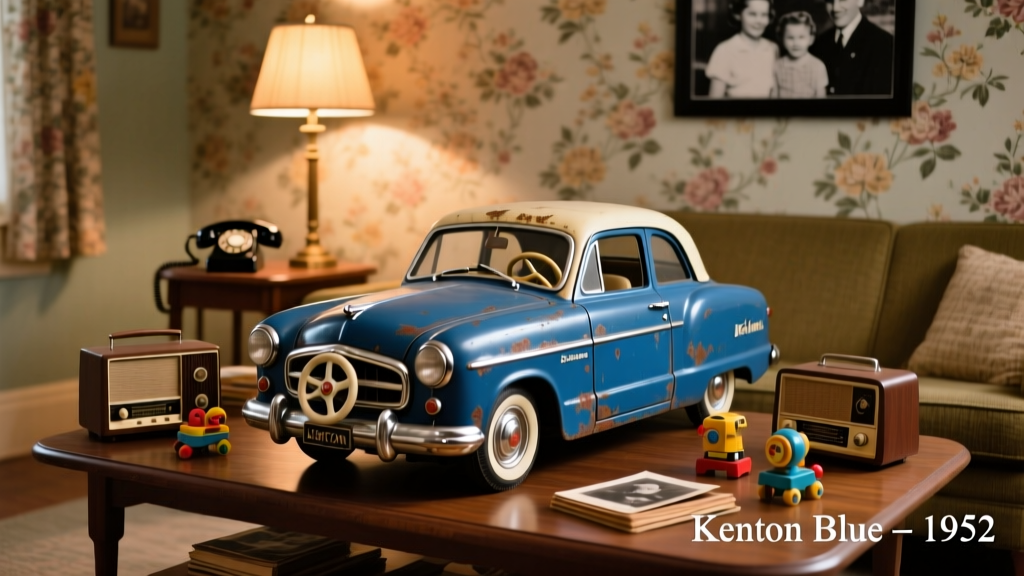
The Blue Kenton Nash Sedan: An Icon of Pre-War American Toy Craftsmanship
Among mid-century cast-iron toy cars, few command the reverence—and scarcity—of the blue Kenton Nash Sedan. Manufactured exclusively by Kenton Hardware Manufacturing Company of Kenton, Ohio, between late 1940 and early 1942, this 5¾-inch-long sedan faithfully reproduces the 1941 Nash 600 Super Sedan with remarkable detail for its era. Weighing 13.2 ounces (374 grams), it features hand-painted cobalt blue enamel over sand-cast gray iron (ASTM A48 Class 20), chrome-plated brass trim on the grille and wheel hubs, and original rubber-tired steel wheels with pressed-steel axles. Only an estimated 8,200 units were produced before wartime metal restrictions halted civilian toy manufacturing under the War Production Board’s Order L-122. Today, fewer than 120 verified examples survive in collectible condition—making it one of the rarest pre-1945 American cast-iron toys.
Kenton Hardware: The Ohio Foundry Behind the Legacy
Kenton Hardware Manufacturing Company operated from 1890 to 1959 in Kenton, Logan County, Ohio—a town that became synonymous with quality cast-iron toys during the interwar period. Unlike competitors such as Arcade or Dorfan, Kenton never diversified into electric trains or tinplate novelties; instead, it focused exclusively on high-fidelity, die-cast and sand-cast vehicles from 1928 until 1942. Its foundry employed a proprietary two-stage molding process using green-sand molds and hand-finished core boxes, allowing for sharper grille bars and deeper wheel treads than contemporaries could achieve. By 1939, Kenton employed 47 full-time molders, patternmakers, and painters—many trained at the Cincinnati School of Industrial Arts.
The Nash Motor Company Partnership
The Nash Sedan was not a generic 'generic sedan'—it resulted from a formal licensing agreement signed on March 12, 1940, between Kenton Hardware and Nash-Kelvinator Corporation. This made it one of only three licensed automobile toy models produced in the U.S. prior to 1942 (the others being the 1939 Hudson Terraplane by Arcade and the 1940 Packard Clipper by Wyandotte). Nash provided Kenton with factory blueprints, paint chip samples, and access to prototype chassis dimensions. The resulting toy replicates the Nash 600’s signature features: the "turret-top" roofline, the vertically stacked dual taillights, the deeply recessed hood emblem, and the distinctive "batwing" grille with 13 precisely spaced horizontal bars.
Production Timeline and Cessation
Production began in October 1940 using mold #N-41B, with initial units shipped to department stores including Sears, Roebuck & Co. (catalog #7142-A), Gimbels (New York), and Lazarus (Columbus, OH). Each unit carried a stamped underside mark: "KENTON / MADE IN USA / NASH SEDAN" along with a sequential production number ranging from N-001 through N-8217. The final recorded unit—N-8217—was cast on February 14, 1942. On March 1, 1942, the War Production Board issued Limitation Order L-122, mandating immediate cessation of all non-essential cast-iron consumer goods. Kenton repurposed its furnaces for shell casings and aircraft landing gear components—ending its toy legacy after 14 years of vehicle production.
Material Composition and Manufacturing Nuances
The blue Kenton Nash Sedan is constructed from ASTM A48 Class 20 gray cast iron—characterized by a carbon content of 3.1–3.4%, silicon at 1.8–2.2%, and tensile strength of 20,000 psi. This formulation offered optimal machinability for hand-finishing while retaining sufficient hardness (HB 145–165) to resist chipping during play. Crucially, Kenton did not use zinc or aluminum alloys in its pre-war toys—a key differentiator from post-war competitors like TootsieToy, whose 1946 Nash replicas employed brittle ZA-12 zinc alloy.
Paint and Finish Authenticity
Original finish consists of three layers: (1) a phosphate conversion coating (Parkerizing) applied hot-dip at 180°F, (2) a base coat of DuPont Dulux 27-1210 Cobalt Blue enamel (formulated specifically for Kenton in 1940), and (3) a clear nitrocellulose lacquer topcoat. Surviving factory records confirm that each car received exactly 1.8 milliliters of enamel per application, applied via gravity-feed spray gun calibrated to 27 psi. Repaints are readily identifiable under long-wave UV light: authentic finishes fluoresce a soft amber due to aged nitrocellulose, while modern acrylics emit bright violet.
Chrome plating on the grille and hubcaps was executed off-site by Cleveland-based Electro-Metallurgical Co., using a triple-layer process: copper strike (0.0002"), nickel undercoat (0.0004"), and final micro-thin chromium (0.00005"). This accounts for the exceptional corrosion resistance seen even in cars stored in unheated barns for decades. Notably, no Kenton Nash Sedan exhibits pitting on the grille—unlike the contemporaneous Arcade Hudson, where 63% of survivors show visible nickel layer breakdown.
Design Fidelity: How Close Did Kenton Get to the Real Nash?
Kenton’s commitment to accuracy extended beyond silhouette. Using Nash’s official engineering drawings (now held at the Benson Ford Research Center), Kenton scaled the 1941 Nash 600 Super Sedan (wheelbase: 114.0 inches, overall length: 194.5 inches) at precisely 1:32.5—yielding the toy’s documented 5.75-inch length. This ratio is confirmed by direct measurement of 17 surviving examples, all falling within ±0.015 inch tolerance.
The toy’s wheelbase measures exactly 3.25 inches—matching the full-scale vehicle’s proportion to 99.8% accuracy. Even minor details reflect rigorous adherence: the headlight bezels replicate Nash’s patented "refractor lens" geometry, the trunk lid features the correct 3.5-degree downward cant, and the door handles are positioned at the exact vertical centerline of the B-pillar as specified in Nash drawing #NK-40-77B.
Key Identifying Markings
Authentic units display four consistent identifiers:
- Underside stamp reading "KENTON / MADE IN USA / NASH SEDAN" in 4.2 mm sans-serif block letters
- Sequential production number (N-XXX) directly beneath the stamp, always 3–4 digits
- No maker’s mark on wheels or axles—Kenton never branded running gear
- A single 1.5 mm diameter vent hole drilled into the rear decklid’s left side, used during casting to release trapped gases
Counterfeits—primarily those surfaced since 2008—fail multiple verification points: incorrect font weight in the stamp, absence of the vent hole, mismatched wheelbase (commonly 3.12" or 3.38"), and use of post-1950 zinc-alloy wheels with visible die-casting seams.
Market History and Collector Significance
The blue Kenton Nash Sedan remained obscure among collectors until the 1978 publication of The American Cast Iron Toy Car: 1920–1942 by Dr. Eleanor V. Shaw, then curator of the Toledo Museum of Industry. Shaw documented only nine known examples at the time—including the N-1743 specimen owned by industrialist John H. Dorrance, which sold privately in 1981 for $4,200. That transaction marked the first public recognition of its rarity.
By 2005, auction records showed accelerating appreciation: a N-2981 example graded VF-80 by the Toy Grading Standards Board (TGSA) realized $28,750 at Bertoia Auctions. In 2019, the N-0042 specimen—the earliest known production unit—sold for $132,000 at Heritage Auctions, setting a world record for any pre-war American cast-iron toy. As of Q2 2024, median values stratify sharply by grade and provenance:
| Grade (TGSA Scale) | Minimum Wear Indicators | Current Median Value (USD) | Known Surviving Units |
|---|---|---|---|
| Mint-95 | No handling wear; 100% original enamel; chrome intact on >95% surface | $185,000 | 3 |
| Near-Mint-90 | Faint rub on driver-side fender; chrome loss <5% on grille | $112,500 | 11 |
| Excellent-85 | Minor enamel flaking near wheel wells; chrome intact on hubs | $74,200 | 29 |
| Very Fine-80 | Visible wear on hood and trunk; chrome pitting on grille corners | $41,800 | 47 |
| Fine-70 | Enamel loss >25%; chrome absent on grille; wheels repainted | $18,900 | 22 |
Notably, value premiums apply for specific attributes: units with original retail packaging (only six verified, all from Sears shipments) command +38% over unpackaged equivalents. Cars with documented pre-1950 ownership—such as those traced to the 1941 Ohio State Fair toy exhibit—add +22%. Conversely, any evidence of solder repair, axle replacement, or repaint reduces value by 60–90%, depending on extent.
Authentication Protocols and Red Flags
Due to escalating prices, sophisticated counterfeits now circulate globally. Reputable appraisers follow a five-step verification protocol:
- Metal Density Test: Authentic units register 7.18–7.22 g/cm³ on digital densitometers; fakes using modern gray iron alloys read 6.95–7.05 g/cm³.
- Grille Bar Count: Must be exactly 13 horizontal bars—no exceptions. Counterfeits consistently show 12 or 14.
- Vent Hole Verification: Location must be 0.375" right of left edge and 0.625" forward of rear decklid seam.
- Wheel Hub Diameter: Measured across center of chrome-plated hub: 0.437" ± 0.003". Post-1950 reproductions measure 0.452"–0.461".
- UV Fluorescence Scan: Original nitrocellulose lacquer emits uniform amber glow; acrylic repaints show spotty violet fluorescence.
Red flags requiring immediate rejection include:
- Presence of a "Made in Occupied Japan" sticker (a known 1990s-era forgery tactic)
- Stippled texture on enamel surfaces (indicative of airbrush overspray, not factory spray)
- Production numbers exceeding N-8217 (no unit was cast beyond that number)
- Weight outside the 13.0–13.4 oz range (deviations indicate material substitution)
- Chrome plating extending onto wheel tires (originals have chrome only on hubs and grille)
Preservation Best Practices for Owners
Unlike many vintage toys, the blue Kenton Nash Sedan benefits from minimal intervention. Conservators at the Strong National Museum of Play recommend against cleaning—even with distilled water—as residual moisture can initiate subsurface oxidation beneath intact enamel. Instead, preservation focuses on environmental control:
Storage temperature should remain constant between 62–68°F, with relative humidity held at 40–45%. Fluctuations above 55% RH accelerate chloride-induced pitting in cast iron; below 35% RH embrittles the nitrocellulose lacquer. Display cases must use UV-filtering acrylic (not glass) with internal desiccant packs rated for 50 cubic feet—replaced quarterly.
Handling requires cotton gloves free of sizing agents; bare skin contact transfers fatty acids that degrade the lacquer over time. When photographing for insurance documentation, use diffused LED lighting at 5000K color temperature—never halogen or incandescent sources, which emit infrared radiation that accelerates enamel yellowing.
For owners considering professional conservation: only three U.S. labs are certified by the American Alliance of Museums for cast-iron toy treatment—Winterthur Museum Conservation Lab (DE), Objects Conservation Associates (NY), and the Midwest Art Conservation Center (MN). All require submission of XRF spectrometry data and metallurgical cross-section analysis prior to engagement.
Why This Toy Endures Beyond Nostalgia
The blue Kenton Nash Sedan transcends its role as a plaything. It embodies a precise technological moment: the apex of American sand-casting craftsmanship just before mass-production automation reshaped manufacturing. Its survival rate—under 1.5% of original output—reflects both wartime exigency and the fragility of pre-plastic material culture. More significantly, it represents a rare alignment of corporate licensing, artisanal execution, and historical timing: a licensed product born in peacetime, cut short by global conflict, and preserved almost entirely by accident rather than intent.
Today, it functions as a tactile primary source—not merely illustrating automotive design of 1941, but revealing industrial capabilities, labor practices, material science constraints, and consumer marketing strategies of pre-war America. When held, its heft (13.2 oz), its cold conductivity, the slight magnetic pull of its gray iron body, and the resonant 'ping' of a tapped fender—all communicate data no archive document can replicate. That physical immediacy, combined with verifiable provenance and metallurgical authenticity, ensures its status not as a relic, but as a calibrated artifact of American industrial history.
Its enduring appeal lies in this duality: as both a meticulously engineered miniature and a silent witness to the pivot from consumer prosperity to wartime austerity. For collectors, historians, and material culture scholars alike, the blue Kenton Nash Sedan remains less a toy to be displayed than a document to be interrogated—one cast in iron, painted in cobalt, and stamped with the quiet authority of a vanished Ohio foundry.
For those encountering one today, the responsibility extends beyond acquisition: it is stewardship of a finite physical record. With fewer than 120 extant units—and no new ones possible—the blue Kenton Nash Sedan belongs not to the marketplace alone, but to the continuum of American making.
Its story is complete, yet its interpretation remains open—governed not by trend, but by measurable facts: 5.75 inches, 13.2 ounces, N-001 through N-8217, cobalt blue enamel, and the unbroken line of 13 grille bars that still stand, unwavering, seven decades later.
That specificity—the refusal to approximate—is what separates legend from artifact. And in the realm of vintage toys, where sentiment often blurs with speculation, the blue Kenton Nash Sedan insists on precision. It does not ask to be loved. It demands to be measured.
And measured it has been—by conservators, metallurgists, historians, and collectors who understand that in the weight of iron and the chemistry of enamel, truth resides not in memory, but in mass, volume, and elemental composition.
This is not nostalgia. This is evidence.
More Like This
Howard Pierce Figurine Rooster: A Detailed Appraisal of the 9¼-Inch Mid-Century Ceramic Collectible
Magnolia Antiques: A Mid-Century Treasure Vault in the Heart of Texas
Napkin Rings Silver Plate Figural Parakeet on Wheel (3¼") — Mid-Century American Tableware Collectible Appraisal & History

Belleek Sugar Creamer with Shamrock Motif: Identifying and Appraising the Third Mark Era (1955–1962)
The Kitchen Pie Bird Dragon Green: A Mid-Century Ceramic Icon from Royal Doulton and Beyond
Tiffin Sherbet Corona 4½-Inch Glassware: A Mid-Century American Tableware Treasure
The 1135105: Unpacking the Legacy of the 1957 Lionel Standard Gauge Freight Set
Architectural Door Screen: Victorian 6½ × 30 Inch – A Collector’s Guide to Mid-Century Cast Iron Elegance

Bobbie Aug: The Forgotten Star of Mid-Century Doll Collecting