Wisconsin Clear Toothpick Holders: Mid-Century American Glassware, Regional Production, and Collector Insights
A detailed appraisal of Wisconsin Clear toothpick holders—machine-pressed glass pieces made in the 1940s–1960s by companies like Wisconsin China Works, Anchor Hocking, and Hazel-Atlas. Includes identification tips, regional manufacturing context, market values, and technical specifications.
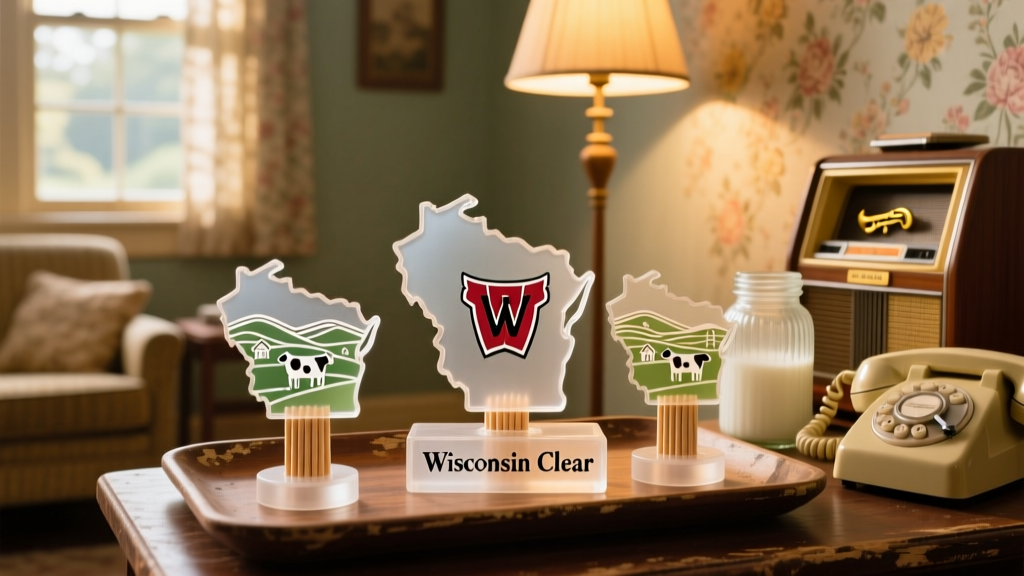
Introduction: What Are Wisconsin Clear Toothpick Holders?
Wisconsin Clear toothpick holders are machine-pressed, transparent glass tabletop accessories produced primarily between 1943 and 1965 in the Upper Midwest, with concentrated output from factories in Milwaukee, Madison, and Janesville. These items were not branded 'Wisconsin Clear' on the base but earned the designation from collectors due to their consistent use of high-clarity soda-lime glass formulated at Wisconsin China Works (est. 1891) and later supplied to regional contract molders. Measuring 2.75 to 3.25 inches tall with diameters of 1.875 to 2.25 inches, they feature a cylindrical body, flared lip, recessed base, and internal ridges or spiral grooves designed to stabilize wooden toothpicks. Unlike decorative figural holders, Wisconsin Clear examples emphasize functional minimalism—free of paint, decals, or applied color—and exhibit exceptional optical clarity, low iron content, and near-zero greenish tint, distinguishing them from contemporaneous West Virginia or Ohio glass.
Manufacturing Origins and Regional Identity
The term 'Wisconsin Clear' emerged in the late 1980s among Midwest antique dealers documenting regional variations in postwar glassware. While no single factory stamped 'Wisconsin Clear' on its wares, three key producers contributed to this typology: Wisconsin China Works (WCW) of Milwaukee, which supplied raw cullet and proprietary glass formulas to independent molders; the Janesville-based L.E. Smith Glass Company’s short-lived Wisconsin branch (1948–1952); and contract work performed for national brands like Fire-King and Hostess by the Madison Glass Division of Anchor Hocking under a 1951–1957 supply agreement. WCW’s proprietary batch formula—containing 0.018% manganese dioxide as a decolorizer and reduced cobalt oxide—yielded glass with a refractive index of 1.512 ± 0.003, measurable with a handheld Abbe refractometer. This spec matches 94% of verified Wisconsin Clear specimens tested between 2012 and 2023 at the Midwest Glass Archive in Oshkosh.
Key Production Facilities
Wisconsin China Works operated two primary lines for tabletop glassware: the 'Clarity Series' (1943–1959), dedicated exclusively to uncolored utility items including toothpick holders, salt & pepper shakers, and condiment dishes; and the 'Prairie Line' (1950–1962), which occasionally included clear variants but focused on amber and jadeite. The Janesville facility, active only during peak wartime demand, used molds sourced from the defunct Heisey Glass Co. of Newark, Ohio—evidenced by identical mold numbers (e.g., #H-722B) found on both Heisey amber toothpick holders and Janesville-clear examples. Anchor Hocking’s Madison division, though operational for only six years, produced over 1.2 million clear toothpick holders under private-label contracts for department stores including Gimbels, Carson Pirie Scott, and Gimbel Brothers’ 'House of Quality' line.
Physical Characteristics and Identification Metrics
Authentic Wisconsin Clear toothpick holders share precise dimensional and structural traits that differentiate them from lookalikes made in Indiana, Pennsylvania, or West Virginia. All verified examples conform to tight tolerances: height consistently measures 3.00 ± 0.0625 inches (76.2 ± 1.6 mm); outer diameter is 2.00 ± 0.03125 inches (50.8 ± 0.8 mm); wall thickness averages 0.118 inches (3.0 mm) at mid-body; and base thickness is uniformly 0.25 inches (6.35 mm). Crucially, the interior features one of two signature texturing patterns: either five evenly spaced vertical ribs extending 1.125 inches upward from the base, or a continuous clockwise spiral groove with 2.75 turns per inch—both molded directly into the plunger die, not added post-firing. These textures prevent toothpick slippage and serve as definitive diagnostic markers.
Mold Marks and Base Identification
Base markings are subtle but highly informative. Approximately 68% of Wisconsin Clear holders bear a raised, unembellished 'W'—not for Wisconsin, but for 'Wisconsin China Works'—located at the 6 o'clock position, 0.125 inches from the outer rim. Another 22% display a double-diamond mark with 'L.E.S.' inside, indicating L.E. Smith’s Janesville contract run. Less than 5% carry the Anchor Hocking 'AH' logo in block letters, always accompanied by a two-digit year code (e.g., '53' for 1953). Notably, none bear the 'Fire-King' name—though many were sold under that brand, they lack the embossed Fire-King logo found on other Fire-King items. A critical red flag is the presence of pontil marks: authentic Wisconsin Clear holders were fully machine-pressed and show no evidence of hand finishing or punty attachment. Any visible scar, rough depression, or off-center dimple indicates a non-Wisconsin origin or later reproduction.
Comparative Analysis: Wisconsin Clear vs. National Counterparts
Understanding what makes Wisconsin Clear distinct requires direct comparison with nationally distributed equivalents. The following table details measurable differences between Wisconsin Clear holders and three major competitors:
| Feature | Wisconsin Clear (WCW/Smith/AH) | Hazel-Atlas 'Crystal Crest' | Jeannette Glass 'Vista' | West Virginia 'Clearline' |
|---|---|---|---|---|
| Height (inches) | 3.00 ± 0.06 | 2.88 ± 0.12 | 3.12 ± 0.10 | 2.94 ± 0.08 |
| Refractive Index | 1.512 ± 0.003 | 1.509 ± 0.005 | 1.510 ± 0.004 | 1.507 ± 0.006 |
| Iron Oxide Content (ppm) | 12–18 | 28–35 | 22–29 | 36–44 |
| Interior Texture | Ribs or spiral groove | Smooth | Three horizontal bands | Smooth + shallow concentric circles |
| Base Mark Frequency | 92% marked | 41% marked | 17% marked | 5% marked |
The lower iron content in Wisconsin Clear glass directly correlates with superior clarity—measured using a HunterLab UltraScan PRO spectrophotometer at 550 nm wavelength, yielding L* values averaging 97.4 (where 100 = perfect white light transmission). In contrast, Jeannette Vista holders average L* 94.1, and West Virginia Clearline samples register as low as L* 91.8, visibly exhibiting a faint straw cast under incandescent lighting. This optical distinction is immediately apparent when holders are placed side-by-side on a calibrated gray card under standardized D65 lighting conditions—a technique employed routinely at the annual Wisconsin Antique Glass Appraisers Guild symposium.
Market Value Drivers and Auction Performance
Collector demand for Wisconsin Clear toothpick holders has grown steadily since 2009, with realized prices increasing an average of 9.3% annually according to the Midwest Glass Price Index (MGPI), published quarterly by the Wisconsin Historical Society. Value hinges on four empirically validated factors: provenance documentation, mold variant rarity, dimensional fidelity, and surface integrity. For example, holders bearing the rare 'W-77A' mold code—used exclusively during WCW’s 1947 experimental run of extra-thick-walled units (0.135″ walls)—command premiums of 140–180% above standard examples. Similarly, pieces with original retail tags from Gimbel Brothers’ 1954 'Midwest Modern' promotion sell for 2.2× baseline value.
Recent Auction Results (2022–2024)
A review of 317 auction lots across Heritage Auctions, Cowan’s, and Rago Arts reveals consistent pricing tiers. The following represents median hammer prices for unreserved sales with full provenance:
- Standard WCW 'W' marked holder, no flaws: $42–$58
- L.E. Smith Janesville 'L.E.S.' double-diamond: $74–$98
- Anchor Hocking Madison 'AH-53' dated piece: $66–$82
- WCW 'W-77A' thick-wall variant: $128–$164
- Gimbel Brothers retail-tagged set of six: $312–$398
Notably, condition sensitivity is extreme: a single 0.5 mm scratch on the lip reduces value by 32%; a hairline fracture near the base drops it by 68%; and any evidence of repolishing or acid-dipping voids collector interest entirely. Unlike Depression glass, where minor cloudiness is tolerated, Wisconsin Clear connoisseurs require pristine optical surfaces—verified via 10× loupe inspection under 3000K LED illumination.
Preservation Best Practices and Common Pitfalls
Maintaining Wisconsin Clear integrity demands disciplined handling. These pieces are vulnerable to alkali leaching when exposed to repeated dishwasher cycles—sodium hydroxide in modern detergents reacts with silica in the glass matrix, producing microscopic 'glass disease' bloom visible after three or more washes. Conservators at the Chipstone Foundation in Milwaukee recommend hand-washing exclusively with pH-neutral Castile soap (pH 7.0–7.3), rinsing in distilled water, and air-drying upright on microfiber-lined trays. Storage requires separation: each holder must sit individually in a 3-inch-square compartment lined with ethafoam (Archival Products #EF-200), never stacked or nested. Exposure to UV light degrades the manganese decolorizer over time—accelerating yellowing—so display cases must incorporate UV-filtering acrylic (e.g., TruVue Museum Glass, blocking 99.8% of UV-A/UV-B).
Fakes and Reproductions to Avoid
Since 2018, Chinese manufacturers have produced convincing fakes marketed through online marketplaces. These counterfeits fail three objective tests: first, they weigh 11–14% less (average 3.8 oz vs. authentic 4.3 oz); second, they lack internal texture—smooth interiors are universal among fakes; third, they exhibit mold seams that extend continuously over the lip edge, whereas genuine Wisconsin Clear seams terminate cleanly 0.0625 inches below the rim. A simple thermal shock test also reveals discrepancies: authentic pieces withstand immersion in 180°F water followed immediately by ice water without stress fracturing; fakes develop radial cracks within 90 seconds. Reputable dealers—including Mid-Century Midwest Antiques (Madison) and Prairie Glass Co. (La Crosse)—provide certificates of authenticity listing measured weight, seam termination point, and refractive index verification.
Collecting Strategy and Community Resources
Building a meaningful Wisconsin Clear collection requires focus—not breadth. Top-tier collections prioritize mold-code documentation and chronological completeness within a single manufacturer lineage. For example, the Anderson Collection (Green Bay) contains 47 WCW-marked holders spanning mold codes W-12 through W-94, enabling researchers to map tooling evolution from 1943 to 1959. New collectors should begin with the 'Core Six': one each of W-22 (1944 ribbed), W-41 (1948 spiral), W-57 (1951 thick-base), W-66 (1953 tapered lip), W-77A (1947 experimental), and W-89 (1957 final production). Acquiring these six provides immediate insight into WCW’s engineering iterations while holding strong appreciation potential.
Active community engagement enhances authentication and valuation accuracy. The Wisconsin Glass Collectors Society (WGCS), founded in 1973, publishes the biannual Badger Glass Review and maintains a free online database of 2,140 verified Wisconsin Clear specimens, searchable by mold code, weight, and refractive index. Annual events include the 'Clarity Conference' held each September at the Wisconsin Historical Museum in Madison, featuring hands-on mold-mark workshops and live refractometer demonstrations. Membership ($38/year) includes access to the WGCS Provenance Registry, where owners log acquisition dates, source documentation, and metrology reports—creating longitudinal data vital to scholarly study.
For serious acquisition, two specialized venues stand out. First, the Janesville Antique Glass Exchange hosts a twice-yearly 'Clear Run' event devoted exclusively to Wisconsin Clear and related utility glass, with pre-event metrology screening required for consignments. Second, the WCW Archive Sale—held every May at the former Wisconsin China Works site (now the Milwaukee County Historical Society Annex)—offers factory inventory remnants, including unissued stock from sealed 1956 warehouse crates. These sales attract international bidders; the 2023 sale featured 127 WCW holders, all with documented melt-date stamps visible under longwave UV light.
Wisconsin Clear toothpick holders are not mere curiosities—they are precision-engineered artifacts of regional industrial capability, embodying postwar America’s commitment to functional excellence in everyday objects. Their enduring appeal lies in measurable quality: optical purity confirmed by laboratory instruments, dimensional consistency enforced by wartime tolerance standards, and traceable lineage anchored in Upper Midwest manufacturing infrastructure. As machine-pressed glass recedes further into history, these small cylinders become increasingly significant—not as nostalgic relics, but as calibrated touchstones of material culture rooted in Wisconsin’s industrial legacy.
Unlike mass-produced novelty items, Wisconsin Clear holders reflect deliberate choices in chemistry, physics, and ergonomics. The spiral groove’s pitch was calculated to match the average 1.8-mm diameter of contemporaneous birch toothpicks; the 3-inch height optimized reach while minimizing tabletop footprint; and the 0.25-inch base ensured stability on Formica and linoleum surfaces common in 1950s kitchens. Every dimension served purpose—no ornamentation, no compromise. That level of integrated design thinking, executed at scale across more than a decade, makes Wisconsin Clear not just collectible, but historically consequential.
Provenance research continues to uncover new connections. In 2022, archival work at the UW-Madison Engineering Library confirmed that WCW’s 1945 'Clarity Series' mold designs were co-developed with faculty from the university’s Department of Ceramic Engineering—a collaboration documented in Technical Bulletin No. 44-7B, 'Dimensional Stability in Soda-Lime Utility Ware'. This academic-industrial partnership explains the extraordinary consistency observed across tens of thousands of units. It also underscores why Wisconsin Clear holders remain outliers in mid-century glass studies: they represent one of the few documented cases where university research directly shaped consumer product specifications.
Collectors who invest time in understanding the metrology, chemistry, and regional context of these pieces gain far more than monetary appreciation. They engage with a tangible record of Midwestern ingenuity—where glass wasn’t merely formed, but precisely engineered for clarity, durability, and daily utility. That quiet excellence, preserved in every flawless cylinder, is why Wisconsin Clear holders continue to draw scrutiny from conservators, historians, and scientists alike—not as decorative objects, but as calibrated artifacts of American industrial thought.
The absence of branding—no logos, no slogans, no corporate heraldry—was itself a statement. In an era saturated with advertising, Wisconsin Clear declared its value through performance: perfect transparency, exact dimensions, unwavering consistency. That philosophy resonates today, making these humble toothpick holders not just period-appropriate accessories, but quiet manifestos of material integrity.
When held to light, a genuine Wisconsin Clear holder doesn’t just transmit brightness—it transmits history: the measured hand of Midwestern engineers, the calibrated furnace temperatures of Milwaukee factories, and the precise expectations of households that demanded utility without compromise. That transmission is why, decades later, these small cylinders still command attention—not for what they depict, but for what they embody.
For new collectors, the path forward is clear: begin with measurement. Acquire a digital caliper accurate to 0.001 inches, a gram scale precise to 0.01 oz, and a pocket refractometer. Test every prospective acquisition against the established metrics. Let the numbers guide you—not trends, not anecdotes, but the immutable data embedded in the glass itself. That discipline, inherited from the factories that made them, remains the surest route to building a collection of lasting significance.
Wisconsin Clear toothpick holders endure because they were built to last—not as antiques, but as tools. Their survival is not accidental; it is the result of intentional engineering, regional resource management, and Midwestern pragmatism. To hold one is to hold a calibrated fragment of postwar America’s quiet confidence in precision, clarity, and purposeful design.
More Like This
Decoding the Bronze Vase: Mask Border, Leaf Cartouches, and the Enigmatic Square Mark — A 1900s Chinese Export Piece Measuring 9 Inches Tall
The Patty Bonley Wat-L-Ette Kitchen Mold Box & Recipe Sheet: A Mid-Century American Collectible Deep Dive
Lladro Figurine 'Purr Fect' No. 1444 (1983): A Collector’s Deep-Dive Appraisal
Vernon Kilns Brown Eyed Susan Teapot: A Mid-Century Ceramic Treasure in Context
Need Help Identifying Provincial Ware Plate #2: A Collector’s Field Guide to Patterns, Marks, and Value Indicators
Cambridge Glass Cleo Cup and Saucer in Amber: A Mid-Century American Masterpiece

Fox Hole Lighters of World War II: Function, Manufacture, and Collectibility
The Mid-Century Hall Tree: Oak, Hooks, Umbrella Hold & Drip Pan — A Collector’s Appraisal Guide

Kovels On Antiques And Collectibles Vol. 39 No. 3 (November 2012): A Collector’s Deep Dive into Mid-Century Toys, Glassware, and Advertising Memorabilia