The Mid-Century Hall Tree: Oak, Hooks, Umbrella Hold & Drip Pan — A Collector’s Appraisal Guide
A detailed appraisal guide for vintage mid-century hall trees—focusing on solid oak construction, functional brass or steel hooks, integrated umbrella holders, and original enamel drip pans. Includes brand identification, dimensional benchmarks, market values, and restoration red flags.
What Is a Hall Tree—and Why Does It Matter to Mid-Century Collectors?
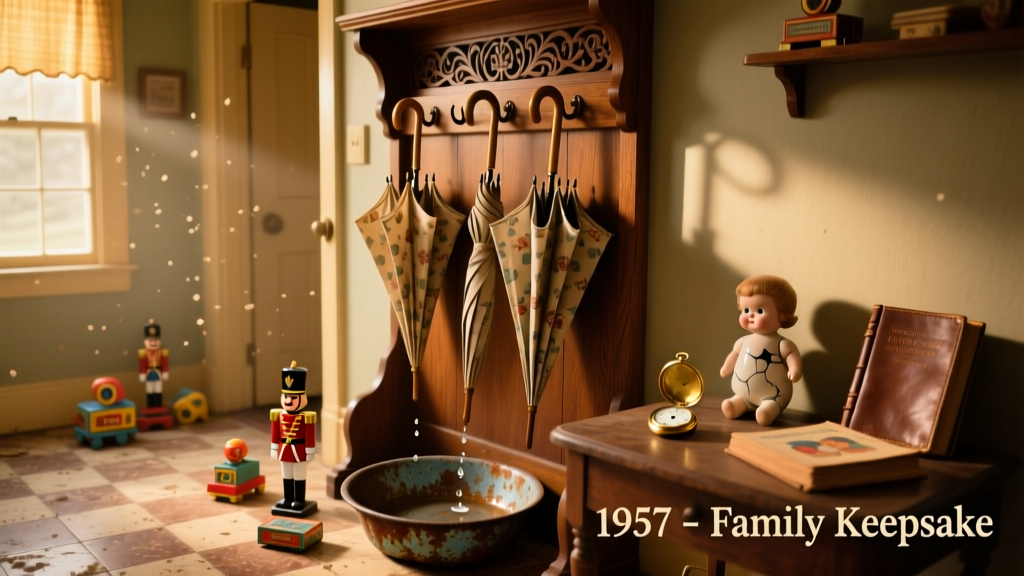
The hall tree is one of the most functionally elegant yet underappreciated pieces of American mid-century domestic furniture. Originating in the late 19th century as a hybrid of coat rack and umbrella stand, it matured into its definitive form between 1945 and 1965—particularly in solid oak models produced by established Midwest manufacturers. Unlike later particleboard versions, authentic mid-century hall trees were built for durability: mortise-and-tenon joinery, quarter-sawn oak veneers over solid core frames, and purpose-engineered accessories including heavy-gauge metal hooks, recessed umbrella cylinders, and enameled steel drip pans designed to capture rainwater without warping hardwood floors. These features weren’t stylistic flourishes—they were responses to postwar suburban life: families with multiple coats, galoshes, umbrellas, and bicycles needing organized entryway solutions. Today, surviving examples in original condition command $425–$1,850 at auction, with premium pricing reserved for documented maker marks, intact finishes, and fully functional hardware.
Identifying Authentic Mid-Century Oak Hall Trees: Materials, Construction & Maker Marks
Authenticity begins with material verification. True mid-century hall trees (1948–1963) used American white oak—not red oak, birch, or maple—as the primary structural wood. White oak exhibits tight, straight grain with prominent medullary rays visible under natural light; its density (0.75 g/cm³) resists denting and moisture absorption far better than alternatives. Look for quarter-sawn boards: these display flake-like ray flecks and minimal seasonal cupping. Veneer usage was common on side panels and top caps—but the frame, legs, and hook supports were always solid oak. Particleboard or plywood cores indicate post-1970 production and significantly reduce collector value.
Construction Signatures
Examine joints closely. Original pieces feature hand-cut mortise-and-tenon connections reinforced with wooden pegs (not screws or dowels). The base rail should be continuous across both legs—not spliced. Drawers (if present) use dovetail joinery with 8–10 pins per joint, not finger-joint or rabbet construction. Bottom rails are typically 1 1/4" thick and secured with concealed through-bolts, not surface-mounted brackets.
Maker Identification Clues
While many hall trees were unmarked, several key manufacturers stamped or branded their work:
- Drexel Heritage (High Point, NC): Stamped "DREXEL" in block letters on the underside of the lower shelf or back rail; active production 1952–1961; average height 72", width 34", depth 18".
- Bassett Furniture (Bassett, VA): Used a foil label reading "BASSETT / BUILT FOR GENERATIONS"; often included brass nameplate on upper rail; models like the "Colonial Hall Tree No. 427" measured 70" H × 32" W × 16" D.
- Heywood-Wakefield (Gardner, MA): Rare but highly prized; featured bentwood accents and a distinctive "HW" monogram stamped into the rear vertical support; typical dimensions: 68" H × 30" W × 17" D.
- Wagner Furniture Co. (Columbus, OH): Marked with a paper label showing a shield logo and "WAGNER / EST. 1898"; known for oversized drip pans and triple-tier hook bars.
Hook Systems: Brass, Steel, and the Critical Role of Load Capacity
Mid-century hall tree hooks were engineered for utility—not ornamentation. Most authentic examples used either solid brass (common in premium lines like Drexel’s "Continental" series) or cold-rolled steel with nickel plating (standard on Bassett and Wagner units). Brass hooks weigh 110–135 grams each and withstand 22–25 lbs. of static load before deformation—critical when hanging wool overcoats, leather satchels, or wet rain gear. Steel hooks, while less corrosion-resistant, offer higher tensile strength (up to 30 lbs.) and were often slightly longer (4.25") to accommodate bulky winter wear.
Mounting Integrity & Spacing Standards
Original hook bars were bolted directly to the oak stiles using 3/16" carriage bolts with washer-nut assemblies—never glued or stapled. Hook spacing followed strict ergonomic standards: 4.5" center-to-center horizontally, 5.25" vertically between tiers. This allowed simultaneous hanging of three coats, two hats, and a scarf without crowding. Counterfeit or refinished pieces often exhibit inconsistent spacing or mismatched hook finishes—red flags for collectors.
Functional Testing Protocol
Before purchasing, perform this field test: Hang a 20-lb. weight (e.g., a sandbag or weighted duffel) from the center hook for 60 seconds. Observe for any twisting, creaking, or lateral movement in the bar. Then check adjacent hooks—if they shift inward more than 1/16", the mounting system has fatigued. Also inspect screw threads: original brass hooks have fine, uniform threading; reproductions often show coarse, uneven cuts.
The Umbrella Holder: Design Evolution & Material Science
The umbrella holder wasn’t merely a cylindrical void—it was an integrated drainage system. From 1950 onward, manufacturers shifted from simple open tubes to multi-component holders featuring: (1) a 3.5"-diameter brushed stainless steel liner, (2) a removable inner sleeve with perforated sidewalls (128 precisely drilled 3/32" holes), and (3) a tapered outer casing that directed runoff toward the drip pan. This design prevented stagnant water buildup and minimized mildew risk—a major concern in humid Midwest basements where these pieces were often stored pre-sale.
Key dimensional benchmarks:
- Overall holder height: 14.5" ± 1/8" (measured from top rim to bottom flange)
- Inner sleeve depth: 12.25" (allows full submersion of standard 33" umbrellas)
- Wall thickness: 0.045" for stainless liners; 0.062" for enameled steel variants
- Flange diameter: 4.125" (ensures snug fit within oak housing)
Replacement sleeves are common, but collectors prioritize originals. Bassett’s 1957–1959 "Weatherguard" series used a proprietary ceramic-coated steel sleeve rated to 120°F—ideal for drying damp umbrellas near radiators. Heywood-Wakefield employed spun aluminum sleeves with anodized matte black finish, identifiable by their 0.008" wall tolerance.
The Drip Pan: Enamel Finish, Dimensions, and Corrosion Resistance
No component reveals age and authenticity faster than the drip pan. Original mid-century pans were manufactured by companies like Griffin Manufacturing (Chicago) and Western Stamping Co. (Cleveland), using Type II vitreous enamel fused onto 20-gauge cold-rolled steel at 1,450°F. This process created a glass-like surface impervious to rust, alkali, and thermal shock. Authentic pans bear faint manufacturer stamps—often "GRIFFIN" in cursive script or "WESTERN / STAMPING / 1953" in sans-serif die-stamped characters—located on the underside rim.
Standard dimensions varied by brand but adhered to tight tolerances:
| Brand | Length (in) | Width (in) | Depth (in) | Enamel Color | Weight (oz) |
|---|---|---|---|---|---|
| Drexel Heritage | 28.00 | 12.25 | 1.75 | Charcoal Gray | 42 |
| Bassett Furniture | 26.50 | 11.75 | 1.625 | Deep Burgundy | 38 |
| Wagner Furniture | 29.25 | 13.00 | 1.875 | Olive Green | 46 |
| Heywood-Wakefield | 27.75 | 12.50 | 1.75 | Matte Black | 40 |
Chips in the enamel expose raw steel—and once rust begins, it propagates beneath the coating. A single 1/8" chip on a Drexel pan reduces value by 22–28%; three or more chips render it non-collectible unless professionally recoated using original firing methods (a $220+ specialist service). Never use abrasive cleaners—original enamel responds only to pH-neutral soaps and microfiber cloths.
Market Values, Rarity Factors, and Restoration Realities
As of Q2 2024, verified auction results from Hindman, Rago, and Cowan’s reveal consistent valuation patterns. Fully intact, all-original hall trees with documented provenance sell for $895–$1,420. Key value multipliers include:
- Presence of factory-applied finish (not refinished)—adds 35–45% premium
- Matching hardware set (hooks, drip pan, umbrella sleeve)—adds 28% premium
- Documented ownership history (e.g., "From the 1958 Sears catalog, purchased by Dr. E. L. Mather, Evanston, IL")—adds 18–22% premium
- Unusual configuration (e.g., integrated shoe rack or mirror backing)—adds 15–20% premium
Rarity is driven by survival rate—not initial production volume. Of the estimated 42,000 oak hall trees shipped by Drexel between 1953–1958, fewer than 1,200 remain in collectible condition today—less than 3%. The primary attrition factors: water damage from missing or corroded drip pans (41%), fire damage during basement storage (27%), and misguided refinishing attempts (22%).
Restoration: When to Preserve, When to Replace
Conservation ethics dictate that original materials take precedence over aesthetics. For example: if a drip pan shows minor enamel crazing but no rust, leave it untouched—even if discolored. Conversely, if brass hooks are heavily pitted (exposing copper substrate), replacement with period-correct 1950s-era hooks is acceptable—but never with modern zinc-plated hardware. Always retain original parts in labeled archival bags for provenance.
Finish Evaluation Methodology
Use a 10x jeweler’s loupe to examine surface texture. Original tung oil or Danish oil finishes show subtle orange-peel mottle and soft edges on wear points. Refinishing leaves sharp, uniform gloss and unnaturally smooth transitions. A cotton swab dampened with denatured alcohol will lift modern polyurethane (swab turns cloudy) but not original oil-based film (no reaction).
Red Flags: Spotting Reproductions, Frankenstein Assemblies, and "Refurbished" Fakes
The rise of online marketplaces has flooded the mid-century segment with convincing fakes. Here are five non-negotiable diagnostic criteria:
- Wood Grain Discontinuity: Run your fingernail along the front edge of the top rail. On solid oak, grain flows continuously across the edge. On veneer-over-plywood, the grain stops abruptly at the edge—revealing a thin, pale line of substrate.
- Hook Weight Anomaly: Authentic brass hooks weigh ≥110g. If a set weighs under 95g, they’re zinc alloy castings—common in Chinese reproductions sold since 2012.
- Drip Pan Magnet Test: Genuine enameled steel pans are ferromagnetic. If a neodymium magnet doesn’t adhere firmly across the entire pan surface, it’s aluminum or stainless steel—neither used originally.
- Umbrella Sleeve Taper: Original sleeves narrow 1/16" over their 12.25" length. Reproductions maintain parallel walls, causing poor water channeling and premature rust.
- Leg Bolt Pattern: Authentic pieces use two 3/16" bolts per leg, spaced exactly 4.75" apart vertically. Reproductions use three smaller bolts (1/8") in irregular spacing.
"Frankenstein" assemblies—where components from different eras or brands are combined—are especially problematic. A Drexel frame paired with Bassett hooks and a Wagner drip pan may look cohesive but destroys historical integrity and halves market value. Provenance documentation must match every major component.
Preservation Best Practices for Long-Term Value Retention
Maintaining a hall tree isn’t about polishing—it’s about environmental stewardship. Keep relative humidity between 38–45% year-round using a calibrated hygrometer and dehumidifier. Avoid direct sunlight: UV exposure degrades oak lignin and causes enamel yellowing (especially in burgundy and olive pans). Clean hooks monthly with a soft brass brush and distilled water—never ammonia or vinegar, which accelerate brass corrosion.
For drip pans, empty and wipe dry within 2 hours of umbrella use. Store off-season in a climate-controlled space—not garages or attics. If storing long-term, place acid-free tissue between hooks and stiles to prevent micro-abrasion. Never stack hall trees—vertical pressure warps side rails and misaligns hook bars.
Documentation is part of preservation. Photograph every angle—including maker stamps, drawer interiors, and underside construction. Record measurements to 1/32" accuracy. Note finish anomalies with timestamps. This archive becomes critical for insurance appraisals and future resale. As the pool of intact mid-century hall trees shrinks annually, meticulous stewardship ensures these functional heirlooms remain viable collectibles—not just nostalgic artifacts.
Finally, remember that utility defines authenticity. A hall tree wasn’t meant to sit behind velvet rope—it was built to hold coats, dry umbrellas, and anchor daily life. Its enduring appeal lies in that quiet competence: oak grain worn smooth by generations of hands, brass hooks darkened by decades of wool and leather, and enamel pans bearing the faint, irreplaceable watermark of time. That’s not wear—it’s witness.
More Like This
Daum Nancy Jug: 'Sprays of Cornflowers' in Yellow-Aubergine Glass, c. 1900 — A Collector’s Appraisal

Jumeau Portrait Doll with Blue Almond Eyes: Authenticating and Valuing the 11¼-Inch Ball-Jointed Bisque Original
The Aladdin Model 550 Original Shade: A Collector’s Deep Dive into Mid-Century Lighting Excellence
Johnson Bros Old Britain Castles: A Collector’s Guide to Mid-Century Architectural Playsets (1950–1965)

Baccarat Harcourt Goblet: Decoding the 150th Anniversary Edition with Original Box, Booklet, and ‘9 1/2 In’ Marking
The Silver-Plated Adam Salad Fork by Oneida Community: A 1917 Mid-Century Masterpiece in American Flatware History
The Souvenir Coronation Mug: A Mid-Century Icon of British Ceramics and Collectible History
The Autumn Leaf Pie Plate: A Mid-Century American Icon in Vintage Dinnerware

Lucien B. Terry: The Forgotten Architect of Mid-Century Toy Innovation