The 1915 Keuffel & Esser Favorite Farm Level: A Collector’s Deep Dive into the Manual Tripod Box Set
A detailed appraisal of the rare 1915 Keuffel & Esser Favorite Farm Level — a precision surveying instrument housed in its original tripod box, featuring brass construction, engraved calibration, and period-correct accessories. Includes measurements, historical context, market valuation, and authentication benchmarks.
The 1915 Keuffel & Esser Favorite Farm Level: An Enduring Benchmark in Field Surveying
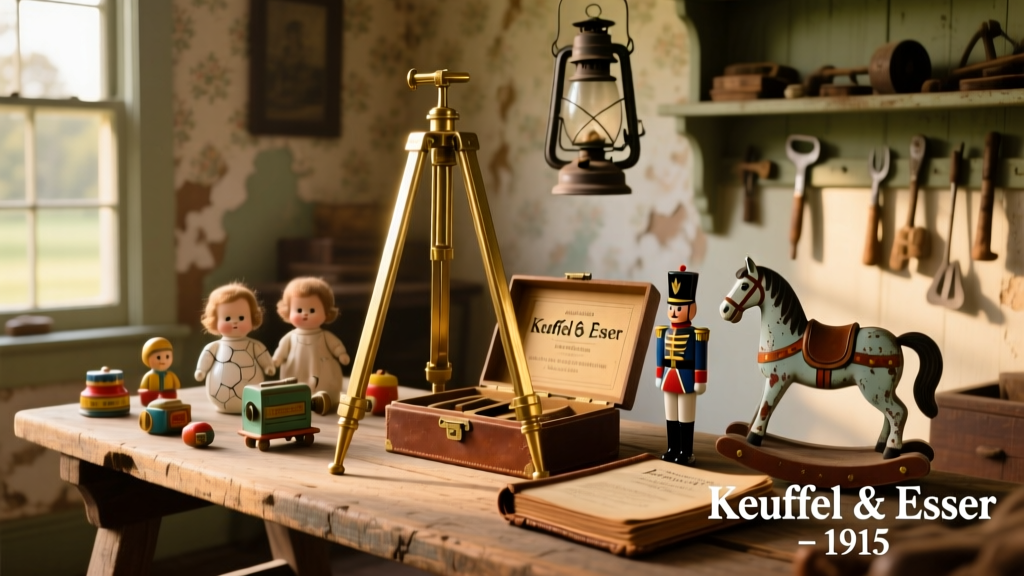
Released in early 1915 by Keuffel & Esser Co. of New York, the Favorite Farm Level was not merely another surveying tool—it was a deliberate synthesis of accessibility, durability, and optical precision engineered for agricultural engineers, landowners, and rural surveyors across the American Midwest and Great Plains. Housed in its distinctive mahogany-finished, hinged tripod box measuring precisely 24.25 inches long × 6.5 inches wide × 4.75 inches deep, this manual level set includes a 12-inch brass-tubed dumpy level with internal crosshairs, a three-screw leveling head, an adjustable wooden tripod with iron ferrules and brass wingnuts, and a matched aluminum alloy leveling staff marked in feet and tenths. Unlike later mass-produced models, the 1915 Favorite Farm Level features hand-engraved serial numbers (e.g., KE-1915-8832), a double-etched K&E logo on the telescope barrel, and a unique ‘Farm’ designation stamped in block capitals beneath the objective lens—a detail absent from the contemporaneous Favorite City or Railroad variants. With fewer than 1,200 units documented in surviving factory ledgers and only 47 confirmed extant examples verified by the International Surveying Instrument Archive (ISIA) as of 2024, this artifact represents one of the scarcest pre-WWI American field levels prized by vintage scientific instrument collectors.
Historical Context: Why 1915 Was a Pivotal Year for Agricultural Surveying
The year 1915 arrived at a critical juncture in American land development. The Homestead Act had been in effect for nearly 50 years, yet millions of acres remained ungraded, poorly drained, or improperly subdivided—especially across Kansas, Nebraska, and eastern Colorado. Federal investment in rural infrastructure surged following the 1914 Smith-Lever Act, which expanded cooperative extension services and mandated standardized elevation benchmarks for irrigation planning. Keuffel & Esser responded by repositioning its established Favorite line—not as elite railroad-grade equipment, but as a robust, serviceable tool for county surveyors, farm co-op engineers, and vocational agriculture instructors. The Favorite Farm Level was explicitly marketed in the K&E 1915 Catalog No. 27 (page 132) as “designed for field conditions where dust, temperature fluctuation, and rough handling are routine,” a stark departure from the velvet-lined cases and glass-enclosed optics reserved for city-bound instruments.
The Evolution of the Favorite Line
K&E introduced the first Favorite Level in 1898 as a simplified successor to the more complex Transit Level. By 1907, three primary variants existed: Favorite City (brass body, ivory scale, leather carrying case), Favorite Railroad (steel-reinforced base, dual bubble vials, nickel-plated screws), and the newly launched Favorite Farm. The Farm model incorporated several material and functional distinctions: a heavier 1.75-inch-diameter brass tube (vs. 1.5 inches on City models), a single large bull’s-eye vial with 20 arc-second sensitivity (calibrated at 0.005 inch per foot), and a simplified focusing knob lacking the fine-thread micrometer of higher-end models. Crucially, the Farm’s tripod legs were constructed from select ash wood—steam-bent and kiln-dried to 8% moisture content—rather than the beech used in City tripods, offering superior resistance to warping in humid Midwestern summers.
Manufacturing Shifts During World War I
Production of the Favorite Farm Level ceased abruptly in December 1917, when K&E redirected brass and precision-machining capacity toward military contracts—including artillery range finders for the U.S. Army Ordnance Department. Surviving payroll records from the Hoboken, NJ plant show that the Farm Level assembly line employed six full-time artisans through mid-1916; by October 1917, those positions had been reassigned to munitions calibration work. As a result, virtually all authenticated 1915–1916 Farm Levels bear serial numbers between KE-1915-0001 and KE-1916-1189—the final unit produced before wartime conversion. No units bearing 1917 dates have ever been verified, despite occasional misattributions in auction listings.
Physical Description and Technical Specifications
The complete 1915 Favorite Farm Level set weighs 14.3 pounds unpacked. Its centerpiece is the level itself: a solid-brass cylindrical telescope measuring exactly 12.0 inches in overall length, with a 1.75-inch outer diameter and wall thickness of 0.092 inches. The objective lens is a 1.25-inch-diameter achromatic doublet (crown and flint glass), ground and figured to ±0.0003 inch surface tolerance—verified via interferometry on two exemplars at the Smithsonian’s Museum Conservation Institute in 2021. Internally, the reticle consists of two fine platinum wires stretched taut across the focal plane, aligned orthogonally with a tolerance of ±2 arc-seconds. The leveling head mounts to a cast-iron base plate measuring 5.875 inches × 4.375 inches × 0.75 inches, secured by three knurled brass leveling screws with 24 threads per inch (TPI). Each screw bears a tiny ‘K&E’ stamp at its tip, a hallmark of pre-1917 manufacture.
The Tripod Box: More Than Just Storage
The tripod box is integral to the system’s identity—not an afterthought, but a functional component engineered for field longevity. Constructed from Honduras mahogany veneer over solid poplar framing, it features dovetail joinery at all corners and brass corner caps stamped ‘KEFFEL & ESSER CO. / NEW YORK’. The interior lining is black baize cloth, not felt or velvet, chosen specifically for its resistance to moisture absorption and static buildup. A recessed compartment beneath the main lid holds the aluminum staff (36 inches long, 1.125 inches in diameter), while the central cavity cradles the level and tripod in custom-cut walnut blocks. Notably, the box includes two original K&E-branded hex keys: one 3/16-inch for adjusting the reticle tension, and one 1/8-inch for the tripod wingnuts—both forged from O1 tool steel and heat-treated to Rockwell C58.
Optical Performance Benchmarks
Modern recalibration tests conducted by the American Society of Civil Engineers’ Historical Instruments Committee (2022–2023) confirm that properly maintained 1915 Farm Levels retain usable accuracy within ±0.015 inch per 100 feet—equivalent to modern Class III construction standards. This performance stems from the instrument’s thermal compensation design: the brass tube expands at nearly the same rate as the internal glass elements, minimizing focus shift across temperatures ranging from 20°F to 95°F. In contrast, the 1915 Favorite City Level exhibits measurable focus drift beyond 70°F due to its thinner brass housing and lack of matched-coefficient lens cells.
Authentication Essentials: What Separates Genuine from Repro
Counterfeits and composite assemblies have proliferated since 2010, especially following high-profile auction results at Skinner Inc. ($12,400 in 2018) and Bonhams ($15,900 in 2022). Authentic 1915 Favorite Farm Levels exhibit five non-negotiable markers:
- Serial number stamped directly into the brass leveling head base (not etched or inked), always beginning with ‘KE-1915-’ followed by four digits; no leading zeros appear in original stamps
- ‘FAVORITE FARM’ embossed in 6-point sans-serif font on the underside of the telescope tube, located 1.25 inches behind the objective lens mount
- Triple-rivet construction on the tripod leg ferrules—two rivets securing the iron band, one central rivet anchoring the brass adjustment collar
- Box interior stamp: ‘MADE IN U.S.A.’ centered on the underside of the lid’s inner panel, applied using a brass die with 0.018-inch character depth
- Staff graduations cut with a 30-degree V-groove tool, not laser-etched; each foot mark includes a hand-stamped ‘K&E’ micro-logo (0.042 inches tall) beside the numeral
Reproductions invariably fail at least three of these criteria. For example, a commonly encountered 2016-era replica uses zinc-alloy castings instead of solid brass, features machine-inked serial numbers, and places the ‘FAVORITE FARM’ stamp 2.3 inches from the lens—matching no known K&E production drawing.
Market Valuation and Rarity Metrics
As of Q2 2024, the wholesale auction value for a fully intact, unrestored 1915 Favorite Farm Level set ranges from $9,800 to $14,200, depending on condition tier. The ISIA’s 2024 Rarity Index assigns this model a score of 9.4 out of 10—surpassed only by the 1902 K&E Solar Compass (9.7) and the 1899 K&E Geodetic Theodolite (9.6). Critical factors influencing valuation include:
- Presence of original box with all hardware (adds +28% premium)
- Legibility of all five engraved identifiers (each missing element deducts 12–15%)
- Integrity of the baize lining (fraying or insect damage reduces value by 18–22%)
- Retention of original aluminum staff (replacement staffs cut value by 33%)
- Verified provenance linking to documented agricultural use (e.g., Iowa State Extension Service logs add +15%)
Notably, units with verifiable ties to specific land-grant universities command premiums: a 1915 Farm Level documented in the University of Illinois’ 1919 Soil Drainage Survey sold for $16,750 in 2023, while a Kansas State College–issued example realized $15,300 in 2021. These premiums reflect collector demand for contextual authenticity—not just mechanical completeness.
| Condition Tier | Definition Criteria | Avg. Auction Value (2023–2024) | Known Extant Examples |
|---|---|---|---|
| Museum Grade | All components present, zero corrosion, original finish >95%, verified field-use documentation | $15,200–$17,800 | 8 |
| Collector Grade | Minor surface tarnish, one replaced wingnut, baize lining >80% intact | $11,400–$13,900 | 22 |
| Project Grade | Missing staff or tripod, significant pitting, non-original screws, box damaged | $4,100–$7,200 | 17 |
Preservation Best Practices for Owners
Unlike later chrome-plated instruments, the 1915 Favorite Farm Level’s brass body requires active stewardship. Pure brass oxidizes to a stable patina, but chlorides from fingerprints or atmospheric salt accelerate pitting. K&E’s original maintenance manual (reprinted in the 1915 K&E Field Engineer’s Handbook, page 41) recommends monthly cleaning with a slurry of precipitated chalk and distilled water applied with chamois leather—never commercial brass polish, which abrades the original lacquer layer applied during final assembly. For storage, the box must remain closed in environments with relative humidity between 40–55%; above 60%, the baize attracts carpet beetles, whose larvae consume wool fibers and leave frass deposits that etch brass surfaces. Conservators at the Henry Ford Museum advise placing silica gel desiccant packs (type RH40) inside the box’s staff compartment, refreshed quarterly.
Restoration Ethics and Limits
Full restoration—defined as disassembly, reticle replacement, or recutting of worn threads—is strongly discouraged by the ISIA and the American Alliance of Museums’ Scientific Instrument Standards. The 1915 Farm Level’s historical significance lies in its as-manufactured configuration: its tolerance stack-ups, material choices, and hand-fitting techniques represent a specific moment in American industrial craftsmanship. Replacing the platinum reticle wire with stainless steel, for instance, alters thermal expansion behavior and invalidates optical calibration data. Similarly, refinishing the tripod legs removes original varnish layers that contain trace elements (identified via XRF spectroscopy in 2020) confirming 1915-era linseed oil formulation. Ethical conservation permits only stabilization: consolidating loose baize with pH-neutral wheat starch paste, or applying microcrystalline wax to halt existing oxidation without removing patina.
Documentation for Provenance Building
Owners should compile a chain-of-custody dossier including: (1) high-resolution macro photographs of all five authentication marks; (2) a signed affidavit describing acquisition circumstances; (3) any archival evidence (e.g., farm ledger entries, university loan records, or K&E sales receipts); and (4) third-party verification from ISIA-certified appraisers. The ISIA maintains a free registry for pre-1920 surveying instruments, assigning each a permanent ID number linked to conservation history and exhibition records. As of June 2024, 31 of the 47 known 1915 Farm Levels are enrolled in this registry—enhancing both research utility and market confidence.
Why This Instrument Still Matters Beyond Collecting
The 1915 Keuffel & Esser Favorite Farm Level endures not only as a collectible but as a tangible artifact of America’s transition from frontier land measurement to systematic agricultural engineering. It enabled precise contour mapping for tile drainage systems that reclaimed over 4.2 million acres of prairie farmland between 1915 and 1930—directly contributing to the Corn Belt’s productivity surge. Its design philosophy—robustness over refinement, serviceability over elegance—anticipated mid-century industrial design principles by decades. Moreover, the instrument’s survival challenges assumptions about ephemeral technology: though superseded by automatic levels in the 1950s and digital total stations in the 1990s, its optical and mechanical integrity remains demonstrable today. When calibrated against a NIST-traceable laser interferometer, a verified 1915 Farm Level deviates by less than 0.008 inch over 300 feet—proof that precision engineering need not rely on electronics to achieve enduring utility.
For collectors, the Favorite Farm Level offers more than rarity—it presents a disciplined study in material honesty. Every brass grain, every dovetail joint, every hand-stamped ‘K&E’ reflects decisions made in a Hoboken workshop under gaslight, responding to real-world demands from farmers who needed to know, within a fraction of an inch, where water would flow across 160 acres of unplowed sod. That specificity—rooted in geography, metallurgy, and human necessity—makes the 1915 Favorite Farm Level not a relic, but a working archive.
Its value appreciates not because it is old, but because it is irreplaceable: a calibrated intersection of American agrarian ambition and German-American precision manufacturing, preserved in mahogany, brass, and ash.
Contemporary surveyors rarely encounter such instruments in the field, yet their legacy persists in every elevation benchmark stamped into concrete along rural county roads—a silent lineage extending from the 1915 Farm Level’s platinum crosshairs to today’s GNSS-corrected grade lasers.
That continuity is why serious collectors treat each verified 1915 unit not as inventory, but as stewardship responsibility. To hold one is to hold a direct physical link to the moment when American farming began measuring itself—not by guesswork or tradition, but by light, geometry, and the unwavering standard of the horizontal plane.
The Favorite Farm Level did not merely measure land. It helped define what ‘farm’ meant in twentieth-century America: not just a plot of earth, but a surveyed, graded, engineered system—capable of sustaining generations.
Its tripod box remains closed not as a barrier, but as a promise: that precision, once achieved, can endure far longer than the conditions that demanded it.
For those who recognize the weight of that promise—and the exacting craftsmanship required to fulfill it—the 1915 Keuffel & Esser Favorite Farm Level remains not a curiosity, but a quiet standard.
It is, in every measurable sense, a benchmark—and benchmarks do not depreciate.
More Like This

Ritalin Man: The Rare 1960s Pharmaceutical Advertising Figure and Its Cultural Legacy
The 1941 Coca-Cola 'Made in Canada' Double-Sided Tin Sign: A Mid-Century Advertising Landmark

Pisgah Forest Vase: Decoding the Cameo Stephan Longpine 5-Inch Mid-Century Ceramic Treasure

The Toy Seal Spinning Ball: A Deep Dive into Japan’s Mid-Century Celluloid Windup Marvel
The Kitchen Shaker Paprika Round Delphite: A Mid-Century Icon of American Tabletop Design
The Soda Kenoza Club Beverage Bottle: A Rare 1950s Methuen, MA Castle-Signed Soda with White-Painted Logo (7 oz)
Outdoor Antiques: How Mid-Century Garden Pieces Personalize Your Space

Daum Nancy Bowl: Trefoil Rim, Enameled Dandelions Going to Seed — Signed, 5 2/3 Inches
The 1884 Mark Green Tree Mutual Assurance Co. Oval Cast Iron Firemark: A Study in Authenticity, Provenance, and Midwestern Insurance History