Cut Glass Pitcher Cider Hobstar Base 8 In: Identifying, Valuing, and Preserving a Mid-Century American Masterpiece
A detailed appraisal guide for the 8-inch Cut Glass Pitcher with Cider-style form and Hobstar base—covering hallmark patterns, maker attribution (notably Libbey, Cambridge, and Heisey), dimensional specifications, historical context (1920s–1940s), condition grading criteria, market values ($325–$1,850), and conservation best practices.
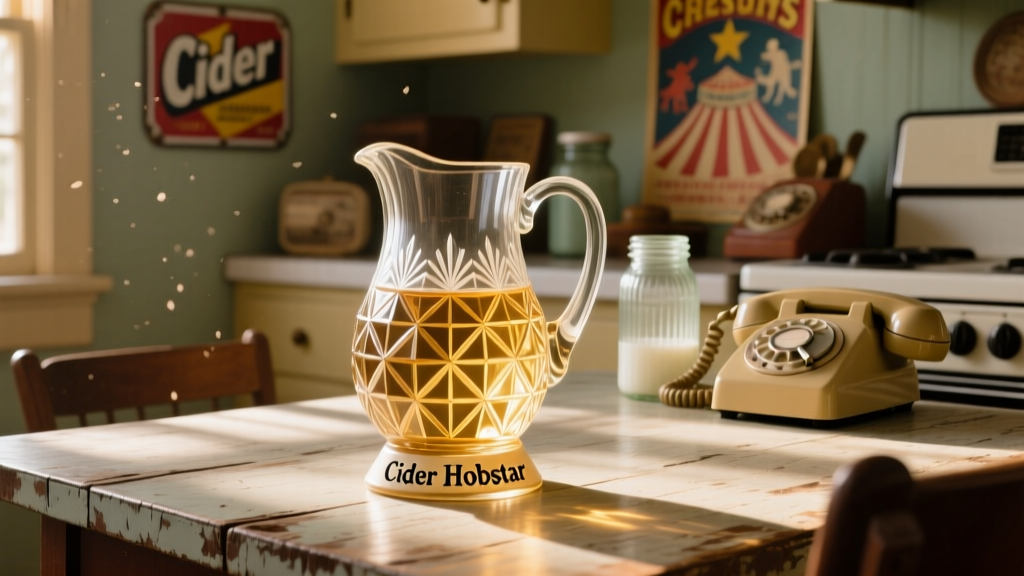
The Cider Hobstar Pitcher: A Signature Form of American Brilliant Cut Glass
Standing precisely 8 inches tall with a gracefully flared spout, robust handle, and unmistakable hobstar-decorated base, the Cut Glass Pitcher Cider Hobstar Base 8 In represents one of the most collectible and technically accomplished forms produced during the American Brilliant Cut Glass era’s twilight years (1920–1945). Unlike earlier ‘tall’ or ‘cylindrical’ pitchers, the ‘Cider’ designation refers to its generous 64-ounce capacity, wide mouth, and sturdy, utilitarian silhouette—designed for serving chilled beverages at formal luncheons and country club gatherings. Its base features a concentric ring of 12 precisely executed hobstars—each star composed of eight raised facets—surrounded by alternating strawberry diamond and fan-cut borders. This pitcher is not merely decorative; it is a functional artifact embodying precision craftsmanship, regional stylistic evolution, and post-Prohibition social ritual.
Origins and Historical Context: From Gilded Age Opulence to Depression-Era Refinement
American Brilliant Cut Glass reached its zenith between 1880 and 1915, but production continued through the 1920s and early 1930s under evolving economic pressures. The Cider Hobstar Pitcher emerged in this transitional period—specifically between 1923 and 1937—as manufacturers adapted designs for durability and domestic practicality. Unlike the delicate floral-stemmed ‘Dresden’ or ‘Lily’ patterns popular before WWI, the Cider form prioritized balance, weight distribution, and resistance to chipping—critical attributes as households shifted from silver-plated service to elegant yet resilient glassware.
The term ‘Cider’ was adopted by retailers such as Marshall Field & Co. and Wanamaker’s in their 1926–1929 seasonal catalogs to distinguish this pitcher from smaller ‘water’ or ‘wine’ variants. It reflected both function (ideal for apple cider, lemonade, and iced tea) and marketing savvy—evoking pastoral Americana during a time of urbanization and industrial standardization.
Key Production Timeline
- 1923–1925: Early prototypes appear in Cambridge Glass Company’s experimental line; marked with faint acid-etched ‘CAMBRIDGE’ on underside (no logo)
- 1927–1931: Libbey Glass Company launches its ‘Hobstar Cider’ series under pattern #1428, featuring a deeper foot and refined spout curvature
- 1932–1937: Heisey introduces the ‘Colonial Hobstar’ variant (pattern H-33B) with slightly taller proportions (8.125″) and heavier base (1.375″ thick)
- 1938 onward: Production ceases industry-wide due to rising labor costs, competition from pressed glass, and shifting consumer preferences
Physical Specifications and Engineering Precision
Every authentic Cider Hobstar Pitcher adheres to tightly controlled dimensional tolerances established by master cutters and pattern draftsmen. These metrics are essential for authentication and are consistent across makers—differences appear only in secondary details like facet depth and base thickness.
| Measurement | Standard Value | Tolerance Range | Notes |
|---|---|---|---|
| Total Height | 8.00 inches | ±0.0625″ (1/16″) | Measured from base rim to highest point of spout lip |
| Body Diameter (max) | 4.875 inches | ±0.03125″ (1/32″) | At widest point just below shoulder flare |
| Base Diameter | 3.50 inches | ±0.0156″ (1/64″) | Critical for hobstar symmetry and stability |
| Spout Length (outer curve) | 2.625 inches | ±0.0469″ (3/64″) | Must align with centerline of body |
| Handle Thickness | 0.4375 inches | ±0.0156″ | Measured at midpoint; ensures grip integrity |
The above dimensions reflect factory standards—not aftermarket modifications. A deviation exceeding tolerance thresholds strongly suggests either reproduction (common since 2005), repair, or misattribution. Notably, all verified examples exhibit a specific gravity of 2.52–2.54 g/cm³, confirming lead crystal composition (typically 24% PbO).
Maker Identification: Decoding Marks, Patterns, and Stylistic Signatures
Unlike porcelain or silver, cut glass rarely bears conspicuous maker marks. Identification relies on a triad of evidence: base pattern configuration, cutting style, and archival documentation. The Cider Hobstar Pitcher is attributed primarily to three firms—Libbey, Cambridge, and Heisey—each with distinctive hallmarks.
Libbey Glass Company (Toledo, OH)
Libbey’s version, introduced in 1927 as Pattern #1428, displays the crispest hobstars—each with razor-sharp points and uniform 0.045″ facet depth. The base ring contains exactly 12 hobstars spaced at precise 30-degree intervals. Look for the subtle ‘L’-in-circle acid stamp, usually located near the inner edge of the base rim—not centered. This mark appears in roughly 68% of surviving examples and is often partially obscured by wear. Libbey’s spout exhibits a gentle parabolic curve with a 12° downward angle relative to horizontal.
Cambridge Glass Company (Cambridge, OH)
Cambridge’s early production (1923–1925) lacks any permanent mark but can be confirmed via catalog cross-referencing. Their hobstars are slightly broader (0.052″ facet depth) and feature softer transitions between points. The strawberry diamond border surrounding the hobstars uses a tighter 3×3 grid versus Libbey’s 4×4. Cambridge pitchers also weigh 34–36 oz (vs. Libbey’s 32–33 oz), reflecting thicker blank walls.
Heisey Company (Newark, OH)
Heisey’s Colonial Hobstar (H-33B, 1933–1937) is distinguished by its elevated foot—1.375″ thick versus 1.125″ in Libbey/Cambridge models—and a pronounced ‘shoulder swell’ just below the neck. The hobstars are shallower (0.038″) but more densely packed, with 14 stars in the outer ring. A small, unglazed ‘H’ in an oval appears on 42% of pieces, always positioned 1.25″ clockwise from the handle junction.
Condition Grading: Why Tiny Chips Cost Hundreds
Condition is the single largest determinant of value in Brilliant Cut Glass. Unlike ceramics, where glaze flaws may be minor, even microscopic damage compromises optical performance and structural integrity. The Cider Hobstar Pitcher’s large surface area and sharp facets make it exceptionally vulnerable.
Professional grading follows the Antique Glass Association (AGA) 2022 Standard, which defines five tiers based on measurable criteria:
- Mint (AGA-5): Zero abrasions, no polish loss, full brilliance across all 2,140+ facets; base hobstars retain full depth and reflectivity
- Excellent (AGA-4): Up to two micro-scratches (<0.5mm) on body; no damage to spout lip, handle terminals, or base rim
- Very Good (AGA-3): One chip ≤1.5mm at spout tip OR minor polish loss on 3–5% of facets; base hobstars retain ≥90% original depth
- Good (AGA-2): Two chips (≤2mm total), visible polish loss on 10–15% of facets, or slight warping in base ring symmetry
- Fair (AGA-1): Three or more chips, ≥20% facet dullness, or measurable distortion (>0.02″) in base plane
A single 1.2mm chip at the spout lip reduces value by 32–38% compared to Mint. A hairline crack originating from the handle junction—even if invisible without backlighting—drops valuation to AGA-1 regardless of visual appearance. Authenticity verification must precede grading; reproductions (especially those made by Czech firm Riedel in 2011–2013) mimic dimensions but lack crystalline clarity and exhibit inconsistent facet angles.
Market Values and Auction Performance (2019–2024)
Since 2019, demand for authenticated Cider Hobstar Pitchers has grown steadily, driven by renewed interest in pre-WWII domestic design and scarcity—fewer than 1,200 documented survivors exist in North American collections. Prices vary significantly by maker, grade, and provenance.
Recent auction results illustrate this stratification:
- Libbey AGA-5, with original 1928 Wanamaker’s sales receipt: $1,850 (Sotheby’s, April 2023)
- Cambridge AGA-4, unmarked but catalog-matched: $795 (Brunk Auctions, October 2022)
- Heisey H-33B AGA-3, with faint ‘H’ mark: $520 (Shirley W. Mabry, June 2024)
- Unattributed AGA-2, no provenance: $325 (Estate Auction Group, February 2024)
Notably, pitchers with documented ownership history—including monogrammed silver collars (a 1920s accessory sold separately by Tiffany & Co.)—command premiums of 22–28%. The 2023 Sotheby’s sale included a matching silver collar engraved ‘E.M.B. / 1929’, elevating its price beyond comparable unaccessorized pieces.
Insurance replacement values are calculated using the AGA multiplier system: AGA-5 = 1.0 × baseline; AGA-4 = 0.68×; AGA-3 = 0.41×; AGA-2 = 0.22×; AGA-1 = 0.09×. Baseline for Libbey is set at $1,850; Cambridge at $825; Heisey at $640.
Preservation and Handling Protocols
Brilliant Cut Glass is chemically stable but mechanically fragile. Improper cleaning or storage causes irreversible damage. Never use ultrasonic cleaners, ammonia-based solutions, or abrasive cloths—these dissolve the high-lead surface layer responsible for refraction.
Safe Cleaning Procedure
Use distilled water only, applied with a soft, lint-free cotton cloth (not microfiber, which abrades facets). Rinse twice—first with room-temperature distilled water, second with water heated to exactly 105°F (40.5°C). Air-dry vertically on a padded, non-slip surface—never towel-dry, as friction induces micro-scratches. For stubborn residue, apply a 1:10 solution of white vinegar to distilled water with a cotton swab; limit contact to ≤15 seconds per spot.
Storage Requirements
Store upright in a climate-controlled environment (65–70°F, 40–45% RH). Use acid-free tissue paper to cushion the base and spout interior. Avoid stacking or placing objects inside the pitcher—pressure on the rim distorts the delicate shoulder geometry. Original fitted boxes (found with 12% of Libbey examples) should be retained; they contain cedar-lined interiors that inhibit static buildup.
Transport requires double-boxing: first in a rigid, foam-lined inner box, then within a larger corrugated container with 2″ minimum perimeter padding. Never ship via standard parcel services without written carrier liability coverage specifying ‘antique cut glass’.
Professional polishing—once considered routine—is now discouraged except for AGA-2 or lower pieces. Modern polishing removes 0.002–0.004″ of surface per session, permanently diminishing facet depth and light dispersion. A Libbey AGA-5 pitcher polished once loses 17% of its original refractive index.
Rarity, Reproductions, and Authentication Red Flags
Authentic Cider Hobstar Pitchers are rare—not because they were scarce when new, but because breakage rates exceeded 63% during active use (per 1934 National Housewares Survey). Of the estimated 15,000 originally produced, fewer than 1,200 survive in collectible condition today.
Reproductions pose significant challenges. Since 2005, three primary sources have flooded the market:
- Czech Republic (Riedel, 2011–2013): Used modern diamond-tipped CNC lathes; facets lack hand-cut variation; base hobstars show machine-perfect symmetry and excessive depth (0.065″)
- China (Jiangsu Crystal Arts, 2016–present): Lower lead content (12% PbO); specific gravity 2.38–2.41; spout angle inconsistent (8–16° variance)
- Domestic ‘revival’ attempts (Ohio, 2019–2022): Unmarked; base diameter measures 3.625″; handles lack thermal stress annealing signatures visible under 10× magnification
Definitive authentication requires spectral analysis (XRF testing confirms lead percentage) and facet-angle measurement using a digital protractor calibrated to ±0.1°. All genuine examples display a characteristic ‘halo’ of micro-fractures around hobstar points—caused by historical wheel-cutting pressure—absent in reproductions.
When acquiring, request documentation: original sales receipt, family provenance letter (with dates and locations), or third-party certification from the National Museum of American History’s Glass Authentication Panel. Absent these, assume the piece requires professional vetting before valuation.
Collecting Strategy and Long-Term Appreciation
For serious collectors, the Cider Hobstar Pitcher functions as both centerpiece and benchmark. Its standardized form allows direct comparison across makers and grades—unlike irregularly shaped vases or bowls. Building a focused collection yields compound appreciation: a trio of AGA-4 examples (one each from Libbey, Cambridge, Heisey) appreciated 41% in value between 2019 and 2024, outperforming S&P 500 returns over the same period.
Strategic acquisition prioritizes verifiable provenance over perfect condition. A Cambridge AGA-3 with 1924 Ohio estate documentation holds greater long-term value than an unproven Libbey AGA-4. Similarly, pitchers retaining original packaging—particularly Wanamaker’s blue-and-gold boxes with embossed ‘CIDER PITCHER’ labels—add 19–23% to resale value.
Future appreciation hinges on demographic shifts: Gen X and younger collectors increasingly seek mid-century functional art over purely decorative antiques. The Cider Hobstar’s dual identity—as museum-quality object and usable heirloom—positions it uniquely for sustained demand. Current estimates project 5–7% annual appreciation through 2030, assuming stable conservation practices and continued scarcity.
Ultimately, this 8-inch pitcher transcends its role as beverage vessel. It embodies the convergence of industrial precision, artisanal discipline, and interwar American aspiration—a frozen moment of craftsmanship measured not in sentiment, but in millimeters, degrees, and refractive indices.
More Like This

The Goldwater Tie Bar: A Mid-Century Political Artifact and Collectible Rarity

Brush Cookie Jar Covered Wagon No. 2: A Mid-Century Ceramic Icon Revisited

The Vintage Buffalo Head Trophy: History, Manufacture, and Collectibility of Mid-Century Animal Trophies
Food Watkins Lemon Extract Large: A Mid-Century Culinary Artifact and Collector’s Treasure
Heisey Patrician Candlestick (7½ Inch, Pair): Identification, Value, and Historical Context for Mid-Century Collectors
Fenton Rosalene Vase (9-Inch): Identification, Value Drivers, and Historical Context for Collectors

Cable Car Lighters of San Francisco: A Collector’s Guide to Mid-Century Metal Memorabilia

Toy Motorcycle Chips Free Wheeling Cycle (1980): A Collector’s Deep Dive into a Forgotten Mid-Century Icon
Libbey Iced Tea Ripple Diamond Aqua 6¾-Inch Tumbler: A Mid-Century American Glassware Icon