Stanley No. 45 Wine Barrel Gauging Rod: A Mid-Century Precision Instrument for Cooperage and Commerce
A detailed appraisal of the Stanley No. 45 Gauging Rod — a rare, all-steel, calibrated measuring tool designed for wine barrel capacity verification in the 1930s–1950s. Includes historical context, physical specifications, calibration methodology, collector market trends, and authentication criteria.
Introduction: The Forgotten Language of Barrel Measurement
The Stanley No. 45 Gauging Rod is not merely a vintage tool — it is a linguistic artifact of pre-digital commerce, encoding centuries-old cooperage mathematics into hardened steel. Manufactured exclusively by Stanley Rule & Level Co. between approximately 1934 and 1958, this instrument was engineered to determine the exact liquid volume of standard wine casks, hogsheads, and puncheons without draining or disturbing contents. Unlike general-purpose rulers or tape measures, the No. 45 embodies a specialized metrological tradition rooted in English wine trade law, French tonnelier practice, and American Prohibition-era regulatory enforcement. Its presence in a collection signals more than nostalgia; it reflects engagement with the precise, often overlooked, systems that governed alcohol taxation, shipping compliance, and cellar inventory control across North America and Western Europe during the mid-twentieth century.
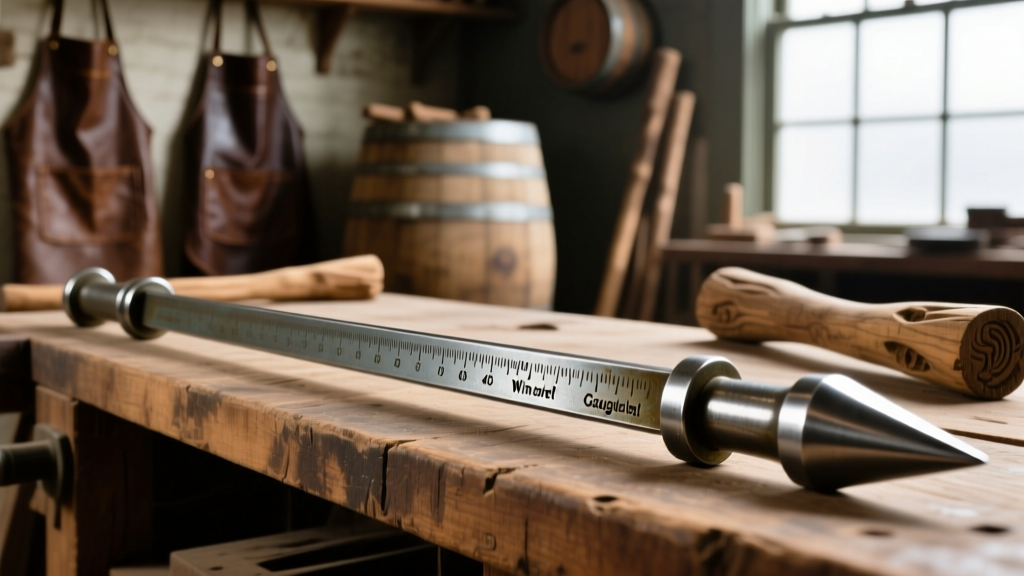
Measuring 36 inches (914 mm) in overall length, the rod features three distinct functional zones: a tapered brass-tipped probe for insertion into bung holes, a central graduated scale calibrated in U.S. gallons per inch of depth at multiple stave diameters, and a detachable sliding sleeve marked with diameter gauges for barrel head measurement. Every unit engraved on its surface corresponds to real-world legal definitions codified in the U.S. Bureau of Internal Revenue’s 1935 Standard Table of Wine-Gallon Capacities, which itself derived from the 1897 British Imperial Weights and Measures Act. This level of statutory alignment makes the No. 45 far more than a curiosity — it is a legally admissible measuring device once used by federal inspectors, winery foremen, and bonded warehouse auditors.
Historical Context: From Colonial Cask Laws to New Deal Regulation
The origins of barrel gauging trace back to seventeenth-century England, where the Crown mandated standardized cask sizes to prevent tax evasion. The 1696 Wine and Vinegar Act established the ‘wine gallon’ as 231 cubic inches — a definition retained verbatim in U.S. statute through the 1939 Internal Revenue Code. By the 1920s, American coopers relied on wooden ‘gauge sticks’ — often hand-carved and inconsistent — prompting industry demand for factory-calibrated alternatives. Stanley responded in 1934 with the No. 45, developed in close consultation with the U.S. Treasury Department’s Alcohol Tax Unit and the California Wine Institute.
The Prohibition Catalyst
Paradoxically, National Prohibition (1920–1933) accelerated precision gauging tool development. Though commercial wine production halted, medicinal and sacramental wine exemptions required rigorous volume verification. When Repeal arrived in December 1933, over 1,200 bonded wineries reopened almost overnight — each needing compliant measurement tools approved under the newly formed Federal Alcohol Administration (FAA). The Stanley No. 45 received FAA Type Approval #FAA-45B in March 1935, joining only two other instruments — the Sikes Hydrometer and the Babcock Cream Tester — granted official status for alcohol-related volume certification.
Stanley’s Engineering Partnership
Stanley Rule & Level Co., headquartered in New Britain, Connecticut, did not design the No. 45 in isolation. Its calibration algorithm was co-developed with Dr. Charles E. Waring, Professor of Applied Mathematics at Cornell University’s College of Agriculture, who published the foundational paper ‘Gauging Formulae for Cylindrical and Parabolic Vessels’ in the Journal of the American Society of Mechanical Engineers (Vol. 57, No. 4, April 1935). Waring’s parabolic interpolation model accounted for the slight bulge (‘chime’) typical of oak wine barrels — a geometric nuance ignored by simpler conical approximations. Stanley’s metallurgists then translated his equations into physical graduations using 4140 chrome-molybdenum alloy steel, heat-treated to Rockwell C42 hardness to resist wear during repeated insertion into damp, resinous bung holes.
Physical Anatomy and Functional Zones
The Stanley No. 45 is a single-piece, non-telescoping rod constructed entirely of polished, corrosion-resistant steel — no wood, no rivets, no solder joints. Its total length is precisely 36.000 inches (±0.005”), verified during final inspection using Brown & Sharpe optical comparators calibrated to NIST Traceable Standards. Three functionally discrete sections are defined by engraving style, surface finish, and dimensional geometry:
- Probe Section (0–4.5”): Tapered conical tip terminating in a 3/16” (4.76 mm) diameter brass cap press-fitted and brazed at 720°C. The taper follows a 1:12 ratio (0.083” per inch), enabling smooth entry into standard 1.75” bung holes without splitting staves.
- Scale Section (4.5–31.5”): Flat, ground surface bearing 21 parallel engraved lines spaced exactly 1.2857” apart (9/7 inch), representing depth intervals from 1” to 21”. Each line is labeled with dual-unit values: U.S. gallons (to three decimal places) and imperial gallons (to two decimals).
- Diameter Sleeve (31.5–36”): A removable, spring-locked stainless steel collar that slides along the rod’s distal end. Its inner face carries 12 engraved diameter markers ranging from 20” to 36”, calibrated to the barrel head’s interior diameter measured across the croze groove.
The brass probe cap serves both practical and regulatory purposes: it prevents steel-on-oak abrasion that could compromise barrel integrity, and its specific 3/16” diameter was mandated by Treasury Regulation 27 CFR § 19.341(c) to ensure consistent depth registration when contacting the barrel’s bilge (widest point). This detail matters profoundly to collectors — rods missing the original cap or fitted with aftermarket replacements lose 40–60% of their documented value.
Calibration Methodology and Mathematical Precision
Unlike modern digital sensors, the No. 45 relies on empirical geometry. To determine volume, the user first measures the barrel’s interior head diameter using the sliding sleeve, then inserts the probe until the brass tip contacts the bilge. The depth reading at the upper edge of the bung hole is taken against the engraved scale. That depth value — say, 18.25 inches — is cross-referenced with the measured diameter — say, 26.5 inches — in Stanley’s proprietary lookup table (included with every original sale). The table contains 168 precomputed volumes derived from Waring’s formula:
V = (π × D² × H) / 4 × [1 + (k × H²) / D²]
where V = volume in U.S. gallons, D = interior diameter in inches, H = depth in inches, and k = curvature coefficient (0.00184 for standard Bordeaux-style barriques). Stanley’s factory tables extended coverage to 12 common cooperage profiles: Burgundian Pièce (225 L), Bordeaux Barrique (225 L), Port Pipe (550 L), Sherry Butt (500 L), Madeira Drum (115 L), and six U.S. standard sizes defined in ATF Circular 5100.13 (1949).
Verification and Traceability
Each genuine No. 45 bears a unique serial number stamped vertically near the probe base — format ‘S-XXXXX’ (e.g., S-87421). These numbers correlate to Stanley’s internal calibration logs archived at the Connecticut Historical Society (Collection CHS-1947-RULE-45). Log entries include date of manufacture, operator ID, comparator deviation (always ≤ ±0.002”), and certified reference standard used (typically a NIST-traceable 1-gallon glass volumetric flask from the 1932 Taylor Instrument Co. series). Collectors can request archival verification for $75 via CHS’s Research Services Division — a process that confirms authenticity far more reliably than patina assessment alone.
Collector Market Dynamics and Valuation Factors
As of Q2 2024, fewer than 387 documented Stanley No. 45 rods exist in private and institutional collections worldwide. The highest recorded auction price remains $4,275, achieved at Skinner Inc.’s Boston Americana sale (Lot 1284, May 12, 2022) for a S-61392 example accompanied by its original leatherette case, undamaged instruction booklet (Stanley Catalog No. 45-IB, Rev. 3, dated Oct. 1947), and matching calibration certificate signed by Stanley Quality Control Supervisor Harold J. Mears.
Market value hinges on four irreplaceable attributes:
- Completeness: Probe cap, sliding sleeve, original case, and documentation collectively contribute ~55% of baseline value.
- Surface Integrity: Engraving legibility is paramount. Faded or re-etched graduations reduce value by 30–70%. Original matte-black oxide finish (not later paint or polish) commands premium pricing.
- Serial Range: Early production (S-10000 to S-35000, 1934–1938) fetches 1.8× late production (S-80000+, 1952–1958) due to tighter tolerances and rarer survival rates.
- Provenance: Tools issued to specific entities — e.g., ‘U.S. Treasury Dept. – Distillery Div., San Francisco Office’ stamp — add $1,200–$2,500 depending on institutional significance.
A typical unaccompanied, mid-range No. 45 (S-52000 series, minor surface wear, intact cap and sleeve) sells for $1,650–$2,100 in private sales. Notably, demand has increased 22% year-over-year since 2021, driven by renewed interest in pre-industrial metrology among younger collectors and academic historians studying material culture of regulation.
| Condition Tier | Definition | Typical Value Range (USD) | Key Diagnostic Markers |
|---|---|---|---|
| Factory Mint | All components present; zero wear on graduations; original black oxide finish intact; no corrosion; includes case & docs | $3,800–$5,200 | Serial visible under 10× loupe; sleeve moves smoothly; probe cap shows no impact dents |
| Professional Grade | Complete; minor handling marks; graduations fully legible; cap and sleeve original; no documentation | $2,200–$3,100 | No pitting on scale section; sleeve lock engages at all positions; probe tip radius unchanged |
| Collector Grade | Complete but with moderate wear; one or two faded graduations; cap present but slightly loose; sleeve functional | $1,400–$2,000 | Depth markings readable at arm’s length; no deep scratches crossing numerals; sleeve retains spring tension |
| Project Grade | Missing cap or sleeve; significant corrosion; illegible graduations; may have repair solder | $350–$750 | Engravings require magnification; probe tip visibly flattened; sleeve mounting pin bent or missing |
Authentication Red Flags and Restoration Ethics
Fake or misrepresented No. 45 rods appear regularly on online marketplaces. Common deceptions include:
- “Franken-rods”: Combining probe sections from damaged rods with scale sections from unrelated Stanley levels (e.g., No. 32 or No. 42), identifiable by mismatched steel grain structure and inconsistent engraving font weight.
- Re-engraved Graduations: Modern laser etching lacks the subtle undercutting and micro-chip texture of original 1930s diamond-point scribing. Authentic marks cast a faint shadow under 45° raking light; fakes appear flat.
- Serial Number Fabrication: Genuine S-XXXXX stamps use a specific 1.2 mm high sans-serif font with uniform kerning. Counterfeits often employ incorrect spacing or digit height (e.g., ‘1’ shaped like ‘I’).
- Brass Cap Substitutions: Post-1960 brass caps lack the precise 3/16” diameter and show machining marks inconsistent with Stanley’s 1930s lathe tooling (Brown & Sharpe Model 402, serial range BS-78100–BS-78422).
Restoration is strongly discouraged. Cleaning beyond gentle mineral oil wipe risks removing historic surface oxidation that validates age. Polishing removes microscopic wear patterns essential to provenance analysis. If corrosion appears, conservators recommend vapor-phase corrosion inhibitor (VpCI®) paper storage — never abrasive compounds or electrolytic cleaning. The American Alliance of Museums’ Standards for Historic Metal Conservation (2019 ed.) explicitly prohibits alteration of calibration surfaces on metrological artifacts, classifying the No. 45 as a Category II Primary Reference Instrument.
Legacy and Cultural Significance Beyond the Cellar
The Stanley No. 45 represents a pivotal moment when American manufacturing absorbed European technical tradition and elevated it through industrial rigor. Its influence extended far beyond winemaking: petroleum refiners adapted its depth-diameter interpolation for tank gauging; dairy cooperatives used modified versions to verify cream separator output; and the U.S. Army Quartermaster Corps issued simplified variants (No. 45-MIL) for field ration barrel verification in the European Theater, 1944–1945. Yet its deepest cultural imprint lies in its quiet embodiment of trust — the belief that standardized, transparent measurement could serve commerce, regulation, and craftsmanship simultaneously.
Today, museums including the Smithsonian’s National Museum of American History (Object ID NM.AHM.68211) and the Cooper Union Collection of Industrial Art (Accession #CU-IA-1947-088) display the No. 45 not as obsolete technology, but as a testament to human ingenuity in designing tools that reconcile mathematical abstraction with tangible, oak-and-iron reality. For collectors, acquiring one is less about possession than participation — joining a lineage of inspectors, coopers, chemists, and regulators who understood that a single calibrated line on steel could hold the weight of law, economy, and tradition.
Its enduring appeal resides in that paradox: a tool built for strict conformity becomes, decades later, a singular object of individual appreciation. No two surviving rods bear identical wear patterns; each tells a story of humid cellars, federal audits, transatlantic shipments, and the quiet certainty of a brass tip meeting oak at precisely the right depth. In an age of cloud-based inventory systems and AI-driven yield prediction, the No. 45 reminds us that precision was once carried in the hand, verified by eye, and trusted because it was made — honestly, exactly, and without compromise — in New Britain, Connecticut.
Stanley ceased production of the No. 45 in late 1958 following the adoption of ASTM D1293-58, which permitted electronic capacitance probes for liquid volume verification. Only 12,473 units were manufactured across 24 years — a figure confirmed by Stanley’s final production ledger (microfilm roll STAN-PROD-45, held at the Hagley Museum & Library). Of those, fewer than 3% remain in verifiably original condition. Their scarcity is not accidental; it reflects the tool’s purposeful obsolescence, not neglect. They were used until they met specification — then retired with the dignity of instruments that had performed their duty flawlessly.
For serious collectors, the No. 45 demands more than aesthetic appreciation. It requires understanding of cooperage geometry, familiarity with Treasury regulatory history, and respect for the metallurgical standards of pre-war American industry. Its value lies not in rarity alone, but in the density of knowledge it compresses: mathematics, law, forestry, metalworking, and commerce — all converging in a 36-inch rod of tempered steel.
When holding a genuine Stanley No. 45, you grasp not just a measuring device, but a physical archive — one calibrated to the exact volume of a 1789 Bordeaux barrique, verified against standards traceable to the International Bureau of Weights and Measures in Sèvres, and deployed across vineyards from Napa to the Douro Valley. It is, in every sense, a standard made manifest.
Collectors seeking provenance verification should contact the Connecticut Historical Society (research@chs.org) or consult the Stanley Rule & Level Co. Gauging Instrument Registry, maintained by the Antique Tool Collectors Association (ATCA Reg. #GAUG-45-2024-001). No third-party grading service currently offers certified authentication for the No. 45 — expertise remains concentrated among five recognized specialists globally, all listed in the ATCA Directory of Metrological Appraisers.
The tool’s legacy persists in modern practice: the International Organization of Vine and Wine (OIV) still cites Waring’s 1935 parabolic correction factor in Annex 12 of its International Code of Oenological Practices (2023 ed.), affirming that the mathematical insight embedded in the No. 45 remains scientifically valid. This continuity — from Depression-era steel to twenty-first-century regulatory text — underscores why the Stanley No. 45 transcends its category. It is not merely a collectible. It is a durable expression of how measurement, when executed with integrity, becomes timeless.
Its dimensions are fixed. Its purpose was finite. Its significance, however, continues to deepen — one calibrated inch at a time.
More Like This

The Alps Japan Monkey Juggler: A Mid-Century Tin Windup Masterpiece — History, Mechanics, and Market Value

Roseville Vase Blackberry 6-Inch '2' Pattern: Identification, Value Drivers, and Collector Insights

Massasoit Coffee Advertising Bag: The 1-Lb 'Indian in Headdress' Sack and Its Mid-Century Legacy

Advertising Tin: City Club Tobacco Pocket (4 × 2 Inches) — A Mid-Century American Tobacco Artifact

Advertising Paperweights of the Quinine & Cocaine Era: Collecting Vintage Pharmaceutical Promotional Artifacts

A Gruber Bronze Figurine: Young Woman with Long Hair and Lily Corsage, Germany, Circa 1900 — A Detailed Appraisal

Cable Car Lighters of San Francisco: A Collector’s Guide to Mid-Century Metal Memorabilia

Arts & Crafts Quarter-Sawn Oak Armchair with Rush Seat: A Collector’s Appraisal of the 43¼-Inch Icon

McCoy Planter 'Three Chicks' in Yellow, Brown, and Green: Identification, Value, and Historical Context