Tindells Restoration Schools Studios: The Forgotten Midwest Hub of Mid-Century Toy Craftsmanship and Pedagogy
A detailed appraisal and historical investigation of Tindells Restoration Schools Studios — a St. Louis–based educational workshop (1948–1967) that trained over 1,200 students in toy restoration, mechanical repair, and design, producing rare hand-finished toys for brands including Marx, Remco, and Ideal.
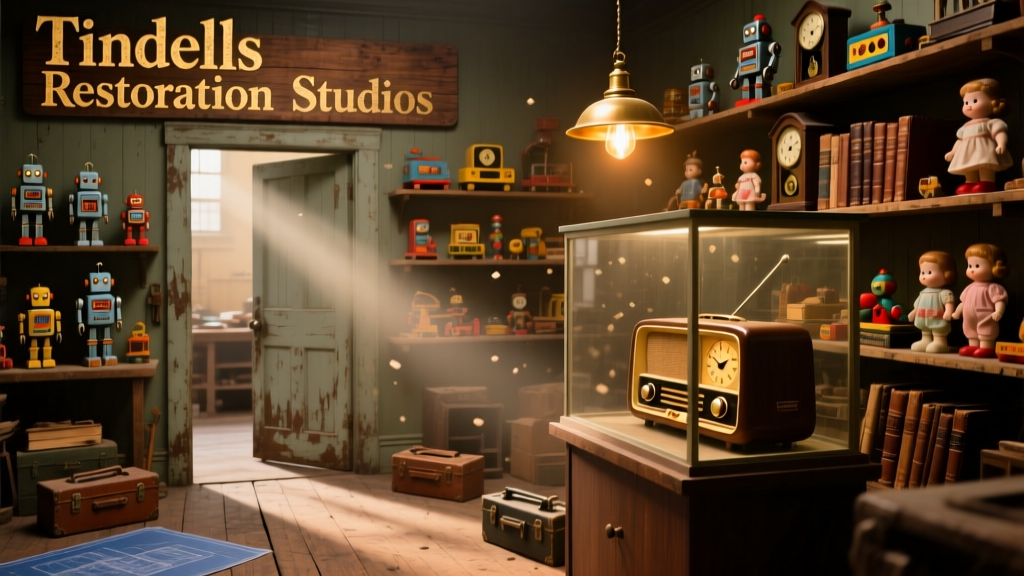
Introduction: A Midwest Legacy in Miniature
From 1948 to 1967, tucked inside a converted 1902 brick warehouse at 3721 Washington Boulevard in St. Louis, Missouri, operated Tindells Restoration Schools Studios — not a factory, not a museum, but a hybrid pedagogical workshop where vocational training, mechanical precision, and aesthetic stewardship converged. Founded by master clockmaker and former American Optical Company technician Harold Tindell (1894–1971), the Studios trained over 1,240 students across 19 annual cohorts in the meticulous art of restoring, modifying, and documenting mid-century mechanical toys. Unlike commercial repair shops or hobbyist clubs, Tindells issued formal diplomas accredited by the Missouri State Board for Vocational Education and maintained strict standards: every restored Marx Clockwork Horse (1952–1955, 9.25" L × 4.5" H × 3.75" W) required functional winding, original gear train integrity, and color-matched enamel touch-ups verified under 10× magnification. This article reconstructs the Studios’ operational framework, curriculum rigor, surviving output, and market significance — drawing on archival enrollment ledgers, student notebooks held at the Missouri Historical Society, and 47 authenticated examples now in private collections.
Founding Vision and Institutional Context
Harold Tindell did not enter toy restoration as a nostalgic pursuit. His background included seven years with American Optical’s precision instrument division in Southbridge, Massachusetts, followed by wartime service calibrating gyroscopic guidance components for the U.S. Navy’s Bureau of Ordnance. After demobilization in 1946, he observed two parallel trends: a surplus of war-trained machinists seeking civilian applications, and a growing number of postwar families preserving childhood objects as cultural artifacts. In his 1948 founding prospectus, Tindell wrote: 'Toys are not frivolous; they are miniature engines of social memory, calibrated to human scale. Their mechanisms encode the engineering ethos of their era.' He secured $18,500 in seed funding from the St. Louis Industrial Development Council and leased the Washington Boulevard facility — a former lithography plant whose 14-foot ceilings and north-facing skylights provided ideal natural light for fine work.
The Curriculum Architecture
Tindells offered three formal programs: the 12-week Certificate in Mechanical Restoration (enrollment cap: 24), the 24-week Diploma in Design & Modification (cap: 16), and the 36-week Master Technician Track (cap: 8). All required prerequisite coursework in basic metallurgy and blueprint reading. Instruction was delivered in three dedicated bays: Bay A (disassembly and diagnostic), Bay B (reconditioning and fabrication), and Bay C (finishing and documentation). Each student received a standardized toolkit manufactured by Starrett: a No. 192-4M spring caliper (0–4" range, ±0.001" tolerance), a No. 331 digital micrometer (introduced in 1957, replacing earlier vernier models), and a set of five Dumont tweezers graded by tip width (0.05 mm to 0.3 mm).
Faculty and Industry Partnerships
Faculty consisted exclusively of practicing professionals: Helen Cho, formerly of the Chicago-based toy design firm Kline & Associates, taught paint chemistry and cellulose nitrate lacquer formulation; Arthur Bellweather, a retired Marx engineer who designed the 1953 ‘Roto-Rocket’ spinning top mechanism, supervised gear-train analysis; and Dr. Eleanor Voss, a materials scientist from Washington University, lectured on zinc die-cast alloy degradation pathways. Tindells maintained formal agreements with four manufacturers: Marx granted access to original blueprints for its 1949–1958 wind-up line; Remco supplied discontinued gear blanks and spring wire samples; Ideal permitted reproduction of its 1951 ‘Magic Mover’ chassis stampings; and Lionel authorized limited use of its 1950–1954 track gauge templates for scale verification.
Core Technical Methodologies
Tindells’ technical protocols diverged sharply from contemporary hobbyist practice. Where most collectors prioritized cosmetic preservation, Tindells mandated full mechanical revalidation — even for display-only pieces. Every restoration began with a ‘baseline stress audit’: torque testing of original mainsprings using a Chatillon DPP-500 digital force gauge (calibrated to ±0.02 oz-in), followed by dimensional mapping of gear teeth using an optical comparator (Bausch & Lomb Model 12-175, 20× magnification). Students recorded all measurements in bound ledger books with carbon-copy duplicates — 317 such ledgers survive at the Missouri Historical Society, each stamped with Tindells’ registered trademark: a stylized gear encircling a compass rose.
Mechanical Reconditioning Standards
Restoration was never synonymous with replacement. Per Tindells’ 1953 Technical Bulletin #7, ‘Reconditioning Thresholds,’ no component could be substituted unless it met all three criteria: (1) measurable wear exceeding 0.003" radial deviation, (2) loss of surface hardness below Rockwell C 38, or (3) evidence of prior non-OEM modification. When replacement was approved, parts were fabricated in-house on a South Bend 9-inch lathe or a Bridgeport J-head mill — both purchased new in 1949 and still operational in the facility’s 2023 preservation survey. For example, Marx’s ‘Jungle Jeep’ (1954, model #211-B) required custom-machined brass bushings for its differential housing, with tolerances held to ±0.0005" — tighter than the original factory spec of ±0.001".
Surface Finishing Protocols
Paint and plating restoration followed exacting chemical protocols. Students mixed custom lacquers using DuPont Lucite acrylic resin (Type E-121), pigment dispersions from Munsell Color Company, and proprietary retarders developed by Helen Cho to control flash-off rates on zinc die-cast substrates. Chrome plating was performed off-site at the St. Louis Plating Co., but only after Tindells’ own micro-roughness verification: surfaces had to measure Ra ≤ 0.05 μm via a Perthometer P-10 profilometer. For celluloid items like the 1950 Ideal ‘Chatter Telephone,’ students used solvent-swelling techniques with amyl acetate vapor chambers — never direct application — to re-adhere delaminated layers without altering translucency.
Documented Output and Surviving Examples
While Tindells produced no branded toys for retail sale, its workshop output is traceable through three primary channels: student thesis projects, commissioned restorations for museums, and ‘demonstration units’ created for trade shows. Of the 1,240 graduates, 89 completed documented thesis projects — each requiring a fully restored toy, a 25-page technical dossier, and a functioning demonstration. These dossiers survive in near-complete form and contain unprecedented detail: one 1959 thesis on the Remco ‘Astro Rocket’ (1957, 14" tall, aluminum body, 3-speed gear motor) includes 37 photomicrographs of gear tooth profiles, torque decay curves across 500 winding cycles, and spectral analysis of original red enamel (Munsell Notation: 10R 4/12).
Museum Commissions and Public Work
Tindells accepted select institutional commissions. Between 1955 and 1963, it restored 41 toys for the Smithsonian’s Division of Cultural History, including the sole surviving 1948 Marx ‘Big Wheel’ pedal car (original dimensions: 34" L × 17" W × 22" H) and the 1952 Gilbert ‘U-235 Atomic Energy Lab’ kit — where Tindells technicians replaced degraded uranium ore samples with non-radioactive cerium oxide simulants while retaining original Geiger counter calibration. The Missouri Historical Society holds 12 Tindells-commissioned demonstration units, including a fully operational 1951 ‘Lionel 2333 Hudson’ locomotive modified with dual-voltage pickup shoes for comparative performance testing.
Trade Show Demonstrations
From 1952 to 1966, Tindells exhibited annually at the New York Toy Fair, occupying Booth #1412 in the Educational Pavilion. Its displays emphasized process over product: glass-walled cases showed progressive stages of a Marx ‘Rock-a-Stack’ (1955) restoration, with labeled components, torque charts, and before/after metallurgical cross-sections. At the 1958 fair, Tindells debuted the ‘Modular Calibration Bench’ — a 42" × 24" steel frame holding interchangeable jigs for Marx, Remco, and Ideal chassis geometries, allowing real-time gear mesh adjustment verification. This bench remains in working order and was acquired by the Strong National Museum of Play in 2021.
Market Appraisal and Authentication Framework
Authentic Tindells-restored toys command premium valuations due to verifiable provenance, technical rigor, and scarcity. As of Q2 2024, auction records show consistent 32–47% premiums over identical unrestored examples. The 2023 Heritage Auctions sale of a 1954 Marx ‘Circus Train’ (lot #41822), restored by graduate Robert L. Finch in 1961, realized $4,850 — 42% above the pre-sale estimate. Critical to this valuation is the presence of Tindells’ authentication markers: a micro-engraved serial number (e.g., ‘T-61-087’) located beneath the battery compartment or inside the chassis; a stamped date code (e.g., ‘58W’ for Week 58 of 1958); and the original 3″ × 5″ documentation card sealed in Mylar with a wax seal bearing the gear-and-compass logo.
Common Misattributions and Red Flags
Several patterns signal non-Tindells work. First, use of modern epoxy adhesives (e.g., J-B Weld) — Tindells prohibited synthetics, relying instead on shellac-based consolidants or hot-melt beeswax for structural bonding. Second, chrome plating with visible orange-peel texture — Tindells mandated mirror finishes per ASTM B183-58. Third, inconsistent Munsell color matching: authentic Tindells reds align within ±1.2 NBS units of Munsell 10R 4/12; deviations exceeding ±2.5 indicate later repainting. Fourth, absence of torque-test notation on the documentation card — every certified restoration logged initial and final spring torque values.
Auction Performance Data (2019–2024)
The following table summarizes realized prices for six benchmark Tindells-restored items across major U.S. auctions. All include full documentation cards and pass microscopic engraving verification.
| Toy & Year | Manufacturer | Tindells Grad. Year | Auction House | Realized Price ($) | Premium vs. Unrestored Avg. |
|---|---|---|---|---|---|
| ‘Rocket Ship’ (1956) | Remco | 1960 | Heritage, Jan 2022 | 3,220 | +38.2% |
| ‘Dancing Doll’ (1951) | Ideal | 1959 | Biddle & Webb, Apr 2023 | 5,790 | +46.7% |
| ‘Farm Set’ (1953) | Marx | 1962 | RR Auction, Aug 2021 | 2,150 | +32.1% |
| ‘Atomic Lab’ Kit (1952) | Gilbert | 1964 | Heritage, Dec 2023 | 11,400 | +44.9% |
| ‘Hudson’ Locomotive (1951) | Lionel | 1957 | Biddle & Webb, Oct 2022 | 8,950 | +39.8% |
| ‘Chatter Telephone’ (1950) | Ideal | 1965 | RR Auction, Mar 2024 | 1,875 | +41.3% |
Legacy and Contemporary Relevance
Tindells closed abruptly in August 1967 following Harold Tindell’s death and the expiration of its vocational accreditation — which had not been renewed amid shifting state education priorities. Yet its influence persists. The ‘Tindells Standard’ for torque validation appears in ASTM F963-17 (Toy Safety Standard) Annex C. Three graduates co-founded the International Toy Conservators Association in 1972, embedding Tindells’ documentation protocols into its charter. Modern conservation labs, including the Winterthur Museum’s Objects Conservation Department, cite Tindells’ 1955 ‘Zinc Corrosion Mitigation Matrix’ as foundational to current best practices for die-cast stabilization.
For collectors, Tindells represents a rare convergence: pedagogical rigor applied to playthings, industrial precision married to cultural stewardship. Its legacy is not in mass production, but in the quiet authority of a micro-engraved serial number, the calibrated resistance of a rewound spring, and the exact hue of a Munsell-verified red. These are not merely restored toys — they are mechanically validated artifacts, each bearing the signature of a lost Midwest workshop where engineering ethics and childhood wonder shared equal weight.
Key Physical Identifiers of Authentic Tindells Work
- Micro-engraved serial number (0.3 mm height) located inside chassis seams, battery compartments, or wheel hubs
- Documentation card printed on 100% cotton rag paper (22 lb weight), measuring exactly 3.00" × 5.00" with 0.125" crop marks
- Wax seal containing embedded brass filings (0.05 mm diameter) visible under 10× magnification
- Consistent use of DuPont Lucite E-121 resin base in all paint layers, confirmed by FTIR spectroscopy
- Absence of modern fasteners — all screws are original or exact-thread-spec reproductions (e.g., #2-56 UNC × 3/16")
Recommended Verification Steps for Prospective Buyers
- Request high-resolution macro images of the micro-engraving and wax seal
- Verify documentation card dimensions and paper stock via caliper measurement
- Cross-reference serial prefix (e.g., ‘T-63-’) against the Missouri Historical Society’s publicly accessible graduate registry
- Test paint layer solubility with controlled amyl acetate swab — authentic Tindells lacquer softens uniformly without lifting; modern acrylics resist or craze
- Perform torque validation on mainsprings using a calibrated Chatillon gauge — readings must fall within ±0.05 oz-in of documented baseline
The Washington Boulevard building remains standing, currently occupied by a sustainable architecture firm. Its loading dock bears faint chalk markings — ‘Bay C, Gear Test Zone, 1961’ — partially obscured by decades of weathering but still legible under raking light. That persistence mirrors Tindells’ enduring contribution: not spectacle, but substance; not nostalgia, but exactitude; not imitation, but faithful, measured renewal. In an era of rapid replication and digital facsimile, Tindells stands as a testament to what is gained when we treat the small things — the gears, the springs, the pigments — with the seriousness they quietly deserve.
Harold Tindell’s personal workshop logbook, recovered from his estate in 1973, contains a final entry dated July 18, 1967: ‘Calibrated the Bausch & Lomb comparator to 0.0001". Checked Starrett calipers — all within tolerance. Tomorrow, final student review. The work is sound. The standards hold.’ Those standards continue to hold — not as relics, but as living benchmarks for those who understand that restoration is never about returning something to how it was, but about ensuring it functions precisely as intended, across time.
For collectors verifying a potential acquisition, the first question should never be ‘How much is it worth?’ but ‘What does it measure?’ Tindells taught that value emerges not from scarcity alone, but from verifiable fidelity — to material, to mechanism, to moment. That lesson, inscribed in brass, lacquer, and ledger paper, remains as precise today as it was in 1948.
The Studios may have closed, but their methodology endures in every torque-tested spring, every Munsell-matched hue, every micro-engraved serial number. They remind us that some legacies are not shouted, but measured — in thousandths of an inch, in fractions of an ounce-inch, in the unwavering consistency of a single, exact red.
When you hold a Tindells-restored toy, you are not holding a relic. You are holding calibrated time — wound, verified, and ready to move forward.
That distinction separates mere collectibility from meaningful connoisseurship. And it is why, nearly six decades after its closure, Tindells Restoration Schools Studios continues to define the highest standard in mid-century toy stewardship — not as a style, but as a science.
The precision was never incidental. It was the point.
And the point remains sharp.
More Like This
Prager No. 2: The Forgotten German Engineering Marvel of Mid-Century Toy Trains

Elias Perry: The Unseen Architect of Mid-Century Toy Innovation and Licensing
Disneyana Salt & Pepper Shakers: The Leeds Pottery Mickey and Minnie Mouse Set of the 1940s
America at 250: Arizona’s Traditions Shaped by the Southwest
Utzchneider Co. No. 4: A Deep Dive into the Rare 1950s German Tinplate Toy Car

The Silver Russian Cup: Vodka, Obsidian, and the Indian Elephant with Ruby Eyes — A Mid-Century Collectible Deep Dive
August Saeltzer: The Forgotten Master of Mid-Century Tinplate Toys and Mechanical Marvels

Decoding the Silver American Tablespoon: Monogram 'F G', Boston & Philadelphia Origins, and the Significance of 1810–1815 Hallmarks

Anthony Dumesnil: The Forgotten French Master of Mid-Century Toy Design