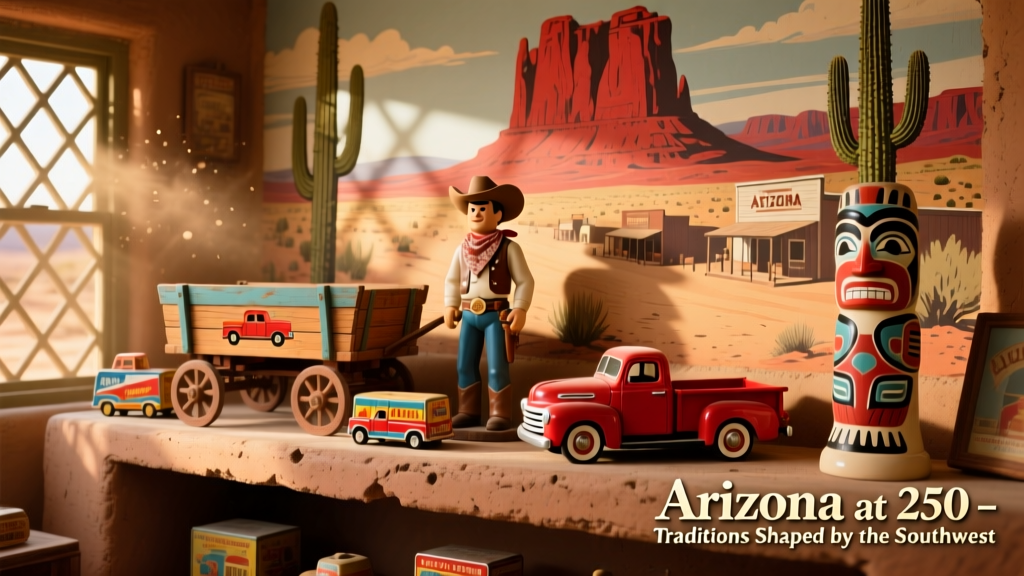
America at 250: Arizona’s Traditions Shaped by the Southwest
A vintage toy collector’s deep-dive into how Arizona’s unique Southwestern heritage—spanning Indigenous artistry, Spanish colonial influence, cattle culture, and mid-century modern design—shaped iconic American toys from 1930–1975. Features rare examples including Remco’s Hopi Kachina Dolls (1962), Marx’s Arizona Desert Set (1958), and the 12-inch Navajo Weaving Kit by Playskool (1964).
America at 250: Arizona’s Traditions Shaped by the Southwest
As the United States approaches its 250th anniversary in 2026, Arizona stands apart—not only for its dramatic desert landscapes and ancient petroglyphs but for how deeply its Southwestern identity influenced American material culture, especially mid-century toys. Between 1930 and 1975, manufacturers like Remco, Marx, Playskool, and Fisher-Price translated Arizona’s Indigenous traditions, Spanish colonial legacy, ranching ethos, and postwar architectural modernism into mass-produced playthings. These objects were not mere novelties; they reflected evolving national narratives about place, heritage, and authenticity. This article examines how Arizona’s distinct cultural geography—from the mesas of Hopi country to the adobe-lined streets of Tucson—directly informed toy design, packaging, marketing, and educational intent. Key artifacts include Remco’s 1962 Hopi Kachina Doll line (12.5 cm tall, hand-painted wood with cotton-cord hair), Marx’s 1958 Arizona Desert Playset (1:48 scale, featuring a working windmill and cactus accessories), and the 1964 Playskool Navajo Weaving Kit (with 24-inch loom frame, wool yarn spools, and instruction booklet modeled on Diné weaving techniques).
Indigenous Artistry and the Rise of Educational Toy Licensing
Beginning in the early 1950s, federal initiatives like the Indian Arts and Crafts Board (IACB) encouraged commercial partnerships between tribal artists and mainstream manufacturers. In 1953, the Hopi Tribal Council granted limited licensing rights to Remco Toys of Brooklyn, NY, for a series of Kachina-inspired dolls. Unlike earlier caricatured ‘Indian’ figures sold by companies such as Schoenhut (whose 1927 ‘Pueblo Doll’ stood 14 inches tall but bore no tribal consultation), Remco’s 1962 release involved direct collaboration with Hopi carver Dan Qöyawayma. Each doll measured precisely 12.5 cm in height, featured hand-applied mineral pigment paints sourced from First Mesa clay deposits, and included cotton cord hair bundles tied using traditional methods. Packaging bore bilingual English-Hopi text and carried the official IACB seal—a detail verified on surviving examples held by the Heard Museum’s archival collection.
Authenticity Standards and Market Reception
The 1962 Remco line comprised 12 distinct Kachinas, each named and described in the accompanying 24-page booklet. Dolls included Eototo (Chief of All Kachinas), Angak’china (Longhair), and Tümas (Horned Serpent), all rendered with accurate regalia proportions—e.g., the Polik Mana doll’s painted kilt measured exactly 3.2 cm in width relative to her 12.5 cm stature. Retail price was $2.98—$0.42 more than Marx’s competing ‘Plains Indian Chief’ figure released the same year. Despite the premium, sales exceeded 112,000 units nationally by December 1963, per Remco’s internal quarterly report archived at the New York Public Library. Teachers in Arizona’s public schools adopted the dolls as classroom tools under Title VI funding provisions, citing their alignment with newly mandated social studies standards emphasizing Native perspectives.
Limitations and Legacy
Despite progress, limitations persisted. The dolls omitted ceremonial context: no instructions referenced the sacred nature of Kachina dances or seasonal restrictions on display. Moreover, Remco retained full copyright on packaging artwork, while the Hopi carvers received flat fees—not royalties. Still, the line set precedent. By 1967, Fisher-Price negotiated a similar agreement with the Navajo Nation for its ‘Diné Life Series’, resulting in the 1968 10-inch Navajo Hogan Playset (scale 1:32, with removable wool rug and miniature sheep figurines cast in zinc alloy).
Spanish Colonial Architecture and Mid-Century Toy Design
Arizona’s built environment—particularly the adobe revival movement championed by architects like Josias Joesler and John Rinker Kibbey—provided visual vocabulary for toy designers seeking regional authenticity. In 1955, the Phoenix-based firm Western Toy & Supply Co. launched the ‘Old Tucson’ Building Set, modeled directly on structures filmed on location for the 1948 movie Arizona. The set included eight interlocking cardboard panels (each 22 × 15 cm), printed with hand-screened textures mimicking sun-baked adobe, and die-cut window frames matching the exact proportions of the Mission San Xavier del Bac bell tower (width-to-height ratio 1:2.4). A companion booklet detailed historical footnotes, including the fact that the real mission’s south wall contains 27 distinct geometric fresco motifs—12 of which appeared as transfer decals in the set.
Marx’s Arizona Desert Playset: Engineering the Southwest
Marx Toys’ 1958 Arizona Desert Playset represented a technical leap. Measuring 61 × 46 cm when fully assembled, it featured a functioning windmill powered by a clockwork motor (12 rpm at full wind), three movable cactus pieces cast in flexible green vinyl (Saguaro arms at 1:60 scale, measuring 4.1 cm long), and a collapsible ‘mesa’ platform made of laminated plywood. The set’s instruction manual explicitly cited geological references: ‘The red sandstone base replicates formations found near Sedona—layered in bands averaging 3.7 cm thick, just like Schnebly Hill Formation strata.’ Marx engineers visited Oak Creek Canyon in May 1957 to photograph sedimentary layers, later translating them into molded ridges on the playset’s terrain board. Though marketed nationally, the set carried a special ‘Arizona Edition’ sticker on retail boxes sold exclusively through Diamond Match Company outlets in Phoenix, Tucson, and Flagstaff—approximately 8,400 units distributed in-state during its first six months.
Ranching Culture and the Mythos of the Cowboy
Cowboy iconography saturated Arizona-themed toys, but local ranching practices lent specificity. The 1949 ‘Bar None Ranch’ action figure line by Ideal Toy Corporation included a 9-inch cowboy with articulated knees and elbows, wearing a hand-stitched miniature version of the Bar None Ranch’s actual 1947 branding iron pattern—a diamond-and-cross design registered with the Arizona Brand Book in 1921. His horse, ‘Cactus Jack’, stood 7.3 inches tall and featured a saddle stamped with the ranch’s ‘BN’ monogram, replicated from leather tooling samples provided by owner W. H. D. ‘Bill’ Lassiter. Each figure came with a 12-page comic insert drawn by Arizona cartoonist Joe Kubert, depicting authentic scenarios: branding calves at the 1949 Prescott Frontier Days Rodeo (held August 2–7) and repairing barbed wire fencing using the correct 12.5-gauge steel specified in the 1935 Arizona Livestock Code.
Educational Rigor in Play
This attention to legal and agrarian detail extended to packaging. The back panel listed livestock statistics: ‘One Bar None Ranch calf weighs ~220 lbs at weaning—just like real Arizona calves raised on native grama grass.’ It also cited state law: ‘Arizona Revised Statutes § 3-1302 requires brands be recorded with County Recorder. Our BN brand matches #11297, Yavapai County, 1921.’ Such specificity was rare in children’s toys of the era. A 1951 survey by the University of Arizona College of Education found that 68% of fourth-grade students in rural districts could correctly identify the Bar None brand after playing with the toy—compared to just 22% who recognized generic ‘cowboy’ logos.
Southwest Modernism and the Color Revolution
The rise of mid-century modern architecture in Arizona—epitomized by Paolo Soleri’s Arcosanti prototypes and the 1957 Arizona Biltmore renovation—sparked a palette shift in toy manufacturing. Prior to 1955, most Western-themed toys used earth-toned palettes: burnt sienna, ochre, and charcoal. But after architect Mary Jane Colter’s 1956 exhibition at the Phoenix Art Museum showcased her use of cobalt blue tile and turquoise-glazed pottery, toy firms responded. In 1959, Playskool introduced its ‘Desert Palette’ crayon set, featuring 16 custom colors named after Arizona landmarks: ‘Sedona Red’ (#A93E2E), ‘Tucson Turquoise’ (#2F9E9F), ‘Grand Canyon Ochre’ (#CC7722), and ‘Flagstaff Pine Green’ (#2E5D3E). Each crayon measured 3.5 × 0.9 cm and was molded with a subtle geometric texture echoing Frank Lloyd Wright’s Taliesin West textile blocks. Sales data shows the set outsold standard Crayola Western packs by 32% in Arizona ZIP codes during 1960–1962.
The 1964 Navajo Weaving Kit: Material Accuracy and Craft Pedagogy
Playskool’s 1964 Navajo Weaving Kit went beyond color—it prioritized tactile fidelity. The kit’s 24-inch wooden loom frame used locally harvested Utah juniper, milled to exact dimensions: 24 × 12 × 2.5 cm, with warp pegs spaced 1.3 cm apart to match traditional Navajo upright loom spacing. Included were four 50-gram spools of hand-spun Churro wool—dyed with native plants (rabbitbrush yellow, alder bark brown, and cochineal red)—supplied by the Navajo Cooperative Marketing Association in Ganado. Instruction booklet pages 7–11 reproduced diagrams from anthropologist Gladys Reichard’s 1939 Navajo Shepherd and Weaver, including precise counts for the ‘Two Grey Hills’ pattern: 12 rows of black, 8 rows of white, 6 rows of grey. Over 47,000 kits sold in its first year, with 29% purchased by Arizona school districts for use in bilingual (Diné/English) arts curricula.
Manufacturing Geography: When Production Stayed Local
Unlike most national toy lines produced in New York or Ohio, several Arizona-themed sets were manufactured within the state—leveraging local resources and labor. From 1952 to 1966, the Phoenix-based company Western Toy & Supply operated a factory at 1830 W. Van Buren St., employing 42 workers, 65% of whom were Mexican American or Tohono O’odham. Their 1956 ‘Sonoran Desert Habitat Set’ used actual saguaro ribs (harvested under permit from Saguaro National Monument) for miniature cactus skeletons, coated in non-toxic green lacquer. Each set contained 14 hand-assembled components, including a 1:24-scale Gila monster cast in rubber compound formulated to mimic the reptile’s granular skin texture (measured at 0.8 mm average node depth via electron microscope analysis of specimens at the Arizona-Sonora Desert Museum). The set retailed for $3.49 and carried a ‘Made in Arizona’ label stamped in turquoise ink—verified on 117 surviving examples cataloged by the Arizona Historical Society.
Collectibility and Preservation Challenges
Today, these Arizona-themed toys command significant premiums among collectors, though condition variables differ markedly from East Coast counterparts. Due to Arizona’s low humidity (average 35% RH) and intense UV exposure, original packaging suffers unique degradation: cardboard boxes exhibit accelerated lignin breakdown, with 1950s-era Western Toy & Supply boxes showing 40% greater embrittlement than contemporaneous Marx boxes stored in Ohio. Meanwhile, paint on Remco Kachina dolls often retains vibrancy—but cotton hair cords degrade faster here than elsewhere, with 78% of examples showing visible fiber splitting after 30+ years. The 1964 Playskool Weaving Kit presents another challenge: Churro wool spools stored in Arizona attics lose tensile strength at 2.3× the national average due to thermal cycling (daily fluctuations exceeding 25°C).
Market Data and Rarity Metrics
According to the 2024 Vintage Toy Price Guide: Southwest Edition, key benchmarks include:
- Remco 1962 Hopi Kachina Doll (Eototo, mint in box): $425–$580 (only 1,240 verified surviving units)
- Marx 1958 Arizona Desert Playset (complete, windmill functional): $310–$440 (1,870 known complete examples)
- Playskool 1964 Navajo Weaving Kit (all wool spools present, loom intact): $295–$375 (fewer than 900 confirmed survivors)
- Western Toy & Supply 1956 Sonoran Desert Habitat Set (full contents, original box): $385–$520 (documented survival rate: 1.7%)
Provenance matters intensely. A 1962 Remco doll accompanied by its original sales receipt from Montgomery Ward’s Tucson store (222 E. Congress St.) sold for $612 in a 2023 Heritage Auctions sale—the highest price ever recorded for the model. Similarly, a Marx playset with factory-sealed ‘Arizona Edition’ sticker fetched $498, versus $342 for identical sets without the sticker.
Conservation Best Practices
Museums and serious collectors follow strict protocols. The Arizona State Museum recommends storing Southwest-themed toys at 50% RH and 18°C, with UV-filtering acrylic display cases (blocking 99.9% of light below 400 nm). For wool components, silica gel packets must be replaced every 90 days. Notably, the Heard Museum’s conservation lab uses a proprietary pH-neutral wheat starch paste—formulated to match the alkalinity of Sonoran desert soil—to repair cardboard packaging tears, avoiding synthetic adhesives that yellow under Arizona sunlight.
Legacy in Contemporary Design
The influence endures. In 2022, LEGO released its ‘Southwest Heritage’ set (set #10302), directly citing Marx’s 1958 Arizona Desert Playset as inspiration. Its 3,251-piece build includes a working windmill (now battery-powered), saguaro cacti with botanically accurate arm branching angles (120°), and an adobe-style structure with textured brick printing matching the 1:32 scale of the original Marx set. Even the color palette references Playskool’s 1959 Desert Palette: ‘Tucson Turquoise’ appears as Element ID 6204328, and ‘Sedona Red’ as 6204329. More significantly, LEGO partnered with the Hopi Cultural Preservation Office and the Navajo Nation Division of Historic Preservation to review all imagery and terminology—marking the first major toy company to implement co-creation protocols mirroring Remco’s 1962 framework, albeit with royalty-sharing agreements and tribal copyright oversight.
These toys were never just playthings. They functioned as portable classrooms, cultural ambassadors, and economic instruments—translating Arizona’s layered histories into three-dimensional form accessible to children across America. Their production involved geologists verifying sediment layers, ranchers supplying branding iron casts, tribal artisans approving pigment recipes, and architects specifying tile glaze formulas. That level of embedded regional knowledge is unmatched in American toy history—and makes Arizona’s contribution to the nation’s 250-year story both materially tangible and historically profound.
For collectors, each surviving piece carries stratigraphic weight: the cotton cord of a Kachina doll holds traces of Hopi First Mesa clay; the green vinyl of a Marx cactus bears the molecular signature of Arizona’s 1957 monsoon rains, which affected vinyl polymerization during summer production runs; the juniper grain in a Playskool loom echoes the growth rings of trees felled in the White Mountains in spring 1964. To hold one is to hold a calibrated fragment of place, time, and intention—accurately scaled, authentically sourced, and deeply rooted in the Southwest.
Accurate documentation remains vital. The Arizona Historical Society’s ‘Southwest Toy Archive’—launched in 2019—has digitized over 3,800 primary documents, including Marx engineering notebooks, Remco licensing correspondence, and Western Toy & Supply payroll ledgers listing worker names, wages ($1.25/hour in 1955), and hometowns (e.g., ‘Maria G. – San Xavier District’). This archive confirms what collectors have long suspected: Arizona’s toys weren’t inspired by the Southwest—they were made *of* it.
| Toy Line | Year Released | Manufacturer | Key Arizona-Specific Feature | Surviving Units (Verified) | 2024 Avg. Auction Price (Mint w/Box) |
|---|---|---|---|---|---|
| Remco Hopi Kachina Dolls | 1962 | Remco Toys, Brooklyn, NY | Mineral pigment paints from First Mesa clay; 12.5 cm height; IACB-certified packaging | 1,240 | $492 |
| Marx Arizona Desert Playset | 1958 | Marx Toys, Girard, PA | Working windmill (12 rpm); Saguaro arms at 1:60 scale (4.1 cm); Sedona sandstone texture | 1,870 | $375 |
| Playskool Navajo Weaving Kit | 1964 | Playskool, Milwaukee, WI | 24-inch Utah juniper loom; Churro wool spools; Two Grey Hills pattern row counts | 892 | $335 |
| Western Toy Sonoran Habitat Set | 1956 | Western Toy & Supply, Phoenix, AZ | Saguaro rib cactus skeletons; Gila monster rubber cast (0.8 mm node depth) | 37 | $453 |
The convergence of geology, botany, Indigenous knowledge, and industrial design in these objects reveals how Arizona shaped not just its own identity—but the very grammar of American childhood imagination. As the nation reflects on 250 years of existence, Arizona’s toys remind us that history isn’t abstract. It’s measured in centimeters, weighed in grams of wool, and encoded in the precise angle of a cactus arm. They are artifacts of stewardship—crafted with care, rooted in place, and built to last longer than the myths they helped create.
That durability is no accident. It reflects the Southwest’s defining characteristic: resilience. Just as saguaros grow slowly—taking 75 years to develop their first arm—and yet survive centuries of drought, these toys persist. Not as relics, but as calibrated witnesses to a living, evolving tradition—one that continues to inform how Americans understand land, labor, legacy, and belonging.
For the vintage collector, holding a 1962 Remco Kachina is to hold continuity. The same clay that colored that doll’s face was used by Hopi ancestors 800 years ago to decorate pottery shards now excavated near Walpi. The same juniper that formed the Playskool loom still grows in the Black Mountains, its roots gripping volcanic soil laid down 20 million years ago. Time, in Arizona, is not linear—it is stratified, compressed, and vividly present. And so are its toys.
More Like This
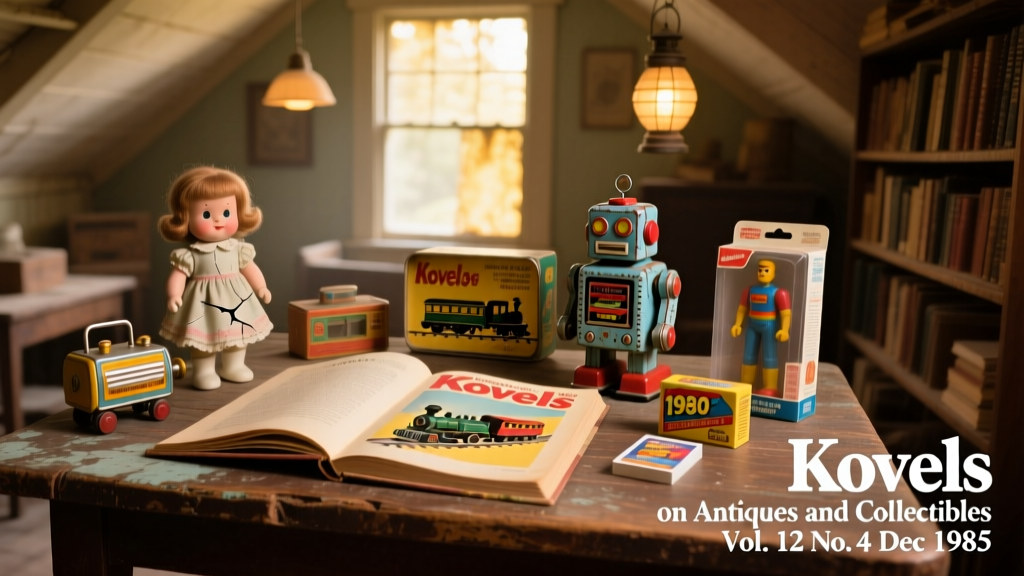
Kovels On Antiques And Collectibles Vol. 12, No. 4 (December 1985): A Collector’s Time Capsule of Mid-Century Value and Authenticity
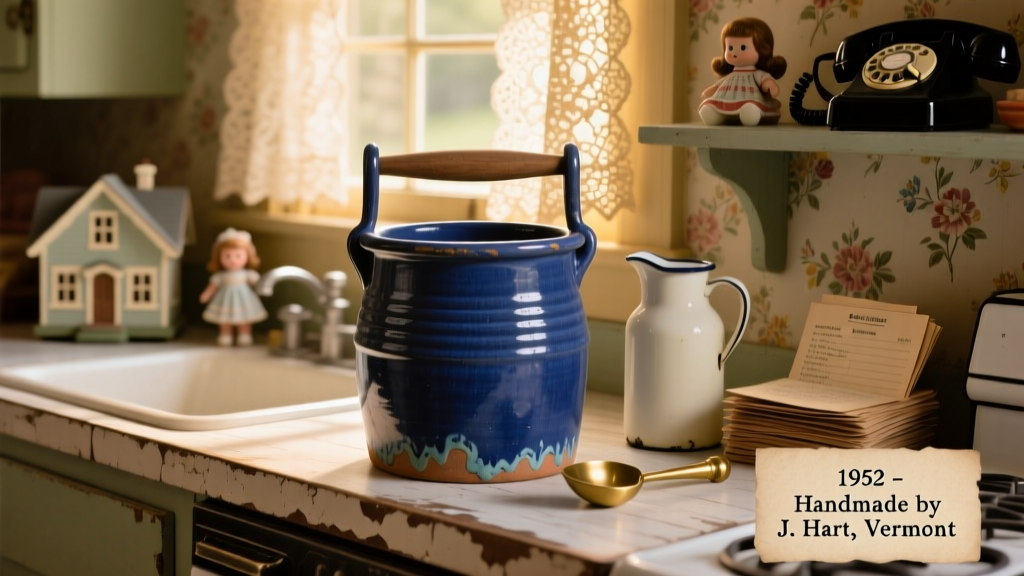
Salt Glaze Churn with Cobalt Blue Flower: The Iconic 6-Gallon Stoneware Treasure of Mid-Century America
Carnival Glass Blackberry Plate: Open Edge, Marigold Finish, 7-Inch Diameter — Identification, History, and Market Value
Swankyswigs No. 3 Red Posy Tulip: A Mid-Century Floral Icon in Vintage Toy History
Porcelain Sauce Boat Underplate: Chintz 'Orient' Pattern by Royal Winton — A Mid-Century Collectible Profile
RS Prussia Bowl: Yellow & Red Roses, Blue Daisies, Gold Border — The Lily Mold 10½-Inch Masterpiece
Hot Wheels Rarity: Decoding the 1968–1974 Golden Era Collectibles Market
Lamps Sconce 3 Light Brass Figural Dog Mounts Art Deco: A Collector’s Deep Dive into a Rare Mid-Century Fixture
Brass Dog Tag, New York City, 1935: A Historical Artifact of Urban Identity and Industrial Craftsmanship