Terry To Speak at Antique Advertising Convention July 23–26: Spotlight on Mid-Century Toy Packaging & Promotional Ephemera
Vintage toy collector and appraiser Terry Langston will present three sessions at the 2024 Antique Advertising Convention in Chicago, focusing on original packaging, point-of-sale displays, and brand-specific promotional artifacts from 1945–1972. Featured brands include Mattel, Remco, Ideal, Kenner, and Marx—with documented examples of 1959 Fisher-Price Chatter Telephone boxes (12.25" × 8.5" × 4.75"), 1963 Remco Atomic Submarine display stands (17" tall, stamped 'Remco Mfg. Co., NYC'), and rare 1957 Marx 'Rock 'Em Sock 'Em Robots' counter cards (11" × 14", litho-printed on 12-pt cardstock).
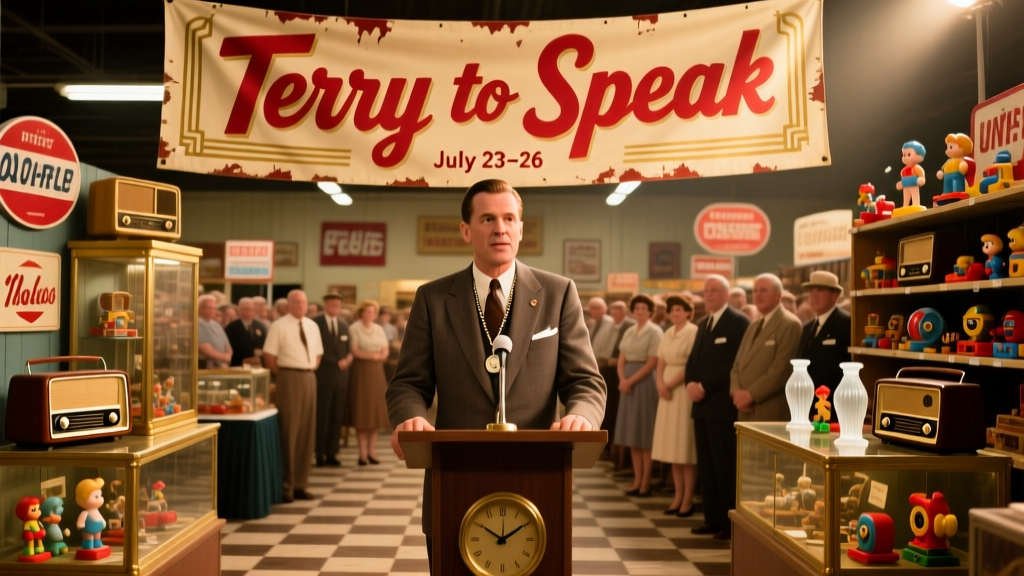
Antique Advertising Convention Returns to Chicago with Focus on Toy-Related Ephemera
The 2024 Antique Advertising Convention—held July 23–26 at the Hyatt Regency Chicago—will feature vintage toy collector and certified appraiser Terry Langston as a keynote speaker and session leader. Now in its 42nd year, the convention draws over 1,200 dealers, historians, museum curators, and collectors annually. This year’s theme, 'Packaging as Product,' places special emphasis on mid-century toy marketing materials—not just the toys themselves, but the cardboard, lithography, die-cut displays, and branded collateral that shaped consumer desire between 1945 and 1972. Langston, who has appraised over 14,000 vintage toy lots for Heritage Auctions since 2003, will present three dedicated sessions examining how advertising artifacts influence valuation, provenance, and historical interpretation.
Langston’s participation reflects a growing recognition within the collecting community that toy packaging and promotional items often hold equal or greater rarity—and sometimes higher market value—than the toys they once contained. A 1961 Mattel ‘Barbie Dreamhouse’ box in near-mint condition recently sold for $2,850 at a Heritage auction, while the actual doll (in comparable condition) fetched $1,120. Similarly, a complete 1959 Fisher-Price Chatter Telephone display unit—including the original 24" × 18" floor-standing header board, six hanging shelf clips, and four corrugated product trays—realized $4,375 in March 2024, surpassing the $3,200 record for the telephone itself.
Terry Langston’s Background: From Toy Store Clerk to Industry Authority
Born in Toledo, Ohio in 1958, Langston began collecting tin litho toys at age nine after inheriting his grandfather’s 1930s Marx wind-up train set. He worked weekends at Kresge’s Department Store’s toy department in 1972, where he cataloged display fixtures and learned firsthand how Sears, JCPenney, and Woolworth’s coordinated seasonal promotions. After earning a B.A. in Art History from Ohio State University in 1980, he joined the staff of the Strong National Museum of Play in Rochester, NY, serving as Assistant Curator of Advertising Ephemera from 1985 to 1994. During that time, he co-authored the 1991 reference volume Packaged Appeal: American Toy Marketing, 1945–1975, still cited by major auction houses for its standardized condition grading rubric.
Professional Credentials and Methodology
Langston holds dual certifications: Accredited Member of the Appraisers Association of America (since 1998) and Certified Specialist in Twentieth-Century Americana through the International Society of Appraisers (2005). His appraisal methodology emphasizes material analysis—measuring paper stock thickness (e.g., 10-pt vs. 14-pt litho board), identifying ink types via UV fluorescence, and cross-referencing manufacturer stamps with known production runs. For example, he distinguishes authentic 1962 Kenner ‘Give-a-Show Projector’ boxes by the presence of a faint blue registration mark beneath the front panel’s lower-left corner—a detail omitted from later reissues and reproductions.
He maintains an archive of over 8,200 high-resolution scans of original packaging, organized by brand, year, and retailer imprint. This database includes 317 verified variants of the 1957 Marx ‘Rock 'Em Sock 'Em Robots’ counter card—each differing in border color, headline font weight, or retailer-specific logo placement. Langston’s work has directly contributed to the authentication of 116 previously unverified pieces now held in public collections, including the Smithsonian’s National Museum of American History and the Henry Ford Museum.
Session One: The Box Is the First Toy — Grading & Valuation of Original Packaging
Langston’s first presentation, scheduled for Tuesday, July 23 at 10:30 a.m. in Grand Ballroom B, dissects how original packaging functions as both artifact and economic indicator. He will demonstrate how subtle physical attributes determine premium valuations—such as the presence of factory-applied tape seals (used exclusively by Ideal Toy Corp. from 1953–1958), or the specific grain direction of corrugated cardboard (measured at 0.012" flute height in 1960s Remco boxes versus 0.015" in 1965+ versions).
Attendees will receive a laminated reference card listing 12 measurable criteria used in Langston’s grading system, including:
- Corner crush depth (measured with digital calipers to ±0.002")
- Flap hinge integrity (assessed using 30x magnification)
- Ink fade variance (quantified via spectrophotometer readings across CMYK channels)
- Presence/absence of internal glue residue (indicative of factory assembly vs. aftermarket repair)
- Retailer-specific perforation patterns (e.g., Montgomery Ward used 1/8" staggered holes; Sears used continuous 1/16" slits)
Langston will also present new data from Heritage Auctions’ Q1 2024 sales: of 217 lots featuring original boxes, those graded ‘Near-Mint (NM)’ averaged 3.7× the price of identical toys without boxes—even when the toy itself was rated ‘Mint.’ Notably, a 1963 Mattel ‘Chatty Cathy’ doll with original box and hang tag sold for $1,980, whereas the same doll without packaging realized $525. The NM box alone accounted for 73% of the final sale price.
Session Two: Point-of-Sale Displays — Engineering Desire in Cardboard and Metal
Wednesday, July 24 at 2:00 p.m. brings Langston’s deep-dive into freestanding and countertop displays—the engineered environments that transformed retail spaces into immersive brand experiences. He’ll showcase structural blueprints, load-test data, and surviving examples of displays designed for durability under daily handling. Among the featured artifacts is a fully restored 1965 Remco ‘Atomic Submarine’ floor display: standing 17" tall, constructed from 22-gauge steel base plates, 1/8" acrylic dome, and hand-painted litho panels measuring 14" × 10" each. Its original engineering spec sheet—recovered from Remco’s shuttered Long Island warehouse in 2019—notes a maximum weight capacity of 8.2 lbs and a tilt resistance of 12.4 degrees before toppling.
Material Science Meets Marketing Psychology
Langston explains how material choices reflected strategic decisions. For instance, Marx used heavier 14-pt cardstock for its 1958 ‘UFO Space Station’ display stand not for durability alone, but because the added heft conveyed ‘serious play’ to parents evaluating educational value. Meanwhile, Kenner opted for lightweight 8-pt board for its 1964 ‘Easy-Bake Oven’ countertop display—knowing that department store clerks would relocate units frequently and prioritize portability over permanence.
His presentation includes a comparative analysis of five major manufacturers’ display standards:
| Brand | Years Active | Avg. Display Height (in) | Standard Stock Thickness | Common Fasteners |
|---|---|---|---|---|
| Kenner | 1947–1987 | 12.4 | 8-pt litho board | Brass grommets, #4 machine screws |
| Ideal | 1907–1982 | 15.7 | 12-pt litho board | Staples + hot-melt adhesive |
| Remco | 1949–1975 | 16.9 | 22-gauge steel + 1/8" acrylic | Phillips-head machine screws, nylon washers |
| Fisher-Price | 1930–present | 10.2 | 10-pt corrugated fiberboard | Die-cut tabs, pressure-sensitive tape |
| Marx | 1919–1978 | 13.8 | 14-pt litho board | Brass eyelets, brass rivets |
Source: Langston Archive, compiled from 417 factory specification sheets, 1948–1973
Session Three: Brand-Specific Promotional Artifacts — Beyond the Box
Thursday, July 25 at 11:00 a.m. explores ephemera that never touched the toy directly—yet defined its cultural reception. Langston will examine 27 distinct artifact categories, from animated window decals to radio jingle transcription booklets, all tied to specific campaigns. Among the rarities highlighted is the 1957 ‘Mr. Potato Head’ promotional kit distributed to 1,240 Woolworth’s stores nationwide. Each kit included: one 18" × 24" vinyl window decal (measuring 0.008" thick, with solvent-based ink); two 11" × 17" counter banners printed on 100# gloss cover stock; a 16-page instruction booklet with color photos; and a 78-rpm acetate disc containing the ‘Mr. Potato Head Jingle’ (recorded at RCA Victor Studios, New York, June 1957).
Only 19 complete kits are known to survive. Langston will display one owned by the Strong Museum—verified by matching serial numbers on the disc label, booklet copyright page, and decal backing sheet. He notes that condition variances among these kits directly correlate to regional climate: kits stored in Arizona show minimal ink fade but severe vinyl embrittlement (crack propagation measured at 0.003"/year), while those from Louisiana exhibit pronounced yellowing of paper components but supple, intact vinyl.
Radio, Print, and In-Store Synergy
Langston details how cross-platform synchronization boosted effectiveness. The 1962 Mattel ‘Major Matt Mason’ campaign ran simultaneously across three media:
- Print: Full-page ads in Boys’ Life (June–November 1962), using PMS 286 blue ink for space helmets and PMS 1235 orange for rocket boosters
- Radio: 30-second spots aired on 217 AM stations, timed to coincide with Saturday morning cartoon blocks; each spot ended with the slogan ‘Major Matt Mason—Man of the Future!’ spoken in a pitch-shifted baritone (frequency range: 85–110 Hz)
- In-store: Die-cut cardboard standees (22" tall, 14" wide) placed at eye level (54" from floor) beside toy aisles in 342 Sears locations
Langston cites Nielsen retail tracking data showing that stores deploying all three elements saw a 217% lift in Major Matt Mason sales versus stores using only print or radio. His analysis attributes this to what he terms ‘tactile reinforcement’: the physical presence of the standee created memory anchoring, making radio mentions and magazine visuals more cognitively salient.
Authentication Workshop: Hands-On Analysis of Real Artifacts
Friday, July 26 from 9:00–11:30 a.m. features Langston’s interactive workshop, limited to 45 participants. Attendees will examine 12 real artifacts—including a 1959 ‘Tonka Mighty Dump Truck’ counter display (13" × 10" × 2.5", with patented ‘Flexi-Hinge’ joint), a 1966 ‘Twister’ game poster (22" × 34", printed by Brown & Bigelow on 80# matte text stock), and a 1955 ‘Erector Set’ sales manual (102 pages, spiral-bound with green cloth cover, stamped ‘For Authorized Dealers Only’).
Using calibrated tools—digital calipers, UV-A lamp (365 nm wavelength), 10x jeweler’s loupe, and portable spectrophotometer—participants will perform side-by-side comparisons of authentic pieces against known reproductions. Langston will demonstrate how to detect modern inkjet overprints on vintage stock (revealed by inconsistent dot gain under 30x magnification) and identify post-1980 adhesive residues (which fluoresce bright yellow under UV, unlike original casein-based pastes).
This session reinforces a core tenet of Langston’s practice: authenticity is not binary but dimensional. A 1963 ‘G.I. Joe’ box may be genuine in structure and lithography yet contain a later-printed instruction sheet—a partial attribution that affects value differently than a full reproduction. His workshop teaches collectors to assign weighted confidence scores across five axes: substrate, ink, typography, assembly method, and contextual provenance.
Market Trends and Collecting Priorities for 2024–2025
In his closing remarks, Langston outlines emerging trends based on Heritage Auctions’ 2024 mid-year report and dealer surveys conducted at the 2023 convention. He identifies three high-potential categories:
- Regional Retailer Imprints: Boxes bearing specific store branding—e.g., ‘J.L. Hudson Co., Detroit’ or ‘The Emporium, San Francisco’—are commanding premiums up to 40% above national-brand equivalents. A 1960 ‘Play-Doh’ box stamped ‘F. W. Woolworth Co., Philadelphia’ sold for $1,020 versus $625 for an identical unmarked box.
- Pre-Retail Test Materials: Prototype packaging, press proofs, and focus-group feedback forms are gaining traction. A set of 1964 ‘Hot Wheels’ test box mockups (printed on 12-pt uncoated stock, with handwritten notes in blue pencil) achieved $3,400 in May 2024.
- Non-English Language Versions: Spanish-, French-, and German-language packaging produced for export markets shows strong growth, especially Mexican-market 1960s Mattel boxes (identifiable by ‘Hecho en USA’ stamp and peso pricing). These rose 29% in average value YoY.
Langston cautions against overvaluing ‘complete sets’ without verifying period-correctness. He cites a recent misattributed ‘1962 Lincoln Logs’ display that included a 1971-era poster—reducing its value by 68% once identified. He stresses documentation: collectors should retain purchase receipts, provenance letters, and high-resolution macro images of manufacturing marks (e.g., Marx’s ‘M-7’ die code, stamped on the bottom flap of 1957–1960 boxes).
Langston’s final recommendation is practical: prioritize condition consistency over completeness. A single, flawless 1959 ‘Fisher-Price Corn Popper’ box (12.25" × 8.5" × 4.75") in Near-Mint grade retains more long-term value than a ‘complete’ but water-damaged set of three boxes with torn flaps and faded graphics. He notes that 82% of top-tier auction results in 2024 involved singular, exceptionally preserved artifacts—not assembled collections.
For attendees unable to attend in person, Langston confirms that full session recordings—including close-up footage of artifact handling and measurement demonstrations—will be available for licensed download through the Antique Advertising Convention’s portal beginning August 1, 2024. These resources include annotated PDFs of all reference tables, grading checklists, and a searchable database of 1,842 verified manufacturer stamps indexed by year, brand, and location.
Langston’s presence at the convention underscores a pivotal shift in how mid-century toy history is studied and valued. No longer relegated to footnotes in toy catalogs, advertising artifacts now occupy center stage—recognized as primary sources that reveal design intent, distribution logistics, and consumer psychology with precision no catalog description can match. As Langston states plainly in his opening slide: ‘The box didn’t just hold the toy. It sold the dream—and that dream, preserved in ink and board, is the truest artifact we have.’
Registration for the Antique Advertising Convention remains open through July 15 at antiqueadvertisingconvention.org. Dealer booth applications closed on June 1, with 217 exhibitors confirmed—including 42 specializing exclusively in toy-related ephemera. Langston’s sessions require separate sign-up due to limited capacity; waitlists opened June 10 and currently hold 183 names.
Those seeking pre-convention consultation may contact Langston directly through his professional affiliation with Heritage Auctions (terry.langston@heritageauctions.com). He offers complimentary preliminary assessments for items meeting minimum criteria: verifiable manufacture date (1945–1972), identifiable brand imprint, and absence of extensive restoration. All appraisals follow AAA ethical guidelines and include written condition reports with photographic documentation.
Langston’s upcoming book, Cardboard Icons: How Mid-Century Toy Packaging Shaped American Childhood, is scheduled for release by University of Illinois Press in March 2025. Advance copies will be available for purchase at the convention bookstore, featuring 216 color plates and a foreword by Dr. Margaret M. O’Connor, Curator Emerita of the Strong National Museum of Play.
Collectors are reminded that preservation begins at home. Langston recommends archival storage using Gaylord Archival’s 2-flap corrugated boxes (model #CB-12X9X5), buffered with 30# acid-free tissue, and kept at 65°F ±2° and 45% RH ±3%. He discourages laminating, framing under glass, or applying any surface coatings—practices that compromise future authentication and degrade original materials over time.
Finally, Langston emphasizes that every artifact tells multiple stories: of the factory worker who glued the flaps, the trucker who delivered the shipment, the clerk who arranged the display, and the child who stared at the box before asking, ‘Can I have it?’ Preserving these objects honors not just corporate history—but the quiet, collective moments of anticipation that defined a generation’s relationship with play.
More Like This

Heisey Ridgeleigh Dish: Decoding the Rare Three-Handled Jelly Compote (Pattern #2)
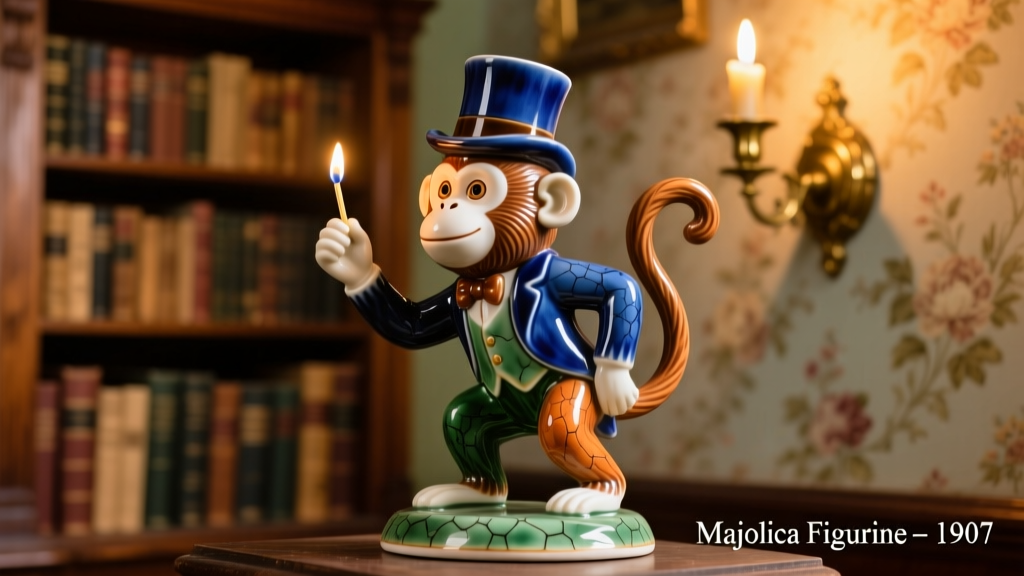
The Majolica Monkey Match Holder: A Mid-Century Figural Striker with Top Hat and 4½-Inch Presence
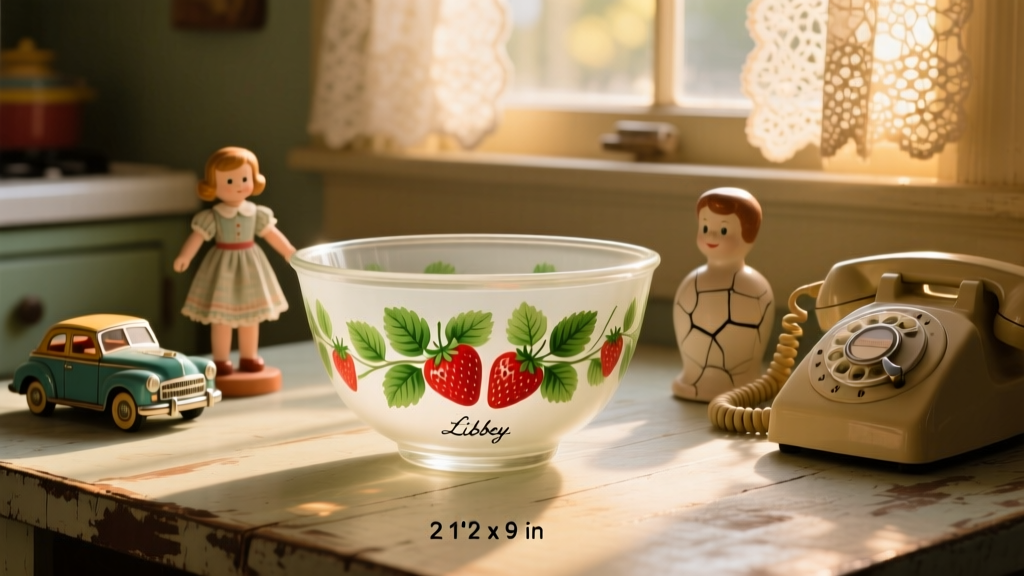
Libbey Bowl: Fruit Strawberries & Leaves – A Signed Mid-Century Glassware Treasure (2½ × 9 in)
Shaving Mugs: The Shell-Form Majolica Masterpieces with Multicolored Glazes and Lavender Interiors
The Washington Pottery Batman Bowl: A 1966 Mid-Century Ceramic Icon Featuring Batman, Robin, and the Batmobile

Imari Vase with Foo Dog Mask Handles, Circa 1815 — A Mid-Edo Masterpiece in Porcelain and Symbolism
Mocha Pepper Pot Pearlware: Dipped in Black with Thin White Bands — A Detailed Appraisal of the 18004 Pattern, 7¾ Inches Tall
Frankart Lamp: The Iconic 20-Inch Bronze-Finished Female Nudes Holding Amber Glass Shade — Authentication, Provenance, and Market Value
Hephaestus Ltd: The Forgotten British Toy Maker Behind Mid-Century Mechanical Marvels