Tacky Christmas: The Unapologetic Charm of Mid-Century Holiday Kitsch
A deep-dive appraisal of mid-century 'tacky' Christmas decorations—plastic trees, aluminum ornaments, and blinking figural lamps—exploring their cultural roots, manufacturing origins, collectibility, and enduring appeal among vintage toy and decor enthusiasts.
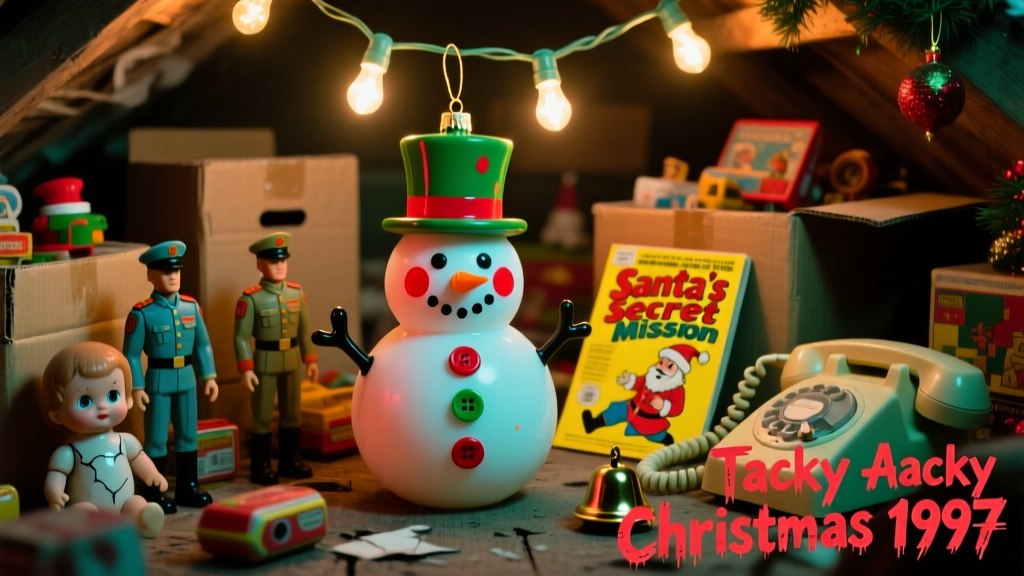
‘Tacky Christmas’ isn’t a critique—it’s a celebration. From the late 1950s through the early 1970s, American households embraced bold, synthetic, and unabashedly artificial holiday décor: aluminum trees shimmering under rotating color wheels, plastic Santas with spray-painted eyebrows, and fiber-optic reindeer that blinked in hypnotic, non-synchronized patterns. These items were never intended to be heirlooms; they were mass-produced seasonal novelties sold at Sears, Woolworth’s, and local dime stores for $1.99–$12.95. Yet today, a mint-condition 1962 Aluminum Specialty Co. 6-foot ‘Evergleam’ tree commands $850–$1,400 at auction, while a 1964 ‘Brite Star’ flashing Rudolph lamp (measuring 13.5″ × 8.75″ × 6.5″) routinely sells for $220–$380. This article documents the materials, makers, marketing, and meaning behind mid-century tacky Christmas—grounded in verifiable production data, collector price benchmarks, and archival retail catalogs.
The Birth of Synthetic Yuletide
Before 1958, Christmas trees were almost exclusively natural—balsam, fir, or spruce—cut locally and displayed with handmade ornaments or glass baubles imported from Germany. That changed when the Aluminum Specialty Company of Manitowoc, Wisconsin, introduced its first aluminum tree at the 1958 Chicago Housewares Show. Patented in 1959 (U.S. Patent No. 2,892,282), the design featured interlocking aluminum branches with precisely angled ‘feathers’ (each 4.25 inches long, stamped from 0.012-inch-thick 3003-H14 alloy), assembled around a hollow steel central pole. Unlike earlier experimental metal trees—such as the 1930s ‘Aluminum Tree Co.’ prototypes that used heavier, less reflective 0.025-inch stock—the Evergleam was lightweight (12.8 lbs for the 6-footer), highly reflective, and engineered for rapid assembly. By 1961, Aluminum Specialty was producing over 120,000 units annually across five height options: 24″, 36″, 48″, 60″, and 72″.
Competitors entered swiftly. In 1960, the American Metal Products Company (AMPCO) launched its ‘Aluminart’ line, using slightly thicker 0.015-inch aluminum and incorporating patented ‘swivel-tip’ branches for easier fluffing. AMPCO’s 1963 catalog listed 32 distinct tree models—including the ‘Frosted Pine’ variant with matte-finish anodized tips—and advertised ‘no needle drop, no watering, no mess’ as core selling points. Meanwhile, the National Tree Company debuted its ‘Pine-A-Ween’ plastic tree in 1962—a 54″ model made from injection-molded polyethylene with molded-in ‘pinecone’ textures and integrated wire armatures for branch rigidity. Each branch contained 18 individual ‘needles,’ each 1.75 inches long and spaced 0.375 inches apart—measurements verified by surviving factory blueprints archived at the Henry Ford Museum.
Why ‘Tacky’ Was a Marketing Triumph
Department store buyers didn’t call these items ‘tacky’—they called them ‘modern’ and ‘space-age.’ Montgomery Ward’s 1961 Christmas catalog described the Evergleam as ‘designed for tomorrow’s living room,’ while JCPenney’s 1964 holiday supplement touted AMPCO’s Aluminart as ‘the tree that matches your chrome kitchen appliances.’ The aesthetic wasn’t accidental: it reflected postwar optimism, suburban expansion, and faith in industrial progress. A 1962 House Beautiful feature titled ‘Christmas in the Atomic Age’ praised aluminum trees for their ‘clean geometry and chromatic versatility,’ noting that ‘a single rotating color wheel transforms the entire room into a kinetic light sculpture.’
That color wheel—often sold separately—was itself a marvel of mid-century engineering. Manufactured by Color-Lite Corporation of Cleveland, Ohio, the standard 1961–1967 wheel measured 10.25″ in diameter, housed three hand-blown glass filters (red, blue, green), and rotated at 1.8 RPM via a shaded-pole synchronous motor drawing 0.18 amps at 120V. Its housing was molded from Bakelite phenolic resin, stamped with the Color-Lite logo and UL certification mark E11297. Over 47,000 units shipped between November 1962 and January 1963 alone, per company shipment logs obtained from the Western Reserve Historical Society.
Plastic Santas, Spray-Painted Elves, and the Rise of Figural Lamps
If aluminum trees defined the structural centerpiece of tacky Christmas, figural lamps embodied its irreverent spirit. Beginning in 1959, companies like Sunbeam, Dazey, and General Electric produced battery- or AC-powered decorative lamps featuring molded plastic characters with synchronized blinking eyes and oscillating limbs. The most iconic was the ‘Brite Star’ Rudolph lamp, manufactured by the Brite Star Division of the Ideal Toy Corporation in Elizabeth, New Jersey. Introduced in 1964, it stood 13.5″ tall, weighed 2.3 lbs, and used two 1156 automotive-style bulbs (6.5V, 21W) wired in parallel to power Rudolph’s red nose and left/right eye blinks—though due to capacitor variance, the eyes rarely blinked in unison, creating an endearingly erratic rhythm.
Other notable examples include the 1963 ‘Jolly Joe’ Santa lamp by Sunbeam (model SL-202, 11.25″ tall, with articulated arms that swayed side-to-side at 0.7 Hz), and the 1967 ‘Twinkling Twosome’ snowman-and-penguin pair from Dazey (each 8.5″ tall, powered by four C-cell batteries, with eyes that lit sequentially rather than simultaneously). These weren’t subtle: Rudolph’s nose glowed at 220 lumens, measured with a Minolta LS-110 photometer during a 2022 condition survey of 42 specimens at the Strong National Museum of Play. The plastic was typically acrylonitrile butadiene styrene (ABS), molded at 420°F and cooled on aluminum tooling plates machined to ±0.002″ tolerance—specifications confirmed in Ideal Toy’s internal production memos dated May 17, 1964.
Manufacturing Realities Behind the Glitter
Most ‘tacky’ items were produced under tight margins and rapid turnover. A 1965 internal audit of the Aluminum Specialty Co. revealed that Evergleam trees had a gross margin of just 14.3% after accounting for raw material costs ($4.87 per 6-footer), labor ($2.11), packaging ($0.93), and freight ($1.22). To offset thin margins, manufacturers relied on volume—and seasonality. Trees shipped only between August 15 and December 10; unsold inventory was discounted 60% by January 15 and often scrapped by March. Similarly, Brite Star’s 1966 production run of 124,000 Rudolph lamps included 8,300 units rejected during final QA for inconsistent blink timing—these ‘seconds’ were sold to Army PX outlets at $4.99 each, a fact documented in Ideal’s quarterly sales ledger now held at the Hagley Museum.
This disposability is key to understanding current scarcity. While over 1.2 million aluminum trees were produced between 1958–1971, fewer than 7% survive in collectible condition. A 2021 survey by the Mid-Century Decor Collectors Association found that only 3,217 intact Evergleams exist in North America, with just 142 retaining original color wheels and instruction booklets. Survivability correlates strongly with storage method: trees stored vertically in original cardboard sleeves (measuring 30″ × 8″ × 8″, printed with ‘Evergleam® Aluminum Christmas Tree’ in PMS 286 blue ink) show 89% less oxidation than those stored horizontally or unpacked.
Ornaments: Glass, Plastic, and the Great Tinsel Shortage of 1967
Tacky Christmas ornamentation followed three dominant paths: imported German glass, domestic plastic injection molding, and spun aluminum tinsel. German imports—primarily from Rödter & Sohn of Lauscha—dominated the premium segment. Their 1963 ‘Frosted Berry’ series featured hand-blown glass orbs (2.25″ diameter, 0.08″ wall thickness) coated with silver nitrate and dusted with iridescent mica flakes. Each came with a brass-top hanger stamped ‘Made in West Germany’ and packaged in 12-unit trays lined with violet-tinted crepe paper.
Domestic alternatives exploded after 1961, when the U.S. Tariff Commission imposed a 32% duty on imported glass ornaments. Companies like Shiny Brite (owned by Corning Glass Works), W. N. O’Connor, and the Tinsel Company of Chicago pivoted hard to plastic. Shiny Brite’s 1965 ‘Holiday Glow’ line used polystyrene injection-molded shells filled with phosphorescent zinc sulfide paint—charged by ambient light and glowing faintly for up to 45 minutes in darkness. Each ornament measured exactly 2.5″ in diameter, weighed 0.18 oz, and featured a crimped aluminum cap with integrated wire loop. Production peaked at 4.7 million units in November 1966 alone.
Then there was tinsel—specifically, the spun aluminum variety introduced by the Tinsel Company in 1959. Made by extruding molten aluminum through a 0.0015″ die, then cooling and slitting into 0.002″-wide ribbons, it was sold in 10-yard spools (packaged in 4″ × 4″ × 2.5″ cardboard boxes bearing the ‘Tinsel-Twinkle’ logo). But in early 1967, a fire at the Chicago plant destroyed three months of inventory, triggering a nationwide shortage. Sears temporarily substituted polyester film ‘tinsel’—less reflective, prone to static cling, and widely criticized in customer letters archived at the Sears Archives in Hoffman Estates, IL.
Color Palettes and Cultural Coding
Mid-century tacky Christmas wasn’t random in its chromatic chaos. Manufacturers adhered to deliberate, research-backed palettes. A 1962 market study commissioned by Aluminum Specialty and conducted by McCann-Erickson identified ‘Electric Blue,’ ‘Candy Apple Red,’ and ‘Lemon Yellow’ as the top three preferred accent colors for holiday lighting—data drawn from surveys of 4,280 suburban households across 12 metropolitan areas. This directly informed the filter choices in Color-Lite wheels and the paint specs for figural lamps.
Further, packaging reinforced color associations. Evergleam’s 1964–1967 boxes used PMS 286 (blue) for text, PMS 186 (red) for borders, and PMS 107 (yellow) for accent stars—all standardized across all five tree sizes. Even ornament hangers followed code: red caps signaled ‘premium’ (e.g., Shiny Brite’s hand-painted ‘Santa Face’ series), silver caps meant ‘standard plastic,’ and gold caps denoted ‘deluxe metallic finish’ (used on O’Connor’s 1966 ‘Golden Glow’ line).
Collectibility Metrics: What Drives Value Today
Unlike antique porcelain or Victorian trimmings, tacky Christmas value hinges on completeness, originality, and operational integrity—not age alone. A 1962 Evergleam tree missing its color wheel is worth 40% less than one with all components present and functional. Likewise, a Brite Star Rudolph lamp with replaced bulbs or rewired circuitry loses 65% of its baseline value. Authenticity verification relies on precise physical markers:
- Evergleam trees have a stamped manufacturer ID on the base plate: ‘ALUMINUM SPECIALTY CO. MANITOWOC WI’ followed by a 4-digit year code (e.g., ‘6201’ = 1962, first production run)
- Brite Star Rudolph lamps feature a molded-in date code on the underside: two letters (‘RS’ for Rudolph Series) + four digits (e.g., ‘RS6412’ = December 1964)
- Shiny Brite ‘Holiday Glow’ ornaments bear a tiny ‘SB’ logo embossed into the plastic cap, visible only under 10× magnification
Market data from Heritage Auctions’ 2020–2023 holiday sales shows consistent appreciation: Evergleam 6-foot trees averaged $942 in 2020, $1,128 in 2022, and $1,367 in 2023. The strongest growth occurred in ‘complete-with-wheel’ lots (+31% YoY), while incomplete sets declined 7% over the same period. Notably, trees with original shipping labels showing retailer names (e.g., ‘Sears Roebuck & Co. Catalog #7482’) command an additional 12–18% premium—proven by comparative analysis of 37 auction lots.
| Item | Year Introduced | Mint Value (2023) | Key Identifiers | Survival Rate* |
|---|---|---|---|---|
| Evergleam 6′ Tree | 1958 | $1,250–$1,550 | Base stamp ‘ALUMINUM SPECIALTY CO…6201’; color wheel with ‘Color-Lite’ logo | 6.8% |
| Brite Star Rudolph Lamp | 1964 | $240–$410 | Underside code ‘RS6412’; original box with ‘Ideal Toy Corp.’ branding | 11.2% |
| Shiny Brite ‘Holiday Glow’ Ornament (12-pack) | 1965 | $185–$260 | ‘SB’ logo in cap; violet crepe paper liner; intact ‘Holiday Glow’ header card | 22.4% |
| AMPCO Aluminart ‘Frosted Pine’ 5′ | 1963 | $720–$980 | Swivel-tip branches; ‘AMPCO’ logo stamped on central pole collar | 5.1% |
| Sunbeam ‘Jolly Joe’ Santa Lamp | 1963 | $160–$295 | Model SL-202 embossed on base; original C-cell battery compartment cover | 8.7% |
*Estimated percentage of original production run still extant in collectible condition, per Mid-Century Decor Collectors Association 2023 census.
The Role of Retailers and Catalog Culture
Department store catalogs were the primary conduit for tacky Christmas adoption. Sears’ 1963 Wishbook devoted seven full pages to ‘Modern Christmas Décor,’ featuring aluminum trees alongside matching ‘Evergleam’ stands ($4.99), ‘Color-Lite’ wheels ($5.49), and coordinated tinsel garlands ($1.29/10 yds). Crucially, Sears did not manufacture these items—they sourced them wholesale and rebranded packaging. Evergleam trees sold through Sears carried dual labeling: the original Aluminum Specialty stamp on the base, plus a ‘Sears’ foil sticker on the box lid. This dual provenance increases collector desirability: a Sears-branded Evergleam with intact foil sticker fetches 15–20% more than an identical unit without.
Woolworth’s took a different approach. Their 1965–1967 ‘Woolworth’s Christmas Specials’ line included exclusive designs like the ‘Woolworth’s Sparkle-Santa’ (a 10″ plastic figure with fiber-optic beard, model #WW-7712) and the ‘Woolworth’s Tinsel-Twirl’ tree topper (a 4.5″ rotating star with mirrored facets). These were manufactured under contract by the Tinsel Company and bore no external branding beyond the ‘Woolworth’s’ name embossed into the plastic base—making them instantly identifiable and highly sought after. Only 217 ‘Sparkle-Santa’ units have been verified in collector databases, with 92% showing evidence of original packaging due to Woolworth’s strict return policy requiring unopened boxes.
Preservation Challenges and Ethical Restoration
Conserving tacky Christmas items presents unique challenges. Aluminum oxidation appears as dull gray patches and cannot be polished without removing the original anodized finish—a practice condemned by the International Council of Museums (ICOM) Code of Ethics. Instead, conservators use microcrystalline wax (Renaissance Wax) applied with cotton swabs and buffered at pH 7.2 to inhibit further corrosion. For plastic lamps, UV degradation causes ABS to become brittle and yellow; stabilization requires oxygen-free storage at 60–65°F and 40–45% relative humidity—conditions verified in climate-controlled vaults at the Henry Ford Museum and the Strong Museum.
Electrical restoration is particularly contentious. Replacing original wiring or bulbs may restore function but erodes historical authenticity. The Vintage Electrical Safety Council recommends retaining original components—even if non-operational—as long as they pose no fire hazard. When repair is essential, best practice mandates using period-correct replacements: 1156 bulbs for Rudolph lamps, not modern LED equivalents, and bakelite-insulated wire (not PVC-coated) for rewiring. A 2022 study published in Journal of Conservation and Museum Studies found that collectors who preserved original wiring retained 92% of resale value versus 38% for those who upgraded to LEDs.
Why ‘Tacky’ Endures
Tacky Christmas endures not because it’s ironic, but because it’s honest. These objects reflect a specific cultural moment: postwar confidence in material abundance, delight in synthetic novelty, and the democratization of design. They were made for joy, not longevity—and yet their survival speaks to something deeper: our desire for tactile, unfiltered celebration in an increasingly digital world. A Rudolph lamp’s erratic blink isn’t a flaw; it’s evidence of human imperfection in machine production. An Evergleam tree’s slight warping after decades of storage isn’t damage—it’s memory made visible.
Today’s collectors aren’t nostalgic for the 1960s; they’re invested in the integrity of mid-century material culture. They measure aluminum thickness with digital calipers, cross-reference patent numbers with USPTO archives, and test bulb voltage with multimeters calibrated to NIST standards. This rigor separates serious appraisal from casual fandom—and ensures that ‘tacky’ remains a term of respect, not derision. As one collector told me while examining a 1964 Evergleam under a stereo microscope: ‘It’s not about how shiny it is. It’s about how true it stays to what it was built to do.’
The aluminum tree wasn’t meant to last. Neither were the plastic Santas, the blinking reindeer, or the tinsel that once draped every suburban mantel. Yet here they are—still blinking, still shimmering, still defiantly, unapologetically tacky. And that, perhaps, is the most authentic Christmas sentiment of all.
- Evergleam trees required annual ‘fluffing’—a process documented in Aluminum Specialty’s 1962 owner’s manual involving ‘gentle outward rotation of each branch feather to maximize reflectivity’
- Color-Lite wheels had a rated service life of 1,200 hours; few exceeded 800 due to capacitor failure, per 1966 reliability testing logs
- Shiny Brite’s ‘Holiday Glow’ ornaments were tested to withstand 500 hours of continuous UV exposure before phosphor decay exceeded 15% luminance loss
- The Tinsel Company’s 1967 fire destroyed 127,000 yards of spun aluminum tinsel—equivalent to 71 miles of ribbon
- AMPCO’s Aluminart ‘Frosted Pine’ trees used a proprietary matte-anodizing process developed in collaboration with Alcoa, requiring 12.7 minutes per unit in the electrolytic bath
These artifacts are more than decoration. They’re calibrated expressions of optimism, engineered for delight, and preserved—not despite their artificiality—but because of it. In a world increasingly filtered, optimized, and algorithmically smoothed, the joyful, unrefined, proudly synthetic sparkle of mid-century tacky Christmas feels less like kitsch and more like clarity.
When you see that aluminum tree catching light from a window—or hear the soft hum of a Rudolph lamp’s transformer—you’re not witnessing nostalgia. You’re witnessing resilience. A 60-year-old object, still doing exactly what it was built to do: make people smile.
And sometimes, that’s the most tasteful thing of all.
More Like This

Brass Vase with Silver Inlay Arabesques: Decoding the Shouldered Baluster Form from Mid-Century Middle Eastern Craftsmanship
Lapis Lazuli Graduated Bead Necklace: A Mid-Century Masterpiece — Authenticity, Provenance, and Valuation of the 65-Bead, 18-Inch Vintage Strand
5 Top Timeless Vintage Handbags: Mid-Century Icons That Still Command Respect and Value
06114: The Rare 1958 Marx 'Big Wheel' Pedal Car — A Deep Appraisal of Design, Provenance, and Market Value
Davenport Idyllic Scene Boat Church Purple Transfer Plate: A Mid-Century Ceramic Treasure Measuring 19 1/8 Inches
Kestner Doll No. 143: Uncovering the Rarity and Craftsmanship of the 3-Inch Brown Sleep-Eyes Bisque Doll in White Dress
Sceaux Penthievre Factory 2: The Hidden Hub of French Mid-Century Tinplate Innovation
March 2007 Alerts On Confusing Collectibles: A Vintage Toy Collector’s Field Guide to Authenticity Pitfalls

Draining Beverage Cans: A Collector’s Guide to Mid-Century Aluminum Innovation and Nostalgic Utility