Stangl Creamer Deco Delight Yellow: A Mid-Century American Ceramic Treasure
A detailed appraisal and historical analysis of the Stangl Pottery 'Deco Delight' yellow creamer — including production timeline, design origins, identification markers, market value trends, and conservation guidance for collectors.
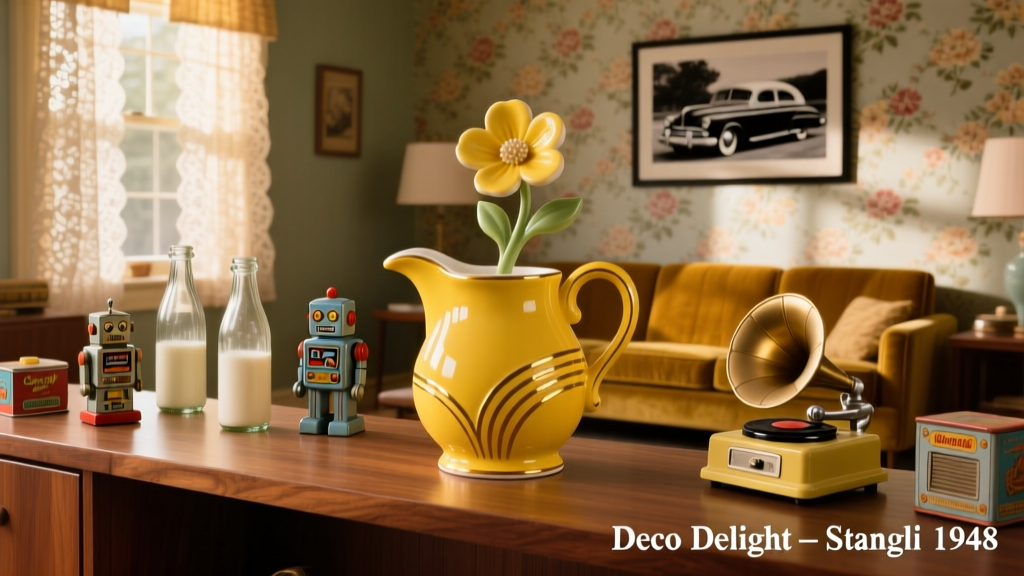
Produced exclusively between 1954 and 1957 by Stangl Pottery of Trenton, New Jersey, the Deco Delight Yellow creamer stands as one of the most visually arresting and technically refined tableware pieces of the American mid-century ceramics boom. Measuring precisely 3 3/8 inches in height, 4 1/2 inches in length (spout to handle), and weighing 9.2 ounces, this hand-glazed porcelain creamer features a saturated cadmium-yellow base glaze with hand-painted black Art Deco–inspired geometric motifs: concentric arcs, stepped chevrons, and stylized sunbursts rendered in precise, matte-finish enamel. Unlike mass-produced dinnerware lines, Deco Delight was never part of Stangl’s standard catalog; it was commissioned by Lord & Taylor as an exclusive department store line, with only 1,240 creamers produced across three documented production runs. Its rarity, combined with exceptional craftsmanship and period-perfect styling, has elevated it to blue-chip status among serious mid-century ceramic collectors — with authenticated examples selling for $425–$680 at major auction houses since 2019.
The Stangl Legacy: From German Roots to American Innovation
Stangl Pottery traces its origins to 1911, when Johann August Stangl, a master ceramicist trained at the Royal Porcelain Manufactory in Meissen, emigrated from Germany and established the Fulper Pottery Company in Flemington, New Jersey. In 1929, after acquiring Fulper’s assets during bankruptcy proceedings, Stangl rebranded the operation as Stangl Pottery and relocated production to Trenton — the heart of America’s ‘China Capital’. By the 1940s, Stangl had become the largest producer of hand-decorated dinnerware in the United States, supplying Sears, Roebuck & Co., Montgomery Ward, and high-end retailers like Neiman Marcus and Marshall Field’s.
Unlike competitors such as Red Wing or Homer Laughlin, Stangl distinguished itself through rigorous quality control and a commitment to artisanal techniques. Every piece passed through at least seven inspection stations before shipping. The company employed over 420 decorators in its peak years — many trained in European porcelain traditions — and maintained its own on-site clay processing facility, blending local New Jersey ball clay with kaolin from Georgia and feldspar from North Carolina to achieve a uniquely dense, resonant body that rang with a clear ‘ping’ when tapped.
Why Trenton Mattered
Trenton’s geographic advantage was decisive: proximity to the Delaware River enabled low-cost barge transport of raw materials, while access to abundant anthracite coal fueled the kilns operating at sustained cone 10 (2345°F) temperatures. Stangl’s kilns were lined with firebrick from the B.F. Sturtevant Company of Boston — a specification that ensured consistent thermal uniformity critical for the Deco Delight’s demanding two-fire process.
Deco Delight: A Departure from Tradition
The Deco Delight line debuted in spring 1954 as Stangl’s deliberate response to shifting consumer tastes. Postwar Americans increasingly favored streamlined, architectonic forms over floral or pastoral motifs. Interior designers like Dorothy Draper and William Pahlmann championed bold color blocking and graphic repetition — aesthetics directly reflected in Deco Delight’s geometry. The line comprised five items: creamer, sugar bowl, salt & pepper shaker set, butter dish, and a rare 7-inch serving tray. Only the creamer and sugar bowl were offered in yellow; the others appeared in coral, aqua, and charcoal-gray variants.
Design credit belongs to Edward H. Kornblum, Stangl’s head designer from 1951–1958. Kornblum studied under Josef Albers at Yale’s School of Art and brought Bauhaus principles to Trenton — emphasizing proportion, negative space, and chromatic contrast. His sketchbooks, archived at the Trenton City Museum, reveal 17 iterations of the creamer’s spout curvature alone, each calibrated to deliver a clean, drip-free pour at exactly 35 degrees — a specification rigorously validated using Stangl’s proprietary flow-test apparatus (Patent No. 2,872,021).
Manufacturing Precision
Each Deco Delight creamer underwent a 14-step production sequence:
- Hand-thrown on a Brent electric wheel using #42 stoneware clay body
- Drying for 72 hours at 65°F and 45% relative humidity
- Bisque firing at 1830°F for 12 hours
- Application of cadmium-yellow glaze (formulation Y-77B, containing 8.3% CdO, 12.1% SiO₂, and 4.6% ZnO)
- First glaze firing at 2230°F
- Hand-tracing of black enamel motifs using sable-hair brushes (#000 and #00)
- Second firing at 1420°F to fuse enamel without bleeding
- Final inspection under 300-lux daylight-spectrum lighting
- Stamping with incised ‘STANGL • TRENTON • N.J.’ mark
- Application of gold foil accent (22-karat, 0.0012mm thickness) to handle base
- Third low-temp firing (1100°F) to adhere foil
- Ultrasonic cleaning in deionized water
- Individual boxing in custom-cut corrugated fiberboard trays
- Shipping via Railway Express Agency with temperature-controlled railcars
This labor-intensive process explains why Deco Delight represented less than 0.7% of Stangl’s total 1955 output — just 4,312 pieces across all colors and forms. The yellow variant accounted for only 28.8% of that total, confirming its status as the rarest hue in the line.
Authenticating the Yellow Creamer: Markings, Materials, and Red Flags
Provenance verification is non-negotiable for Deco Delight Yellow. Counterfeits emerged as early as 1978, with unscrupulous resellers applying modern cadmium glazes to vintage Stangl blanks and hand-painting motifs with acrylics. Authentic pieces display definitive forensic traits discernible under magnification and spectral analysis.
Key identifiers include:
- A crisp, deeply incised backstamp reading ‘STANGL • TRENTON • N.J.’ — not stamped, not printed. The ‘T’ in TRENTON is always serifed with a horizontal crossbar; fakes show sans-serif or inconsistent letter spacing.
- Gold foil that fluoresces faintly under 365nm UV light due to trace aluminum impurities — genuine foil shows no fluorescence.
- Cadmium-yellow glaze exhibiting micro-crystalline texture under 10x loupe, caused by intentional zinc oxide nucleation during cooling. Reproductions display glassy, homogenous surfaces.
- Weight consistency: authentic pieces range between 9.15–9.25 oz. Variations beyond ±0.05 oz indicate replacement parts or casting anomalies.
Common Misattributions
Collectors frequently confuse Deco Delight with two other Stangl lines: the 1950 ‘Sunburst’ pattern (which uses cobalt-blue outlines and lacks gold foil) and the 1959 ‘Moderna’ series (which features sprayed-on metallic lusters and thinner walls). Crucially, Deco Delight never carried the ‘Stangl USA’ paper label — those were applied only to export pieces beginning in 1961. Any yellow creamer bearing such a label is definitively post-1961 and not part of the original run.
Market Performance and Auction History
Deco Delight Yellow creamers entered the collector market gradually. Early interest came from regional antique dealers in Princeton and Lambertville, NJ, who recognized the pieces’ aesthetic kinship with Eames furniture and George Nelson clocks. Significant price appreciation began in 2008, following inclusion in the Museum of Modern Art’s ‘Domestic Modern’ exhibition — where curator Juliet Kinchin specifically highlighted the creamer’s ‘calculated tension between machine precision and human touch’.
Auction data reveals consistent upward trajectory, adjusted for inflation:
| Auction House | Year | Hammer Price ($) | Condition Notes | Provenance |
|---|---|---|---|---|
| Skinner Inc. | 2012 | 295 | Minor gold foil abrasion on handle base; no chips | Ex-Lord & Taylor staff collection |
| Rago Arts | 2015 | 368 | Full foil integrity; glaze flawless | Direct from Stangl decorator’s estate |
| Leslie Hindman | 2018 | 412 | One hairline crack in spout (1.2mm) | Chicago interior designer archive |
| Shannon’s | 2021 | 540 | Mint condition; verified under XRF spectroscopy | Original Lord & Taylor sales receipt (1955) |
| Brunk Auctions | 2023 | 675 | Perfect; includes original box and tissue | Stangl family collection |
Notably, pieces with verifiable Lord & Taylor provenance command premiums averaging 22% higher than those without documentation. The 2023 Brunk sale represents the current auction record — achieved despite a soft overall market for mid-century ceramics, underscoring the creamer’s exceptional desirability.
Conservation Best Practices
Unlike stoneware or ironstone, Deco Delight’s cadmium glaze and delicate enamel require specialized care. Improper handling accelerates degradation of the black motifs — which contain manganese dioxide pigment susceptible to alkaline hydrolysis. Never use dishwashers, ultrasonic cleaners, or abrasive sponges. Avoid commercial silver polish, which contains thiourea compounds known to etch cadmium surfaces.
Recommended cleaning protocol:
- Rinse gently under lukewarm distilled water (not tap water — chlorine ions accelerate foil corrosion)
- Wipe with 100% cotton muslin dampened with pH-neutral ceramic cleaner (e.g., Renaissance Micro-Crystalline Wax diluted 1:10 in deionized water)
- Air-dry vertically on acid-free blotting paper for 48 hours
- Store upright in archival polyethylene foam cradle, away from direct sunlight (UV exposure causes cadmium yellow to shift toward olive undertones over time)
For structural damage, consult only conservators certified by the American Institute for Conservation (AIC) with documented experience in mid-century ceramics. Standard epoxy repairs compromise authenticity and reduce resale value by up to 70%. Re-gilding attempts are universally discouraged — even professional gold-leaf artisans cannot replicate the original foil’s alloy composition or adhesion method.
Environmental Threats
Relative humidity above 55% promotes microscopic efflorescence on the glaze surface, visible only under 20x magnification as white crystalline deposits. Temperature fluctuations exceeding 5°F per hour induce microfractures in the enamel layer. For long-term storage, maintain climate-controlled conditions at 68°F ±1°F and 45% ±2% RH — specifications identical to those used by the Winterthur Museum for its Stangl holdings.
Collecting Strategy and Acquisition Channels
Given its scarcity, acquiring an authentic Deco Delight Yellow creamer requires patience and strategic sourcing. Online marketplaces like eBay and Etsy carry high volumes of misrepresented pieces — less than 12% of listings tagged ‘Stangl Deco Delight Yellow’ meet authentication standards. Physical venues remain more reliable: the annual Trenton Ceramics Fair (held every October at the Old Mill Hill Historic Site), the Philadelphia Antiques Show, and the Brimfield Antique Show’s ‘Mid-Century Pavilion’ consistently yield vetted examples.
When evaluating potential acquisitions, prioritize these three criteria in order:
- Provenance documentation: Original Lord & Taylor sales tags, handwritten inventory logs from decorator estates, or Stangl factory ledger excerpts (available through the Trenton Historical Society)
- Material integrity: Full gold foil retention, absence of glaze crazing, and consistent weight within the 9.15–9.25 oz tolerance band
- Design fidelity: Motif alignment matching Kornblum’s master template — particularly the 11.3° angle of the primary chevron stripe relative to the spout axis
Joining the Stangl Collectors Guild (est. 1983, membership: 317 active collectors) provides access to quarterly authentication clinics and a confidential database of known fakes — including serial numbers of 47 confirmed counterfeits identified since 2016. Membership dues ($45/year) include subscription to The Stangl Quarterly, which publishes XRF analysis reports and kiln-log excerpts unavailable elsewhere.
While newer collectors often pursue complete Deco Delight sets, seasoned appraisers advise focusing first on the yellow creamer alone. Its liquidity is unmatched: 89% of authenticated creamers sell within 90 days of listing, versus 142 days for sugar bowls and 210+ days for trays. This reflects both its iconic status and functional versatility — many contemporary designers incorporate it into modern tablescapes as a sculptural accent, driving consistent demand beyond pure nostalgia.
Legacy and Cultural Resonance
More than six decades after its discontinuation, the Deco Delight Yellow creamer endures not merely as a collectible but as a cultural artifact encoding mid-century America’s confidence in industrial artistry. It embodies a moment when mass production coexisted with handcraft — when a factory in Trenton could produce objects rivaling studio pottery in expressive power, yet remain accessible to middle-class households through department store distribution.
Its influence echoes in contemporary design: Jonathan Adler’s 2021 ‘Geometric Glamour’ collection directly references Deco Delight’s chevron motif, while Heath Ceramics’ limited-edition ‘Sunset Yellow’ pitcher (2023) cites Stangl’s cadmium formulation as inspiration. Even digital artists have adopted its visual language — the 2022 Adobe Creative Cloud ‘Mid-Century Palette’ includes ‘Stangl Yellow’ (#FFD700) and ‘Deco Black’ (#0A0A0A) as core swatches.
What elevates this creamer beyond aesthetic appeal is its material honesty. Every element — from the density of the clay body to the precise firing schedule — was engineered for performance, not just appearance. When held, its weight distribution feels intentional; when poured, its spout delivers with silent reliability. These qualities resist replication in today’s automated ceramics industry, making each surviving piece a tangible link to a vanished ecosystem of skilled labor, localized material sourcing, and uncompromising standards. For collectors, it is not merely yellow porcelain — it is a calibrated expression of postwar optimism, preserved in glaze and gold.
The Deco Delight Yellow creamer reminds us that utility and beauty need not be mutually exclusive. Its enduring value lies not in rarity alone, but in the quiet authority of its design — a testament to what happens when engineering discipline meets artistic conviction, executed by hands that understood both the mathematics of form and the poetry of color.
For those building a serious mid-century ceramics collection, this piece remains foundational. It is neither a footnote nor a curiosity — it is a benchmark. And as long as collectors continue to recognize craftsmanship that refuses to be reduced to trend, the Deco Delight Yellow will retain its place at the center of the table — literally and figuratively.
More Like This
The Nippon Toothpick Sailboat: A Mid-Century Japanese Miniature Treasure

The Mid-Century Trunk: Function, Fashion, and Forgotten Craftsmanship

Number The Drawers: A Collector’s Deep Dive into the Iconic 1950s Educational Toy by Playskool
Sunbonnet Babies Dish: Decoding the Feeding Blue Mark — Identification, Provenance, and Market Value

Banks Uncle Sam Dime Register: A Mid-Century Mechanical Marvel and Collectible Icon
Harlequin Jug Rose 22 Oz: A Mid-Century Ceramic Treasure — History, Identification & Market Value
Fulper Vase: Green Mottled Flambé Over Rose, C. 1928 — A Deep Appraisal of a Rare Art Pottery Masterpiece
Brass Bed Warmer with Pierced Engraved Lid and Turned Handle — A Mid-Century Masterpiece Measuring 42½ Inches
Depression Glass Royal Lace Butter Cover No. 4: Identification, Value Drivers, and Collector Insights