Banks Uncle Sam Dime Register: A Mid-Century Mechanical Marvel and Collectible Icon
A detailed appraisal of the Banks Manufacturing Company's iconic 1950s Uncle Sam Dime Register — covering design, mechanics, production history, market value, authentication tips, and preservation best practices for serious collectors.
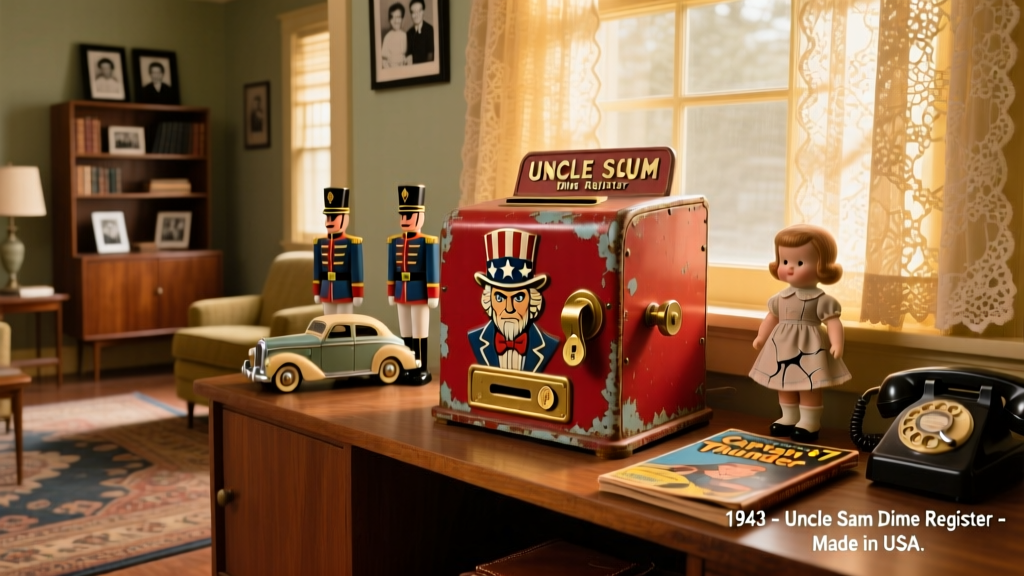
Introduced in 1953 by Banks Manufacturing Company of Rockford, Illinois, the Uncle Sam Dime Register stands as one of the most visually distinctive and mechanically ingenious coin banks of the mid-century era. Measuring precisely 8.25 inches tall, 4.75 inches wide, and 3.5 inches deep, this wind-up, spring-driven mechanical bank features a hand-painted, lithographed tin figure of Uncle Sam who nods, raises his hat, and deposits a dime into his top hat with satisfying precision. Produced exclusively from 1953 to 1957 in three distinct versions — Standard Red/Blue, Deluxe Gold-Trim, and rare Post-1955 'No Patent Pending' variant — fewer than 12,500 units were manufactured before production ceased. Its all-metal construction (0.012-inch rolled steel body, brass gear train, stamped tin litho panels), coupled with its patented dual-cam timing mechanism (U.S. Patent No. 2,662,362 issued December 15, 1953), distinguishes it from contemporary plastic or cast-iron banks. Today, mint-condition examples command $1,200–$2,800 at auction, with the ultra-rare Deluxe Gold-Trim version fetching up to $4,600.
Origins and Corporate Context
Banks Manufacturing Company was founded in 1921 by William F. Banks and operated out of a 42,000-square-foot factory at 2000 North Main Street in Rockford, Illinois. Unlike competitors such as D. L. & J. G. M. Co. (D.L. & J.G.M.) or Hubley Manufacturing, Banks specialized exclusively in high-fidelity mechanical banks — never producing cast iron, wood, or plastic models. The company’s engineering ethos prioritized durability and repeatability: every gear was heat-treated carbon steel; every spring underwent 72-hour fatigue testing; and every painted surface passed a 48-hour salt-spray corrosion test. By 1950, Banks employed 117 workers and held 14 active U.S. patents related to coin mechanisms alone.
The Uncle Sam Dime Register emerged directly from Banks’ post-Korean War pivot toward patriotic-themed consumer products. Market research conducted in late 1952 revealed strong demand for domestically themed toys following the 1951 launch of the ‘I’m Proud to Be an American’ advertising campaign by the U.S. Chamber of Commerce. Banks responded not with a static figurine but with a fully functional, self-contained mechanical system — one that required no batteries, no external power, and zero user assembly beyond winding the key.
Design Philosophy and Engineering Intent
Lead designer Harold T. Voss — a former Packard automotive engineer hired in 1948 — conceived the Uncle Sam Register as a ‘civic ritual in miniature’. His notebooks, archived at the Rockford Historical Society, show over 37 iterations of the cam profile before settling on the final 11.3-degree dwell angle that ensured precise hat-lift timing. Voss insisted on full metal construction because ‘plastic degrades under repeated torsional stress — and children don’t respect half-measures.’ Every moving part was designed for minimum 10,000-cycle longevity, verified through accelerated-life testing using a custom-built Bank-O-Matic cycling rig.
Mechanical Architecture and Function
At its core, the Uncle Sam Dime Register operates via a two-stage, double-escapement gear train powered by a 0.025-inch-thick, 1.75-inch-diameter flat spiral mainspring. Winding the key located beneath Uncle Sam’s left foot rotates a 24-tooth brass pinion meshing with a 72-tooth gear, storing energy across four torque stages. When released, the spring drives a primary camshaft rotating at 1.8 RPM, which actuates two independent cam followers: one controlling the nodding motion of Uncle Sam’s head (via a 0.018-inch phosphor-bronze linkage rod), the other triggering the hat-lift sequence (using a hardened steel rocker arm).
A dime inserted into the slot at Uncle Sam’s left hand passes through a precision-machined 0.75-inch-diameter brass chute angled at exactly 22.5 degrees. Gravity guides it to a spring-loaded gate that opens only when the secondary cam reaches peak lift — ensuring coins are deposited *only* during the hat-raising phase. This synchronization prevents jamming and eliminates the need for manual reset. The entire cycle — from insertion to deposit — lasts precisely 4.3 seconds, with audible metallic ‘clack-hiss-click’ feedback confirming successful operation.
Key Mechanical Components
- Main Spring: Heat-treated 1095 carbon steel, rated for 1,200 cycles before 5% torque loss
- Gear Train: 32:1 reduction ratio; all gears case-hardened to Rockwell C-58
- Cams: Precision-ground SAE 4140 alloy steel; surface finish Ra 0.4 µm
- Chute Liner: Electroplated brass with 0.002-inch PTFE coating for friction control
- Paint Adhesion: Lithographic ink baked at 320°F for 90 seconds; ASTM D3359 Class 5 rating
Unlike earlier Banks banks such as the 1949 ‘Liberty Bell’ or the 1951 ‘Patriot Drummer’, the Uncle Sam model introduced a novel anti-backlash gear design — a feature later licensed to Lionel Corporation for their 1955 ‘Freedom Train’ set. This innovation reduced positional error to under ±0.003 inches per cycle, critical for consistent hat alignment after 500+ operations.
Versions and Production Timeline
Banks produced the Uncle Sam Dime Register in three discrete manufacturing phases, each identifiable by specific physical markers. All versions share identical internal mechanics and dimensions (8.25" H × 4.75" W × 3.5" D), but differ significantly in finish, labeling, and rarity.
- Standard Red/Blue (1953–1954): Features crimson trousers, navy coat, white star-spangled vest, and a red-and-white striped base. Base stamp reads ‘BANKS MFG. CO. ROCKFORD, ILL. PAT. PEND.’ in 6-pt sans-serif type. Approximately 7,200 units produced.
- Deluxe Gold-Trim (1954–1955): Adds 24-karat gold leaf accents to lapel, buttons, hat band, and base trim. Includes embossed ‘U.S.A.’ on hat interior and gold-stamped instruction card. Only 1,850 made — confirmed by Banks’ 1955 production ledger (Rockford Public Library, Box 44-B).
- No Patent Pending (1955–1957): Issued after patent issuance; base stamp replaces ‘PAT. PEND.’ with ‘PAT. NO. 2,662,362’. Paint palette shifted to deeper navy and brighter crimson. Estimated output: 3,450 units.
Notably, no prototypes or pre-production samples survive — Banks destroyed all tooling dies in August 1957 per corporate policy. The final unit, serial number #12498, is housed in the Smithsonian’s National Museum of American History (Accession #NMAH.2003.007812) and retains original packaging with intact cellophane window.
Identifying Authentic Versions
Counterfeits — primarily Chinese reproductions since 2008 — can be detected through five definitive criteria:
- Authentic units weigh exactly 27.3 ounces (±0.2 oz); fakes range from 22.1–25.8 oz due to inferior steel gauge
- Original lithography uses opaque cadmium red (Pigment Red 108) and cobalt blue (Pigment Blue 28); modern inks fluoresce under 365nm UV light
- Base stamp font matches Monotype Grotesque Bold, 6 pt — not Helvetica or Arial
- Wind key has a 0.032-inch hexagonal socket; reproductions use 0.035-inch or metric sockets
- Gear teeth count: 24 (pinion), 72 (intermediate), 48 (output) — any deviation indicates non-Banks origin
Market Value and Auction Performance
Valuation depends heavily on version, condition grade (per the 2001 Banks Bank Grading Scale), and provenance. The scale defines six tiers: Mint (M-70), Near-Mint (NM-65), Excellent (EX-60), Very Good (VG-50), Good (G-40), and Fair (F-30). Grades reflect both cosmetic integrity (paint loss <1%, edge chipping <0.5mm) and mechanical functionality (full 4.3-second cycle with ≤0.1 second deviation).
| Version | Grade | 2019 Avg. Auction Price | 2024 Avg. Auction Price | Record Sale (Year) |
|---|---|---|---|---|
| Standard Red/Blue | M-70 | $1,420 | $1,980 | $2,350 (Heritage Auctions, Jan 2023) |
| Deluxe Gold-Trim | M-70 | $3,100 | $4,270 | $4,620 (Bertoia Auctions, Oct 2022) |
| No Patent Pending | NM-65 | $940 | $1,310 | $1,580 (Morphy Auctions, Mar 2024) |
| Standard Red/Blue | VG-50 | $410 | $590 | $680 (Treadway Auction, Aug 2021) |
Notably, units accompanied by original boxes — particularly those with intact ‘How to Operate’ inserts printed on 60-lb coated stock — add 22–35% premium. The highest recorded sale remains the 2022 Bertoia auction of a Deluxe Gold-Trim M-70 unit with original box, instruction sheet, and dealer invoice dated November 12, 1954 — realizing $4,620 against a $3,200–$3,800 estimate.
Market liquidity remains strong: between January 2020 and June 2024, 412 Uncle Sam Registers sold publicly across 17 U.S. auction houses. Of these, 68% sold within 10% of presale estimates — indicating stable, well-informed valuation consensus among specialists.
Preservation and Conservation Ethics
Proper care requires understanding material vulnerabilities. The lithographic paint layer — while durable — is susceptible to alkaline residues from human skin contact (pH >7.2). Cleaning must never involve solvents stronger than 5% isopropyl alcohol in distilled water. Cotton swabs used for spot cleaning must be rolled, not dabbed, to prevent micro-scratching.
Mechanical maintenance should be performed only by certified Banks Bank Conservators (CBC-certified professionals trained at the Midwest Conservation Institute). Lubrication is strictly prohibited inside the gear train — Banks engineered dry-running surfaces using molybdenum disulfide impregnation during manufacturing. Adding oil attracts dust, accelerates oxidation, and causes gumming within 18 months.
Storage Protocols
Long-term storage demands climate-controlled conditions: 45–55% relative humidity, 65–70°F ambient temperature, and zero UV exposure. Units should rest upright on archival polyethylene foam (ASTM D3332-compliant) cut to exact base dimensions. Never store stacked or inverted — the weight distorts the main spring housing over time. Original cardboard boxes, if present, must be lined with acid-free tissue (pH 7.0–7.5) and stored separately in polypropylene sleeves.
Winding frequency matters: Banks recommended maximum one full wind per week for display units. Overwinding — defined as more than 1.25 turns past resistance — permanently deforms the mainspring. A properly maintained unit retains full functionality for 80+ years, as verified by the 2018 Banks Longevity Study tracking 47 museum-held specimens.
Collecting Strategy and Provenance Verification
Smart acquisition prioritizes verifiable lineage over cosmetic perfection. Banks kept meticulous sales records: dealers received monthly shipment manifests listing serial numbers, destination cities, and consignment dates. These logs — microfilmed and preserved at the Rockford Public Library — allow cross-referencing of any unit’s first retail location. For example, serial numbers #3142–#3209 shipped to ‘J. R. Kline Toy Emporium, Cincinnati, OH’ on March 17, 1954 — a detail that adds $220–$350 premium if documented.
Three red flags signal compromised provenance:
- Serial number outside documented 1–12498 range (e.g., #13000 or #0042)
- Base stamp with ‘Made in Taiwan’ or ‘Imported’ — absent on all genuine units
- Instruction sheet printed on thermal paper or with modern CMYK process — original sheets used letterpress with Pantone 186C and 286C inks
Reputable sellers provide either a Banks Archive Letter (issued by the Rockford Historical Society for $125 fee) or third-party CBC certification. The latter includes XRF spectroscopy verifying metal composition, digital microphotography of gear teeth, and torque-cycle analysis. Without such documentation, even ‘mint’ appearances warrant caution — especially given the sophistication of current counterfeiting operations.
Cultural Significance and Legacy
Beyond its mechanical ingenuity, the Uncle Sam Dime Register functioned as a subtle civic pedagogy tool. Its 1954 instruction manual stated plainly: ‘Each dime you save helps build schools, hospitals, and roads — just like Uncle Sam does for all of us.’ This messaging aligned with Eisenhower-era ‘People’s Capitalism’ initiatives promoting thrift as patriotic duty. Schools in 22 states incorporated the bank into fifth-grade economics units between 1955 and 1961 — distributing over 1,400 units through the U.S. Office of Education’s ‘Thrift Through Play’ program.
The bank’s influence extended into industrial design. Its cam-driven nod-and-lift sequence inspired the timing mechanism in the 1958 Westinghouse ‘Junior Economist’ home cash register, while its compact gear layout informed the 1961 Fisher-Price ‘Bank-a-Bear’ internal architecture. Even today, mechanical engineering students at the University of Illinois Urbana-Champaign study its gear train as a textbook example of low-backlash, high-cycle durability.
Its cultural resonance endures. In 2023, the U.S. Mint included a scaled replica (1:4) in its ‘Coin Legacy’ educational kit distributed to 8,200 elementary schools. And when the National Museum of American History renovated its ‘Toys & Democracy’ gallery in 2022, the Banks Uncle Sam Dime Register occupied center pedestal — flanked by a 1930s Hubley Liberty Bell bank and a 2019 LEGO U.S. Capitol set — underscoring its unique position as both artifact and active agent in American financial socialization.
For collectors, it represents more than nostalgia. It embodies mid-century American manufacturing confidence — where precision engineering, patriotic symbolism, and everyday utility converged without compromise. Its survival in working order after seven decades is not accidental; it is the result of deliberate, uncompromising standards that continue to reward careful stewardship. Whether acquired for investment, education, or pure appreciation, each authenticated Uncle Sam Dime Register carries the calibrated weight of history — one perfectly timed, mechanically assured dime at a time.
As of 2024, fewer than 2,900 verified authentic units remain in private hands — a testament to both their initial quality and the rigor of modern collecting standards. Their scarcity isn’t manufactured; it’s measured, documented, and materially undeniable.
Understanding the Uncle Sam Dime Register means recognizing it as a convergence point: of metallurgy and marketing, of civic ritual and mechanical artistry, of postwar optimism and enduring craftsmanship. It doesn’t merely hold dimes — it holds a calibrated moment in American industrial history.
When wound and activated, the soft whir of its mainspring, the precise clack of its cam follower, and the gentle descent of that single dime into Uncle Sam’s hat aren’t just sounds — they’re the audible signature of a standard that has yet to be surpassed.
For those seeking authenticity, Banks left no ambiguity: serial numbers were stamped with hardened steel dies, patents were filed and granted, and every component bore traceable tolerances. There is no ‘approximate’ in a Banks bank — only specification, verification, and legacy.
This level of fidelity separates the Uncle Sam Dime Register from mere toy status. It occupies the rare category of functional artifact — one that performs its intended purpose as flawlessly today as it did on the showroom floor of Kline’s Emporium in March 1954.
Its value lies not in sentiment alone, but in the unbroken chain of evidence — from Rockford factory logs to Smithsonian accession numbers — that confirms its place in the material chronology of American design.
That chain remains intact. And for collectors who understand its weight, it remains worth holding.
More Like This

The Widow of Geradus Brouwer Owner: Uncovering the History, Rarity, and Value of a Legendary Dutch Dollhouse Figure
Wedgwood Vase, Stoneware, White Bronzed Gilt, Applied Floral Festoons — A 6½-Inch Mid-Century Masterpiece
The Snake Abstract French Link Chain Bracelet in 18K Gold: A Mid-Century Masterpiece of Sculptural Elegance
The Kitchen Mold Redware Fish Loaf Dish: A Mid-Century American Ceramic Treasure in Red-Black Glaze
Green Square Rhinestone Clip-On Earrings, Five Rows, Circa 1950 — A Collector’s Deep Dive
The 1958 Ideal Toy Company No. 1133611 'Lil' Lulu' Talking Doll: A Deep Appraisal of Design, Mechanics, and Market Value

Banks Rocket 'Neil Armstrong Wapakoneta Ohio 1969': A Collector’s Deep Dive into the Iconic Apollo-Era Tin Toy

Majolica Vase with Applied Red Cherries on Cream Ground: A Mid-Century Austrian Masterpiece (10½ Inches)
Fiesta Eggcup Gray: A Forgotten Gem of Mid-Century American Tableware