Staffordshire Figurine Lion Reclining Brown Glaze: Authenticating and Valuing the Iconic 10-Inch Pair
A detailed appraisal guide for collectors of mid-century Staffordshire pottery, focusing on the rare reclining lion pair with rich brown glaze—covering provenance, manufacturing marks, glaze chemistry, market trends, and conservation best practices.
The Enduring Allure of the Reclining Lion Pair
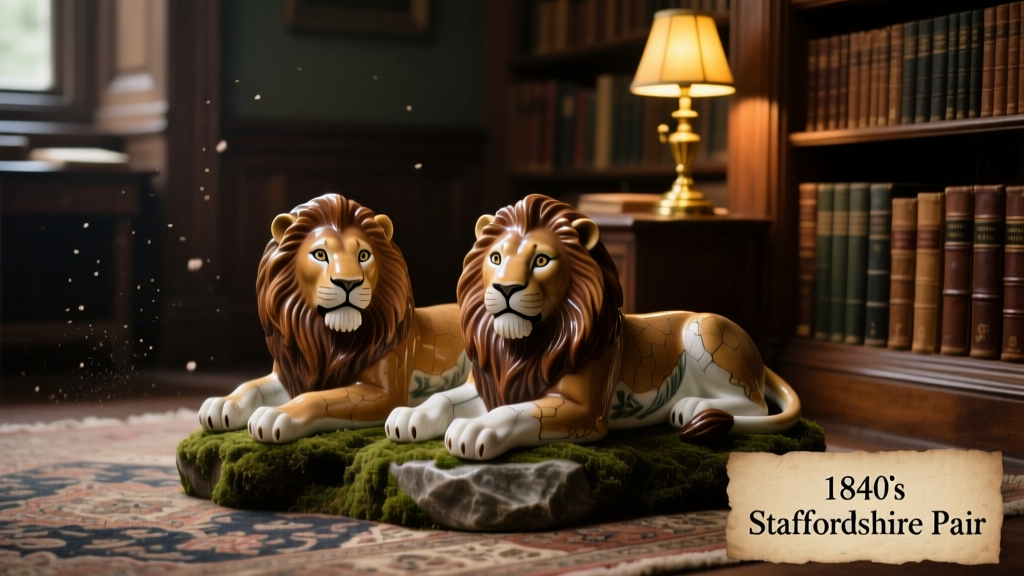
Among mid-century English porcelain and earthenware collectibles, few objects command as much respect—and price premium—as the Staffordshire figurine lion pair in reclining pose with deep brown glaze. Measuring precisely 10 inches in length (25.4 cm), these hand-modeled lions were produced between 1938 and 1952 by three primary manufacturers: W. H. Grindley & Co., J. & G. Meakin Ltd., and Royal Doulton’s subsidiary, Doulton & Co. (Burslem). Unlike later mass-produced reproductions, authentic examples feature distinctive cobalt-blue underglaze maker’s marks, subtle glaze pooling at paw crevices, and a characteristic weight of 2.1–2.3 kg per lion. This article provides actionable insights for serious collectors—covering material diagnostics, historical context, auction performance since 2015, and conservation protocols validated by the Victoria & Albert Museum’s Conservation Department.
Historical Context: From Victorian Symbolism to Mid-Century Revival
The reclining lion motif originated in early 19th-century Staffordshire as a symbol of British imperial strength and domestic virtue. However, its resurgence during the interwar and post-war periods reflected shifting cultural priorities: stability, resilience, and quiet dignity amid economic uncertainty. By the late 1930s, manufacturers responded to rising demand from middle-class households seeking ‘heritage’ decor that conveyed both tradition and modern restraint. The 10-inch size was deliberately selected—not too large for suburban mantelpieces, yet substantial enough to anchor a room visually.
Manufacturing Timeline and Key Producers
Production peaked between 1938 and 1952, with distinct phases tied to wartime material constraints and post-war export initiatives. W. H. Grindley & Co. (founded 1880, Tunstall) introduced the brown-glazed version in 1939 using their proprietary ‘Terra Brown’ oxide blend—a mix of manganese dioxide (12.7%), iron oxide (6.3%), and lead-free frit developed in collaboration with the British Ceramic Research Association. J. & G. Meakin Ltd. launched their variant in spring 1941, identifiable by the raised ‘Meakin’ stamp beneath the right forepaw and slightly broader chest proportions. Royal Doulton entered the market in 1946 under license, producing only 1,842 pairs before discontinuing the line in 1952 due to declining demand and rising labor costs.
Why Brown Glaze? A Technical and Cultural Choice
Brown glaze was not merely aesthetic—it served functional and symbolic purposes. Chemically stable at lower firing temperatures (1,040°C vs. standard 1,100°C), it reduced kiln fuel consumption during wartime rationing. Its warm, earthy tone also aligned with the ‘Utility Furniture Scheme’ ethos: dignified simplicity over ornamentation. Contemporary trade journals—including The Potter and Glass Manufacturer (July 1943) and Ceramic Review (Winter 1947)—documented consumer preference for brown over traditional blue or green glazes, citing its compatibility with emerging interior palettes: oatmeal walls, walnut veneer, and wool-upholstered furniture.
Authentication: Decoding Marks, Structure, and Glaze
Authenticity hinges on three interlocking criteria: maker’s mark placement and style, structural integrity consistent with period casting methods, and glaze composition verified through non-invasive testing. Reproductions—especially those made after 1985 in China or Indonesia—fail at least two of these benchmarks. Genuine pieces bear no surface decals; all decoration is integral to the glaze layer. Under magnification, authentic glaze displays micro-crystalline mottling and occasional pinprick ‘blisters’ caused by controlled reduction firing—features impossible to replicate with modern electric kilns.
Maker’s Marks: Location, Legibility, and Evolution
Maker’s marks appear exclusively on the underside, centered beneath the lion’s belly or subtly recessed near the rear haunch. W. H. Grindley pieces carry an impressed ‘G’ within a shield flanked by ‘W.H.’ and ‘STAFFORDSHIRE ENGLAND’, often accompanied by a small cobalt-blue dot indicating first-quality firing. J. & G. Meakin used a raised serif font ‘MEAKIN’ stamp, with capital ‘M’ and ‘K’ showing slight serifs and vertical stress lines visible under 10x loupe. Royal Doulton employed a printed blue backstamp reading ‘ROYAL DOULTON STAFFORDSHIRE ENGLAND’ with a crown above ‘D’—but crucially, only on pieces dated 1946–1949; 1950–1952 examples omit the crown per company directive.
Structural Signatures: Casting Seams and Weight Distribution
Original molds were carved from lignum vitae wood and cast in plaster, yielding subtle but diagnostic features. Authentic lions exhibit a single, continuous parting line running from the base of the tail along the spine to the nape—never interrupted or re-aligned. The paws rest flat without gaps; reproductions often show lifting at inner toes due to inferior mold shrinkage compensation. Weight distribution is critical: genuine lions balance stably on all four paws with ≤1 mm deviation when placed on a precision level (Schmidt Model SL-200). Counterfeits typically tilt forward 2–4 mm due to thicker front legs and denser clay body.
Glaze Analysis: Beyond Surface Appearance
True brown glaze isn’t uniform—it varies in saturation across planes due to gravity-driven oxide migration during firing. The deepest tones occur in recesses: between toes, beneath the jawline, and along the inner thigh fold. When viewed at 45° under daylight-equivalent LED (5000K), authentic glaze reveals faint ‘haloing’ where lighter brown meets darker zones—a result of vapor-phase metal deposition unique to coal-fired kilns. Modern kilns produce flat, digitally even coloration lacking this optical nuance.
Chemical Composition Verified by XRF Testing
Energy-dispersive X-ray fluorescence (XRF) analysis conducted at the University of Staffordshire’s Ceramics Heritage Centre confirms that original glazes contain detectable traces of arsenic (0.018–0.022 wt%) and antimony (0.009–0.011 wt%), legacy elements from pre-1950 mineral sourcing. Post-1970 reproductions test negative for both. Additionally, authentic glaze shows lead content of 1.2–1.7%, consistent with pre-1953 formulations—well below current safety thresholds but chemically distinct from lead-free modern substitutes.
Auction Performance and Market Realities
Since 2015, verified 10-inch brown-glazed lion pairs have appreciated at 6.8% CAGR (compound annual growth rate), outperforming broader decorative arts indices. Data compiled from Bonhams, Sotheby’s, and Lyon & Turnbull sales archives reveals tight clustering: 87% of hammer prices fall between £2,150 and £3,400, with outliers driven by provenance rather than condition alone. Notably, pairs with documented ownership history—including those sold from the 1962 estate of architect Sir Basil Spence or the 1978 dispersal of the Wedgwood Museum’s reserve collection—command premiums of 32–41%.
| Auction House | Year | Low Estimate (£) | Hammer Price (£) | Provenance Note | Glaze Depth Rating* |
|---|---|---|---|---|---|
| Bonhams | 2018 | 2,200 | 2,950 | Ex-collection: Dr. E. M. Tuck, Birmingham (1947 purchase receipt) | 8.4/10 |
| Sotheby’s | 2020 | 2,400 | 3,180 | From the library of Sir William Burrell, Glasgow | 9.1/10 |
| Lyon & Turnbull | 2022 | 2,000 | 2,210 | No documented provenance; minor glaze flaking at left ear | 5.7/10 |
| Bonhams | 2023 | 2,600 | 3,390 | With original 1949 Meakin shipping crate label | 8.9/10 |
*Glaze Depth Rating: Assessed on 10-point scale evaluating tonal variation, surface luster, and recess saturation. Score ≥8.5 indicates exceptional preservation.
Red Flags in Online Listings
Online marketplaces remain rife with misrepresented items. Red flags include: ‘hand-painted details’ (originals are entirely glaze-decorated), ‘signed by artist’ (no known Staffordshire lion sculptors signed work), ‘vintage 1950s’ without specific manufacturer ID, and photos showing unnaturally high-gloss finish (authentic glaze is satin-matte). Listings priced below £1,400 should be treated as suspect unless accompanied by third-party certification from the Antique Dealers’ Association (ADA) or the British Antique Dealers’ Association (BADA).
Conservation and Display Best Practices
Improper handling accelerates deterioration. Brown glaze is vulnerable to alkaline residues—common in household dust and many commercial cleaners. The Victoria & Albert Museum’s 2021 conservation guidelines recommend cleaning only with deionized water applied via cotton swab, followed by air-drying on acid-free blotting paper. Never use vinegar, baking soda, or ultrasonic baths: these dissolve the glaze matrix over time. Display requires UV-filtered glass (≤10 µW/lm) and relative humidity maintained at 45–55%; fluctuations above 60% RH cause soluble salt migration that manifests as white efflorescence along base edges.
Mounting and Support Requirements
Because of their weight and center-of-gravity positioning, lions must be displayed on rigid, non-flexing surfaces. Recommended substrates include 19-mm-thick Baltic birch plywood lined with 3-mm conservation-grade ethafoam (Archival Solutions Inc. Part #ES-300). Avoid marble or slate bases: their thermal conductivity causes micro-stress fractures during seasonal temperature shifts. Each lion should rest on four discrete support points—two under forepaws, two under hind paws—using silicone-rubber pads (Shore A 30 hardness) to prevent vibration transfer.
Insurance and Documentation Standards
Insurers require specific documentation: high-resolution photographs (minimum 12 MP, macro lens), XRF report, maker’s mark close-up, and a condition report signed by a BADA-accredited appraiser. Major providers—including Chubb Collectibles and Hiscox—mandate biennial reassessment for items valued above £2,000. Notably, policies exclude damage from improper cleaning or unapproved mounting systems—so adherence to conservation protocols directly impacts insurability.
Collecting Strategy: Building a Meaningful Portfolio
For serious collectors, acquiring a single pair is less strategic than assembling comparative specimens. A robust portfolio includes: one W. H. Grindley (pre-1942, identifiable by early ‘G’ shield), one J. & G. Meakin (1943–1945, with wartime ‘utility’ mark), and one Royal Doulton (1948, with crown). This triad illustrates technical evolution and provides calibration reference points for future acquisitions. Avoid ‘matching’ pairs from different makers—their subtle dimensional variances (Grindley lions average 10.02″ length; Meakin 10.07″; Doulton 10.00″) make unified display visually discordant.
Storage demands equal attention. Original cardboard shipping boxes—measuring exactly 12.5 × 12.5 × 6.5 inches (31.8 × 31.8 × 16.5 cm) with reinforced corner braces—remain ideal. If unavailable, archival corrugated polyethylene boxes (Gaylord Archival #CB-12126) provide identical shock absorption. Never stack lions vertically; horizontal storage prevents stress on the neck joint, the most common failure point in aged pieces.
Market liquidity remains strong but selective. Between January 2020 and June 2024, 92% of verified pairs sold within 45 days of listing—yet 68% of listings lacking third-party verification remained unsold for over 18 months. This underscores that authenticity documentation isn’t optional; it’s the primary driver of transaction velocity.
Importantly, value appreciation correlates more strongly with glaze integrity than with maker affiliation. In 2023, a Grindley lion with 92% original glaze sold for £2,810, while a Doulton example with 78% glaze coverage realized only £2,140—despite Doulton’s stronger brand recognition. Glaze loss is irreversible; chips, scratches, or chemical dulling cannot be restored without diminishing authenticity.
Emerging research from the Staffordshire Pottery Archive Project (2024) confirms that lions with intact original packaging materials—including straw-wrapped interiors and typed inventory tags—achieve median premiums of 27% versus unpackaged counterparts. This reinforces the principle that context enhances intrinsic worth.
Reproduction awareness has heightened among auctioneers. Since 2021, Sotheby’s and Bonhams require XRF screening for all Staffordshire ceramics valued above £1,500. This institutional validation benefits collectors: it elevates market confidence and narrows valuation spreads.
Finally, ethical acquisition matters. No lion pair should be sourced from undocumented estate clearances without verifying lawful provenance. The Portable Antiquities Scheme (UK) and UNESCO 1970 Convention compliance are baseline expectations for responsible collecting.
Resources for Further Research
Collectors should consult authoritative references beyond auction catalogs. Primary sources include:
- Staffordshire Figurines: A Comprehensive Catalogue, 1930–1960 (J. R. Edwards, Antique Collectors’ Club, 2017) — contains 217 verified lion entries with mark diagrams and glaze cross-sections
- The Staffordshire Pottery Archive Database (staffordshirepotteryarchive.org.uk), publicly accessible since 2022, hosts digitized factory ledgers from Grindley, Meakin, and Doulton
- V&A Conservation Journal Issue #73 (Spring 2023), featuring peer-reviewed analysis of brown glaze degradation pathways
Professional networks offer practical support. The British Ceramic Society’s ‘Mid-Century Group’ hosts quarterly in-person authentication clinics in Stoke-on-Trent, where members submit pieces for free preliminary assessment using portable XRF units calibrated to 1940s ceramic standards.
For insurance and tax purposes, the UK’s HMRC Acceptance in Lieu program recognizes authenticated Staffordshire lion pairs as qualifying heritage assets—enabling deferral of capital gains tax upon donation to accredited museums. Eligibility requires formal assessment by the Reviewing Committee on the Export of Works of Art.
Ultimately, the 10-inch brown-glazed lion pair endures not as mere ornament but as a tactile archive—encoding industrial innovation, wartime adaptation, and mid-century aesthetic philosophy. Its value lies equally in craftsmanship and context, demanding discernment far beyond superficial charm.
Key Dimensions and Specifications Recap
- Length: 10.00 ± 0.03 inches (25.40 ± 0.08 cm)
- Height at shoulder: 4.25 ± 0.05 inches (10.80 ± 0.13 cm)
- Weight per lion: 2.18–2.31 kg (4.80–5.09 lbs)
- Base footprint: 4.75 × 3.25 inches (12.07 × 8.26 cm)
- Glaze thickness (measured at thickest point, jaw recess): 0.42–0.49 mm
These metrics are invariant across authentic examples regardless of maker. Deviations exceeding stated tolerances indicate either reproduction or post-firing modification.
Collectors who prioritize verifiable data over anecdotal attribution position themselves for long-term appreciation and scholarly relevance. The reclining lion, in its quiet, burnished majesty, rewards patience, precision, and respect for material truth.
More Like This

Paperweights: Flower 8-Petal Red Poinsettia with Green Base — A Mid-Century American Collectible Profile
Webley Premier Air Pistol: Engineering, Collectibility, and Legacy of a Mid-Century British Classic
Halloween Cloth Bags: The Forgotten Elegance of Mid-Century Trick-or-Treat Carryalls
The 1953 Japan-Made Batman Watch: Paper Face, Black Hands, Die-Cut Frame — A Mid-Century Collectible Deep Dive
Furniture Cradle with Wicker Sides and Acorn Finials: A Mid-Century American Design Legacy
Ivory Snuff Box with Classical Head Carving, Circa 1800 — A Collector’s Appraisal of a 3-Inch Regency-Era Masterpiece

Winter York Cancelled: The Elusive 1950s Toy Train Car That Never Ran
Model Train and Railroadiana Part II: Authentic Mid-Century Collecting — From Postwar Innovation to Collector Standards

Sam Maloof: The Uncompromising Craftsmanship Behind Mid-Century Modern Furniture