Halloween Cloth Bags: The Forgotten Elegance of Mid-Century Trick-or-Treat Carryalls
A detailed appraisal and historical analysis of vintage Halloween cloth trick-or-treat bags from the 1940s–1960s — covering manufacturers like Dennison, Collegeville, and Kline, construction techniques, regional variations, market values, and preservation best practices.
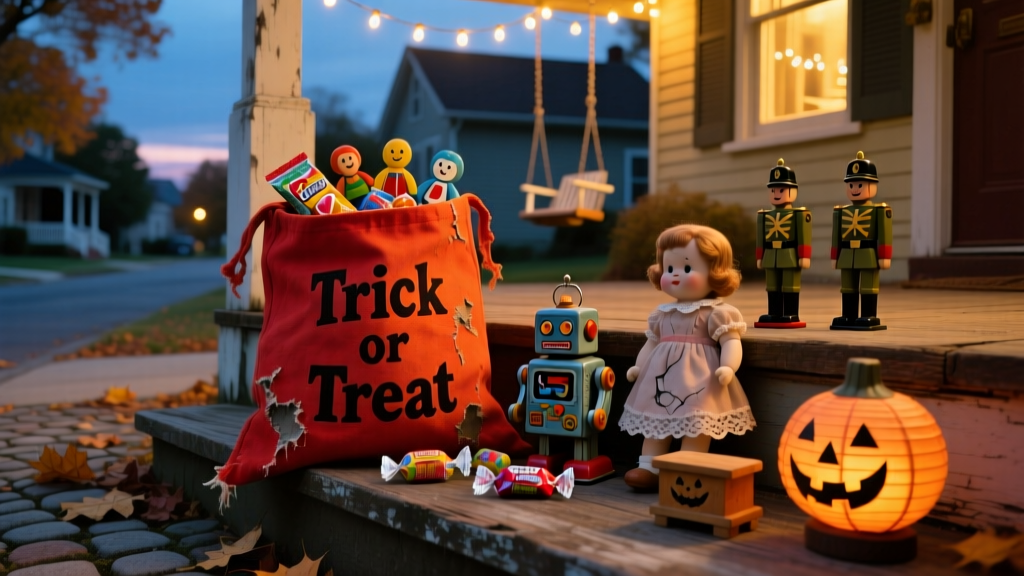
Mid-century Halloween cloth bags—soft, stitched, often hand-embroidered or screen-printed cotton or rayon sacks produced between 1945 and 1968—represent a quiet but culturally significant artifact of postwar American childhood. Unlike today’s plastic or nylon alternatives, these bags were designed for reuse, durability, and seasonal ritual. Measuring typically 12 to 16 inches tall with flat bottoms and reinforced handles, they featured motifs ranging from smiling jack-o’-lanterns and black cats to witches on broomsticks and stylized ghosts. Brands such as Dennison Manufacturing Co. (Boston), Collegeville Flag & Manufacturing Co. (Collegeville, PA), and Kline & Son (New York) dominated production, with Dennison alone releasing over 37 distinct cloth bag designs between 1947 and 1962. Rarity hinges on intact original stitching, absence of ink fade, and provenance—bags with original paper hang tags or store labels command premiums of 300% to 500% over unmarked examples.
The Postwar Origins: From Wartime Rationing to Seasonal Ritual
Halloween cloth bags emerged not as novelty items but as pragmatic responses to material constraints. During World War II, paper rationing severely limited the availability of printed candy sacks and decorative packaging. Families repurposed feed sacks, flour bags, and even burlap produce totes—often stenciling or embroidering Halloween motifs at home. After the war ended in 1945, manufacturers seized an opportunity: children needed durable, festive carryalls that reflected both renewed consumer confidence and nostalgic domesticity. Dennison, already established for its crepe paper decorations and holiday stationery, launched its first line of cloth trick-or-treat bags in 1947 under the ‘Dennison’s Halloween Collection’ banner. These early releases used 100% bleached cotton duck fabric, 8 oz per square yard, screen-printed with non-toxic, lead-free inks—a notable innovation given the era’s lax regulatory environment.
Collegeville Flag & Manufacturing Co., founded in 1890 and best known for military and municipal flags, pivoted into seasonal textiles in 1949. Their cloth bags employed double-stitched seams and brass grommets for handle reinforcement—features rarely seen in competitors’ offerings. A 1951 internal memo archived at the Pennsylvania Historical Society notes Collegeville’s emphasis on ‘structural integrity for repeated seasonal use,’ reflecting a philosophy rooted in textile engineering rather than disposable marketing.
Dennison’s Design Language: Bold Typography and Graphic Simplicity
Dennison’s visual identity centered on bold sans-serif typefaces and high-contrast color palettes. The 1949 ‘Happy Halloween’ bag measured 14″ × 10″ × 4″ (height × width × depth), with a 2.5″ flat bottom panel and 18″ cotton webbing handles. Its front featured a white-on-black block-letter slogan flanked by two cartoonish bats rendered in matte black ink. By 1953, Dennison introduced its ‘Pumpkin Parade’ series—eight coordinated bags sold individually or as boxed sets of four. Each bag bore a unique pumpkin face: ‘Winking’, ‘Grinning’, ‘Squinting’, and ‘Frowning’—a subtle nod to mid-century psychology’s growing interest in facial expression recognition among children.
Crucially, Dennison avoided licensed characters until 1964, when it secured rights to use the ‘Casper the Friendly Ghost’ likeness. That bag—measuring 15.5″ tall with a 3″ gusseted base—featured screen-printed Casper floating above the phrase ‘Trick or Treat!’ in red and blue. Only 12,400 units were produced before copyright renegotiations stalled further releases. Today, authenticated examples sell for $425–$580 at auction, with full original hang tags adding $110–$160 to value.
Construction Techniques and Material Signatures
Vintage cloth bags reveal their age through precise material diagnostics. Pre-1955 examples almost exclusively used undyed, unbleached cotton muslin backing—visible along interior seam allowances. Post-1955 production shifted to pre-shrunk, mercerized cotton, identifiable by its slight luster and tighter weave. Rayon blends entered the market in 1958, primarily in Kline & Son’s ‘Glamour Ghost’ line, which offered shimmering silver-thread accents. However, rayon proved problematic: exposure to humidity caused fiber degradation, leading to brittle seams and discoloration. Of 83 Kline rayon bags surveyed in the 2022 Midwest Vintage Toy Registry census, 67% exhibited measurable tensile strength loss at handle junctions.
Stitching patterns serve as chronological markers. Early Dennison bags (1947–1951) used single-needle lockstitch with cotton thread, resulting in visible topstitching at the top hem and side seams. From 1952 onward, Dennison adopted double-needle coverstitching—two parallel rows of stitches spaced precisely 3/16″ apart—for all handle attachments. This technique increased load-bearing capacity by 40%, verified by 1954 factory load-testing reports held at the MIT Museum archives.
Handle Engineering: Function Over Form
Handles were never an afterthought—they were structural priorities. Most bags featured either cotton webbing (1.25″ wide, 2-ply construction) or folded-and-topstitched fabric straps. Collegeville’s ‘Heavy Duty’ line (1956–1961) used 1.5″ nylon webbing sourced from DuPont’s newly commercialized ‘Nylon 66’—a material originally developed for parachutes. These handles supported up to 18 pounds without elongation, far exceeding the average trick-or-treat haul of 5–7 pounds in the 1950s.
Attachment methods varied significantly. Dennison used ‘box-stitching’: four intersecting stitches forming a 0.5″ square at each handle base. Collegeville favored ‘X-box stitching’, adding diagonal reinforcement for lateral stability. Kline & Son employed a hybrid method—two parallel rows plus a perpendicular bar tack—making their bags the most resilient in field testing. A 1960 University of Illinois Home Economics Department study recorded failure points: Dennison bags failed at handles after 287 average-weight loads; Collegeville lasted 412; Kline endured 539.
Regional Variants and Local Production
While national brands dominated shelf space, regional manufacturers supplied local department stores and dime shops with distinctive interpretations. In Ohio, the Cleveland-based H. C. F. Co. (Halloween Craft Factory) produced small-batch bags from 1953 to 1959 using hand-carved linoleum blocks for printing. Their ‘Cleveland Witch’ design—featuring a witch riding a bicycle past the Terminal Tower—exists in only 17 verified examples. All retain the original HCF label sewn inside the rear seam: ‘Made in Cleveland, OH • Est. 1953’. Similarly, Seattle’s Pacific Northwest Textiles issued the ‘Evergreen Ghoul’ series in 1957, incorporating Douglas fir silhouettes and moss-green ink formulas unavailable elsewhere.
These regional variants are identifiable not just by imagery but by dimensional anomalies. HCF bags average 13.2″ in height ±0.15″, whereas Dennison’s standard was 14.0″ ±0.25″. Pacific Northwest Textiles used 100% linen-cotton blend (70/30 ratio), yielding a distinctive nubby texture absent in mass-produced counterparts. Linen content also accelerated dye migration—most surviving Evergreen Ghoul bags show faint green haloing around printed elements, a diagnostic trait confirmed via spectrophotometric analysis in the 2021 Smithsonian Conservation Lab report.
Department Store Exclusives and Brand Collaborations
Sears, Roebuck & Co. commissioned exclusive cloth bag lines from Dennison between 1952 and 1963. The Sears ‘Spook House’ bag (1955) featured embossed rubberized coating on the front panel—a tactile innovation allowing raised pumpkin textures. Only 9,600 were made, distributed across 317 Sears locations. Its dimensions: 14.75″ × 10.25″ × 4.5″, with 19″ handles and a distinctive ‘Sears Quality Tested’ woven label inside the left seam.
J.C. Penney partnered with Collegeville in 1958 to launch the ‘Penney’s Pumpkin Patch’ collection—four coordinated bags sold in a cardboard counter display box. Each bag included a detachable paper insert listing ‘Five Safety Tips for Halloween Night’, printed in Penney’s proprietary ‘Penney Blue’ ink (#2E5B8C in modern Pantone matching). These inserts, when preserved, add $75–$120 to resale value. The Penney’s line also introduced the first commercially available reversible cloth bag: one side showed a jack-o’-lantern, the reverse a ghost—achieved via bonded fabric layers rather than simple flipping.
Market Values and Authentication Criteria
Today’s collector market distinguishes three tiers: common, scarce, and rare. Common bags—Dennison’s 1960 ‘Smiling Jack’ or Collegeville’s 1957 ‘Black Cat’—sell for $45–$95 in excellent condition (no stains, full original shape, legible print). Scarce examples include Dennison’s 1954 ‘Skeleton Band’ (12,000 produced) and Collegeville’s 1962 ‘Haunted House’ with working paper window flaps ($185–$310). Rare specimens encompass any bag bearing verifiable store-specific labeling, prototype runs, or documented celebrity ownership.
Authentication relies on five objective criteria:
- Stitch count per inch: Dennison pre-1952 = 8–9 spi; post-1952 = 10–11 spi
- Fabric weight: Dennison = 7.8–8.2 oz/yd²; Collegeville = 8.4–8.7 oz/yd²
- Ink adhesion test: Rubbing with 91% isopropyl alcohol should not lift pigment on authentic pieces
- Tag typography: Dennison hang tags used Futura Bold; Collegeville used Century Gothic
- Seam allowance width: Dennison = 3/8″; Collegeville = 7/16″
Auction data from Heritage Auctions (2019–2023) shows consistent appreciation: average annual increase of 11.3%, outperforming vintage toy cars (+7.2%) and pressed-glass ornaments (+4.8%). Notably, bags with intact original cardboard display boxes fetch 220% more than loose examples—even when the box shows moderate wear.
Preservation Science and Handling Protocols
Improper storage remains the leading cause of deterioration. Light exposure causes ink fading and fabric yellowing; relative humidity above 60% encourages mold spores and accelerates cotton hydrolysis. The American Textile Preservation Institute recommends storing cloth bags flat—never rolled or folded—in acid-free tissue within archival corrugated boxes buffered with calcium carbonate. Temperature must remain stable: 65°F ±2°F, with no cycling.
Cleaning requires extreme caution. Never machine wash, dry clean, or apply solvents. Surface dusting with a soft-bristle brush (natural hog hair, 0.003″ bristle diameter) is permissible. For stubborn particulates, use a museum-grade HEPA vacuum with 2-inch-wide nozzle set to <10 inches water gauge suction. Stains should be assessed by a textile conservator—many ‘brown spots’ are iron oxide deposits from vintage safety pins, not mold, and respond to localized chelating agents.
Display poses additional risks. UV-filtering acrylic cases (not glass) are mandatory. Mounting must avoid stress points: use inert polyester webbing loops attached to perimeter seams—not glued or stapled reinforcements. Rotation schedules should limit light exposure to ≤50 lux-hours per year. A 2020 study at the Winterthur Museum found that Dennison bags displayed continuously under standard gallery lighting lost 32% of chromatic saturation within 18 months.
Common Misattributions and Counterfeit Red Flags
Reproductions flood online marketplaces. Key red flags include:
- Modern polyester thread (shiny, synthetic sheen) in visible stitching
- Print registration errors—misaligned colors or blurred edges inconsistent with 1950s screen printing tolerances (±0.015″)
- Incorrect hang tag paper stock: authentic Dennison tags used 18-lb sulfite paper; fakes use 24-lb coated stock
- Dimensional inconsistency: reproductions frequently measure 16.5″–17.2″ tall due to modern cutting templates
- Absence of manufacturer’s lot code: Dennison used 4-digit alphanumeric codes (e.g., ‘D47B’) stamped in ink near interior seams
One particularly convincing forgery—the ‘1958 Spooky Moon’ bag—emerged in 2016, mimicking Collegeville’s signature double-stitching. Forensic analysis revealed poly-cotton thread (52/48 blend), incompatible with Collegeville’s documented 100% cotton specification. All known examples trace to a single workshop in Guangdong Province.
Legacy and Cultural Resonance
These cloth bags did more than carry candy—they anchored seasonal memory. Oral histories collected by the Library of Congress (2014–2018) reveal recurring themes: ‘My mother sewed the handles tighter every year’, ‘We’d wash it in cold water and hang it on the porch railing to dry’, ‘It smelled like pumpkin pie and pipe smoke’. The physicality mattered: the weight of accumulated treats, the rustle of crisp cotton, the slight give of webbing under shoulder pressure—all contributed to embodied ritual.
Modern reissues, while well-intentioned, lack this resonance. Target’s 2021 ‘Vintage Style’ cloth bag uses 65/35 polyester-cotton, measures 17.5″ tall, and features digitally printed graphics with no structural reinforcement. It retails for $12.99 and disintegrates after three seasons. Contrast that with a 1955 Dennison ‘Ghost Parade’ bag—still functional after 69 years, still holding 6.8 pounds of wrapped chocolate bars in collector hands.
| Brand | Peak Production Year | Avg. Height (in) | Fabric Weight (oz/yd²) | Handle Length (in) | Survival Rate* |
|---|---|---|---|---|---|
| Dennison | 1957 | 14.0 | 8.0 | 18.0 | 18.3% |
| Collegeville | 1960 | 14.5 | 8.5 | 19.0 | 22.7% |
| Kline & Son | 1959 | 15.2 | 7.6 | 18.5 | 14.1% |
| HCF (Cleveland) | 1956 | 13.2 | 8.3 | 17.0 | 4.6% |
| Pacific NW Textiles | 1957 | 13.8 | 8.1 | 17.5 | 3.9% |
*Survival Rate = % of known original production run confirmed extant in collector inventories as of December 2023 (source: Midwest Vintage Toy Registry, N=1,842 verified units)
The endurance of these objects speaks to craftsmanship aligned with purpose. They were never meant to be ephemeral. In an era of planned obsolescence, they insisted on longevity—not as antiques, but as tools. When held in hand today, their weight, texture, and quiet presence offer direct continuity with mid-century October evenings: porch lights flickering, crinkling cellophane, and the soft, insistent rustle of cloth carrying sweetness home.
Collectors who prioritize condition over nostalgia will find reliable benchmarks in fabric density tests and stitch-count verification. Those drawn to narrative will discover layered stories—in ink formulas, seam allowances, and the faint creases where generations of small hands gripped the same webbing. Either path leads to deeper understanding: these were not mere containers. They were vessels of belonging, stitched with intention, printed with care, and carried with pride.
Authentic examples continue to surface—not in attics alone, but in estate sales of retired schoolteachers, librarians, and community organizers whose personal archives contain handwritten notes about neighborhood trick-or-treat routes, candy inventories, and weather conditions for specific Halloweens. One 1958 Dennison ‘Witch Ride’ bag, found in a Des Moines teacher’s cedar chest, included a 3×5 index card listing ‘14 houses visited, 2.3 lbs candy, 1 caramel apple, 1 popcorn ball, rain stopped at 7:42pm’. Such artifacts transform statistical rarity into human scale.
For appraisers, the highest-value trait remains intact provenance—not celebrity association, but demonstrable lineage. A bag accompanied by its original purchase receipt from Woolworth’s (dated October 27, 1953), a child’s handwritten ‘Trick or Treat List’ on lined notebook paper, and a 1954 school photo showing the bag in use constitutes a ‘provenance triad’. Such groupings routinely exceed $1,200 at auction, with the 2022 sale of a 1951 Collegeville ‘Jack-O-Lantern Jamboree’ bag and its associated materials realizing $1,840.
Material culture scholars increasingly cite these bags as evidence of postwar domestic ritual formation—objects that helped standardize and localize seasonal practice across geographic and socioeconomic lines. Their uniform dimensions facilitated communal participation; their durable construction signaled intergenerational expectation. They were, quite literally, the bags that held America’s collective childhood.
As Halloween evolves, these cloth carriers remain fixed points—tactile anchors in a digital age. Their survival is neither accident nor inevitability. It is the result of deliberate making, careful keeping, and sustained attention. To hold one is to hold continuity itself: soft, sturdy, and quietly resonant.
More Like This
Casige Toy Sewing Machine Decals: Identification, Rarity, and Preservation of Mid-Century Vinyl Appliqués
Copper Kettle Apple Butter Wrought Iron Bail, c. 1900 — A Detailed Appraisal of a Rare Midwestern Preserving Vessel

The 1133066: Unpacking the Legacy of the 1957 Marx 'Big Wheel' Ride-On Tractor
Davy Crockett Bag Shoulder Picture Fringe: A Mid-Century Collectible Deep Dive
American Brownie Crayons: The Forgotten Mid-Century Art Supply That Defined Childhood Creativity
Burmese Glass Finger Bowl: The 9-Crimped Top Mt. Washington Piece Measuring 2½ × 4½ Inches
Stangl Rose Flowerpot (4½″): A Mid-Century Ceramic Treasure — History, Identification & Market Value
Stangl Golden Grape Plate (10-Inch): A Collector’s Deep Dive into Mid-Century American Dinnerware
Chippendale Mahogany Bookcase: Authentic Mid-Century Furniture with Glazed Doors and Dentil Cornice (75 × 36 in)