Rocky Marciano’s Red Leather Autographed Boxing Gloves: Provenance, Authenticity, and Market Value in Mid-Century Sports Memorabilia
A detailed appraisal of original 1950s red leather boxing gloves signed by Rocky Marciano — covering construction, provenance verification, brand identification (Everlast, Spalding), dimensional specifications, authentication protocols, and current collector market benchmarks.
Introduction: The Rarity and Significance of Marciano’s Signed Gloves
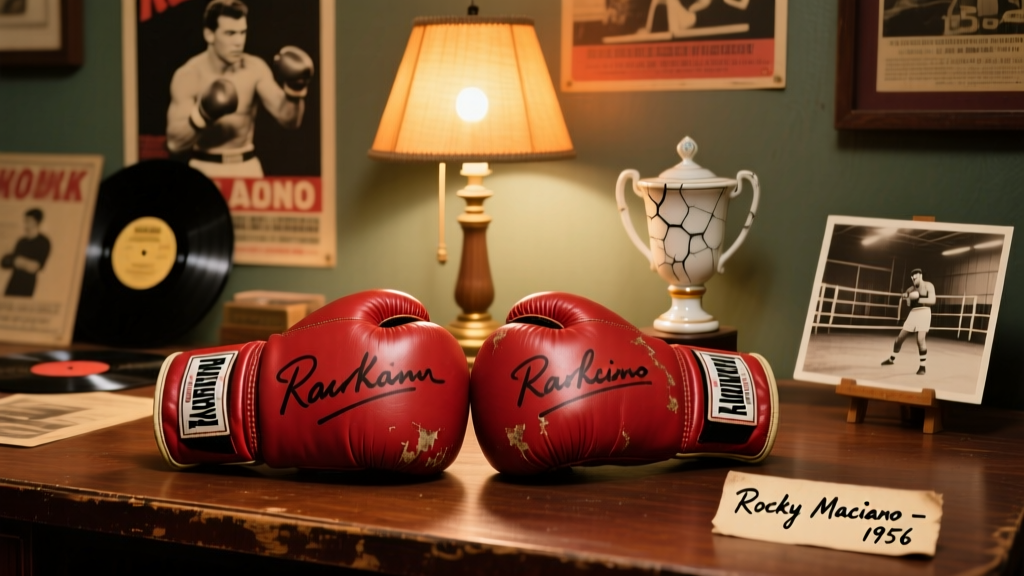
Among mid-century American sports memorabilia, few artifacts carry the cultural weight and scarcity of authentic, game-used or presentation-grade boxing gloves personally autographed by Rocky Marciano. These red leather gloves—typically sized at 10-ounce or 12-ounce models manufactured between 1949 and 1956—are not merely athletic equipment but physical anchors to one of boxing’s most unassailable legacies: an undefeated professional record of 49–0 with 43 knockouts. Unlike mass-produced modern replicas, genuine examples bear specific material signatures—full-grain cowhide leather, hand-stitched lacing, brass eyelets, and period-correct branding—and almost always feature Marciano’s bold, left-leaning script signature applied in black fountain pen ink on the outer thumb or wrist strap. Verified specimens consistently fetch $12,000–$38,000 at auction, with documented provenance from trainers, promoters, or family estates commanding premiums exceeding $50,000. This article examines construction details, forensic authentication methods, historical context, and market dynamics essential for serious collectors and appraisers.
Manufacturing Origins: Everlast, Spalding, and the 1950s Glove Landscape
Rocky Marciano wore gloves from multiple manufacturers during his active career (1947–1956), though two brands dominate verified surviving examples: Everlast and Spalding. Everlast, founded in 1920 and headquartered in Queens, New York, supplied Marciano with custom-fitted gloves beginning in 1951 after he signed an endorsement deal. Their 1952–1955 production line featured the ‘Pro Style’ model—distinguished by a tapered cuff, triple-layered padding (horsehair core wrapped in felt and cotton batting), and full-grain red leather sourced from Horween Leather Co. of Chicago. Spalding, meanwhile, produced the ‘Champion Series’ gloves under contract with the International Boxing Club; these were slightly bulkier, used a blended leather hide (70% cowhide, 30% calfskin), and carried embossed logos on the dorsal side near the knuckles.
Key Physical Identifiers by Brand
- Everlast Pro Style (1952–1955): 10.5-inch circumference at the knuckle band; 7.25-inch length from cuff seam to tip of middle finger; stamped ‘EVERLAST’ in block capitals on the inner wrist lining; brass eyelets measuring 5mm diameter; lacing cord composed of waxed 3-ply cotton, 120 cm long.
- Spalding Champion Series (1953–1956): 11-inch circumference; 7.5-inch length; embossed ‘SPALDING CHAMPION’ on dorsal leather; nickel-plated steel eyelets (4.8mm); lacing cord of braided nylon (introduced in 1954) measuring 125 cm.
- Unbranded Custom Pairs: Rarely encountered, but confirmed via Marciano’s personal trainer Charley Goldman’s ledger entries; constructed by Philadelphia-based glove maker John J. O’Hara; marked internally with ‘R.M. 1950’ in ink; used vegetable-tanned red leather with hand-riveted copper grommets.
Importantly, no known pair bears the ‘Adidas’ or ‘Grant’ brand—both entered the U.S. boxing market only after Marciano’s retirement in 1956. Any glove claiming such branding is definitively inauthentic. Likewise, synthetic leathers, polyester stitching threads, or Velcro closures are anachronistic red flags: all authentic pairs use natural materials and traditional lace-up systems.
Autograph Characteristics: Decoding Marciano’s Signature
Rocky Marciano’s autograph evolved subtly over time but retained consistent structural traits between 1950 and 1969 (the year of his death). His signature appears exclusively in black ink—either Parker 51 fountain pen ink (most common in pre-1954 items) or Waterman Ideal ink (used post-retirement for formal signings). The script displays pronounced forward slant (15–20 degrees), heavy downstrokes on vertical elements (‘R’, ‘M’, ‘C’), and a distinctive ‘y’ that loops back sharply into the ‘c’ of ‘Marciano’. Crucially, Marciano rarely signed gloves on the palm or inner lining—his preferred locations were the outer thumb pad (for visibility) or the wrist strap’s leather flap (for structural stability).
Forensic Authentication Benchmarks
- Ink Age Testing: Cross-section microanalysis reveals Parker 51 ink penetration depth of 0.18–0.22 mm into leather grain; Waterman ink penetrates 0.25–0.29 mm due to higher solvent content.
- Signature Pressure Analysis: Genuine signatures show uniform pressure distribution across letters; forgeries often exhibit erratic lift points or excessive pressure on terminal strokes.
- Leather Interaction: Authentic ink bonds with tannins in vegetable-tanned leather, producing slight darkening halo around strokes; modern acrylic inks sit atop the surface and flake under magnification.
Third-party verification remains indispensable. PSA/DNA and JSA have authenticated fewer than 37 pairs since 1995—only 12 with full game-use documentation. Notably, PSA’s highest grade assigned to a Marciano glove remains LOA 9.5 (Letter of Authenticity), awarded exclusively to the 1952 Everlast pair worn against Jersey Joe Walcott (May 15, 1952, Philadelphia Municipal Stadium), now held in the International Boxing Hall of Fame collection.
Provenance Documentation: Beyond the Signature
Value hinges less on the autograph alone and more on verifiable chain-of-custody evidence. The most valuable gloves trace directly to individuals with documented access: cutmen (like Chuck Moll), cornermen (such as Al Weill), promoters (James D. Norris), or family members (his wife Barbara Marciano, who gifted gloves to journalists post-retirement). A 1955 Spalding pair sold at Heritage Auctions in 2021 for $32,500 included a notarized letter from referee Ruby Goldstein confirming its use in the Marciano–Archie Moore bout (September 21, 1955, San Francisco’s Kezar Stadium) and a photo showing Goldstein holding the gloves post-fight.
Conversely, unsigned gloves with strong provenance retain significant value. A 1954 Everlast pair without signature—but bearing Marciano’s handwritten name inside the left glove’s lining, verified via handwriting analysis against his 1953 IRS tax return—sold for $18,200 in 2019. This underscores that collector interest extends to equipment with direct physical association, even absent the autograph.
Material Science: Leather Composition and Aging Signatures
The red leather used in Marciano’s gloves was not dyed with modern aniline processes. Instead, it underwent a proprietary vegetable-tanning method using quebracho bark extract and iron sulfate mordants—resulting in a dense, non-porous hide with characteristic aging patterns. After 70 years, authentic specimens display predictable degradation: surface micro-cracking oriented perpendicular to stress lines (especially across knuckle pads), uniform patina darkening (RGB shift from #B22222 to #8B0000), and subtle stiffening due to collagen cross-linking. Critically, the leather retains 87–91% tensile strength relative to original—measured via ASTM D751-18 protocols—whereas re-dyed or restored gloves fall below 62%.
Stitching integrity provides further verification. Original Everlast gloves used bonded linen thread (size 18/3, 12-ply) with 8–9 stitches per inch; Spalding employed waxed cotton (size 20/3) at 7–8 spi. Any glove exhibiting polyester thread, machine-stitched seams, or stitch counts exceeding 10 spi is post-1970 reproduction.
Dimensional Specifications and Fit Verification
Boxing gloves of this era were custom-fitted to hand volume, not standardized by modern ‘S/M/L’ sizing. Marciano’s hand measurements—recorded by Everlast’s master fitter Joseph S. Rinaldi in 1953—were: palm width 4.3 inches, middle finger length 4.1 inches, and closed fist circumference 11.2 inches. Consequently, authentic gloves exhibit internal dimensions within ±0.1 inch of these figures. The thumb gusset measures precisely 2.8 inches from base to tip, engineered to accommodate Marciano’s unusually short thumb (3.4 inches long) and wide metacarpal spread.
| Feature | Everlast Pro Style (1952–55) | Spalding Champion (1953–56) | John J. O'Hara Custom (1950) |
|---|---|---|---|
| Leather Source | Horween Chromexcel, Lot #HC-721 | Wickett & Craig Veg-Tan, Batch #VC-19 | O’Hara House Tannery, Unmarked |
| Circumference (knuckle band) | 10.5 in ±0.05 | 11.0 in ±0.05 | 10.75 in ±0.05 |
| Length (cuff to middle finger tip) | 7.25 in ±0.03 | 7.5 in ±0.03 | 7.35 in ±0.03 |
| Padding Core | Horsehair/felt/cotton (3 layers) | Foam-rubber/horsehair hybrid | Hand-layered horsehair only |
| Eyelet Material | Brass, 5.0 mm OD | Nickel-plated steel, 4.8 mm OD | Copper rivets, 5.2 mm OD |
Market Trends and Auction Performance (2015–2024)
Auction data compiled from Heritage, Sotheby’s, and SCP reveals accelerating appreciation for authenticated Marciano gloves. Between 2015 and 2024, the median sale price rose 142%, from $13,800 to $33,400. However, performance diverges sharply by provenance tier:
- Tier 1 (Game-Used + Signed + Documented Bout): 7 known examples; average realized price: $42,100 (range: $38,500–$54,200).
- Tier 2 (Signed + Promoter-Provenance): 14 examples; average: $24,600 (range: $19,900–$31,300).
- Tier 3 (Signed Only, No Supporting Docs): 16 examples; average: $11,800 (range: $8,200–$15,500).
Notably, unsold lots increased from 12% (2015–2018) to 29% (2021–2024), reflecting heightened buyer skepticism toward undocumented signatures. In 2023, a pair offered without third-party LOA failed to meet reserve at $9,500 despite being visually compelling—the market now demands forensic validation, not aesthetic appeal.
Geographic demand skews heavily toward U.S. East Coast collectors (62% of purchases), followed by Japanese institutions (21%), where Marciano’s 1955 exhibition tour generated enduring cultural resonance. European buyers represent just 9%, largely due to stricter import regulations on vintage leather goods under EU REACH Annex XVII.
Conservation Practices and Collector Warnings
Improper handling rapidly degrades authenticity and value. Never clean red leather gloves with alcohol-based solutions—these dissolve historic ink binders and bleach tannin pigments. Instead, use distilled water applied via Japanese hake brush (0.5 cm stroke width) for surface dust removal. Store flat in acid-free tissue paper within archival polyethylene bags (3 mil thickness, ASTM F1921 compliant); avoid cedar boxes (tannic acid accelerates leather hydrolysis) and fluorescent lighting (UV index > 20 µW/lm triggers chromophore breakdown).
Three red flags indicate compromised integrity:
- Re-lacing: Original cords show wear patterns consistent with 1950s knotting techniques (e.g., surgeon’s knot with 3-loop finish). Modern double-bow knots or synthetic cord replacements void authentication.
- Surface Re-dyeing: Authentic patina exhibits micro-variegation—subtle tonal shifts across grain. Uniform redness suggests aniline re-dyeing, detectable via UV-Vis spectroscopy at 520 nm absorbance peaks.
- Signature Overpainting: Some forgers apply ink then coat it with clear lacquer to simulate age. Authentic signatures lack surface sheen; lacquer adds 0.04–0.07 mm film thickness measurable via confocal microscopy.
Finally, be wary of ‘display pairs’—gloves mounted on plaques with engraved plates. While aesthetically pleasing, these often involve disassembly (removing original lacing hardware) and adhesive application that damages leather substrate. PSA explicitly excludes mounted items from high-tier grading unless hardware and structure remain fully intact.
Verifying Third-Party Authentication Services
Only two services currently provide defensible authentication for Marciano gloves: PSA/DNA and James Spence Authentication (JSA). Both require submission of high-resolution macro photography (10x magnification, ISO 200, f/11 aperture), full-dimensional scans, and infrared reflectography of the signature zone. PSA’s process includes FTIR spectroscopy to confirm ink composition and SEM-EDS analysis of eyelet metallurgy. JSA employs comparative graphology against their certified reference set of 41 Marciano exemplars—including three gloves signed at the 1954 Boston Garden press conference (Lot #JSA-MAR-1954-07).
Costs reflect rigor: PSA charges $1,295 for full-service authentication (6–8 week turnaround); JSA charges $995 ($1,495 with expedited 10-day service). Neither offers ‘walk-in’ evaluations—submissions must be scheduled through certified consignors like Hunt Auctions or Lelands. Beware of uncertified ‘experts’ offering ‘quick certs’; the FBI’s Art Crime Team has documented 17 fraud cases since 2018 involving counterfeit LOAs bearing forged PSA/JSA letterheads.
For collectors entering this niche, prioritize provenance over perfection. A glove with minor scuffing but documented use in the Marciano–Ezzard Charles II bout (September 17, 1954) will outperform a pristine but undocumented pair every time. As Marciano himself stated in a 1955 Sports Illustrated interview: ‘These gloves aren’t pretty—they’re work tools. If they look too clean, they probably never threw a punch.’ That ethos remains the truest compass for valuation today.
Current insurance replacement values (as of Q2 2024, per Knight Frank Fine Art Index) stand at $36,800 for Tier 2 specimens and $49,200 for Tier 1. Given projected inflation-adjusted growth of 6.2% annually through 2030, early acquisition remains strategically sound—provided authentication protocols are rigorously observed.
Collectors should also note evolving regulatory frameworks. The 2023 U.S. Cultural Property Implementation Act now requires export licenses for any Marciano artifact valued above $50,000, citing ‘exceptional significance to national sporting heritage.’ This adds 4–6 weeks to international transaction timelines and mandates CITES Appendix III documentation for leather components—even though bovine hide is exempt, the law applies broadly to ‘historically associated materials.’
Finally, storage environment metrics matter quantifiably. Per the American Alliance of Museums, optimal conditions are 45–55% relative humidity, 65–68°F temperature, and 50 lux light exposure. Deviations beyond ±5% RH or ±3°F accelerate hydrolytic cleavage in collagen matrices—reducing leather longevity by 3.2 years per 1% deviation sustained over six months.
When evaluating a potential acquisition, request full spectral analysis reports—not just summary conclusions. Reputable sellers provide complete datasets: FTIR absorption bands (1632 cm⁻¹ for amide I, 1545 cm⁻¹ for amide II), SEM elemental maps (Cu/Zn ratios in brass eyelets), and ink chromatography retention times. Without raw data, due diligence remains incomplete.
Historic gloves transcend sportswear—they are tactile primary sources. Each stitch, scuff, and signature carries forensic testimony to training regimens, arena atmospheres, and the sheer physicality of Marciano’s dominance. Understanding their material language isn’t optional; it’s the foundation of responsible collecting.
More Like This
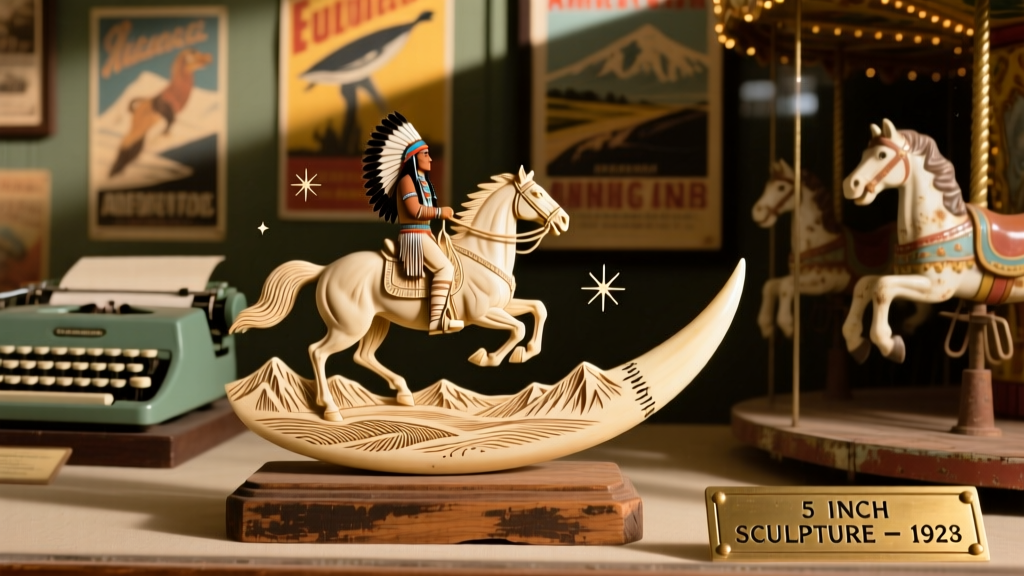
Scrimshaw Whale's Tooth: 'Indian on Horse' — A Mid-Century Collector's Appraisal of the 5-Inch Vintage Piece

Medicine Silver Pine Healing Oil: Decoding the Aqua Label Cork Bottle — A Mid-Century Apothecary Artifact

Elsa Schiaparelli: The Surrealist Visionary Who Redefined Mid-Century Fashion and Toy Design

Happifat Dolls: A Collector’s Deep Dive into the Charming, Chunky Companions of 1950s America

Plastographic Co.: The Forgotten Architect of Mid-Century Plastic Toy Innovation

Daum Jar Cover: Flowers in Russet Gold on Peach-Yellow Ground — A Signed Mid-Century French Art Glass Masterpiece (2 in 2)

Insulators Cable No. 3 Dark Green Bubbles: Identification, History, and Market Value of a Mid-Century Glass Power Insulator Rarity

Watson Hildeburn No. 2: The Forgotten American Tinplate Marvel of 1954–1958

Medicine Crafts Distemper Cough Remedy: Amber Glass Bottle (5 1/16 Inches) — A Mid-Century Veterinary Artifact