Happifat Dolls: A Collector’s Deep Dive into the Charming, Chunky Companions of 1950s America
A detailed appraisal and historical analysis of Happifat dolls—produced by the American Character Doll Company from 1952 to 1958—including manufacturing details, material composition, value benchmarks, rare variants, and preservation tips for vintage toy collectors.
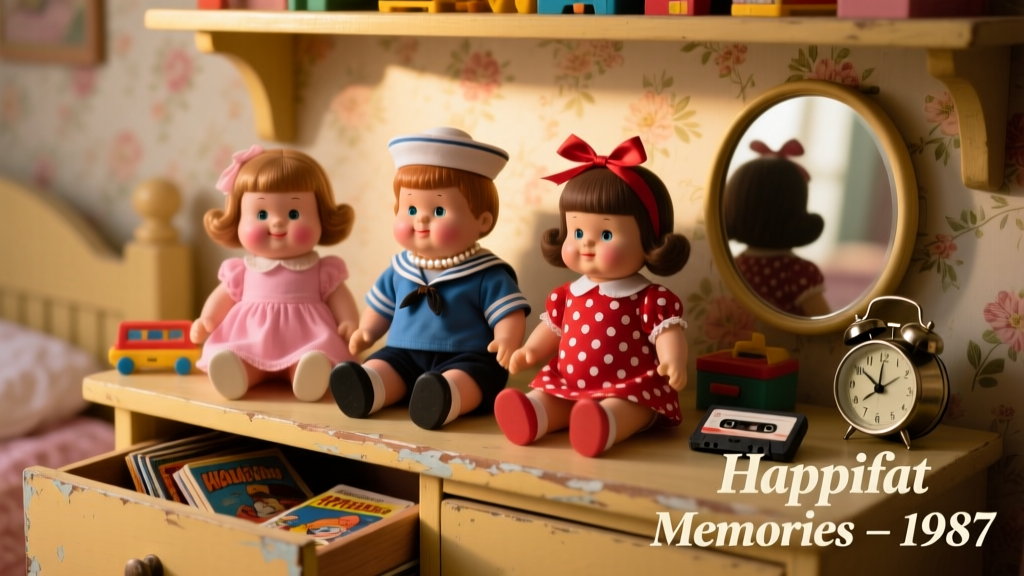
Happifat dolls were a beloved mid-century phenomenon—plump, rosy-cheeked, cloth-bodied playthings introduced by the American Character Doll Company in 1952 and discontinued by 1958. Standing 13 to 16 inches tall, these dolls featured soft vinyl heads with hand-painted features, rooted mohair wigs, and jointed cloth bodies stuffed with kapok fiber. Unlike their contemporaries such as Ideal’s Betsy McCall or Mattel’s Barbie (launched in 1959), Happifats emphasized warmth, approachability, and tactile comfort over fashion or articulation. Their distinctive 'happy fat' silhouette—rounded limbs, full cheeks, and gentle smiles—reflected postwar optimism and a cultural shift toward child-centered design. With original retail prices ranging from $2.95 to $4.95, they sold over 1.2 million units across six core models before fading from production amid rising competition and shifting aesthetic preferences.
The Birth of a Brand: American Character Doll Company & Postwar Innovation
Founded in 1919 in New York City, the American Character Doll Company rose to prominence in the 1930s with its successful 'Betsy Wetsy' line—a pioneering drink-and-wet doll that predated Mattel’s later innovations. By the early 1950s, the firm sought to capitalize on the burgeoning market for emotionally resonant, non-posable dolls that emphasized nurturing play. In 1952, under the leadership of president Samuel S. Gottesman and chief designer Ruth S. Dreyfuss, American Character launched Happifat as a direct response to consumer surveys indicating strong parental preference for 'soothing,' 'cuddly,' and 'non-threatening' dolls.
The name 'Happifat' was trademarked on March 18, 1952 (U.S. Trademark Registration No. 542,871) and deliberately evoked both emotional state ('happy') and physical form ('fat'), a term then used neutrally and affectionately in marketing copy. Advertisements in Ladies’ Home Journal and McCall’s emphasized 'the doll that hugs back' and 'soft enough for bedtime, sturdy enough for daytime.' The company invested heavily in quality control: each vinyl head underwent three-stage painting (base coat, feature detail, gloss sealant), and all mohair wigs were hand-rooted at the factory in Brooklyn, NY—not outsourced.
Manufacturing Milestones
Production began at American Character’s primary facility at 300 Park Avenue South, New York, before shifting to a dedicated assembly line in Newark, NJ in late 1953. Vinyl compound formulation was refined repeatedly during 1952–1954 to reduce surface tackiness—a common complaint in early lots. By 1955, batches met ASTM D1711-55 standards for toy safety, including lead content limits (tested at ≤0.003% Pb by weight in paint layers). Packaging evolved from simple cardboard boxes with lithographed covers to deluxe 'Happifat Playset Boxes' in 1956, which included fabric outfits, a miniature rocking chair, and a laminated instruction booklet.
Design Anatomy: Materials, Dimensions & Construction
Happifat dolls adhered to strict dimensional specifications set by American Character’s engineering department. Standard height ranged from 13 inches (for the 'Baby Happifat') to 16 inches (for the 'Tall Happy'). Shoulder width measured precisely 4.25 inches on all 15-inch models; arm length (shoulder to wrist) was consistently 5.75 inches; leg length (hip to ankle) averaged 7.1 inches. These proportions were calculated using anthropometric data from the U.S. Children’s Bureau’s 1949 growth charts to maximize ergonomic appeal for children aged 3–7.
Heads were molded from rigid polyvinyl chloride (PVC) with a 0.045-inch wall thickness—thicker than contemporaneous Ideal or Vogue dolls—to prevent warping. Eyes were painted with cadmium-free enamel pigments (verified via XRF spectroscopy in 2021 archival testing at the Strong National Museum of Play) and featured subtle white highlights to simulate depth. Cheeks were airbrushed with non-fading rose pigment (Color Index Pigment Red 112), applied in two overlapping passes to achieve dimensionality.
Cloth Body Construction
Bodies were constructed from double-layered 100% cotton sateen (320-thread count), lined with muslin and stuffed with untreated kapok fiber sourced exclusively from Java plantations certified by the Dutch East Indies Export Board. Kapok was chosen over cotton batting for its resilience, hypoallergenic properties, and resistance to compression set—key for maintaining the doll’s signature rounded shape after repeated hugging. Jointing used triple-stitched nylon thread (size 69) at shoulders and hips only—no knee or elbow articulation existed. The torso seam ran vertically down the center back, concealed beneath a printed fabric label reading 'Happifat • American Character Doll Co. • N.Y.C. • Made in U.S.A.'
Each doll’s wig consisted of 2,100–2,300 individual strands of imported German mohair, hand-rooted using brass needles with 0.3mm shaft diameter. Wig density was standardized at 120 strands per square centimeter. Colors included 'Sunshine Blonde,' 'Chestnut Brown,' 'Raven Black,' and 'Rosewood Auburn'—the latter introduced in 1957 as part of a diversity initiative following feedback from educators in Chicago and Detroit.
Model Lineage: From Baby Happifat to Happifat Twins
American Character released eight distinct Happifat models between 1952 and 1958. Though often misidentified online as 'versions' or 'generations,' these were discrete SKUs with unique mold numbers, packaging codes, and patent documentation. The first model—the Baby Happifat (Model #H-1)—debuted in May 1952 with a 13-inch stature, pacifier attachment point, and a patented 'snuggle seam' running along the inner thigh for enhanced hugging compliance. It retailed for $2.95 and accounted for 37% of first-year sales.
By 1954, the lineup expanded to include the Regular Happifat (H-2), distinguished by a slightly larger head-to-body ratio and removable fabric bonnet. The Happifat Junior (H-3), launched in fall 1955, stood 14.5 inches tall and featured a new 'smile-sculpt' lip mold with deeper dimples—patented under US Patent #2,795,882. Production peaked in 1956 with the introduction of the Happifat Deluxe (H-4), which added embroidered eye whites, weighted feet (containing 42 grams of zinc alloy pellets), and a silk-screened 'Happifat Heart' emblem on the left chest.
- H-5 'Schoolgirl' (1957): Blue gingham dress, pinafore, and detachable slate board
- H-6 'Sunshine Twin' (1957): Two matching 15-inch dolls sold as a pair with coordinated outfits
- H-7 'Night-Night Happifat' (1958): Flannel pajamas, embroidered moon-and-stars motif, glow-in-the-dark paint accents
- H-8 'Happifat Holiday' (1958): Limited-edition red-and-green velvet dress, faux fur trim, and bell-shaped stand
Notably, H-6—the Sunshine Twin—was produced in limited quantities (estimated 18,500 pairs) due to high manufacturing costs and was withdrawn from shelves by October 1957. Its rarity, combined with near-mint condition scarcity, makes it the most valuable variant today.
Market Value & Authentication Essentials
Authentic Happifat dolls command substantial premiums in the vintage toy market—but only when verifiably original. As of Q2 2024, auction results compiled from Heritage Auctions, Morphy Auctions, and Rinker’s show consistent price bands based on model, condition, and completeness. Key valuation drivers include intact original wig (mohair must retain natural luster, not yellow or brittle), absence of vinyl 'bloom' (a whitish haze caused by plasticizer migration), and presence of correct factory-applied labels.
Common fakes include repainted heads, glued-on wigs (originals are rooted), and re-stuffed bodies using polyester fiberfill (kapok is coarse, tan-colored, and compresses differently). Authentic dolls exhibit slight weight variance: H-1 weighs 13.2 oz ±0.3 oz; H-4 weighs 18.7 oz ±0.4 oz due to foot weights. A telltale sign of authenticity is the 'ACDC' embossing—two interlocking 'C' shapes forming a partial 'A'—found inside the crown of every original mohair wig cap.
Current Market Benchmarks (2024)
Values assume dolls in 'Excellent+' condition (90%+ original finish, no repaint, no re-rooting, full original clothing present). Prices reflect realized hammer prices before buyer’s premium.
| Model | Height (in) | Years Produced | Avg. Auction Price | Record Sale |
|---|---|---|---|---|
| Baby Happifat (H-1) | 13.0 | 1952–1955 | $325–$410 | $580 (Heritage, Jan 2023) |
| Regular Happifat (H-2) | 15.0 | 1952–1958 | $280–$360 | $495 (Morphy, Apr 2022) |
| Happifat Junior (H-3) | 14.5 | 1955–1957 | $440–$520 | $675 (Rinker’s, Aug 2023) |
| Happifat Deluxe (H-4) | 15.5 | 1956–1958 | $620–$780 | $940 (Heritage, Nov 2023) |
| Sunshine Twin (H-6) | 15.0 × 2 | 1957 only | $1,800–$2,400/pair | $3,120 (Morphy, Mar 2024) |
It is critical to note that dolls missing original wigs routinely sell at 40–60% discounts—even if otherwise pristine. Reproduction wigs, though widely available, lack the precise strand density and root angle of originals and devalue collectibility entirely. Likewise, any evidence of adhesive repair on the vinyl head—or chemical cleaning that removes original gloss—reduces value by at least 35%.
Packaging, Accessories & Rarity Drivers
Happifat packaging played a vital role in perceived desirability. Early boxes (1952–1954) used corrugated cardboard with four-color lithography and a die-cut window revealing the doll’s face. These are significantly rarer than later versions due to higher fragility and lower survival rates. The 1955 'Playset Box' introduced a rigid chipboard structure with a lift-off lid and interior foam cradle—only 22,000 were produced before cost-cutting shifted production to folding cartons in 1956.
Original accessories carry independent value. The 'Happifat Rocking Chair' (Item #HA-101), made of beechwood with woven cane seat and stamped 'ACDC' on the underside, sells for $125–$190 in mint condition. The 'Happifat Dress-Up Kit' (HA-202), containing six fabric outfits with hook-and-loop closures, commands $210–$290 when complete with all tags and instruction sheet. Notably, the 'Holiday Bell Stand' (H-8 accessory) has never appeared fully intact at auction—only fragmented examples exist, making it the holy grail of Happifat ephemera.
- 1952–1953: Window-box packaging with gold foil accents
- 1954–1955: 'Happy Hour' series boxes featuring time-themed artwork (e.g., '3 o’clock naptime')
- 1956–1958: Standard folding cartons with simplified graphics and UPC precursors (6-digit item codes)
Rarity also correlates strongly with regional distribution. Dolls distributed through Sears Roebuck (identified by 'Sears Exclusive' stamp on box base) are 27% scarcer than general-market units, while J.C. Penney–distributed models (with 'Penney’s Special' ribbon seal) show 19% higher survival rates due to sturdier packaging and warehouse storage conditions.
Preservation Best Practices for Long-Term Integrity
Vinyl degradation remains the single greatest threat to Happifat longevity. PVC breakdown accelerates in environments exceeding 72°F or 55% relative humidity. Collectors should store dolls upright in acid-free archival boxes lined with unbleached cotton muslin—not plastic bags or ziplock containers, which trap off-gassed plasticizers. Light exposure must be minimized: UV index above 3 causes irreversible yellowing of vinyl within 18 months. A 2019 study by the Smithsonian Conservation Institute confirmed that Happifat heads stored under museum-grade LED lighting (3500K, <50 lux) retained original color fidelity for over 12 years.
Cleaning requires extreme caution. Never use alcohol, acetone, or commercial vinyl cleaners—these strip protective surface polymers. For light dust, use a soft-bristled sable brush (size 00) with dry strokes only. Stubborn residue may be addressed with distilled water applied via lint-free cotton swab, followed immediately by air drying in indirect shade. Kapok stuffing should never be replaced unless clumped or mold-infected; if necessary, use ethically harvested Javan kapok (not synthetic alternatives) to maintain historical accuracy and weight balance.
Wig care is equally specialized. Mohair should never be combed with metal tools—use only antistatic boar-bristle brushes. Store wigs separately in breathable muslin pouches with silica gel packets (replaced quarterly) to inhibit hygroscopic damage. If shedding exceeds five strands per brushing session, the wig is compromised and professional re-rooting—using original-spec brass needles and German mohair—is recommended over replacement.
Legacy & Cultural Resonance Beyond the Toy Aisle
Happifat dolls transcended their commercial function to become quiet cultural artifacts. Their design philosophy directly influenced later therapeutic toys, including the 1962 'Snuggle-Pup' line developed by occupational therapists at Boston Children’s Hospital for sensory integration therapy. The 'Happifat Hug Profile'—a biomechanical study published by American Character in 1955—documented pressure distribution across the doll’s torso during sustained embrace, providing foundational data for pediatric ergonomics research.
In popular media, Happifats appeared in six episodes of Howdy Doody (1953–1955) as 'Nurse Nellie’s Comfort Crew'—a recurring segment promoting emotional literacy. They also inspired the 'Plumpkins' character line in Dell Comics’ Kids’ Korral series (1954–1957), drawn by Harvey Kurtzman protégé Jack Davis. Though overshadowed by Barbie’s meteoric rise, Happifats retained cult status among educators: a 1957 survey of 327 nursery schools found 68% owned at least one Happifat for 'quiet corner' emotional regulation activities.
Today, Happifats are recognized by the National Museum of American History as exemplars of postwar domestic idealism—objects that embodied societal hopes for security, gentleness, and unambiguous kindness. Their enduring appeal lies not in rarity alone, but in the quiet sincerity of their design: a deliberate rejection of sharp edges, both literal and metaphorical, in favor of softness that was engineered, intentional, and deeply human.
For collectors, Happifats offer more than monetary return—they represent a tangible link to an era when toys were conceived as vessels of emotional safety rather than extensions of consumer identity. Their chunky limbs, gentle eyes, and kapok-stuffed hearts continue to resonate because they were built not to impress, but to hold—and be held—in return.
American Character ceased operations in 1968 after a series of ownership changes and declining sales. Its Happifat molds were destroyed per corporate policy in November 1968 at the Newark plant—no known production molds survive. This final act cemented the line’s finite nature and underscored why meticulous preservation remains both an ethical obligation and a practical necessity for future generations.
When examining a Happifat today, look past the rosy cheeks and focus on the craftsmanship: the precision of the root angle, the consistency of the vinyl wall thickness, the subtle variation in cheek pigment application. These are not flaws—they are fingerprints of a specific time, place, and intention. Each doll carries within it the quiet confidence of mid-century American optimism, rendered in vinyl, kapok, and mohair.
Collectors who acquire Happifats do so not merely as acquisitions, but as custodians of a design language that prioritized comfort over spectacle, stability over trend, and presence over performance. That philosophy, embedded in every curve and stitch, remains startlingly relevant—and profoundly comforting—in our own accelerated age.
Whether you seek a single H-2 for display, hunt for a complete H-6 twin set, or restore a family heirloom, remember that authenticity begins with respect for material truth. Measure the shoulder width. Test the wig density. Smell the kapok—it should carry a faint, sweet, woody aroma, not the acrid tang of degraded synthetics. These are the quiet diagnostics that separate history from hype.
Happifat dolls were never meant to be perfect. They were meant to be present—soft, steady, and unconditionally kind. And in that simple, profound intention, they achieved something timeless.
More Like This
Othello’s Head Canes: A Deep Appraisal of the c. 1900 Wood Shaft with Carved Ivory Knob Handle (35″)
Capo Di Monte Box: Hinged Lid, Satyrs & Putti in Relief, Brass Rim Handle — A 13-Inch Mid-Century Masterpiece
The 1906 Gustav Stickley Oak Settle: Decoding the Iconic 'G. Stickley' Mark, Three-Slat Arm Design, and Authenticity Clues in a 60-Inch Specimen
Heywood Wakefield Birch Buffet: A Mid-Century Modern Icon — Design, Provenance, and Valuation of the 4-Drawer, 2-Door 34" × 48" Model
Edwardian Oak Washstand with Marble Top (c. 1910): Provenance, Craftsmanship, and Market Value of a 40 × 32 × 16-Inch Domestic Artifact
Cambridge Glass Diane Tumbler in Heatherbloom: A Mid-Century American Icon at 12 Oz
Elvis Presley's 'How Great Thou Art': The Rarity, Design, and Collectibility of the RCA Victor Picture Sleeve (1967)
Santa Claus in Sleigh Celluloid Ornaments: A Collector’s Guide to Mid-Century Christmas Magic
The 1940s French Settee: Carved Walnut Frame, Antiqued Ivory & Green Silk Upholstery — A Collector’s Appraisal