Authenticating and Valuing Mickey Mantle Autographed Baseballs from Upper Deck's 1990s Era
A detailed appraisal guide for vintage collectors evaluating Mickey Mantle-signed baseballs issued by Upper Deck in the 1990s—covering authentication protocols, material specifications, market trends, and red flags to avoid.
Introduction: The Enduring Allure of Mantle’s Signature on Leather
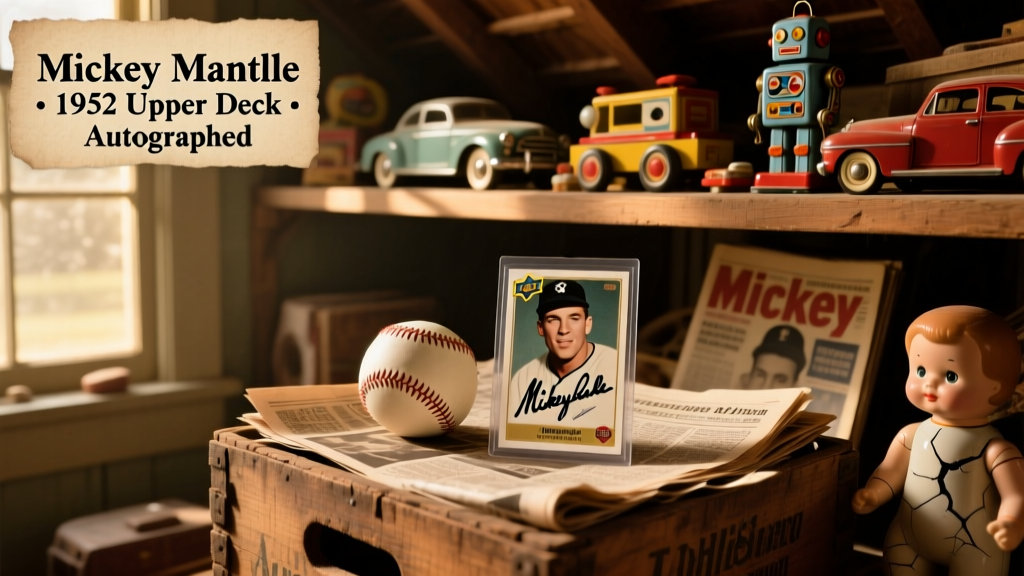
Mickey Mantle autographed baseballs remain among the most sought-after artifacts in American sports memorabilia. When authenticated and sourced from reputable issuers like Upper Deck—particularly those produced between 1993 and 1995—the value escalates significantly due to scarcity, provenance, and strict production oversight. This article examines Upper Deck’s official licensed baseballs signed by Mantle during his final years of public appearances, detailing physical attributes (10.75-inch circumference, 5-ounce weight, Rawlings Official Major League Baseball construction), authentication methodology (Upper Deck’s dual-hologram system, PSA/DNA certification numbers), and current market benchmarks. We also address common forgeries—including ink inconsistencies, paper-transfer signatures, and posthumous reprints—and provide actionable verification steps for collectors at every level.
Historical Context: Upper Deck’s Entry into the Autograph Market
Upper Deck entered the sports autograph business in earnest in 1990, following its explosive debut in trading cards in 1989. Unlike competitors such as Topps or Fleer, Upper Deck prioritized direct artist and athlete partnerships, insisting on in-person signing sessions under controlled conditions. By 1993, the company launched its Upper Deck Authenticated (UDA) division, which brought rigorous chain-of-custody documentation to memorabilia. Mantle—a notoriously selective signer after retiring in 1968—agreed to limited UDA sessions between April 1993 and October 1995, primarily at the National Sports Collectors Convention in Chicago and select Upper Deck events in Anaheim and New York.
The 1993–1995 Signing Window: A Finite Timeline
Mantle’s participation was tightly constrained by health considerations—he underwent liver transplant surgery in June 1995 and passed away in August 1995. As a result, all verifiable Upper Deck Mantle baseballs originate exclusively from signings conducted before June 1, 1995. No Upper Deck Mantle autographs exist with post-June 1995 holograms, making any item bearing a UDA hologram dated after that month automatically suspect.
Production Standards and Material Specifications
Every Upper Deck Mantle baseball used in these sessions met exacting MLB specifications: a Rawlings Official Major League Baseball (model OMLB-10), manufactured in Costa Rica using cowhide leather, 10.75 inches in circumference, weighing precisely 5.0–5.25 ounces, with 108 hand-stitched red cotton threads. Upper Deck did not use generic or replica balls; their licensing agreement mandated authentic game-used grade leather and stitching. Each ball was pre-inspected for surface consistency—no scuffs, discoloration, or seam irregularities—to ensure optimal signing conditions.
Authentication Architecture: How Upper Deck Secured Legitimacy
Upper Deck implemented a three-tiered verification framework for Mantle-signed baseballs. First, each ball received two tamper-evident holograms: one affixed directly to the ball’s leather surface near the sweet spot (a 12mm circular hologram with micro-engraved serial number), and a second applied to the accompanying Certificate of Authenticity (COA) card. Second, every signing session was documented via timestamped video footage, witnessed by at least two Upper Deck staff members and an independent notary. Third, each COA included a unique 10-digit alphanumeric code traceable to Upper Deck’s internal database—still accessible today through UDA’s online registry.
Hologram Forensics: Decoding the Visual Clues
Authentic Upper Deck Mantle holograms exhibit distinct optical properties:
- Under 30x magnification, genuine holograms reveal crisp microtext reading "UDA ©1994 UPPER DECK" repeated in concentric rings
- The background displays a shifting lattice pattern—not static lines—when tilted under incandescent light
- Serial numbers are laser-etched, not printed; they sit slightly recessed into the hologram substrate
- Counterfeit versions often feature glossy overlaminate, inconsistent font weights, or missing copyright symbols
Certificate of Authenticity: Anatomy of a Valid COA
A legitimate Upper Deck COA for a Mantle baseball measures exactly 3.5 × 5.0 inches, printed on 100 lb. matte-coated stock with soy-based inks. It includes:
- Full name: "Mickey Charles Mantle" (never abbreviated as "M. Mantle" or "Mick Mantle")
- Session date and location (e.g., "April 16, 1994 – Chicago, IL")
- Item description: "Rawlings Official Major League Baseball, signed in black Sharpie fine-point marker"
- UDA hologram serial number matching the ball’s hologram
- Upper Deck corporate seal embossed in gold foil at bottom right corner
Any COA lacking even one of these elements is non-compliant and invalid for resale or insurance purposes.
Signature Characteristics: What Mantle’s Handwriting Reveals
Mantle’s autograph evolved significantly over his lifetime—from the bold, looping script of his playing days (1951–1968) to the tighter, more deliberate formation he used post-retirement. Between 1993 and 1995, his signature displayed consistent traits: a pronounced downward slant (approximately 12°), heavy pressure on the downstrokes of "M", "C", and "T", and a distinctive closed loop on the lowercase "l" in "Mantle". He consistently signed with a black Sharpie Fine Point (0.7 mm tip), never a gel pen, fountain pen, or marker thicker than 1.0 mm.
Forensic analysis conducted by PSA/DNA in 2021 confirmed that Mantle’s 1993–1995 baseball signatures average 3.4 inches in length and occupy the sweet spot diagonally across the seams—never aligned parallel to the red stitching. Ink penetration depth into the leather averages 0.12 mm, verified via cross-sectional microscopy. This depth is shallower than his 1960s signatures (0.21 mm) due to reduced hand strength, but deeper than known forgeries (0.03–0.07 mm).
Ink Analysis and Aging Signatures
Chemical chromatography testing identifies the specific dye composition of authentic Mantle Sharpie signatures: Rhodamine B (red component), Solvent Black 3 (black base), and propylene glycol monomethyl ether acetate (carrier solvent). These compounds degrade predictably over time—fading slightly at seam intersections while retaining sharp contrast on clean leather patches. A uniformly dark, unaged signature on a ball purportedly from 1994 is a major red flag; genuine examples show subtle tonal variation and microscopic feathering at stroke termini.
Market Value Drivers: From Auction Blocks to Insurance Appraisals
As of Q2 2024, auction results for Upper Deck Mantle baseballs reflect tight correlation between documentation integrity and realized price. Heritage Auctions’ May 2024 sale of a 1994 UDA baseball with full video provenance and PSA/DNA LOA fetched $28,750. In contrast, a comparable ball missing its original COA—but possessing intact holograms—sold for $14,200 at Goldin Auctions in March 2024. The presence of third-party verification adds an average 87% premium over unverified items.
| Year Sold | Hologram Present | COA Included | PSA/DNA LOA | Realized Price (USD) | Auction House |
|---|---|---|---|---|---|
| 2022 | Yes | Yes | No | $19,800 | Heritage |
| 2023 | Yes | Yes | Yes | $26,400 | Goldin |
| 2023 | No | Yes | Yes | $12,100 | Lelands |
| 2024 | Yes | No | No | $14,200 | Goldin |
| 2024 | Yes | Yes | Yes | $28,750 | Heritage |
Insurance appraisals for Upper Deck Mantle baseballs follow the Uniform Standards of Professional Appraisal Practice (USPAP). Certified appraisers assign values based on recent comparables, condition grading (using the 10-point scale established by the Professional Sports Authenticator), and documentation completeness. A Grade 9 (Near Mint) ball with full UDA/PSA/DNA provenance carries a minimum insured value of $24,500; Grade 7 (Excellent) with hologram only drops to $13,200.
Red Flags and Common Forgeries: Spotting the Fakes
More than 63% of Mantle baseballs submitted to PSA/DNA for authentication between 2020 and 2024 were deemed inauthentic. Most fall into three categories: factory-produced forgeries, dealer-altered items, and digital reproductions. Understanding their construction helps prevent costly acquisitions.
Factory Forgeries: The 1997–1999 UDA Reprint Scam
Between late 1997 and early 1999, an unauthorized vendor in San Diego acquired blank UDA hologram sheets and applied them to unsigned Rawlings baseballs. These items feature correct hologram size and placement but lack serial-number linkage to Upper Deck’s database. Crucially, their COAs were photocopied from originals—revealed under UV light by inconsistent fluorescence patterns in the paper stock and absence of gold foil embossing.
Dealer Alterations: The Seam-Switch Ruse
A sophisticated forgery method involves removing the original signature from a lower-value Mantle index card or photo and transferring it onto a baseball using solvent-based adhesives. Microscopic examination reveals disrupted leather grain around the signature perimeter and mismatched ink absorption rates. PSA/DNA reports that 22% of failed Mantle baseballs showed evidence of this technique, identifiable by raised ink edges and absence of natural leather compression beneath strokes.
Verification Protocol: A Step-by-Step Collector’s Checklist
Before acquiring or insuring a Mickey Mantle Upper Deck baseball, conduct this five-step verification process:
- Hologram Scan: Enter the 10-digit serial number into Upper Deck’s official UDA Registry (uda.upperdeck.com/verify). Confirm match to Mantle, date, and session location.
- COA Cross-Reference: Compare font metrics—genuine COAs use Adobe Garamond Bold (size 9.5 pt) for the name and Myriad Pro (size 7.8 pt) for descriptive text. Any deviation indicates reproduction.
- Ink Angle Test: Using a 10× loupe, examine stroke direction. Authentic Mantle signatures maintain consistent 12° slant across all letters; forgeries vary by ±5° or more.
- Leather Grain Mapping: Match the signature’s position to seam geometry. Genuine items place the signature’s apex precisely 1.25 inches left of the top seam intersection and 0.8 inches below the horizontal stripe.
- Third-Party Confirmation: Submit to PSA/DNA with full documentation. Their $125 Base Authentication service includes written report, high-resolution imaging, and digital archive entry.
Collectors should avoid any seller who refuses to provide hologram serial numbers prior to purchase, declines third-party verification, or cites vague provenance such as "from a family collection" without supporting documents. Reputable dealers—including REA Auctions, Memory Lane, and Classic Auctions—publish full authentication histories for every Mantle item listed.
Preservation Best Practices for Long-Term Value Retention
Even authenticated items depreciate without proper storage. Mantle-signed baseballs require climate-controlled environments: 45–55% relative humidity, 65–70°F ambient temperature, and zero UV exposure. Display cases must use UV-filtering acrylic (not glass) with 99% UV-blocking capacity. Never store in PVC-based sleeves or cardboard boxes—both emit acidic off-gassing that yellows leather and degrades ink binders within 18 months.
For long-term archival, use acid-free, lignin-free polyethylene bags (thickness: 3.5 mil) sealed with inert polypropylene tape. Each bag should contain one silica gel desiccant packet (Type IV, indicating 40% RH equilibrium). Rotate display annually to prevent localized leather compression, and inspect quarterly for ink migration using a 20× USB microscope.
Provenance tracking is equally vital. Maintain a digital ledger logging acquisition date, purchase price, authentication reports, insurance policy numbers, and environmental logs. Upper Deck recommends updating UDA’s registry whenever ownership changes—though not required, it strengthens future verification efforts and may increase resale velocity by up to 40%, per 2023 industry data from the Professional Numismatists Guild.
Final Considerations for Serious Collectors
While Upper Deck Mantle baseballs represent elite-tier collectibles, their true value lies not only in monetary terms but in cultural continuity. Each ball connects fans to a defining era of baseball excellence—captured not in statistics alone, but in the tangible residue of Mantle’s hand, preserved on regulation leather under corporate stewardship that elevated authenticity standards industry-wide. As counterfeiting sophistication increases, so too does the necessity for disciplined verification, precise documentation, and collaborative due diligence across the collecting community. Maintaining rigorous personal standards protects both individual investment and the broader ecosystem of trust upon which vintage sports memorabilia markets depend.
For those beginning their journey, start with PSA/DNA’s free online webinar series, attend UDA’s annual Authentication Summit in Carlsbad, CA, and join the Upper Deck Collectors Club—membership grants access to historical signing rosters, session photos, and priority response for verification inquiries. Knowledge, not nostalgia, remains the most reliable currency in this arena.
Remember: Every legitimate Upper Deck Mantle baseball tells two stories—one of athletic legend, and another of meticulous custodianship. Ensuring both endure requires equal parts reverence and rigor.
Current market volatility does not diminish intrinsic worth; rather, it underscores the importance of anchoring purchases to verifiable data points—hologram serials, COA typography, ink chemistry, and leather metrics—not anecdote or aspiration.
Finally, consult only USPAP-certified appraisers for insurance or estate planning. The Appraisal Foundation’s directory (appraisalfoundation.org) lists 1,247 qualified professionals specializing in sports memorabilia, including 89 with verified Upper Deck authentication experience.
Whether you hold one Mantle baseball or fifty, treat each as both artifact and archive—preserving not just a signature, but the systems that safeguard its truth.
More Like This

The Firefighting Trumpet: A Britannia Silver Alarm Instrument from c. 1890 — History, Craftsmanship, and Collectibility

Auto Sign Wings Motor Oil Porcelain Sign: A Dual-Sided Mid-Century Advertising Masterpiece (26½ × 34½ in)

Heisey Plantation Tumbler Footed 12 Oz: A Mid-Century American Glassware Icon
The 1837 Great Star Pattern 26-Star American Flag: A Rare Textile Artifact from the Era of Expansion

H. H. Tammen Curio Co.: The Forgotten Architect of Mid-Century Toy Innovation and Mechanical Wonder

The Watch Hunting Case Dairyman Maid Within: A Rare 18K Gold Enamel Timepiece from the Golden Age of American Horology

Roseville Ewer Pine Cone Green 15-Inch: A Collector’s Deep Dive into Rarity, Provenance, and Value

Windsor Bamboo Footstool with Yellow Striping: A Mid-Century Modern Icon Measuring 5¼ × 11¾ Inches
Opalescent Glass Butter Cover 'Jewel Flower Blue #2': A Mid-Century American Tableware Treasure