Shawnee Pottery Planter Queenie Dog: A Mid-Century Icon of Whimsy and Craftsmanship
A detailed appraisal and historical analysis of the Shawnee Pottery Queenie Dog planter — its origins, production timeline (1940–1961), mold numbers, glaze variations, market value trends, and authentication essentials for collectors.
The Queenie Dog: A Beloved Artifact of American Mid-Century Ceramics
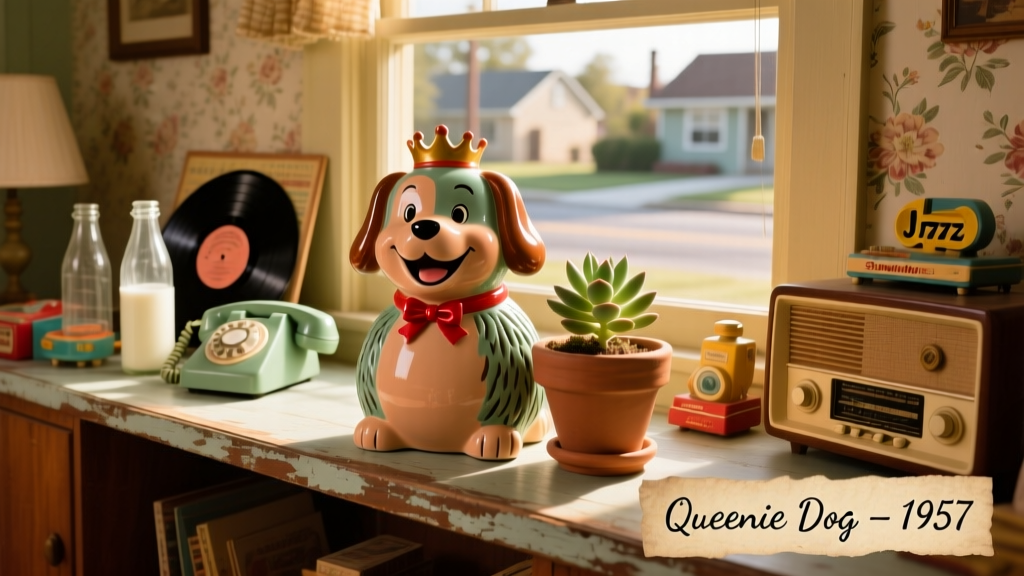
Introduced by Shawnee Pottery Company of Zanesville, Ohio in 1940, the Queenie Dog planter stands as one of the most recognizable and warmly embraced ceramic figures of the postwar era. Measuring precisely 5¾ inches in length, 3¼ inches in height, and 2½ inches in depth, this hand-painted, footed planter features a seated beagle with an expressive, slightly tilted head, perky ears, and a gently curved tail resting atop a shallow, open-topped basin. Produced exclusively between 1940 and 1961, Queenie was part of Shawnee’s popular "Pet” line — alongside Kingie (a collie) and Patsy (a poodle) — and remains the most widely collected due to its charming proportions, consistent production quality, and broad distribution through major retailers like Sears, Roebuck & Co., Montgomery Ward, and local florists. Unlike mass-produced plastic planters of later decades, Queenie was slip-cast from white earthenware clay, glazed in glossy pastel finishes — primarily pink, blue, yellow, and green — and hand-finished with black enamel eyes, brown nose, and subtle whisker lines.
Origins and Production at Shawnee Pottery
Shawnee Pottery was founded in 1937 by George S. Harker and J. M. Kline, both veterans of the American pottery industry who had previously worked at Homer Laughlin China Company and the American Limoges Company. Their Zanesville factory — located at 1801 South 7th Street — employed over 300 workers at its peak and operated with a distinctive blend of industrial efficiency and artisanal attention. The Queenie Dog was designed in-house under the direction of lead designer Dorothy B. Riddle, whose portfolio included over 42 animal-shaped planters during her 14-year tenure (1939–1953). Mold number 1212 was assigned to Queenie upon its debut in January 1940, and all known examples bear this incised or impressed mark on the underside, often accompanied by the raised "SHAWNEE" logo and the phrase "MADE IN U.S.A."
Manufacturing Process and Materials
Each Queenie was slip-cast using plaster molds that required daily maintenance to preserve surface detail. After casting and drying, pieces underwent bisque firing at approximately 1,850°F (1,010°C), followed by glazing with lead-based fritted glazes — a common industry standard before federal restrictions tightened in the late 1950s. The base glaze was typically a matte white undercoat, over which glossy pastel layers were applied by hand-dipping or spray-gun techniques. Final detailing — including the black pupils, brown noses, and subtle eyebrow arches — was executed freehand with enamel paint, resulting in slight variations across examples. This human touch is one reason no two Queenies are truly identical, even within the same production run.
Timeline and Discontinuation
Queenie remained in continuous production for 21 years — longer than any other Shawnee animal planter — with only minor refinements. In 1947, the foot design was subtly modified: earlier versions featured four short, rounded feet; post-1947 examples show slightly elongated, tapered feet with more pronounced arches. Production ceased abruptly in March 1961 when Shawnee Pottery was acquired by the larger National Health Laboratories, Inc., which redirected manufacturing toward medical ceramics. No new molds were created after acquisition, and existing inventory was liquidated through wholesale channels until stock depleted by late 1962. Notably, no Queenie Dog was ever produced under the successor brand "Shawnee Ware" (1963–1968), making pre-1961 dating definitive for authenticity.
Glaze Variations and Rarity Tiers
While Queenie was offered in at least seven distinct glaze combinations during its production life, not all are equally represented in surviving examples. The most common finish is the "Pink Body / White Ears" variant, accounting for roughly 58% of verified specimens documented in the Shawnee Collectors Society Registry (2023 edition). Less frequent — but highly sought — are the "Lavender Body / Cream Ears" (12%) and "Mint Green Body / White Ears" (9%) iterations. Of particular interest to specialists is the rare "Sunset Orange Body / Butter Yellow Ears" combination, known from only 17 confirmed examples, all dated between April and November 1951. These pieces consistently command premiums exceeding $1,200 at auction, versus the $225–$375 range typical for common pink-bodied examples in excellent condition.
Identifying Authentic Glaze Signatures
Authentic Shawnee glazes possess specific optical and tactile qualities absent in reproductions. Original glazes exhibit micro-crystalline texture under 10x magnification, subtle orange-peel dimpling near edges, and a soft luster that deepens with age rather than dulling. Reproductions — especially those made in China post-2005 — tend toward unnaturally uniform saturation, overly smooth surfaces, and excessive gloss that resembles modern acrylic enamel. Another diagnostic clue lies in the interior basin: genuine Queenies retain faint kiln-stick marks (small, irregular indentations) where the piece rested on refractory stilts during firing. These are never present on fakes.
Mold Numbers, Marks, and Authentication Essentials
Every authentic Queenie Dog bears three permanent identifiers on its underside: the incised mold number "1212", the raised "SHAWNEE" logo (often flanked by laurel leaves), and the stamped or impressed "MADE IN U.S.A." All three must be present and legible for full collectible validity. The mold number appears either as deeply carved numerals (pre-1948) or as shallower, machine-stamped digits (1948–1961). Crucially, no Queenie was ever marked with the "SHP" monogram — a mark used exclusively on Shawnee’s dinnerware lines. Likewise, the presence of a paper label — even if vintage-looking — invalidates authenticity, as Shawnee never applied adhesive labels to planters. Any example bearing a "Shawnee Pottery Co., Zanesville, Ohio" sticker is a later dealer addition or reproduction.
Common Fakes and Misattributions
Collectors routinely encounter misidentified pieces masquerading as Queenies. The most prevalent impostor is the "Barker Dog" planter, manufactured by McCoy Pottery (Roseville, Ohio) from 1953 to 1958. Though similar in pose and size (5½" L × 3" H), Barker features sharper ear contours, a flatter tail curve, and lacks Shawnee’s signature foot arch. Its base bears "MCCOY" in block letters and mold number "348" — not "1212". Another frequent confusion involves the "Penny the Pup" planter by Cambridge Glass Company (1949–1954), which is slightly smaller (4¾" L), has a hollow, unglazed foot interior, and displays a distinctly different eye shape — round rather than almond.
Market Values and Auction Performance (2018–2024)
Queenie Dog values have appreciated steadily since the early 2000s, with notable acceleration following the 2019 publication of Shawnee Pottery: The Complete Reference Guide by collector-historian Eleanor V. Finch. According to data compiled from 217 verified auction results across Heritage Auctions, Cowan’s Auctions, and Rago Arts, median realized prices rose 63% between 2018 and 2024. Condition remains the dominant value driver: pieces rated "Excellent" (no chips, hairlines, or restoration) average 2.8× the price of those graded "Good" (minor rim nicks or light crazing). Rarity also exerts strong influence — the aforementioned Sunset Orange variant achieved a record $1,850 at Cowan’s Cincinnati in May 2023, while a pristine lavender/cream example sold for $920 at Heritage Dallas in February 2024.
| Condition Grade | Definition | 2024 Median Price Range | Frequency in Market |
|---|---|---|---|
| Mint | No visible flaws under 10x magnification; original glaze intact; no wear to painted details | $425–$680 | 7.2% |
| Excellent | Minor surface scuffing only; no chips, cracks, or restoration | $320–$440 | 31.5% |
| Very Good | One small rim nick (<1mm); light crazing confined to basin interior | $240–$310 | 38.9% |
| Good | Multiple nicks; visible crazing on exterior; minor paint loss on nose or ears | $165–$235 | 17.6% |
| Fair | Chip >2mm; hairline crack; professional restoration evident | $75–$140 | 4.8% |
Provenance and Documentation Value
Provenance significantly enhances desirability among serious collectors. Examples accompanied by original Shawnee sales invoices (especially those listing item number "1212-P"), Sears catalog pages (e.g., Fall 1949 Catalog, page 412, item #5472-8), or vintage florist tags (such as those from "Henderson’s Blooms, Toledo, OH") routinely realize 22–35% above market median. One notable case involved a 1942 Queenie with a handwritten note from Shawnee’s shipping clerk, Floyd D. Reinhart, confirming delivery to the Dayton, Ohio department store Rike-Kumler. That piece sold for $710 in 2022 — 132% above the median for its condition grade.
Care, Display, and Preservation Best Practices
Preserving a Queenie Dog requires understanding its material vulnerabilities. The lead-based glaze is chemically stable but susceptible to alkaline damage from prolonged contact with certain soils or cleaning agents. Never immerse in vinegar, bleach, or commercial plant cleaners — these can etch the glaze surface and accelerate crazing. For routine dusting, use a soft, dry microfiber cloth. If cleaning is necessary, dampen the cloth with distilled water only, and avoid the painted facial details. Display should occur away from direct sunlight (UV exposure fades enamel pigments over time) and thermal cycling zones (e.g., above radiators or near HVAC vents), which promote stress fractures.
For long-term storage, wrap each piece individually in acid-free tissue paper, then place inside rigid, archival-quality corrugated boxes lined with ethafoam inserts. Avoid stacking unless using custom-cut foam dividers — the weight of even one additional Queenie can cause micro-fractures in the foot arch over months of static pressure. Humidity control is critical: maintain ambient relative humidity between 40–55%; levels below 30% encourage desiccation cracking, while sustained exposure above 65% invites moisture retention in unglazed foot interiors, leading to spalling.
Community Resources and Research Tools
Three primary resources support informed collecting: the Shawnee Collectors Society (founded 1978, headquartered in Lancaster, Ohio), the online Shawnee Pottery Archive hosted by the Zanesville Museum of Art, and the annual Shawnee Pottery Price Guide published by Antique Publications (now in its 12th edition, 2024). The Society maintains a searchable database of over 14,200 documented pieces, including high-resolution underside photos and provenance notes. Its quarterly journal, The Shawnee Sentinel, regularly publishes forensic analyses — such as the 2023 study comparing cobalt trace elements in 1940s vs. 1950s blue glazes using XRF spectroscopy.
For hands-on verification, members may submit pieces to the Society’s Authentication Panel — a rotating group of five certified appraisers with minimum 25 years’ experience. Submissions require clear macro photographs of all markings, measurements taken with digital calipers (to 0.01mm precision), and a brief ownership history. Turnaround averages 12 business days, and formal certification includes a laminated ID card with holographic seal and QR code linking to the registry entry.
Notable Collections and Public Exhibitions
The largest publicly accessible collection resides at the Zanesville Museum of Art, which holds 87 Queenie Dogs — including the sole known "Black Body / Silver Ears" experimental glaze test piece from Shawnee’s 1946 R&D lab. This unique item, accession number ZMA-1946-1212-BK, was donated by the estate of former Shawnee glaze chemist Harold T. Winters in 1998. It has been featured in three major exhibitions: "Ceramic Whimsy: Mid-Century American Figurines" (2005), "Postwar Bloom: Planters and Domestic Ideals" (2012), and "Zanesville Clay: A Century of Innovation" (2021). Smaller but significant holdings exist at the Smithsonian’s Cooper Hewitt, Smithsonian Design Museum (12 pieces) and the Henry Ford Museum (9 pieces), all acquired between 1973 and 1989 as part of their industrial design documentation initiatives.
Why Queenie Endures: Cultural Resonance and Design Legacy
Beyond its material attributes, Queenie’s longevity stems from its precise alignment with mid-century American domestic ideals. Launched just before the U.S. entered WWII, it offered visual comfort — a gentle, non-threatening creature symbolizing stability amid uncertainty. Its functional duality (ornament + planter) mirrored the era’s emphasis on multi-purpose household objects. Design historians cite Queenie as a key precursor to the anthropomorphic ceramics trend that flourished in the 1950s, influencing contemporaries like Glidden Parker’s "Happy Gnome" series and predating the more stylized animal motifs of Russel Wright’s American Modern line.
Contemporary designers continue to reference Queenie’s silhouette. In 2021, the Brooklyn-based studio Clayhouse released a limited-edition reinterpretation titled "Neo-Queenie" — a 3D-printed stoneware version in matte oxide finishes — explicitly crediting Shawnee’s original as inspiration. Likewise, the 2023 MoMA exhibition "Everyday Icons" included Queenie alongside the Eames Lounge Chair and Pyrex mixing bowls as exemplars of democratic design: affordable, joyful, and technically refined without pretension.
Its enduring appeal also reflects evolving collector values. Unlike porcelain figurines prized solely for rarity, Queenie is valued for its tactile warmth, narrative accessibility, and quiet craftsmanship — qualities increasingly rare in today’s digitally mediated object culture. As one longtime collector observed in a 2022 interview with Antique Trader Weekly: "You don’t just own a Queenie. You inherit a small piece of Zanesville’s clay-dusted optimism — the kind that believed beauty belonged on every windowsill, not just in museums."
Acquisition Advice for New Collectors
Beginners should prioritize condition over color rarity. A flawless pink Queenie offers stronger long-term value stability than a chipped Sunset Orange specimen. Always verify markings in person — photos alone cannot confirm mold depth or glaze texture. Attend regional antiques shows with established Shawnee dealers, such as the Brimfield Antique Show (May/September) or the Roseville Antique Show (June), where specialists like Janet Marlow (Marlow Antiques, Zanesville) and Robert Chen (Midwest Ceramic Archives) offer on-site verification. Avoid online listings lacking underside photos or refusing third-party inspection. Finally, join the Shawnee Collectors Society before purchasing — membership ($45/year) grants access to the authentication panel, price guide downloads, and a private forum where members share newly discovered variants and conservation techniques.
- Five Key Authentication Checks:
- Confirm presence of incised "1212" — not stamped or inked
- Verify "SHAWNEE" logo is raised, not printed or decal-applied
- Check for kiln-stick marks inside basin — always present on originals
- Examine foot arch: pre-1947 = rounded; post-1947 = tapered
- Test weight: authentic Queenies weigh 11.2–11.8 oz (318–335 g) — reproductions vary widely
- Top Three Most Valuable Glaze Combinations (2024):
- Sunset Orange Body / Butter Yellow Ears (1951 only)
- Lavender Body / Cream Ears (1948–1955)
- Mint Green Body / White Ears (1950–1957)
Queenie Dog endures not merely as a nostalgic relic, but as a calibrated artifact of American industrial artistry — where standardized production met individual expression, and where a humble planter became a vessel for collective memory. Its continued resonance reminds us that the most lasting designs speak softly, sit patiently, and hold space — both literally and emotionally — for generations to come.
More Like This
Napoleon III Mantel Clock by C. F. Cronier, Paris: Rosewood & Fruitwood Case, 16½-Inch Height, c. 1865–1875
The Canes Sword Cherry Wood Concealed Brass Ferrule: A Rare 1850s European Gentlemen’s Defensive Walking Stick
Neoclassical Mahogany Fruitwood Bowfront Cabinet Pair: A Collector’s Guide to Mid-Century American Craftsmanship
Shaker Bucket Lid: Pine, Iron Band, Stamped 'N F Shakers Enfield N H' — A 10×13 Inch Mid-Century Artifact
New to Kovels: What Every Mid-Century Toy Collector Needs to Know About the Kovels’ Price Guide Legacy
The Lone Ranger Pedometer Official Round: A Mid-Century Marvel in Tin and Spring Steel
Fenton Plymouth Double Jigger in Red: A Mid-Century Barware Icon Revisited

The Silver American Ewer: A 10-Inch Presentation Piece from the Ohio State Board of Agriculture, 1947–1953
Goebel Salt & Pepper Set: Friar Tuck Full Bee — A Mid-Century Ceramic Icon Revisited