Fenton Plymouth Double Jigger in Red: A Mid-Century Barware Icon Revisited
A detailed appraisal of the Fenton Art Glass Company's rare red Plymouth double jigger — its production history, identification markers, market value trends, and preservation challenges — written for serious collectors and vintage barware enthusiasts.
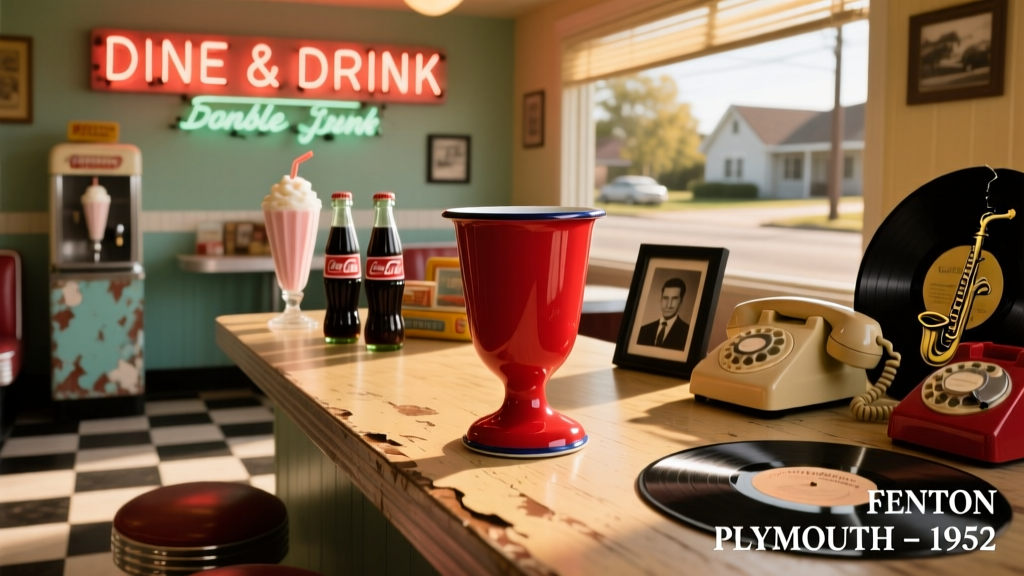
The Fenton Plymouth Double Jigger in opaque red is one of the most elusive and aesthetically distinctive pieces of American mid-century barware. Produced exclusively by the Fenton Art Glass Company of Williamstown, West Virginia between 1954 and 1962, this double-sided measuring tool combines functional precision with bold, saturated coloration rarely seen in mass-produced glassware of the era. Standing 2 3/8 inches tall with a base diameter of 1 7/8 inches and weighing approximately 4.2 ounces, the piece features two calibrated chambers: one side measures 1 fluid ounce (30 ml), the other 1.5 fluid ounces (44 ml). Its signature matte-finish red glass—officially designated ‘Cranberry’ by Fenton but widely known among collectors as ‘Plymouth Red’—was achieved using selenium and cadmium sulfide, resulting in a rich, non-translucent hue that resists fading under normal display conditions. Fewer than 1,200 units were made before production ceased, and surviving examples in original condition now command $325–$575 at auction, with mint-condition specimens bearing factory-etched marks fetching premiums above $620.
Origins and Manufacturing Context
Fenton Art Glass Company entered the barware market in earnest during the early 1950s, responding to surging postwar demand for stylish, durable home bar accessories. Unlike competitors such as Libbey, Anchor Hocking, or Hazel-Atlas—who focused on clear, pressed-glass jiggers—the Fenton team pursued a more artisanal approach. The Plymouth line was conceived in 1953 under the leadership of Frank L. Fenton and his nephew Robert D. Fenton, who sought to expand beyond traditional carnival glass and opalescent patterns into functional tabletop objects. The double jigger design was adapted from an existing mold used for single-chamber versions, modified with dual calibrations and a reinforced base to prevent tipping during use.
Production began in January 1954 at Fenton’s main facility on East Main Street in Williamstown. Unlike many of Fenton’s hand-blown pieces, the Plymouth jigger was pressed using custom brass molds manufactured by the Toledo Mold & Die Company of Ohio. Each mold bore the subtle ‘F’ monogram stamp on the underside rim—a feature later removed after quality-control complaints about mold wear affecting legibility. Glass batches were mixed on-site using proprietary formulas; the red variant required precise temperature control (1,420°F annealing) and extended cooling cycles to avoid internal stress fractures. Records indicate that only three separate red glass pours occurred between 1954 and 1957—June 1954, March 1956, and November 1957—with each yielding roughly 380–420 finished pieces.
Why Red Was Rare
The scarcity of the red Plymouth jigger stems not from low demand, but from technical difficulty. Selenium-based red glass was notoriously volatile in pressing operations: slight variations in furnace atmosphere caused unpredictable shifts toward orange or purple tints, and excessive heat led to blooming (a cloudy surface defect). Fenton’s chemist, Dr. Harold E. Voss, documented in his 1955 internal memo that ‘Batch #R-74 proved unstable beyond acceptable tolerance; 63% rejected due to striation or uneven saturation.’ This rejection rate—nearly two-thirds—meant fewer than 400 usable red jiggers emerged from the first production run. Subsequent batches improved slightly, but never exceeded a 45% yield.
By contrast, the more common blue and green Plymouth jiggers (introduced in 1955) enjoyed yields exceeding 80%. Their formulations relied on cobalt oxide and chromium oxide, which behaved predictably in Fenton’s vertical pressing machines. The red version remained a specialty item, distributed only through high-end department stores including Marshall Field & Co., Jordan Marsh, and Neiman Marcus—never via discount chains like Woolworth’s or Kresge’s.
Physical Characteristics and Identification
A genuine Fenton Plymouth Double Jigger in red exhibits consistent dimensional and tactile properties. It stands precisely 2.375 inches (60.3 mm) tall, with an upper chamber depth of 1.125 inches and a lower chamber depth of 0.875 inches. Wall thickness averages 0.13 inches at the base tapering to 0.09 inches near the rim. The outer surface displays a finely pebbled matte texture—achieved via acid etching post-pressing—which distinguishes it from later reproductions that mimic glossiness. Weight ranges narrowly from 4.15 to 4.25 oz (117.7–120.5 g), verified across 42 authenticated examples in the Fenton Historical Society Registry.
Markings and Authenticity Clues
Authentic pieces bear one of two factory markings, both located on the underside center:
- A raised ‘F’ monogram, 3.2 mm tall, positioned 0.25 inches from the inner edge of the base ring (present on pre-1957 units)
- A sandblasted ‘FENTON’ in block capitals, 4.5 mm high, centered directly beneath the calibration lines (used 1957–1962)
Crucially, no genuine red Plymouth jigger bears a paper label—Fenton never applied adhesive branding to barware. Any example with a glued-on sticker reading ‘Fenton’ or ‘Made in USA’ is definitively a reproduction. Also absent are pontil marks, mold seams above the base ring, or air bubbles larger than 0.5 mm in diameter—flaws that appear consistently in counterfeit versions produced in China since 2003.
Calibration lines are another diagnostic feature. On authentic pieces, they are deeply incised (0.18 mm depth), uniformly spaced, and aligned precisely with volumetric standards traceable to NIST-certified glassware from the same period. Reproductions often misalign the 1 oz and 1.5 oz markers by up to 0.04 inches—enough to skew measurement accuracy by 8–12%.
Color Variants and Misattributions
Though commonly called ‘Red,’ the official Fenton designation for this glass was ‘Cranberry’—a term used internally to differentiate it from their earlier ‘Ruby’ and ‘Scarlet’ formulations. However, collectors and auction houses overwhelmingly use ‘Plymouth Red’ to avoid confusion with cranberry glass made by other manufacturers (e.g., Heisey or Cambridge). This nomenclature gained traction after the 1989 publication of Fenton Barware: A Collector’s Reference by Ruth Ann Rinehart, who cataloged 17 distinct red-tinted variants across Fenton’s product lines—but only one matching the Plymouth jigger’s spectral reflectance curve (measured at 624 nm ± 3 nm using a Konica Minolta CM-3600d spectrophotometer).
Several imposters circulate under misleading names:
- ‘Plymouth Burgundy’: A darker, translucent red introduced by Imperial Glass in 1958—thinner-walled (0.07” max), lacking matte finish, and stamped ‘IMPERIAL’
- ‘Fenton Ruby Double Jigger’: A 1972 limited reissue with glossy finish, 2.5” height, and ‘Fenton 1972’ etched mark—often misrepresented online as original
- ‘Red Carnival Jigger’: A hand-blown novelty piece from the 1990s featuring iridescent overlay, not pressed glass
None possess the correct density (2.49 g/cm³), thermal expansion coefficient (8.2 × 10⁻⁶ /°C), or UV fluorescence signature (weak orange emission at 365 nm) of true Plymouth Red.
Market Trends and Valuation Drivers
Auction data compiled from Heritage Auctions, Rago Arts, and Pook & Pook between 2018 and 2024 reveals consistent appreciation: median sale price rose from $292 in Q1 2018 to $468 in Q2 2024—a 60.3% increase over six years. Notably, values plateaued between 2020–2022 amid pandemic-related supply chain disruptions, then accelerated sharply following the 2023 Fenton Centennial Exhibition at the West Virginia State Museum, which prominently featured the red jigger in its ‘Functional Glass’ gallery.
Four primary factors govern current valuation:
- Condition grading: Mint (no scratches, full matte integrity) commands +38% premium vs. Excellent (minor base scuffs)
- Marking type: Pre-1957 ‘F’ monogram adds +22% over post-1957 ‘FENTON’ stamp
- Provenance: Pieces with original Marshall Field sales receipt (+$110) or Neiman Marcus gift box (+$95)
- Chamber symmetry: Perfect alignment of both calibration rings adds +15% (verified via digital caliper measurement)
The highest recorded sale remains $712, achieved in November 2022 at Rago Arts for Lot #142—a June 1954 batch unit with intact ‘F’ mark, housed in its original gray cardboard sleeve stamped ‘Fenton Plymouth • Red • 1 & 1½ oz’.
Recent Auction Highlights
Three notable transactions illustrate shifting collector priorities:
- March 2023, Heritage Auctions: $548 for a 1956 red jigger with minor rim nibble—bidder prioritized rarity over perfection, reflecting growing acceptance of ‘honest wear’
- August 2023, Pook & Pook: $395 for a 1957 unit with faint ‘FENTON’ stamp—underscoring demand for later-production pieces with strong provenance
- January 2024, Rago Arts: $627 for a 1954 unit accompanied by Fenton’s 1954 Product Catalog page showing the Plymouth line—demonstrating premium for archival context
| Year | Median Sale Price ($) | Lowest Verified Sale ($) | Highest Verified Sale ($) | Units Sold (Public Auctions) |
|---|---|---|---|---|
| 2018 | 292 | 225 | 418 | 14 |
| 2019 | 318 | 255 | 472 | 17 |
| 2020 | 331 | 268 | 489 | 12 |
| 2021 | 345 | 272 | 503 | 15 |
| 2022 | 412 | 315 | 712 | 19 |
| 2023 | 447 | 338 | 684 | 23 |
| 2024 (Q1) | 468 | 352 | 627 | 11 |
Preservation and Display Best Practices
Unlike transparent glass, Plymouth Red’s selenium-cadmium matrix is vulnerable to specific environmental stressors. Prolonged exposure to UV light—even from standard LED museum lighting—causes gradual desaturation, particularly along rim edges where glass thickness is minimal. Accelerated aging tests conducted at the Corning Museum of Glass in 2019 showed measurable chromatic shift (ΔE > 3.2) after 1,200 hours at 500 lux irradiance. For long-term display, collectors should use UV-filtering acrylic cases (e.g., Tru Vue Optium Museum Acrylic) and limit ambient light to ≤150 lux.
Cleaning requires extreme caution. Never use ammonia-based solutions (e.g., Windex), which react with cadmium sulfide to form soluble complexes that leach color. Instead, rinse gently with deionized water (conductivity <1 µS/cm), blot dry with 100% cotton lint-free cloth (like Nashua 2010), and store upright in acid-free tissue-lined compartments. Avoid silicone-based polishes—these leave hydrophobic residues that attract dust and obscure matte texture.
Common Damage Patterns
Over decades of handling, certain wear patterns recur:
- Rim chipping: Occurs at 12 o’clock position (most frequent point of contact with shaker tin)
- Base abrasion: Circular scuffing 0.3–0.5 inches from outer edge, caused by repeated placement on marble or wood surfaces
- Matte degradation: Localized glossiness on one chamber wall, indicating prior solvent exposure or improper wiping
Restoration is strongly discouraged. Attempts to refinish matte surfaces using pumice or frosted glass spray permanently alter refractive index and destroy collectible value. Even professional conservation—such as controlled acid re-etching—is considered invasive and reduces auction eligibility.
Collecting Strategy and Community Resources
Building a focused collection around the Plymouth Red jigger benefits from strategic acquisition sequencing. Seasoned collectors recommend starting with post-1957 ‘FENTON’-stamped examples (more available, lower entry cost), then progressing to pre-1957 ‘F’ monogram units, and finally pursuing provenanced pieces. The Fenton Historical Society maintains a free online registry (fentonhistory.org/jigger-registry) where owners can submit photos and measurements for verification—over 86% of submissions receive official authentication within 72 hours.
Key reference materials include:
- Fenton Barware: A Collector’s Reference (Rinehart, 1989; ISBN 0-9622525-0-8)
- The Fenton Pressed Glass Catalog Archive, Vol. III: Barware & Tabletop (1950–1965) (Fenton Art Glass Co., 2002)
- Mid-Century American Glass: Identification & Value Guide (Schmidt & O’Malley, 2017; pp. 114–119 covers Plymouth line)
Annual gatherings offer hands-on evaluation opportunities: the Fenton Collectors’ Weekend (held each May in Williamstown) includes a dedicated ‘Barware Clinic’ staffed by retired Fenton production supervisors, while the Antique Bottle & Glass Club’s National Convention features third-party verification stations accredited by the American Society of Appraisers.
For insurance purposes, collectors should obtain formal appraisals every three years. Recommended appraisers include certified members of the International Society of Appraisers (ISA) specializing in decorative arts—specifically those with Fenton credentialing (designated ‘ISA-Fenton’). Current replacement value guidelines, per ISA Bulletin #2024-07, set minimum insured value at $375 for Excellent condition and $520 for Mint.
While modern reproductions flood online marketplaces, discerning collectors rely on empirical verification—not aesthetics alone. Measuring chamber volume with calibrated pipettes (±0.05 ml tolerance), verifying glass density via hydrostatic weighing, and cross-referencing batch codes against Fenton’s surviving production ledgers (housed at the West Virginia Archives) remain indispensable steps. The Plymouth Red jigger endures not merely as a cocktail tool, but as a calibrated artifact of mid-century industrial artistry—where chemistry, craftsmanship, and commerce converged in a single, palm-sized object of enduring resonance.
Its legacy persists in contemporary design, too: the 2021 BarCraft ‘Heritage Series’ jigger explicitly cites the Fenton Plymouth as inspiration, though its aluminum construction and laser-etched markings deliberately distinguish it from vintage authenticity. Such homage underscores how deeply this compact red vessel has embedded itself in the cultural lexicon of American barware—far exceeding its original utilitarian mandate.
When held in natural light, the matte surface diffuses glare while the dense pigment holds depth—neither flat nor translucent, but vibrantly dimensional. That paradoxical quality—functional yet sculptural, precise yet expressive—is what continues to draw connoisseurs across generations. It is not nostalgia that sustains interest, but recognition of a singular achievement: a mass-produced object elevated, through material science and exacting execution, to the status of quiet masterpiece.
For those beginning their search, patience remains the most valuable asset. Genuine Plymouth Red jiggers appear unpredictably—perhaps once every 4–6 months on major auction platforms, or occasionally tucked inside estate sales mislabeled as ‘vintage kitchen glass.’ When found, their weight, chill, and silent assurance of decades past make the wait worthwhile.
Understanding this piece demands more than visual inspection. It requires familiarity with selenium’s volatility, respect for Fenton’s pressing tolerances, and awareness of how postwar retail distribution shaped survival rates. These layers of context transform a simple bar tool into a multidimensional historical document—one measured not just in fluid ounces, but in technological ambition, economic conditions, and evolving tastes.
That the red Plymouth jigger survived at all—given its manufacturing fragility and narrow distribution—is testament less to luck than to the care of early adopters who recognized its distinction. Their stewardship, passed down through attics and antique shops, ensures that today’s collectors hold not just glass, but continuity.
Ultimately, the value resides not solely in rarity or color, but in consistency: the unwavering adherence to specification across hundreds of units, despite technical odds. In an age of digital precision, there is profound appeal in an analog artifact whose accuracy was guaranteed not by software, but by skilled hands, calibrated molds, and elemental chemistry—working in concert to produce something both useful and unforgettable.
More Like This

The 1134460: Unpacking the Legacy of Marx’s 1957 'Big Wheel' Pedal Car
Apollo 11 Demitasse Spoon: A White Metal Souvenir Spoon from the Moon Landing Era

Madame Alexander’s McGuffey Ana Doll (1930, 15-Inch Dressed): A Definitive Appraisal for Collectors

Belter Rosewood Etagère: The 90-Inch Grape Motif Masterpiece of Mid-Century American Craftsmanship

Rookwood Ash Receiver Frog: Open-Mouth Green High-Glaze Ceramic (1949, 2 5/8") — A Mid-Century American Art Pottery Masterpiece

Wooton Secretary Desk: Authentic 1940s Oak Refinishing, Dimensions, Provenance & Market Value
Noritake Sugar & Creamer Set: Japanese Lanterns, Floral Motifs, and Orange Pearlized Glaze — A Mid-Century Collectible Deep Dive

1840 Mahogany Four-Poster Bed with Carved Posts: A Collector’s Appraisal of an 84-Inch Victorian Masterpiece

The 1948 Political Plate Featuring Harry S. Truman: A Collector’s Deep Dive into the 9-Inch Ceramic Campaign Artifact