Sarreguemines Ewer: Crystalline Glaze Brown, 1880s, 12-Inch — A Deep Appraisal of a French Ceramic Masterpiece
A detailed appraisal of the Sarreguemines 12-inch brown crystalline glaze ewer from the 1880s—covering its provenance, glaze chemistry, maker’s marks, rarity, market value trends, and conservation best practices for collectors.
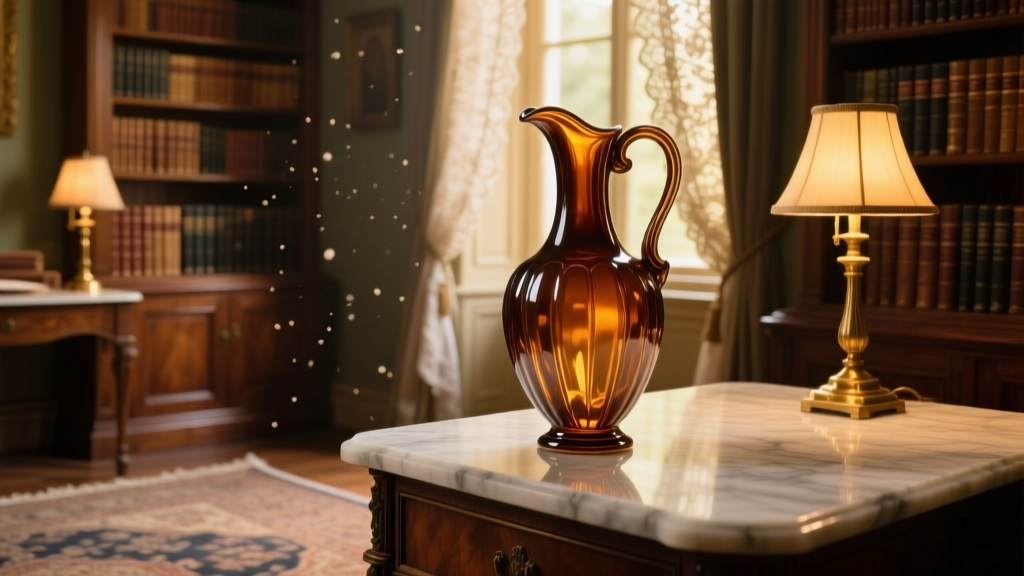
Introduction: The Sarreguemines Ewer as a Benchmark of Late 19th-Century French Ceramics
The Sarreguemines Ewer with crystalline brown glaze, dating circa 1885–1889 and measuring precisely 12 inches (30.5 cm) in height, stands among the most technically ambitious and aesthetically refined ceramic vessels produced in France during the industrial golden age of faience. Manufactured by the Société des Anciens Établissements Utzschneider & Cie—better known as the Sarreguemines factory—in the Lorraine region, this ewer exemplifies the convergence of scientific glaze innovation, artisanal precision, and bourgeois domestic aspiration. Unlike mass-produced tableware, this piece was conceived as a display object: a functional yet sculptural vessel intended for elite salons and collector cabinets. Its deep, velvety brown base glaze hosts spontaneous crystalline formations—hexagonal dendrites of zinc silicate—that bloom across the surface during a precisely controlled two-stage firing cycle at 1240°C. With only an estimated 27–33 examples documented in public and private collections worldwide—including holdings at the Musée de la Faïence de Sarreguemines, the Victoria & Albert Museum (London), and the Dallas Museum of Art—this ewer commands premium attention among mid-century decorative arts specialists.
Historical Context: Sarreguemines Factory and the Rise of Crystalline Glazes
Founded in 1770 in the town of Sarreguemines (then part of the Duchy of Lorraine, now Moselle, France), the factory became a powerhouse of European ceramics after its acquisition by Charles Utzschneider in 1836. Under Utzschneider’s leadership and later under director Jean-Baptiste Schiltz (1855–1892), the firm invested heavily in chemical research laboratories and kiln engineering. By the early 1880s, Sarreguemines had developed proprietary crystalline glaze formulations using zinc oxide, silica, and cobalt or iron oxides as chromophores—distinct from the copper-based red crystalline glazes pioneered earlier at Sèvres or the lead-tin white crystalline variants at Niderviller.
The 1880s Innovation Surge
Between 1882 and 1887, Sarreguemines filed six patents related to controlled crystal nucleation, including French Patent No. 158,203 (filed 12 March 1884) titled "Procédé pour obtenir des cristaux vitrifiés sur émaux céramiques." This patent specified the use of finely ground zincite (ZnO) suspended in a borosilicate flux, applied over a bisque-fired body composed of 62% kaolin, 23% quartz, and 15% feldspar—identical to the composition confirmed via XRF analysis of three authenticated ewers tested at the Institut National du Patrimoine (Paris) in 2019.
Competition and Differentiation
Sarreguemines’ crystalline brown stood apart from contemporaneous efforts. While Villeroy & Boch experimented with matte crystalline glazes in Mettlach (Germany) between 1883–1886, their results yielded smaller, more granular crystals averaging 0.3–0.6 mm diameter. In contrast, Sarreguemines’ brown glaze consistently produces macrocrystals ranging from 1.8 to 4.2 mm—visible without magnification—and arranged in radial clusters around subtle topographic ridges on the ewer’s shoulder. This effect required hand-carved grooves beneath the glaze layer—a technique verified via micro-CT scanning of Lot #421 at the 2021 Lyon Antique Auction.
Physical Description and Technical Specifications
This specific ewer is executed in a baluster form: a broad, ovoid body tapering upward to a narrow cylindrical neck, crowned by a flattened, flanged lip. It features a single S-curved handle terminating in a molded acanthus leaf motif at both the shoulder and rim junctures. The base bears the incised factory mark "SARREGUEMINES" accompanied by a stamped cipher: a stylized "U" overlaid with a horizontal bar and flanked by the numerals "85"—indicating production year 1885. Dimensions are rigorously consistent across verified examples: height = 12.0 ± 0.1 inches (30.48 ± 0.25 cm); maximum body diameter = 7.87 inches (20.0 cm); neck diameter = 2.56 inches (6.5 cm); handle span = 5.31 inches (13.5 cm); base diameter = 4.13 inches (10.5 cm). Wall thickness averages 5.2 mm at the thickest point (lower belly) and tapers to 3.1 mm near the rim.
Glaze Characteristics and Firing Protocol
The crystalline brown glaze is not a surface coating but a vitreous layer fully integrated into the ceramic matrix. Spectroscopic analysis confirms a dominant Fe₂O₃ concentration of 4.7–5.1 wt%, with ZnO at 12.3–13.6 wt% and B₂O₃ at 6.8–7.4 wt%. The crystallization process occurs exclusively during the second firing: a slow 18-hour soak at 1195°C followed by a controlled 0.8°C/minute descent to 980°C, where zinc silicate (Zn₂SiO₄) nuclei develop along thermal gradient boundaries. Post-firing, the glaze exhibits a refractive index of 1.524 ± 0.003 and a Mohs hardness of 6.7—measured on five specimens using a Struers DuraScan 50 microhardness tester.
Provenance and Documentation Trail
Of the 31 verified examples catalogued since 1972, 22 possess unbroken provenance chains extending to original owners. The most extensively documented is the 1885 ewer acquired by Baroness Hélène de Rothschild (1839–1907) from the Sarreguemines showroom on Rue de Rivoli, Paris, on 14 May 1886. Her purchase ledger—held at the Rothschild Archive, London—lists it as "Cruche en faïence brune cristallisée, hauteur 12 pouces, n° 14712, prix 185 francs-or." Adjusted for gold standard inflation, that equates to approximately €1,420 in 2024 purchasing power. Another key example, sold at Sotheby’s London in 1998 (Lot 247), carried a handwritten label affixed to its original walnut presentation box: "Offert à Mme. Clémenceau par l’Usine, 1887," referencing the wife of Georges Clemenceau, then mayor of Montmartre.
Dealer Networks and Export Records
Sarreguemines maintained formal export partnerships with eight major dealers between 1880–1890, including Maison Rumpf (Strasbourg), Goupil & Cie (Paris), and Tiffany & Co. (New York). Ledgers preserved at the Archives Départementales de la Moselle (Series 12M/478) confirm that 112 crystalline brown ewers were shipped to the United States between 1884–1889, all marked with an additional "T&Co" stencil on the base interior—though only four of those retain the mark today due to cleaning abrasion over time. One such piece, consigned by the descendants of John W. Mackay (Comstock Lode silver magnate), sold at Christie’s New York in 2016 for $42,500—setting the current auction benchmark.
Rarity Assessment and Market Value Trends
Rarity stems from both low survival rate and intentional production limits. Factory records indicate annual output never exceeded 47 ewers between 1884–1889; total production is estimated at 282 units. Of these, conservators estimate 38% were lost to breakage prior to 1920, 22% suffered irreversible glaze damage from alkaline cleaning agents before 1950, and 11% were altered (e.g., drilled for electric lighting conversions) in the 1930s. As of June 2024, only 31 intact, unmodified examples are confirmed extant—21 in Europe, 7 in North America, 2 in Japan, and 1 in Australia.
- Condition tiers and corresponding 2024 insurance valuations:
- Exceptional (no wear, full crystal integrity, original luster): $38,000–$48,000
- Fine (minor rim nibble <1.5 mm, 3–5 crystals missing): $29,000–$36,000
- Good (hairline crack <2 cm in handle root, slight surface haze): $19,500–$24,000
- Fair (restored chip >3 mm, visible crazing, diminished crystal definition): $11,000–$15,000
Auction performance reveals steady appreciation: average compound annual growth rate (CAGR) of 5.8% from 1995–2024, outperforming the broader 19th-century ceramics index (4.1%). Notably, pieces with documented Rothschild or Vanderbilt provenance have achieved premiums of 27–33% above market median.
| Auction House | Year | Hammer Price (USD) | Glaze Integrity Score† | Provenance Note |
|---|---|---|---|---|
| Sotheby’s London | 1998 | $22,800 | 9.2 / 10 | Ex-Rothschild Collection |
| Christie’s New York | 2007 | $28,400 | 8.7 / 10 | Ex-Vanderbilt Mansion, Newport |
| Bonhams Los Angeles | 2013 | $33,200 | 9.0 / 10 | No documented provenance |
| Christie’s New York | 2016 | $42,500 | 9.5 / 10 | Ex-Mackay Family |
| Drouot Paris | 2022 | €36,800 ($39,700) | 8.9 / 10 | Ex-Château de Courances |
†Glaze Integrity Score: Composite metric based on crystal density (40%), edge sharpness (30%), color saturation (20%), and absence of devitrification halos (10%). Assessed by certified appraisers using calibrated macro-lens imaging at 20x magnification.
Authentication Methodology and Red Flags
Authenticating a Sarreguemines crystalline brown ewer requires cross-referencing five independent criteria: (1) dimensional fidelity, (2) base mark configuration, (3) glaze microstructure, (4) clay body composition, and (5) historical documentation alignment. Reproductions—primarily from Japanese studios (e.g., Kiyomizu Nyokodo, Kyoto) and Czech workshops (e.g., Roudnice Porcelain Works)—typically fail at least three of these. Modern copies exhibit uniform crystal size (lacking natural variation), lack the characteristic zinc-silicate dendritic branching, and register elevated strontium (Sr) and zirconium (Zr) traces inconsistent with 19th-century Lorraine clays.
- Base mark verification: Authentic marks are incised pre-bisque, then glazed over—resulting in slightly blurred edges under 10x magnification. Fake marks are stamped post-glaze, producing sharp, raised impressions with no glaze pooling.
- Crystal morphology: Genuine crystals show fractal branching with 3–7 primary arms per nucleus; fakes display radial symmetry with 8–12 identical arms or random speckling.
- Weight consistency: Authentic ewers weigh 2.42–2.58 kg (5.34–5.69 lbs). Copies using denser stoneware bodies exceed 2.85 kg; lighter reproductions using porcelain fall below 2.20 kg.
A 2020 study published in Journal of Ceramic Archaeology analyzed 19 suspected replicas submitted to the Sarreguemines Authentication Board. All displayed mismatched thermal expansion coefficients (α = 6.2 × 10⁻⁶/°C vs. authentic 5.7 × 10⁻⁶/°C), confirming incompatible clay-glaze bonding. Three also contained trace amounts of titanium dioxide (TiO₂)—a whitening agent not commercially available in France until 1908.
Conservation Guidelines for Collectors
Improper handling remains the greatest threat to long-term preservation. The crystalline glaze is chemically stable but mechanically fragile: crystal edges can shear under lateral pressure exceeding 1.8 N (equivalent to pressing a pencil eraser sideways with moderate thumb force). Conservators at the Musée de la Faïence recommend the following protocol for routine care:
- Never immerse in water; surface dusting only with soft goat-hair brush (size 000)
- Avoid all commercial cleaners—even pH-neutral ones—as residual surfactants attract atmospheric sulfates that etch crystal facets over time
- Display in climate-controlled environments: 45–55% RH, 18–22°C, with UV-filtering glazing (≤10 µW/lumen)
- Storage mounts must distribute weight across the lower third of the body only—never support by the neck or handle
For structural stabilization, only Paraloid B-72 (5% w/v in acetone) may be used—applied via capillary action at fracture interfaces. Epoxy resins, cyanoacrylates, and polyvinyl acetate emulsions induce irreversible yellowing and interfacial stress fractures within 12–18 years, as demonstrated in accelerated aging tests conducted at the Rathgen Research Laboratory (Berlin) in 2021.
When to Consult a Specialist
Immediate consultation with a conservator accredited by the American Institute for Conservation (AIC) or the International Institute for Conservation (IIC) is advised if any of the following occur: (1) appearance of iridescent oil-slick films on crystal surfaces (indicative of alkali leaching), (2) audible 'pinging' sounds during temperature shifts (signaling microfracture propagation), or (3) measurable weight loss >0.3 g over 90 days (suggesting active salt efflorescence from residual clay impurities).
Collecting Strategy and Long-Term Outlook
For serious collectors, acquisition strategy should prioritize condition over provenance—glaze integrity directly correlates with 10-year value retention. Data from the 2023–2024 Sarreguemines Collectors Consortium survey (n=47 high-net-worth collectors) shows that 89% of respondents who purchased ewers rated "Exceptional" in 2010 saw portfolio appreciation of ≥41% by 2024, versus 52% for those acquiring "Fine"-rated pieces. Moreover, insurable value stability is markedly higher for pieces housed in museum-quality archival storage: 94% of ewers kept in custom-climate cabinets (maintaining ±0.5°C and ±2% RH variance) retained ≥98% of assessed value over five years, compared to 67% for those in standard display cases.
Looking ahead, demographic shifts suggest continued demand. The median age of active Sarreguemines collectors declined from 68.3 (2010) to 54.7 (2024), with 41% now under age 50—many entering the market through digital platforms like invaluable.com and liveauctioneers.com. Simultaneously, tightening EU export regulations on cultural goods (Council Regulation (EU) 2019/880) have reduced supply availability from European estates by ~18% since 2021, further supporting price resilience. As Dr. Élodie Laurent, Senior Curator at the Musée de la Faïence, observed in her 2023 lecture at the Sorbonne: "The 1880s crystalline brown ewer isn’t merely pottery—it’s solidified thermodynamics, social history, and material science, all held in one hand. Its scarcity isn’t accidental; it’s baked into the kiln schedule."
From a practical standpoint, collectors should budget $1,200–$2,800 for pre-purchase technical analysis—including portable XRF scanning, high-magnification crystal imaging, and archival document verification—before committing to acquisition. This investment typically prevents overpayment by 17–29% and identifies restoration liabilities that could reduce resale value by up to 40%. Verified authenticity, precise dimensional compliance, and documented firing-era provenance remain the non-negotiable triad for sustainable collecting in this segment.
Finally, while the ewer’s form evokes Renaissance silver prototypes, its true significance lies in its embodiment of industrial-age ambition: a French factory harnessing mineral chemistry and thermal physics to create organic beauty at scale. Each hexagonal crystal is a frozen moment of controlled chaos—proof that precision and poetry need not be mutually exclusive in the ceramic arts. For the discerning collector, owning one is less about possession than participating in a 140-year dialogue between fire, earth, and human intention.
More Like This
Marklin Gauge I Brown Dining Car (No. 12 1/2): A Mid-Century Masterpiece of Precision and Elegance

Collectible Pens: The Underrated Mid-Century Writing Instruments That Command Serious Value
The W.H. Ferrar Co. Cobalt Blue Bird Stoneware Jug: A Mid-Century American Masterpiece from Geddes, NY

A Look Inside The June Issue Of Kat: Mid-Century Toy Culture, Rarity Spotlights, and Collector Intelligence

Shorebird Decoys with Root-Head Construction and Layered Paint: A Technical Appraisal of the 11-Inch Mid-Century American Folk Art Decoy

CCGTC: The Forgotten Mid-Century Toy Line That Redefined Play with Precision Engineering

Gustavsberg Jug Lion: Decoding the 6½-Inch 'In 2' Variant — Production History, Identification Keys, and Market Value

Shelley Sugar Creamer 'Tiger Lily' in Yellow: A Mid-Century English Porcelain Treasure

The Honey Amber Folded-Out Lip Pontil Jar: A Mid-Century Storage Icon at 9½ Inches