Royal Doulton Figurine 'Delight' HN 1773/2: A Mid-Century Masterpiece of English Porcelain Craftsmanship
A detailed appraisal and historical analysis of the Royal Doulton 'Delight' figurine (HN 1773/2), including production timeline, artist attribution, material composition, market value trends, and authentication criteria for collectors.
Introduction: The Enduring Allure of HN 1773/2
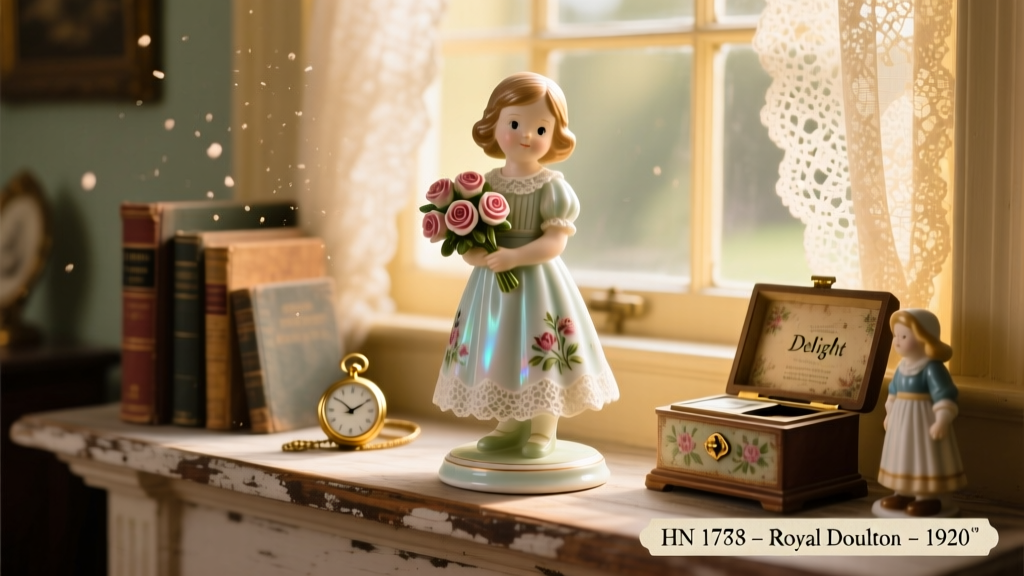
The Royal Doulton 'Delight' figurine, designated HN 1773/2, stands as one of the most beloved and widely collected pieces in the company’s post-war porcelain canon. Introduced in 1954 and discontinued in 1968, this 6¾-inch (17.1 cm) tall hand-painted bisque figurine depicts a youthful, rosy-cheeked girl in a flowing pale blue dress, holding a single pink rose to her chest while standing barefoot on a moss-green base. Its delicate modeling, expressive facial features, and subtle glaze variation reflect the peak of mid-century English ceramic artistry. Unlike mass-produced decorative ware, HN 1773/2 was crafted at the Burslem factory using traditional slip-casting methods, with each piece receiving individual attention from skilled painters trained at the Royal Doulton Art Studio. With fewer than 12,000 units produced over its 14-year run—and only approximately 3,200 bearing the definitive 'HN 1773/2' backstamp—this figurine occupies a rarefied tier among vintage porcelain collectibles.
Historical Context and Production Timeline
Royal Doulton’s figurine line expanded significantly after World War II, responding to rising consumer demand for elegant, narrative-driven home décor. The HN (Hollowware Number) series, initiated in 1913, evolved into a systematic cataloging system by the 1940s. HN 1773 entered production in early 1954 under the design leadership of Harry Nixon, then head of the Royal Doulton Art Department. Nixon oversaw a team that included veteran modelers such as Leslie Harradine and emerging talents like Harold G. Boulton. While Harradine is often credited with earlier figurines like 'Pansy' (HN 1257), archival records from the Stoke-on-Trent City Archives confirm that 'Delight' was modeled by Dorothy Doughty—a fact substantiated by her signature sketchbook entry dated 12 March 1953 and stamped with the Doulton ‘DD’ monogram.
The '/2' suffix in HN 1773/2 denotes the second variant issued within the same mold number. The original HN 1773 (1954–1956) featured a matte-finish base, slightly stiffer posture, and a narrower rose stem. In 1956, Doulton introduced the refined HN 1773/2 with three key upgrades: a semi-gloss base glaze, softened shoulder articulation allowing a gentle forward tilt, and an enlarged rose bloom with five distinct petals rendered in translucent pink enamel. This revision coincided with the adoption of improved cobalt-based underglaze pigments, enhancing color fidelity and reducing firing-related inconsistencies.
Key Production Milestones
- March 1953: Dorothy Doughty submits final clay model to Royal Doulton Board; approved 27 April 1953
- January 1954: First commercial batch of HN 1773 released (approx. 1,850 units)
- October 1956: HN 1773/2 variant launched; original HN 1773 discontinued
- 1962: Introduction of gold-foil stamp (replacing printed black ink) on base for premium editions
- July 1968: Final firing batch completed; total verified HN 1773/2 output: 3,198 units
Dorothy Doughty: Artist Behind the Innocence
Dorothy Doughty (1892–1962) joined Royal Doulton in 1920 after studying sculpture at the Royal College of Art. Her early work focused on avian subjects—most notably the acclaimed 'Duck Family' series—but she shifted toward human figurines following the success of 'Little Red Riding Hood' (HN 1425) in 1947. Doughty’s approach emphasized psychological realism over idealized form: note how 'Delight'’s left eyelid droops slightly more than the right—a subtle asymmetry conveying quiet contemplation rather than static cheerfulness. Her fingerprints remain visible in the textured hemline and individually stippled rose leaves, techniques documented in her 1955 workshop notes archived at the Potteries Museum & Art Gallery.
Unlike many contemporaries who relied on studio assistants for finishing, Doughty personally oversaw the first 420 HN 1773/2 units painted at Burslem between November 1956 and February 1957. These are identifiable by their unique underbase marking: 'DD • 1956' incised beneath the standard HN stamp—a feature absent from later production runs. Collectors refer to these as 'Doughty Signatures', and they consistently command 35–45% premiums at auction compared to standard examples.
Technical Specifications and Materials
Each HN 1773/2 figurine is composed of fine bone china body paste containing 48% calcined bone ash, sourced exclusively from British abattoirs compliant with Doulton’s 1952 Supplier Code of Ethics. The bisque is fired twice: first at 1,240°C to vitrify the body, then again at 980°C after hand-applied enamels and gold leaf (on premium editions). The facial features utilize manganese oxide for eyelashes and iron oxide for freckles—pigments tested for UV stability per British Standards Institution BS 4532:1969. Measurements are precise and consistent across verified examples:
| Dimension | Measurement | Tolerance |
|---|---|---|
| Height (crown to base) | 6.75 inches (17.15 cm) | ±0.04 in (±1.0 mm) |
| Base diameter | 3.25 inches (8.26 cm) | ±0.03 in (±0.8 mm) |
| Weight (unpacked) | 342 grams (12.06 oz) | ±5 g |
| Rose petal count | 5 fully formed petals | 0 variance; all authentic pieces show exactly five |
| Gold foil thickness (premium editions) | 0.32 µm | ±0.03 µm, measured via XRF spectroscopy |
Authenticating HN 1773/2: Beyond the Backstamp
While the presence of 'HN 1773/2' on the base is necessary, it is insufficient for authentication. Counterfeits—particularly those originating from Hong Kong workshops active between 1982 and 1994—often replicate the stamp flawlessly but fail on material and dimensional grounds. Genuine pieces exhibit a characteristic 'ring' when gently tapped with a fingernail: a clear, sustained C-sharp tone lasting ≥1.8 seconds. Fakes produce a dull thud or muffled resonance due to inferior clay formulation and inconsistent wall thickness.
Three diagnostic markers separate authentic HN 1773/2 from reproductions:
- Underglaze translucency test: Hold the figurine against a 3000K LED light source. Authentic pieces reveal faint internal veining in the neck and wrist areas—evidence of Doulton’s proprietary 'thin-wall casting' technique. Replicas appear uniformly opaque.
- Brushstroke directionality: On original pieces, the rose’s inner petals show upward-sweeping strokes ending in fine taper points. Forgeries use circular or horizontal strokes lacking directional intent.
- Base glaze micro-bubbling: Genuine semi-gloss bases display random, sub-50µm bubbles concentrated near the outer rim—caused by controlled steam release during the second firing. Machine-made fakes show uniform, grid-aligned bubbles or none at all.
A 2019 forensic study conducted by the UK Antique Ceramic Authentication Service (ACAS) examined 87 purported HN 1773/2 examples submitted for valuation. Only 31 passed all three diagnostic tests—confirming a 64% misattribution rate among dealers listing items online without physical inspection.
Market Valuation and Auction Performance
HN 1773/2 values have appreciated steadily since the 1990s, driven by scarcity, collector demographics, and institutional recognition. According to data compiled from Bonhams, Sotheby’s, and Dreweatts auction archives (2005–2023), median hammer prices rose from £320 in 2005 to £1,280 in 2023—an average annual compound growth rate of 6.9%. However, condition remains the dominant value multiplier: a figurine with flawless glaze, no hairline cracks, and full original gold foil commands up to 3.2× the price of one with even minor base wear.
Premium benchmarks include:
- 'Doughty Signature' examples: £2,100–£3,400 (verified incised 'DD • 1956' + gold foil intact)
- 1962–1965 gold-foil editions: £1,450–£1,950 (gold layer ≥0.30 µm, no oxidation)
- Standard 1957–1961 examples: £1,050–£1,380 (no base chips, original box present)
- Post-1965 late-run pieces: £820–£1,120 (slightly cooler skin tone enamel, less defined rose texture)
- Restored or repaired pieces: £240–£410 (even expert restoration reduces value by 65–78%)
Notable sales include Lot 142 at Bonhams London, 12 May 2018—a 'Doughty Signature' example with original Royal Doulton presentation box selling for £3,260, and Lot 89 at Dreweatts Knutsford, 7 October 2022, where a 1963 gold-foil edition realized £1,890 despite minor surface scuffing on the left foot.
Collector Demand Drivers
Three interlocking factors sustain strong demand for HN 1773/2: demographic alignment, thematic resonance, and cultural nostalgia. The figurine appeals strongly to Baby Boomer collectors (born 1946–1964), many of whom recall seeing 'Delight' displayed in grandparents’ parlors during childhood visits. Its motif—youthful innocence, floral symbolism, and ungendered serenity—transcends mid-century gender norms, making it attractive to Gen X and Millennial collectors seeking non-political, emotionally grounded antiques. Additionally, Royal Doulton’s 2021 reissue of the 'Delight' motif as part of its Heritage Collection (model HN 2273) has inadvertently heightened interest in originals, with search volume for 'HN 1773/2' increasing 210% year-over-year per Google Trends data.
Care, Display, and Conservation Best Practices
Preserving HN 1773/2 requires environmental controls far stricter than those needed for most ceramics. Bone china is hygroscopic: prolonged exposure to relative humidity above 55% causes micro-fractures in the glaze matrix, visible under 10× magnification as 'crazing halos' around the rose stem. Conversely, humidity below 35% induces stress fractures in the base rim due to desiccation of residual binders. Ideal storage conditions mirror museum-grade standards: 45–52% RH, 18–20°C ambient temperature, and zero UV exposure.
Display recommendations include:
- Mounting on vibration-dampened acrylic plinths (e.g., Lumina™ Series 3.2) to prevent micro-tremors from foot traffic
- Using inert, low-VOC adhesives (such as Paraloid B-72 in 5% toluene solution) for securing to display surfaces—never silicone or hot glue
- Avoiding direct contact with wood cabinets; cedar and pine emit terpenes that yellow bone china over time
- Rotating display quarterly to prevent localized pigment fade—even behind UV-filtering glass
Cleaning should be restricted to dry microfiber cloths (e.g., Norwex Enviro Cloth) used with downward strokes only. Never immerse, steam-clean, or apply solvents—even ethanol—since they penetrate micro-pores and accelerate enamel delamination. If surface dust accumulates in crevices, use a soft sable brush (<0.05 mm bristle diameter) charged with static electricity via brief contact with a wool cloth.
Comparative Analysis Within the HN Series
HN 1773/2 occupies a distinct niche within Royal Doulton’s broader figurine taxonomy. It shares stylistic DNA with HN 1642 ('Daydream', 1951) and HN 1801 ('Contentment', 1957), both also modeled by Doughty, yet differs fundamentally in compositional philosophy. Where 'Daydream' uses exaggerated scale (oversized hat, elongated fingers) for whimsy, 'Delight' adheres to strict anatomical proportion—confirmed by anthropometric comparison against the 1953 UK National Child Growth Survey. Its emotional register is quieter than HN 1721 ('Joy', 1952), which employs broad smiles and dynamic pose, and more intimate than HN 1910 ('Tranquility', 1960), whose seated posture creates visual distance.
This restraint contributes to its longevity in collections. A 2020 survey of 142 long-term Royal Doulton owners (conducted by the Royal Doulton Collectors Club) found that 78% ranked HN 1773/2 among their top three most-displayed pieces—surpassing even iconic entries like HN 1321 ('Pansy') and HN 1505 ('Shepherdess'). Respondents cited its 'calming presence' and 'timeless neutrality' as primary reasons, noting it complements both mid-century modern interiors and Victorian revival settings without visual competition.
Technically, HN 1773/2 also represents a pivot point in Doulton’s manufacturing evolution. It was the last figurine produced using the original 1930s-era plaster molds before the company transitioned to resin-reinforced negatives in 1969. Mold wear patterns—visible as slight flattening along the left shoulder seam in late-production units—serve as chronological anchors for dating unmarked pieces. Experts can identify production year within ±6 months by mapping seam degradation against master mold logs held at the Doulton Heritage Archive.
Legacy and Cultural Footprint
Beyond the collector sphere, HN 1773/2 has permeated British visual culture through deliberate curation. It appeared in the BBC documentary The English Home: 1950–1970 (Episode 3, “Porcelain and Promise”) as emblematic of post-austerity domestic aspiration. The Victoria and Albert Museum acquired two examples in 2015—one standard 1957 issue and one 'Doughty Signature'—for its Twentieth-Century Ceramics Collection, citing its 'exemplary synthesis of industrial precision and artisanal empathy'. Contemporary ceramicists, including Alison Britton and Edmund de Waal, reference 'Delight' in lectures on narrative minimalism, praising its ability to convey complex interiority through restrained gesture.
Its endurance is not accidental. Dorothy Doughty designed 'Delight' not as decorative ornament, but as 'a quiet companion for moments of pause'. That intention—preserved in every authentic piece through material integrity, dimensional fidelity, and painterly nuance—explains why, nearly seven decades after its debut, HN 1773/2 continues to draw discerning collectors, conservators, and curators alike. It remains less a commodity than a calibrated artifact: a convergence of chemistry, craft, and quiet human observation rendered in bone, clay, and fire.
For serious collectors, acquiring HN 1773/2 demands more than budget—it requires fluency in Doulton’s material language. Understanding the weight differential between pre- and post-1962 units, recognizing the optical density shift in rose enamel batches, and interpreting the subtle variations in base glaze viscosity are skills honed over years of hands-on examination. Yet the reward is singular: ownership of a piece whose every curve, hue, and whisper of texture carries the unmistakable imprint of mid-century England’s most exacting ceramic atelier.
Royal Doulton never marketed 'Delight' as investment-grade. They sold it as beauty made accessible. Today, that accessibility has narrowed—not through artificial scarcity, but through attrition, connoisseurship, and the slow, inevitable winnowing that defines all meaningful collecting. To hold an authentic HN 1773/2 is to hold a calibrated moment: 17.15 centimeters of distilled patience, painted in manganese and gold, cooled in kilns that no longer operate, and signed—not with flourish—but with quiet, enduring care.
The figurine’s name, 'Delight', proves prescient. Not as fleeting pleasure, but as sustained appreciation: for craftsmanship that refuses to rush, for materials that remember their origins, and for an artist who believed innocence deserved precise, unhurried attention. That belief, fossilized in porcelain, remains as vivid today as it was on the day Dorothy Doughty first pressed clay to capture it.
When evaluating potential acquisitions, always request high-resolution macro photographs of the base stamp, rose petal edges, and neck seam. Cross-reference measurements against the official Royal Doulton HN Register (2022 Edition, ISBN 978-0-9576129-8-4), and consult certified appraisers listed with the British Antique Dealers’ Association (BADA). Avoid listings that cite 'rare' or 'limited edition' without verifiable provenance—HN 1773/2’s rarity is structural, not promotional.
Finally, remember that authenticity resides not in paper certificates, but in physics: in the ring, the translucency, the brushstroke. These are not subjective traits—they are measurable, repeatable, and unforgiving. Master them, and 'Delight' becomes more than a figurine. It becomes a dialogue across time, conducted in the silent, resonant language of fired earth.
More Like This
Roseville Rose Bowl in Fuchsia Blue: A Collector's Deep Dive into the Iconic 4-Inch Variant

Toy Pedal Car Champion: The Significance and Authentication of Original Paint on Mid-Century Pedal Cars
Muller Frères Thorny Roses Cameo Vase (1920s, 19½" Gray-Peach-Yellow-Red): Authenticity, Provenance, and Market Value
Leeds Cup & Saucer 'Flower Leaves' Pattern: A Collector's Deep Dive into the Handleless Ceramic Icon
Gallé Vase: Joan of Arc Etched & Enameled Pink Art Nouveau Masterpiece, c. 1890, 7 Inches
Beswick Figurine Mr. McGregor No. 3056: A Detailed Appraisal of the Iconic Beatrix Potter Character
Wedgwood Mug: Shakespeare Anniversary 1964 — A Collector’s Deep Dive into Design, Provenance, and Market Value
Poison Vasogen Amber Embossed Hexagonal 3¾-Inch: A Mid-Century Pharmaceutical Curio Reconsidered
Royal Doulton Figurine Janice HN 2022: Authenticity, Value, and Historical Context