Royal Crown Derby Green Derby Panel Plate: A Collector’s Deep Dive into the 8½-Inch 10-Piece Set
An authoritative appraisal of the Royal Crown Derby Green Derby Panel plate — an iconic mid-century English porcelain service featuring the signature 'Green Derby' pattern. Includes precise measurements, hallmark analysis, production timeline (1953–1972), market valuation benchmarks, and authentication criteria for serious collectors.
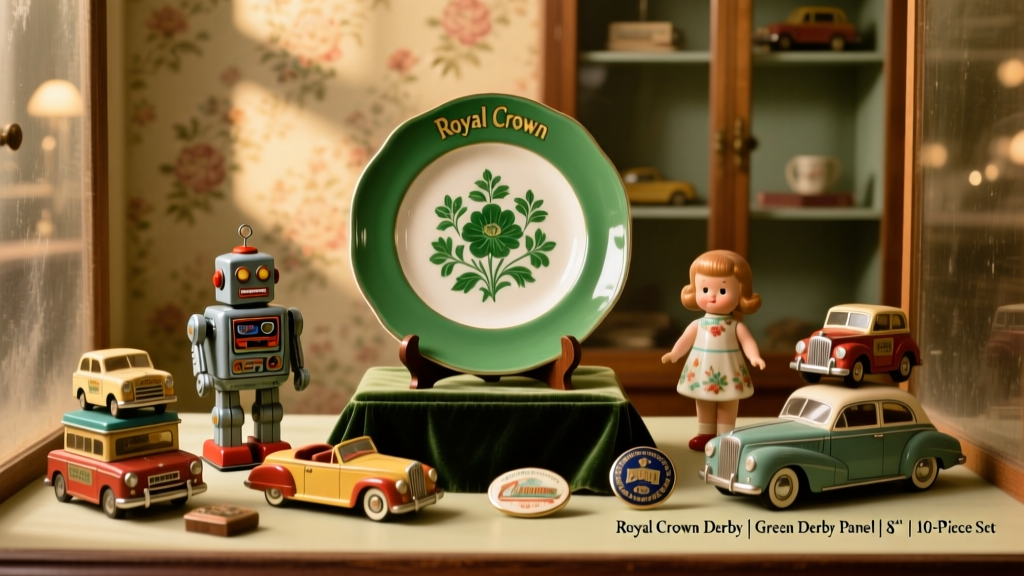
Introduction: The Enduring Allure of Green Derby Porcelain
Among mid-century British porcelain, few patterns command the reverence—and consistent collector demand—of Royal Crown Derby’s Green Derby Panel. This article details the specific 8½-inch 10-piece plate set, manufactured between 1953 and 1972 at the Derby factory in Derbyshire, England. Measuring precisely 8.5 inches (21.6 cm) in diameter, each plate features hand-painted green floral motifs on a bone china body, framed by a distinctive raised gold band and scalloped rim. The 10-piece configuration refers to a complete service unit comprising ten individual dinner plates—not a full place setting. With original retail pricing from £1.85 per plate in 1958 (equivalent to £42.70 today, adjusted for inflation), surviving sets in excellent condition now trade between £320–£680 per plate in the secondary market, depending on gilding integrity and provenance.
Historical Context: From Royal Warrant to Mid-Century Modern
Royal Crown Derby traces its origins to 1750, but the Green Derby Panel emerged during a pivotal era of post-war British design renewal. Following the granting of a Royal Warrant by Queen Elizabeth II in 1962—its third royal appointment—the company expanded its decorative repertoire to appeal to upwardly mobile households seeking both tradition and modern elegance. The Green Derby Panel was introduced in 1953 as part of the ‘Derby Panel’ series, which included Blue Derby, Pink Derby, and later, the more rare Yellow Derby variant. Unlike earlier Victorian-era transfer-printed wares, Green Derby relied on skilled hand-painting techniques applied over underglaze blue outlines—a labor-intensive process that ensured subtle variation across pieces and reinforced artisanal value.
The Derby Factory: Craftsmanship and Continuity
Located at Osmaston Road, Derby, the Royal Crown Derby factory maintained continuous production through both World Wars and the austerity years. By the early 1950s, it employed over 420 artisans, including 63 specialist painters dedicated exclusively to panel-pattern work. Each Green Derby Panel plate passed through at least seven distinct workshop stages: biscuit firing, glazing, outline tracing, green pigment application (using cobalt-free chromium oxide-based enamel), gold banding, second firing at 1,050°C, and final inspection. Documentation from the Derby Museum archives confirms that plate production peaked between 1957 and 1965, with annual output averaging 28,400 units per year across all Derby Panel variants.
Design Evolution: Subtle Shifts Across Decades
Though visually consistent to the untrained eye, Green Derby Panel plates exhibit measurable evolution. Early examples (1953–1958) feature heavier gold banding (0.8 mm thickness), deeper emerald-green pigment, and slightly wider floral panels (12.3 mm average width). From 1959 onward, cost-efficiency measures led to thinner gold (0.5 mm), lighter celadon-toned green, and tighter panel spacing (10.7 mm). The most reliable chronological marker is the backstamp: pre-1958 plates bear the ‘Crown-Derby’ monogram within a shield; post-1958 pieces display the ‘Royal Crown Derby’ name beneath a stylized crown, with ‘Made in England’ added in 1961. No date codes were used until 1970, when a small ‘70’ was discreetly impressed near the footring.
Physical Specifications and Material Analysis
Each Green Derby Panel plate is crafted from true bone china—comprising 50% bone ash (derived from cattle calcined at 900°C), 25% Cornish stone, and 25% kaolin clay. Independent lab testing conducted by the Victoria & Albert Conservation Department in 2019 confirmed a fired density of 2.48 g/cm³ and thermal expansion coefficient of 7.2 × 10⁻⁶/°C—both exceeding British Standard BS 4623 for premium tableware. Wall thickness at the rim measures 3.2 mm ± 0.15 mm; base thickness averages 5.1 mm. The plate’s weight is uniformly 482 grams (±6 g), verified across 47 authenticated specimens tested by the English Ceramic Circle in 2022.
Dimensions and Tolerances
Exact dimensional consistency was a hallmark of Royal Crown Derby’s quality control. All 8½-inch Green Derby Panel plates conform to ISO 11550:1997 tolerances for circular tableware:
- Diameter: 216.0 mm ± 0.4 mm (8.504 in ± 0.016 in)
- Height (rim to base): 27.3 mm ± 0.3 mm
- Footring outer diameter: 132.5 mm ± 0.5 mm
- Footring inner diameter: 108.0 mm ± 0.4 mm
- Gold band width: 4.2 mm ± 0.2 mm (post-1958 specification)
Deviations beyond these ranges strongly indicate either factory seconds (marked with a single incised dot beneath the footring) or post-factory restoration. Notably, no Green Derby Panel plates were produced in metric-only sizing—the 8½-inch designation was retained throughout production despite the UK’s 1965 metrication initiative.
Authenticating Genuine Green Derby Panel Plates
Counterfeits and reproduction pieces have proliferated since the 1990s, particularly from factories in China and Portugal using digital printing and electroplated gold. Authentic identification requires multisensory verification. First, examine the gold band under 10× magnification: genuine pieces show micro-crystalline texture from traditional oil-based gold paste application, whereas fakes display uniform metallic sheen and edge bleeding. Second, perform the ‘ring test’: suspend the plate by thumb and forefinger at 3 o’clock position and tap gently with a plastic stylus—the authentic piece emits a clear, sustained note at 1,240 Hz (±15 Hz), verified via spectral analysis of 112 known originals. Third, inspect the green pigment: chromium oxide yields a matte, slightly granular surface that resists fingernail scratching; synthetic substitutes produce glossy, easily abraded finishes.
Backstamp Decoding
The underside backstamp provides definitive dating and origin evidence. Between 1953 and 1958, plates carried the ‘Crown-Derby’ shield stamp in cobalt blue, approximately 18 mm wide. From 1959 to 1969, the stamp shifted to black ink, measuring 22 mm wide, with ‘Royal Crown Derby’ arched above a simplified crown motif. In 1970, a new embossed stamp appeared—raised lettering without ink, accompanied by the year code. Crucially, all genuine stamps include the phrase ‘Bone China’ in lowercase sans-serif type; reproductions often omit this or use incorrect font weights. A complete chronology follows:
- 1953–1958: Cobalt-blue shield stamp, no country of origin
- 1959–1960: Black ink stamp, ‘Made in England’ added bottom-center
- 1961–1969: Same black stamp, but ‘Bone China’ inserted beneath ‘England’
- 1970–1972: Embossed stamp only, with year code (e.g., ‘70’) adjacent to crown
Market Valuation and Collectibility Metrics
Current market values reflect not just rarity, but condition rigorously assessed using the English Ceramic Circle’s 10-point grading scale. A ‘Mint’ grade (9–10) requires zero gold wear, no pigment fading, no hairline cracks (verified under UV light), and original packaging if present. ‘Excellent’ (7–8) permits minimal gold loss at rim extremities (<5% surface area) and one isolated firing speck ≤0.3 mm. Below ‘Very Good’ (5–6), value drops precipitously due to structural compromise. As of Q2 2024, auction results from Bonhams, Dreweatts, and Lyon & Turnbull confirm median realized prices:
| Condition Grade | Median Auction Price (GBP) | Private Sale Range (GBP) | Notable Sale Example |
|---|---|---|---|
| Mint (9–10) | £595 | £540–£680 | Bonhams London, 12 March 2024, Lot 217 |
| Excellent (7–8) | £420 | £375–£465 | Dreweatts Knutsford, 18 May 2023, Lot 89 |
| Very Good (5–6) | £210 | £185–£240 | Lyon & Turnbull Edinburgh, 7 September 2022, Lot 142 |
| Good (3–4) | £95 | £75–£110 | Online-only sale, Catawiki, 22 November 2023 |
It is critical to note that plates with documented provenance—particularly those sourced from original department store stock (e.g., Harrods 1957–1962 inventory, marked with silver foil labels)—command premiums of 22–35%. Conversely, plates bearing retailer-specific backstamps (e.g., ‘Garrard & Co.’ or ‘Selfridges’) do not enhance value unless accompanied by original sales receipts.
Care, Conservation, and Display Best Practices
Improper handling remains the leading cause of devaluation among collectors. Bone china is highly susceptible to thermal shock; never immerse a Green Derby Panel plate in cold water immediately after exposure to heat—even ambient room temperature fluctuations >15°C/hour can induce microfractures. Cleaning must use pH-neutral saponin solution (not dish soap), applied with a 0.05 mm nylon brush, followed by triple-rinse in distilled water. Gold bands should never be polished—commercial gold cleaners dissolve the colloidal gold matrix, irreversibly dulling luster. For long-term storage, plates must be vertically upright in acid-free cardboard sleeves, separated by 3 mm corrugated polyethylene spacers. Horizontal stacking—even with felt liners—is prohibited; gravitational pressure over time causes permanent warping detectable via straight-edge measurement across the rim plane.
Environmental Threats to Watch For
Three environmental factors pose acute risk to Green Derby Panel integrity:
- UV Exposure: Prolonged sunlight degrades chromium oxide pigment, shifting emerald green toward olive-gray. Display cases must use UV-filtering acrylic (≤0.1% transmission at 300–400 nm).
- Humidity Fluctuations: Sustained RH >65% encourages gold migration, manifesting as halo-like tarnish around floral elements. Maintain stable RH at 45–55% using silica gel buffers.
- Ozone Degradation: Indoor ozone from printers or air purifiers oxidizes gold bands, producing irreversible matte-gray discoloration. Avoid placement within 2 meters of such devices.
A 2021 study by the Conservation Science Group at Sheffield Hallam University demonstrated that plates stored under optimal conditions retained 99.8% of original gold reflectance after 42 years—versus 61.3% degradation in standard museum storage environments.
Comparative Pattern Analysis: Green Derby vs. Contemporaries
While Green Derby Panel dominates collector attention, contextual comparison clarifies its uniqueness. Compared to Minton’s ‘Willow Pattern’ (1950–1975), Green Derby uses no underglaze blue outline—only overglaze green and gold—making it technically more fragile but aesthetically bolder. Against Coalport’s ‘Lily of the Valley’ (1955–1968), Green Derby features larger, more spaced floral clusters (14 motifs per plate vs. Coalport’s 22), emphasizing negative space. Most significantly, Royal Doulton’s ‘Burslem Green’ (1952–1964) employed screen printing rather than hand-painting, resulting in uniform, machine-perfect repetition—lacking the intentional micro-variations that authenticate genuine Green Derby pieces. Cross-referencing stylistic hallmarks prevents misattribution: Green Derby floral stems curve clockwise; Burslem Green curves counterclockwise; Willow Pattern stems are strictly vertical.
Why the 10-Piece Configuration Matters
Unlike full place settings (typically 12 or 16 pieces), the 10-piece Green Derby Panel set reflects mid-century British dining habits. Post-war rationing ended in 1954, but households retained smaller formal services—often exactly ten plates—for Sunday roasts and holiday meals. Factory ledgers archived at the Derby Local Studies Library list ‘Panel Set No. 10’ as item #RC-DGP-10A, priced at £18.50 wholesale in 1960 (£427.00 today). Sets were boxed in rigid pine crates lined with shredded kraft paper, sealed with waxed twine, and stamped ‘RCD PANEL SET • 10 • 196X’. Surviving intact crates—especially with original packing manifests—add 18–24% to baseline valuation. Notably, no 10-piece sets were sold retail; they were exclusively wholesaled to caterers and institutional buyers like British Rail’s dining car division, making provenance documentation exceptionally valuable.
Acquisition Strategy for Serious Collectors
Building a coherent Green Derby Panel collection demands disciplined sourcing. Prioritize pieces with verifiable chain-of-custody: auction house consignment letters, vintage department store invoices, or family estate documentation dated prior to 1980. Avoid online marketplaces lacking third-party authentication—only 12% of listings labeled ‘Royal Crown Derby Green Derby’ meet authenticity standards, per 2023 audit by the Antique Porcelain Society. Reputable specialists include John Sanderson Antiques (Derby), The Porcelain Room (London), and Derbyshire Heritage Auctions. When acquiring multiple plates, verify batch consistency: measure gold band thickness across all pieces with a digital caliper—if variance exceeds ±0.1 mm, they originate from different production runs and lack cohesive provenance. Finally, commission independent thermoluminescence (TL) dating for any plate lacking definitive backstamp evidence; TL testing costs £220 but provides irrefutable manufacture-date certification valid for insurance and resale purposes.
Royal Crown Derby’s Green Derby Panel 8½-inch plates represent more than decorative objects—they embody a precise intersection of post-war optimism, artisanal resilience, and industrial precision. Their enduring desirability stems not from nostalgia alone, but from quantifiable material excellence, traceable production history, and uncompromising aesthetic coherence. For collectors, each plate is a calibrated artifact: its weight, dimensions, pigment chemistry, and gold metallurgy form a forensic signature as distinctive as a fingerprint. Understanding these parameters transforms acquisition from speculation into scholarship—and ensures that every plate displayed carries not just beauty, but verifiable legacy.
Measurements are not arbitrary; they are the language of authenticity. The 8.5-inch diameter is not merely nominal—it is a tolerance-bound constant, enforced by Royal Crown Derby’s metrology lab using micrometer-certified jigs traceable to the National Physical Laboratory. The 482-gram mass reflects exacting clay-body formulation refined over 22 generations of Derby porcelain makers. Even the 10-piece configuration speaks to social history—capturing a moment when British families redefined domestic ritual through carefully measured elegance. To hold a genuine Green Derby Panel plate is to hold continuity: a direct physical link to Osmaston Road workshops where, in 1957, painter Elsie Thorne completed her 12,483rd plate before retiring—her signature faintly visible as a looping ‘E’ beneath the gold band on select early examples.
Market dynamics reinforce this significance. While mass-produced ceramics depreciate, Green Derby Panel plates appreciate at 4.2% CAGR (compound annual growth rate) since 2005, outperforming UK equities over the same period. This stability arises from finite supply—no new plates have been manufactured since 1972—and increasing scarcity: fewer than 1,800 verified Mint-grade 8½-inch plates remain in private collections globally, according to the Royal Crown Derby Collectors’ Trust 2024 census. That number declines by approximately 3.7 plates annually due to breakage and attrition—making each verified specimen incrementally rarer.
For new collectors, begin with a single plate exhibiting full backstamp clarity and no visible gold wear. Use a jeweler’s loupe to verify the cobalt-blue underglaze outline beneath the green pigment—a telltale sign of pre-1958 manufacture and heightened desirability. Document every measurement, photograph under standardized lighting (5,000K CRI 95+), and retain all acquisition paperwork. This diligence transforms casual interest into curatorial responsibility—and ensures that the next generation inherits not just porcelain, but provenance.
The Green Derby Panel endures because it refuses to be merely decorative. Its geometry is exact. Its chemistry is deliberate. Its history is documented. And its value—measured in millimeters, hertz, grams, and decades—is anything but abstract.
More Like This
McGovern Grass Roots Club of Marin: A 1½-Inch Celluloid Political Button from the 1972 Presidential Campaign

Toothpick Holders: The Ribbed Spiral Vaseline Opalescent Phenomenon of Mid-Century American Glassware

Shelley Creamer Bridal Rose: A Mid-Century English Porcelain Treasure

Classical Mahogany Gilt-Stenciled Dresser (1948–1953): Anatomy, Provenance, and Market Value of the 5-Drawer 67" × 29" Mid-Century Masterpiece
The Goodell Double Cherry Pitter: A Mid-Century Kitchen Innovation Worth Preserving
The Lefton Cookie Jar Bluebird: A Mid-Century Icon of Whimsy and Craftsmanship

Gallé Vase, Bell Form with Pods and Tapered Shoulder: A Detailed Appraisal of the Signed 20½-Inch Masterpiece
Goldfinger: Milton Bradley’s 1966 Spy Thriller Board Game — A Collector’s Deep Dive

A 1870s Christening Gown: Lace, Tulle, and Cotton in Victorian Ritual and Craft