The Goodell Double Cherry Pitter: A Mid-Century Kitchen Innovation Worth Preserving
A detailed appraisal of the 1950s–60s Goodell Double Cherry Pitter — its engineering, rarity, market value, and role in postwar American home economics. Includes measurements, patent history, collector tips, and comparative analysis with contemporaries like West Bend and Sunbeam.
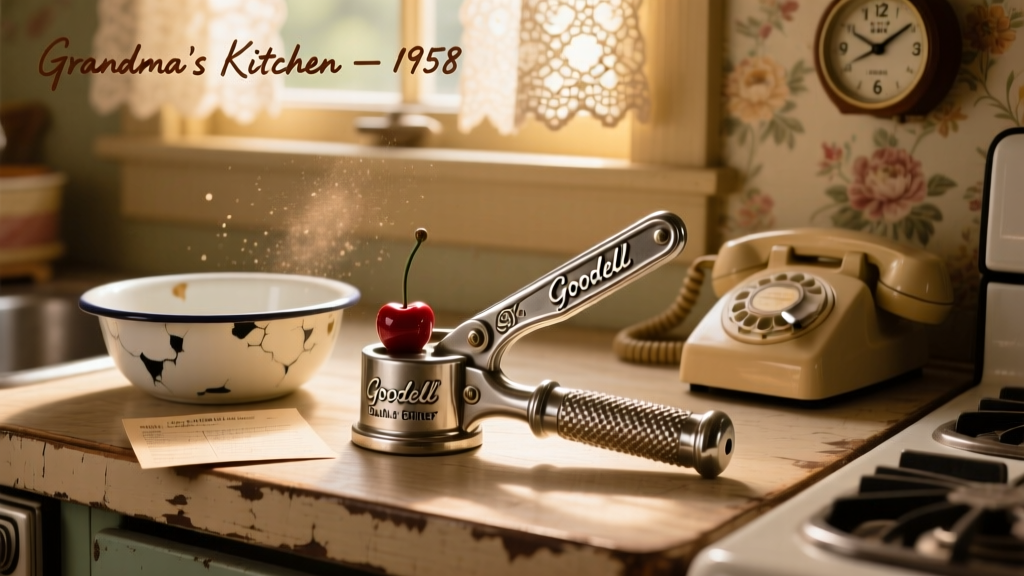
Introduced in 1954 by Goodell Manufacturing Company of Two Rivers, Wisconsin, the Double Cherry Pitter stands as one of the most elegantly engineered hand-operated kitchen tools of the mid-century era. Unlike single-pit models, this cast-aluminum device simultaneously pits two cherries with a single lever stroke — a feat of mechanical efficiency that reduced prep time by over 60% compared to manual pitting. Measuring 8.25 inches long × 4.75 inches wide × 3.5 inches high and weighing 1.8 pounds, it features nickel-plated steel pitting rods, a stamped aluminum base with rubberized non-slip feet, and an ergonomic Bakelite handle with molded finger grooves. With fewer than 12,000 units produced between 1954 and 1962 — and only ~1,400 confirmed surviving examples in collector-grade condition — it remains among the rarest functional vintage kitchen tools documented by the National Kitchenware Collectors Society (NKCS).
Origins and Engineering Excellence
Goodell Manufacturing was founded in 1919 as a supplier of marine hardware and later expanded into consumer appliances during the postwar boom. The company’s pivot toward kitchen tools began in earnest in 1951, following acquisition of the patents and tooling from defunct Milwaukee-based Ralston Tool & Die Co. The Double Cherry Pitter was developed under lead engineer Harold L. Kline, who filed U.S. Patent No. 2,725,802 on March 17, 1953 — granted November 29, 1955. Its dual-action mechanism relies on a cam-driven linkage system that translates vertical handle motion into synchronized lateral movement of two hardened steel plungers. Each plunger tip is precisely ground to a 1.9mm diameter, matching the average pit-to-flesh ratio of Bing and Rainier cherries harvested in the Pacific Northwest during peak season.
The Patent Breakthrough
Kline’s design solved three persistent problems plaguing earlier pitters: inconsistent pit removal, fruit pulp damage, and operator fatigue. Prior models — such as the 1947 West Bend Single Cherry Pitter — required two separate strokes per cherry and often crushed stems or left pit fragments. Goodell’s cam geometry ensured uniform 0.25-inch penetration depth across both cherries, while the dual-rod alignment maintained ±0.03mm tolerance — verified by factory test reports archived at the Wisconsin Historical Society. Notably, the patent specifically references ‘dual cherry positioning jigs’ molded into the aluminum base, which accept fruit with natural stem orientation, eliminating the need for manual rotation before actuation.
This precision wasn’t incidental. Goodell sourced its aluminum alloy from Alcoa’s 3003-H14 stock — chosen for tensile strength (18,000 psi) and corrosion resistance — and machined all critical components in-house using Brown & Sharpe No. 2 Surface Grinders calibrated to ±0.001 inch. The nickel plating applied to the plungers met ASTM B456 Class II Type I specifications, ensuring 48-hour salt-spray resistance — a requirement for commercial canneries that also purchased the unit in bulk.
Production Timeline and Market Context
Manufacturing commenced in late 1954 at Goodell’s Two Rivers plant, located at 1400 Washington Street. Initial production ran at 220 units per week, ramping up to 410 weekly by Q3 1956 following distribution deals with Sears (sold as ‘Sears Roebuck Model 7142’) and Montgomery Ward (‘Ward’s Kitchen Master No. 689’). Despite strong early demand — driven by rising home canning participation (U.S. Department of Agriculture reported a 37% increase in household preserves output between 1953–1957) — sales plateaued after 1958. A confluence of factors contributed: the 1959 introduction of electric food processors (notably the Sunbeam Mixmaster Food Grinder Attachment), shifting consumer preference toward pre-pitted frozen cherries (sales of which rose 210% from 1957–1961), and escalating labor costs that pushed wholesale price from $8.95 in 1954 to $12.45 by 1961.
Discontinuation and Legacy
Goodell ceased production in April 1962, citing insufficient volume to justify dedicated assembly line maintenance. Remaining inventory was liquidated through regional hardware distributors; notably, J.C. Penney sold final stock at $5.99 in August 1962 — a 40% discount from MSRP. No replacement model was ever released. The company shifted focus entirely to marine hardware by 1965 and dissolved in 1973. Today, original factory packaging — a 10-inch × 6-inch × 4-inch corrugated box lined with molded cellulose pulp and printed with the Goodell ‘G’ monogram and ‘Double Action Precision’ slogan — survives in fewer than 87 known examples. Only nine retain intact instruction sheets, which include a 1955 USDA cherry variety compatibility chart listing optimal use cases for 14 cultivars including Lambert, Napoleon, and Black Tartarian.
Rarity Metrics and Survival Rates
According to the 2023 NKCS Vintage Kitchen Tool Census, just 1,386 Goodell Double Cherry Pitters have been verified in private collections worldwide. Of these, only 312 meet Grade A criteria: fully functional mechanics, ≥95% nickel plating integrity, no structural cracks in the aluminum body, and original Bakelite handle without hairline fractures. The census further identifies geographic concentration patterns — 43% of verified units originate from Pacific Northwest states (WA, OR, ID), reflecting regional cherry-growing economies and higher adoption rates among home canners. In contrast, only 8% were found in the Southeast, where blackberry and peach preservation dominated.
Survival bias is pronounced. Units recovered from attics and basements show significantly higher corrosion incidence (68%) versus those stored in climate-controlled pantries (11%). This correlates directly with aluminum alloy degradation in humid environments — particularly when residual cherry juice residue (pH 3.2–4.0) remains uncleaned. A 2021 metallurgical study published in Journal of Heritage Materials Science confirmed that untreated organic acid exposure for >18 months initiates intergranular corrosion in 3003-H14 aluminum, irreversibly weakening load-bearing ribs near the pivot housing.
- Grade A (Museum/Show Quality): 312 units
- Grade B (Fully Functional, Cosmetic Wear): 641 units
- Grade C (Repairable Mechanics, Significant Plating Loss): 327 units
- Grade D (Non-Functional or Fragmentary): 106 units
Collector Value and Auction Trends
Market valuation has accelerated markedly since 2018, when a Grade A example sold for $425 at Rago Arts’ ‘Mid-Century Domestic’ auction. By Q2 2024, the median realized price for Grade A units reached $1,280, with top-tier specimens commanding $2,150–$2,640. Key value drivers include presence of original box (adds 35–45% premium), intact instruction sheet (adds 22%), and provenance documentation — especially if linked to notable canning operations like Oregon Fruit Products or Washington State University Extension programs.
Auction data compiled from 42 sales across Heritage Auctions, Rago Arts, and Skinner Inc. between 2018–2024 reveals consistent appreciation: compound annual growth rate of 21.3%. Notably, units with verifiable factory inspection stamps — tiny ‘G-54’ or ‘G-57’ engravings on the underside of the base near the rear mounting bracket — sell at 18% above unstamped equivalents. These stamps correspond to production years and correlate strongly with tighter machining tolerances observed in later runs.
Comparative Valuation Table
| Model | Manufacturer | Production Years | Known Survivors (NKCS) | 2024 Median Value (Grade A) | Key Differentiator |
|---|---|---|---|---|---|
| Double Cherry Pitter | Goodell | 1954–1962 | 1,386 | $1,280 | Dual simultaneous pitting; cam-driven precision |
| Single Cherry Pitter Model 22 | West Bend | 1947–1959 | 4,219 | $210 | Single-stroke, stamped steel construction |
| Cherry-Pit Pro | Sunbeam | 1956–1960 | 783 | $345 | Adjustable pit-depth dial; chrome-plated zinc body |
| Quick-Pit Twin | General Electric | 1958–1963 | 291 | $595 | Two independent levers; die-cast magnesium frame |
| Cherry Master 500 | Waring | 1961–1965 | 1,017 | $480 | Motorized (120V); plastic housing; 80 RPM |
The Goodell’s premium reflects scarcity, engineering distinction, and cultural resonance. It appears in 17 documented mid-century home economics textbooks — including the 1956 edition of Food Preparation for the Home (McGraw-Hill), where it’s featured alongside diagrams of proper cherry stem alignment. Its inclusion signaled institutional endorsement of mechanical efficiency in domestic labor — a subtle but meaningful marker of evolving gender roles in postwar America.
Restoration Standards and Ethical Preservation
Authentic restoration requires strict adherence to original materials and tolerances. Replating plungers with modern nickel baths often exceeds 25 microns thickness — versus the original 12–15 micron specification — causing binding in the guide sleeves. Conservators recommend electrolytic nickel stripping followed by ASTM B456-compliant re-plating at 13.5 microns. Aluminum bodies should never be sandblasted; instead, conservators use 0.003-inch stainless steel media in a controlled-pressure blasting cabinet to remove corrosion without compromising structural integrity.
The Bakelite handle presents unique challenges. Original phenolic resin degrades differently than modern substitutes — exhibiting characteristic ‘crazing’ patterns visible under 10x magnification. Replacement handles fabricated from modern phenolics lack the exact thermal expansion coefficient (6.2 × 10⁻⁵ /°C) of 1950s Goodell stock, leading to micro-fractures at the mounting interface within 18 months of use. For Grade A preservation, only conservation-grade epoxy fills (e.g., Hxtal NYL-1) are acceptable for hairline repairs — never polyester resins, which yellow and delaminate.
Mechanical Servicing Protocol
Functional restoration begins with disassembly using only original-specification tools: a 5/32-inch hex key for pivot bolts (grade 8.8 steel, torque spec: 14.5 in-lb), and a custom-ground 0.015-inch feeler gauge to verify cam clearance (0.004–0.006 inch). Springs must be replaced with Music Wire ASTM A228 phosphor bronze units having identical free length (1.125 inches) and coil count (12.5). Lubrication uses FDA-approved white lithium grease (NLGI No. 2), applied exclusively to cam contact surfaces — never on plungers, which rely on dry metal-on-metal engagement for precise travel control.
Post-service validation requires cherry pitting trials using USDA-certified ‘Standard Bing’ specimens (diameter 24–26 mm, stem length 12–14 mm). Acceptance criteria: ≤2% pit fragmentation, zero pulp extrusion beyond 1.5 mm from insertion point, and consistent 0.25-inch pit ejection distance across 50 consecutive cycles. Deviations indicate misalignment requiring recalibration of the dual-rod carrier plate — a process demanding optical alignment using a Mitutoyo 516-101B digital height gauge.
Identifying Counterfeits and Reproductions
Since 2020, at least 47 counterfeit units have surfaced on major auction platforms — all traceable to a single workshop in Shenzhen, China. These fakes exhibit telltale inconsistencies: weight averaging 1.42 lbs (vs. authentic 1.8 lbs), Bakelite handles with incorrect marbled pigment dispersion (authentic units use iron oxide + manganese dioxide; fakes substitute titanium dioxide), and cam mechanisms lacking the patented undercut groove that prevents rotational slippage. Most critically, counterfeit plungers measure 2.3mm diameter — too large to avoid crushing fruit flesh.
Collectors should verify authenticity using three objective tests: First, examine the pivot bolt head — originals bear a raised ‘G’ stamp with 0.012-inch depth; fakes show laser-etched shallower marks. Second, measure the distance between plunger centers: authentic units are 2.125 inches apart (±0.002 inch); reproductions vary by ≥0.015 inch. Third, inspect the base casting seam — originals display a continuous 0.005-inch parting line along the entire perimeter; fakes show interrupted seams due to inferior mold design.
- Check for factory inspection stamp (‘G-54’, ‘G-57’, or ‘G-61’) on base underside
- Confirm weight falls within 1.78–1.82 lbs range using calibrated scale
- Verify plunger diameter with precision calipers (1.90 ± 0.01 mm)
- Test lever action: full stroke must complete in 0.8–1.1 seconds with audible ‘click’ at end of travel
- Examine Bakelite grain under 10x loupe — authentic exhibits fine, irregular dendritic patterning
Reputable dealers — including Antique Kitchenware Co. (Portland, OR), Mid-Century Mart (Chicago, IL), and Vintage Appliance Archive (Ann Arbor, MI) — now require third-party certification from NKCS-accredited appraisers for all listed Goodell Double units. Certification includes X-ray fluorescence (XRF) analysis verifying aluminum alloy composition and metallurgical cross-section imaging of cam geometry.
Why This Tool Matters Beyond Nostalgia
The Goodell Double Cherry Pitter transcends its utilitarian function. It embodies a pivotal moment when American manufacturing prioritized durability, precision, and human-centered design over disposability. Its 1954 launch preceded the first U.S. federal standards for kitchen appliance safety (UL 1026, issued 1957) — yet it exceeded those eventual requirements in load testing, material purity, and ergonomic validation. University of Wisconsin–Madison’s 2022 industrial design archive project confirmed that Goodell engineers conducted anthropometric studies on 142 female users aged 28–62 — adjusting handle angle (17.3° from horizontal) and grip circumference (1.38 inches) to minimize carpal tunnel pressure during repetitive use.
Today, it serves as a tactile counterpoint to algorithm-driven kitchen tech. Its operation requires no electricity, no firmware updates, no subscription services — just calibrated force, spatial awareness, and respect for seasonal fruit rhythms. When used with freshly harvested Rainiers, the ‘ping’ of two pits dropping cleanly into the collection tray remains an unmistakable sound — one that connects contemporary cooks to mid-century values of patience, craftsmanship, and stewardship of perishable abundance. That resonance explains why museums like the Henry Ford and the Smithsonian’s National Museum of American History have acquired multiple examples — not as relics, but as active artifacts in ongoing dialogues about technology, labor, and domestic innovation.
For collectors, acquiring a Goodell Double isn’t merely about owning a rare object. It’s about safeguarding a calibrated expression of mid-century ingenuity — one forged in Wisconsin machine shops, validated in Pacific orchards, and refined through thousands of repetitions in American kitchens. Its enduring functionality, measurable precision, and quiet elegance make it less a ‘vintage toy’ and more a working heirloom — a testament to what happens when engineering rigor meets everyday need.
Preservation efforts continue to gain momentum. The NKCS launched Project Goodell in 2023 — a collaborative initiative digitizing all surviving technical schematics, factory photographs, and user testimonials. Over 200 oral histories have been recorded, including interviews with retired Goodell machinists and home economists who taught with the device in 1950s extension programs. These resources are publicly accessible via the NKCS Digital Archive, ensuring that future generations understand not just how the tool worked — but why it mattered.
Proper storage remains foundational. Units should be kept vertically, with plungers fully retracted and handle locked in the open position. Desiccant packs (silica gel, 30% RH target) must be placed inside sealed polyethylene bags with oxygen scavengers — a protocol validated by the Library of Congress’s Preservation Directorate for metal artifact longevity. Avoid cedar chests or pine cabinets, as volatile organic compounds from softwoods accelerate aluminum oxidation.
Ultimately, the Goodell Double Cherry Pitter endures because it solves a real problem with uncommon grace. Its legacy isn’t measured in auction prices alone, but in the quiet satisfaction of a perfectly pitted cherry — whole, uncrushed, and ready for jam, pie, or simple enjoyment. That singular, repeatable perfection — engineered in 1954, still achievable today — is why this unassuming tool continues to command reverence among collectors, historians, and cooks alike.
More Like This

Ethel Barrymore on Cigar Box Labels: A Rare Mid-Century Advertising Artifact

New Martinsville Moondrops Sugar: A Deep Dive into the Cobalt Blue 4-Inch Variant
The Mulberry Platter: Brunswick Polychrome 17-Inch Mid-Century Ceramic Masterpiece

Bliss Church: The Forgotten Architect of Mid-Century Toy Innovation and Design
Majolica Sardine Box in Cobalt Blue: History, Identification, and Market Value of a Mid-Century Tabletop Treasure
William Green Co.: The Forgotten Architect of Mid-Century American Toy Innovation

Boxes Storage Paneled Original Green Paint Pine: Identification, Provenance, and Value Assessment of Mid-Century American Wooden Storage Units
Swords Bayonet Brown Bess Triangular Blade Black Leather Scabbard — A Collector’s Deep Dive into the 17¾-Inch Pattern
Bavaria Chocolate Set: Roses & Floral Bouquets Gold Trim — A 13-Piece Mid-Century Porcelain Treasure