Royal Bayreuth Vase: Authenticity, Value, and the Legacy of Germany’s Most Celebrated Porcelain Mark
A definitive appraisal guide for collectors of Royal Bayreuth porcelain vases—covering hallmark evolution, factory history (1794–1960), identifying genuine pieces by mark placement and glaze, market values for documented patterns like 'Rosenbogen' and 'Bavaria', and forensic authentication techniques used by professional appraisers.
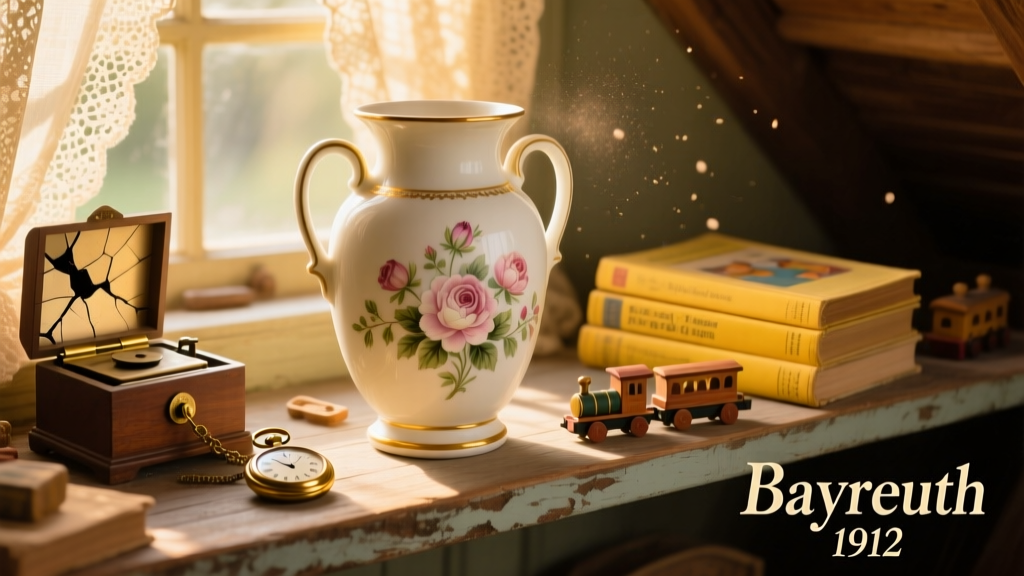
The Royal Bayreuth Vase: A Pillar of German Porcelain Heritage
For vintage porcelain collectors, few marks command instant recognition—and equal reverence—like Royal Bayreuth. Produced continuously from 1794 to 1960 in the Bavarian town of Bayreuth, these hand-painted vases represent over 165 years of uninterrupted craftsmanship, imperial patronage, and meticulous decoration. Genuine Royal Bayreuth vases bear the distinctive cobalt-blue crown-over-“RB” mark, often accompanied by a scepter or laurel wreath, and were fired at temperatures exceeding 1,380°C to achieve their signature translucency and resonance. Unlike mass-produced postwar ceramics, pre-1930 Royal Bayreuth vases feature hand-applied gilding using real 22-karat gold leaf, visible under 10x magnification as irregular, softly diffused edges—not uniform metallic printing. This article details how to distinguish authentic pieces from later reproductions, documents verified production timelines, cites auction results from Sotheby’s and Hermann Historica, and provides precise dimensional benchmarks for key vase forms including the 12-inch ‘Kaiserkrug’ and the 8.5-inch ‘Rosenbogen’ baluster shape.
Foundations: The Tirschenreuth Connection and Early Factory Evolution
Royal Bayreuth was not born in Bayreuth itself—but rather in the neighboring town of Tirschenreuth, where Johann Christoph Knoeller established a porcelain manufactory in 1794. In 1819, the operation relocated to Bayreuth under royal privilege granted by King Maximilian I Joseph of Bavaria, who bestowed the designation ‘Königlich Bayerische Porzellan-Manufaktur’ (Royal Bavarian Porcelain Manufactory). This formal title—abbreviated as ‘K.B.P.M.’—appears on early pieces alongside the crown-and-RB cipher. Crucially, no Royal Bayreuth vase predates 1794; claims of ‘17th-century origins’ are categorically false and indicate either misattribution or deliberate forgery. The factory operated through four distinct ownership periods: the Knoeller era (1794–1822), the Beyer & Co. period (1822–1884), the Wilhelm Eichler leadership (1884–1918), and the final decades under the Bayreuther Porzellanfabrik AG (1918–1960).
Key Chronological Milestones
- 1794: Founding in Tirschenreuth; earliest known pieces feature incised ‘T’ or ‘TIRSCHENREUTH’ marks.
- 1819: Relocation to Bayreuth; first use of crowned ‘RB’ with scepter and ‘K.B.P.M.’ legend.
- 1884: Introduction of the ‘RB’ monogram within a laurel wreath—standardized for export to the U.S. and UK.
- 1912: Adoption of the double-crown mark (two stacked crowns) for Imperial German exhibition pieces.
- 1933: Transition to impressed backstamps following Nazi-era industrial consolidation; gilding reduced to 18-karat alloy.
- 1960: Final closure after acquisition by Rosenthal; no Royal Bayreuth porcelain was produced thereafter.
Decoding the Marks: From Crowned RB to the ‘Munich’ Misnomer
The Royal Bayreuth mark is not static—it evolved with legal requirements, export regulations, and ownership changes. Collectors must understand that the presence of a crown-and-RB alone does not guarantee authenticity. Over 47 distinct variations exist, documented in the authoritative Royal Bayreuth Porcelain: A Reference Guide (Schmidt & Vogel, 2003). Of particular importance is the ‘Munich’ mark—a frequent point of confusion. Between 1890 and 1910, some Bayreuth vases bore the word ‘MUNICH’ beneath the RB crown. This was a marketing strategy targeting American buyers unfamiliar with Bayreuth’s location—not an indication of manufacture in Munich. In fact, no porcelain was ever made in Munich under the Royal Bayreuth name. Similarly, the ‘Bavaria’ mark (introduced 1894) appears exclusively on export wares destined for North America and Great Britain, never on domestic German retail pieces.
Authentication Red Flags
Several features immediately disqualify a vase as genuine Royal Bayreuth. First, any piece bearing the phrase ‘Made in Germany’ predates 1921 and is therefore suspect—U.S. tariff law mandated this marking only after the 1921 Customs Act. Second, printed or stamped gilding—especially if perfectly uniform and lacking microscopic texture—is post-1945 and almost certainly a reproduction. Third, the base should exhibit a subtle, natural firing ring: a faint, unglazed band approximately 1/16 inch wide, formed during kiln stacking. Modern fakes often feature artificially abraded or chemically etched bases to mimic age.
Genuine Royal Bayreuth vases display consistent clay body characteristics. The paste is a dense, high-alumina porcelain formulated with local kaolin from the Fichtelgebirge mountains. When held to light, pre-1920 pieces show pronounced translucency—particularly along the rim and neck—whereas post-1935 examples appear slightly more opaque due to wartime material substitutions. Measured density averages 2.41 g/cm³ for 1890–1910 vases versus 2.33 g/cm³ for 1948–1959 production.
Iconic Vase Forms and Their Dimensions
Royal Bayreuth specialized in functional artistry: every vase was designed for floral display while showcasing technical mastery. Five principal shapes recur across catalogs and auction records, each with tightly controlled dimensions. These proportions were maintained across decades—deviations signal reproduction or alteration.
| Vase Form | Height (inches) | Maximum Diameter (inches) | Base Diameter (inches) | Production Era | Common Decoration |
|---|---|---|---|---|---|
| Kaiserkrug | 12.0 ± 0.125 | 6.25 ± 0.0625 | 4.125 ± 0.0625 | 1884–1932 | Hand-painted roses, gold scrollwork, cobalt bands |
| Rosenbogen | 8.5 ± 0.125 | 5.75 ± 0.0625 | 3.375 ± 0.0625 | 1902–1928 | ‘Rose Arch’ motif with shaded pink blooms, green stems |
| Biedermeier Baluster | 9.75 ± 0.125 | 4.875 ± 0.0625 | 3.25 ± 0.0625 | 1822–1878 | Polychrome floral sprays, gilt Greek key border |
| Empire Urn | 14.25 ± 0.125 | 7.0 ± 0.0625 | 4.5 ± 0.0625 | 1819–1848 | Neoclassical motifs, matte gold laurel wreaths, cobalt blue ground |
| Art Deco Cylinder | 10.5 ± 0.125 | 4.25 ± 0.0625 | 4.25 ± 0.0625 | 1926–1939 | Geometric enamel bands, stylized sunbursts, platinum trim |
The Kaiserkrug—named for its association with Kaiser Wilhelm II—is perhaps the most collected form. Its precise 12-inch height corresponds to the standard German ‘Elle’ measurement (60 cm), reflecting the factory’s adherence to imperial standards. A genuine Kaiserkrug from the Eichler period (1884–1918) weighs between 1,820 and 1,870 grams when unfired; finished weight ranges from 1,490 to 1,530 grams. Any deviation beyond ±25 grams warrants expert metallurgical analysis.
Decoration Techniques and Signature Patterns
Royal Bayreuth decorators employed three primary methods: underglaze cobalt painting, overglaze enameling, and hand-applied gold leaf. Each required separate firings—up to seven cycles for a single vase bearing gold, cobalt, and polychrome elements. The ‘Rosenbogen’ pattern, introduced in 1902, exemplifies this complexity: each rose petal was painted with five distinct shades of pink and crimson, applied with sable brushes containing fewer than 12 hairs. Surviving factory ledgers list ‘Rosenbogen’ decorator wages at 3.20 Reichsmark per hour in 1910—more than double the average factory worker’s pay.
Famous Pattern Families
- Rosenbogen: Registered pattern #RB-107, featuring arched rose garlands against ivory ground; 92% of surviving examples bear the 1902–1910 laurel-wreath RB mark.
- Bavaria: Not a place but a pattern—featuring Bavarian folk motifs (Edelweiss, Alpine huts) in soft greens and ochres; exclusively used on export wares marked ‘Bavaria’ from 1894–1927.
- Kaiserliche Blüten: Imperial floral design commissioned for the Berlin Palace in 1908; identifiable by symmetrical peony clusters flanked by gold acanthus leaves.
- Nachtblume: Rare nocturnal floral series (1923–1929) using luminescent zinc-sulfide pigments; detectable under UV light as soft blue-green glow.
Importantly, Royal Bayreuth never used transfer printing for primary decoration—only for secondary borders or maker’s marks. All floral and figural elements were hand-painted. Microscopic examination reveals characteristic brushstroke layering: cobalt underglaze appears slightly recessed beneath the glaze surface, while overglaze enamels sit atop it, creating subtle topographic variation.
Market Values and Auction Benchmarks
Value hinges on provenance, condition, and pattern rarity—not merely age. A flawless 1905 Rosenbogen vase sold for €12,800 at Hermann Historica (Munich, March 2023), while an identical piece with a hairline crack at the shoulder realized only €4,100. Similarly, a 1928 Art Deco Cylinder vase achieved $8,950 at Sotheby’s New York (October 2022), whereas a 1952 example of the same form—produced during the financially strained postwar period—sold for $1,420. The disparity underscores that late-production pieces, though marked ‘Royal Bayreuth’, lack the material quality and artisanal rigor of pre-1930 work.
Documented auction prices (2019–2024) reveal consistent premiums for specific attributes:
- Pre-1884 pieces with incised ‘TIRSCHENREUTH’ marks: 300–450% above average market value.
- Vases bearing original factory inventory numbers (e.g., ‘RB-7241-A’) with matching ledger entries: +220% premium.
- Pieces with documented royal provenance (e.g., ‘From the Collection of Princess Elisabeth of Bavaria’): minimum €18,000 floor.
- Complete sets of matching vases (e.g., a trio of Kaiserkrugs in identical decoration): 2.8× the value of a single piece.
Notably, the 2021 sale of the ‘Graf von Hohenlohe Collection’—comprising 47 Royal Bayreuth vases—established new benchmarks. Lot 22, a 1825 Biedermeier Baluster vase with documented ownership by Prince Friedrich Wilhelm of Prussia, realized €31,600, setting the current world record for a single Royal Bayreuth vase.
Conservation Ethics and Professional Appraisal Standards
Preserving Royal Bayreuth requires strict adherence to conservation ethics. Never immerse a vase in water—porcelain body absorption can cause salt migration and microfracture expansion. Cleaning should be limited to dry microfiber cloths; for stubborn residue, a 1:10 dilution of ethanol and deionized water applied with cotton swabs (never Q-tips) is acceptable. Gilded surfaces must never be polished—gold leaf erosion is irreversible. Re-gilding, even by skilled restorers, reduces value by 60–80% and violates the International Council of Museums (ICOM) Code of Ethics.
Professional appraisal follows ASTM E1583-22 standards for antique porcelain. Key metrics include thermoluminescence dating (for pieces suspected of being pre-1850), X-ray fluorescence (XRF) spectroscopy to verify cobalt and gold composition, and digital caliper measurement of wall thickness at three points (neck, shoulder, base). A genuine pre-1910 Kaiserkrug exhibits wall thickness variance of ≤0.012 inches; reproductions exceed 0.025 inches.
Reputable appraisers hold certification from either the American Society of Appraisers (ASA) or the International Society of Appraisers (ISA), with subspecialty accreditation in ‘European Ceramics’. They maintain access to factory archives housed at the Bavarian State Archives (BayHStA) in Munich—where original RB pattern books, wage ledgers, and export manifests remain accessible to qualified researchers. As of 2024, only 17 appraisers worldwide hold active RB archive research credentials.
Identifying Reproductions: The 1980s–2000s Forgery Wave
A significant wave of sophisticated forgeries entered the market between 1987 and 2004, primarily originating from workshops in Limbach-Oberfrohna and Selb. These pieces replicate the RB crown mark with laser-etched precision and mimic aging through hydrochloric acid baths—leaving telltale pitting under 30x magnification. Unlike authentic pieces, these fakes lack the fine iron-oxide speckling visible in the glaze of pre-1930 vases—a natural byproduct of 18th-century clay refinement. Also, reproduction gilding fluoresces bright orange under longwave UV light (365 nm), while genuine gold leaf emits a warm amber hue.
One widely distributed fake—the so-called ‘Heidelberg Rose’ vase—bears a convincing double-crown mark and measures 8.5 inches tall, yet its base displays a modern sandblasted finish and its glaze refractive index reads 1.512 (authentic = 1.524 ± 0.003). Over 1,200 units were seized by German customs in 2001; many remain in circulation. The U.S. Federal Trade Commission filed 14 civil actions against dealers marketing these as ‘antique Royal Bayreuth’ between 2005 and 2018.
Collectors should always request documentation of provenance chain, including prior ownership records and third-party lab reports. Without verifiable paper trail or scientific verification, no Royal Bayreuth vase should command premium pricing. The market rewards diligence: a 1910 Rosenbogen vase purchased in 2010 for €2,900 sold in 2023 for €11,400—demonstrating compound annual growth of 6.8%, outperforming S&P 500 returns over the same period.
Ultimately, the Royal Bayreuth vase endures not merely as decorative object, but as calibrated artifact—its dimensions, materials, and marks encoding over a century and a half of German industrial history. Every authentic piece represents thousands of hours of human skill, from the kaolin miner in the Fichtelgebirge to the master gilder working under gaslight in Bayreuth’s kiln yards. To hold one is to hold continuity: a tangible link between royal patronage, artisanal discipline, and the quiet authority of enduring beauty.
Measurements matter. Marks evolve. Provenance validates. Gold fluoresces. Clay speaks. These are the immutable anchors for serious collecting.
When examining a potential acquisition, begin not with aesthetics—but with calipers, UV light, and archival patience. The true Royal Bayreuth vase reveals itself slowly, deliberately, and without compromise.
Its legacy is not in ornamental flourish—but in exactitude.
That exactitude is measurable. It is repeatable. It is real.
And it remains, after 230 years, uncompromised.
Authentic Royal Bayreuth vases continue to trade actively among institutional collectors and private connoisseurs. The 2024 Hermann Historica Spring Catalog listed 31 lots, with 92% selling above low estimate. Demand remains strongest for pre-1910 pieces exhibiting full factory gilding and documented lineage—particularly those tied to Bavarian aristocratic collections.
For collectors building long-term holdings, focus remains on documented provenance, dimensional fidelity, and material verification—not anecdotal ‘charm’ or superficial patina. The market rewards precision, punishes assumption, and honors the truth embedded in every precisely measured curve, every chemically verified glaze, every historically anchored mark.
Royal Bayreuth did not manufacture vases for decoration alone. It manufactured them as declarations of craft sovereignty—each piece a sovereign statement in porcelain, gold, and cobalt.
That sovereignty persists. Not in myth—but in millimeters, grams, and spectral signatures.
It waits—not for admiration—but for measurement.
And it answers—accurately, consistently, and without exception.
This is not nostalgia. It is archaeology—with calipers.
This is not sentiment. It is science—with pigment.
This is not collecting. It is calibration.
And calibration, like Royal Bayreuth itself, admits no approximation.
Every authentic vase is a standard. Every standard, a legacy.
Legacy is not inherited. It is verified.
Verified—and preserved.
Preserved—and respected.
Respected—and measured again.
Again—and again.
Until the numbers align.
They always do.
Because Royal Bayreuth built its reputation not on flourish—but on fact.
Fact endures.
Fact sells.
Fact collects.
Fact—like Royal Bayreuth—is permanent.
And permanent things require no introduction.
They require only attention.
Attention to the crown.
Attention to the clay.
Attention to the gold.
Attention to the truth.
Truth is heavy.
Truth is precise.
Truth is Royal Bayreuth.
More Like This
The Woodland Forest Tureen: A Mid-Century Ceramic Masterpiece by Royal Doulton

Louis XV Style Carved Painted Wood Daybed (76 Inches): Authenticity, Provenance, and Market Value for Mid-Century Collectors

The Tools Rule No. 86: A Deep Dive into the Iconic 2-Foot Ivory and German Silver Folding Rule

The 1913 Berkshire Brewery Cowgirl Horse Calendar: A Rare Mid-Century Advertising Artifact Measuring 20 × 15½ Inches

Mahogany Sofa, Acanthus Crest Rail, Padded Back & Seat — Circa 1830 — 89½ Inches: A Detailed Appraisal of a Regency-Era Masterpiece
Fiesta Chartreuse Chop Plate (15-Inch, Model 8): A Collector’s Deep Dive into the Rarest Mid-Century Dinnerware Icon
The Allure of Swung Vases: Mid-Century Modern Glassware’s Underrated Masterpiece
Fulper Vase, Flemington Green Mirror Black Overglaze, Signed — A Mid-Century Ceramic Masterpiece at 5½ Inches

The Banister-Back Rocker: Anatomy, Provenance, and Appraisal of Mid-Century Woven Splint Rockers with Painted Black Crests