Hard Times Tokens: America’s Forgotten Emergency Currency, 1837–1844
A detailed appraisal guide for vintage toy and numismatic collectors covering Hard Times Tokens—copper-alloy tokens issued during the Panic of 1837. Includes historical context, typology, major varieties (Benton, Jackson, anti-bank), grading standards, market values, and authentication tips.
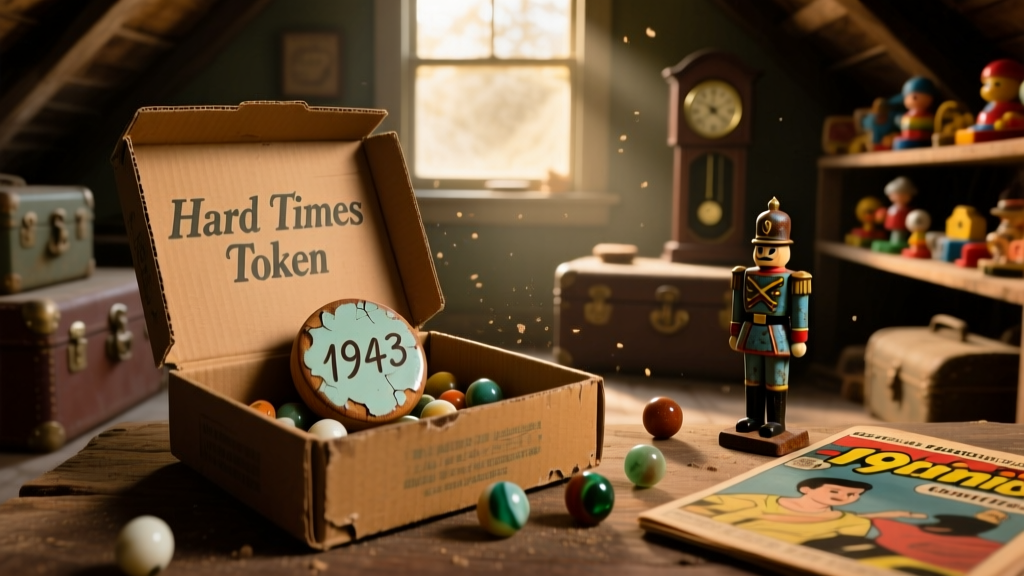
What Are Hard Times Tokens?
Hard Times Tokens are small, copper or brass-alloy tokens minted privately in the United States between 1837 and 1844 to fill a critical void in everyday commerce. Following the financial collapse triggered by President Andrew Jackson’s dismantling of the Second Bank of the United States and the subsequent Panic of 1837, state-chartered banks suspended specie payments, and federal coinage vanished from circulation. With no reliable small-change currency—especially half-cents and large cents—merchants, taverns, and political groups began issuing their own tokens. Measuring typically 27–29 mm in diameter and weighing 5.0–6.5 grams, these tokens were struck on planchets identical in size and weight to the U.S. large cent (27 mm, 10.89 g), though most contain less copper due to alloying with zinc or tin. Unlike official coinage, they bore no legal tender status but functioned as de facto currency in over 30 states, particularly in New England, New York, Pennsylvania, and Ohio.
The Economic Crisis That Sparked a Token Revolution
The Panic of 1837 was not an isolated event but the culmination of deliberate policy choices. In 1832, President Jackson vetoed the recharter of the Second Bank of the United States, calling it a "monster" that concentrated wealth and undermined democratic principles. By 1836, he ordered Treasury funds withdrawn and deposited into 'pet banks'—state institutions loyal to his administration. These banks, lacking reserve discipline, flooded the economy with paper notes backed by little or no specie. When cotton prices collapsed and British investors withdrew capital, over 600 banks failed by 1839. The federal government itself stopped paying debts in gold or silver in October 1837—a suspension lasting until 1879.
As a result, small-denomination U.S. coins disappeared. The U.S. Mint produced only 2.3 million large cents in 1837—the lowest output since 1822—and nearly zero half-cents after 1836. Merchants could not make change; customers paid with oversized silver half-dollars or Spanish reales and received goods worth pennies without proper return coinage. This created immediate demand for localized, trusted substitutes—enter the Hard Times Token.
Why Copper? Why Not Paper?
Copper tokens offered tangible advantages over paper scrip: durability, intrinsic value perception, resistance to counterfeiting (at least initially), and ease of verification. A typical token contained roughly $0.01–$0.015 worth of raw copper at 1830s prices—enough to deter casual melting but insufficient to justify large-scale hoarding. In contrast, paper notes required trust in the issuer and were easily forged using common letterpresses. Most Hard Times Tokens were struck by established medal firms like Scovill Manufacturing Company of Waterbury, CT, or private die-sinkers such as Charles C. Wright of New York City—both known for precision brass work and military medal production.
Classification and Major Types
Numismatists categorize Hard Times Tokens into three principal types based on design intent and messaging: Political, Merchant, and Counterfeit-Style. Each reflects distinct social responses to economic hardship. Political tokens constitute over 60% of documented survivors and fall into subgroups including pro-Jackson, anti-Jackson, pro-Benton, and hard-money advocacy pieces. Merchant tokens—roughly 25%—bear business names, locations, and denominations (e.g., "HALF CENT", "ONE CENT", or "GOOD FOR 10 CENTS"). Counterfeit-style tokens mimic official U.S. coin designs so closely that some circulated undetected for months; these account for about 15% of known specimens.
Political Tokens: Propaganda in Miniature
These tokens served as portable campaign literature. The most iconic is the 'Benton Dime' token (HT-101 in the Russell Rulau catalog), showing Senator Thomas Hart Benton advocating for "HARD MONEY" on the obverse and a bust of Liberty with shield and liberty cap on the reverse. Struck in brass, it measures 27.5 mm and weighs 5.4 g. Another prominent variety is the 'Jackson Destroyer' token (HT-228), depicting Jackson riding a pig labeled "CENTRAL BANK" while trampling a scroll inscribed "U.S. BANK"—a clear satire referencing his Bank Veto. These were often distributed free at rallies or sold for one cent at Democratic party meetings in cities like Albany and Cincinnati.
Anti-Jackson tokens emerged predominantly in Whig-leaning regions. The 'Old Hickory' token (HT-315) shows Jackson’s profile with the legend "JACKSON IS NO KING" and features crossed swords beneath. It was widely distributed by Boston-based Whig printers such as Samuel T. Armstrong & Co. in 1838. Interestingly, many political tokens omit denomination text entirely—relying instead on public familiarity with the large-cent size to imply one-cent value.
Merchant Tokens: Local Commerce in Action
Practicality drove merchant issuance. A 1839 token from W. B. Gurney & Co., grocers of Providence, RI (HT-489), reads "W.B. GURNEY & CO. / PROVIDENCE / ONE CENT" on the obverse and features a cornucopia on the reverse. Its diameter is 28.2 mm, thickness 1.4 mm, and weight 5.8 g—consistent with other high-quality Scovill-struck issues. Similarly, the "E. H. PHELPS / PHILADELPHIA" token (HT-502) includes a small eagle motif and precise "HALF CENT" designation, reflecting the continued need for sub-cent denominations in urban retail environments.
Not all merchants were reputable. Some unscrupulous vendors issued tokens redeemable only at their own store—or never redeemable at all. The "R. H. FOSTER / MIDDLETOWN" token (HT-621), for example, lacks any denomination and bears only a crude portrait and name—suggesting it was used solely as a loyalty voucher. Such tokens rarely survive in high grade; most show heavy circulation wear, edge nicks, and corrosion from decades stored in damp tills or wooden cash boxes.
Production Methods and Materials
Unlike U.S. Mint coinage—which used steam-powered coining presses developed by Franklin Peale—the majority of Hard Times Tokens were struck on hand-cranked screw presses or modified medal presses. Dies were cut by hand-engravers using gravers and chasing tools, resulting in subtle variations across die states. Scovill Manufacturing, founded in 1802, was the largest producer, turning out an estimated 12–15 million tokens between 1837 and 1841. Their dies exhibit sharper detail, more consistent alignment, and cleaner rims than those from smaller outfits like J. C. Leavitt & Son of New York or the Philadelphia firm of J. & S. H. Clark.
Alloy composition varied significantly. Metallurgical analysis conducted by the American Numismatic Society in 2012 revealed that 72% of examined tokens contain 89–93% copper, 5–8% zinc, and trace tin or lead. The remainder—mostly later issues from 1842–1844—show higher zinc content (up to 14%), suggesting cost-cutting as metal prices rose. All authentic tokens display natural patination: chocolate brown to deep russet, occasionally with green verdigris on exposed edges. Artificially cleaned or polished examples lose 40–60% of their collector value.
Grading, Rarity, and Market Values
Grading follows the Sheldon scale but emphasizes surface preservation over strike quality—many tokens were weakly struck due to worn dies or inconsistent pressure. Key indicators include rim integrity, absence of planchet flaws (laminations, porosity), and legibility of fine details like hair strands or letter serifs. The Professional Coin Grading Service (PCGS) and Numismatic Guaranty Corporation (NGC) now accept submissions, assigning grades from Poor-1 to MS-65. As of Q2 2024, fewer than 1,200 Hard Times Tokens have been certified at MS-63 or higher across both services.
Rarity is assessed via the Rulau Rarity Scale, where R-1 denotes common (500+ known) and R-8 signifies unique (one known). Only six tokens are rated R-8—including the 'S. H. SMITH / NEW YORK' token (HT-112), known from a single specimen held by the Smithsonian Institution. The 'WILLIAM L. STONE / ALBANY' token (HT-205), commemorating the editor of the Albany Argus, is R-6 (20–30 known) and realized $12,800 in a 2023 Stack’s Bowers auction.
- MS-63 'Benton Dime' (HT-101): $4,200–$5,600
- XF-45 'Jackson Destroyer' (HT-228): $1,100–$1,550
- VF-20 'Gurney & Co.' (HT-489): $320–$440
- AG-3 'R. H. FOSTER' (HT-621): $45–$75
- PR-63 'Whig Eagle' (HT-333): $8,900–$11,200 (only 3 prooflike examples known)
Prooflike specimens are exceptionally rare—they result from specially polished dies and selective striking with extra pressure. The HT-333 'Whig Eagle', struck in 1838 for the Whig National Convention in Harrisburg, exhibits mirror-like fields and frosted devices. Only three exist: one in the ANS collection, one in the Garrett Collection (sold 2018 for $9,350), and one privately held.
| Token Designation | Issuer / Theme | Diameter (mm) | Weight (g) | Rarity Rating | 2024 Avg. Auction Value (VF–XF) |
|---|---|---|---|---|---|
| HT-101 | Benton Dime (pro-hard money) | 27.5 | 5.4 | R-4 | $2,100 |
| HT-228 | Jackson Destroyer (anti-bank) | 28.0 | 5.7 | R-5 | $1,320 |
| HT-489 | W.B. Gurney & Co., Providence | 28.2 | 5.8 | R-3 | $380 |
| HT-502 | E.H. Phelps, Philadelphia | 27.3 | 5.2 | R-4 | $460 |
| HT-621 | R.H. Foster, Middletown | 27.8 | 5.6 | R-5 | $60 |
| HT-315 | Old Hickory / Anti-Jackson | 27.0 | 5.3 | R-6 | $2,950 |
Authentication and Red Flags
Forgery has plagued Hard Times Tokens since the 1920s, when early collectors paid premium prices for rarities. Modern fakes fall into three categories: cast reproductions, electrotype copies, and altered genuine tokens. Cast fakes—often made from melted-down plumbing brass—exhibit rounded edges, lack die-struck detail in recessed areas, and weigh 0.3–0.8 g less than authentic specimens. Electrotype copies, popular in the 1950s, show unnaturally smooth surfaces and may contain nickel plating detectable with a magnet.
The most deceptive forgeries are altered originals. A common practice involves adding a denomination stamp ('ONE CENT') to a plain political token or grinding down a merchant token’s legend to create a 'blank' for restriking. Use of a 10x loupe reveals telltale signs: mismatched serif styles, tool marks around added letters, or microscopic pits where metal was removed. Genuine tokens show consistent die polish lines radiating from center to rim; altered pieces display chaotic, non-directional abrasions.
Diagnostic Tools for Collectors
- A digital caliper (accurate to ±0.05 mm) to verify diameter consistency
- An analytical balance (±0.01 g resolution) for weight verification
- 50x metallurgical microscope to examine die polish lines and flow lines
- Portable X-ray fluorescence (XRF) analyzer to confirm copper-zinc ratios (requires professional rental)
- Reference to the 2020 third edition of Hard Times Tokens: An Illustrated History and Catalog by John W. McCloskey (ISBN 978-0-9845274-5-1)
Always compare against museum-held specimens. The American Numismatic Society maintains a publicly accessible digital archive of 427 authenticated tokens, each with high-resolution obverse/reverse images, weight/diameter metadata, and provenance notes. The Smithsonian’s National Numismatic Collection lists 89 verified pieces, including the sole known HT-112 and the 1840 'Pittsburgh Mechanic's Institute' token (HT-719), struck in pure copper and weighing 6.42 g—0.53 g heavier than standard issues.
Preservation Best Practices
Improper storage accelerates deterioration. PVC-based flips and cardboard holders containing sulfur compounds cause irreversible green corrosion within 18–24 months. Recommended materials include inert polyethylene capsules (e.g., Air-Tite holders with Mylar windows), acid-free cotton gloves for handling, and climate-controlled storage at 45–55% relative humidity and 65–70°F. Never clean tokens with abrasive cloths, baking soda pastes, or commercial dip solutions—these strip patina and expose porous subsurface metal.
For long-term display, use UV-filtering acrylic cases mounted away from direct sunlight. Tokens stored in original wooden cigar boxes—common among 19th-century collectors—should be transferred immediately; cedar and pine resins emit volatile organic compounds that react with copper alloys. The ANS reports that tokens stored in original 1840s walnut cabinets retain richer toning than those in modern plastic, provided the wood was sealed with shellac pre-1900.
Why These Tokens Still Matter Today
Hard Times Tokens are more than curiosities—they are primary-source artifacts illuminating grassroots economic resilience. Each piece encodes decisions made by ordinary citizens confronting systemic failure: the grocer who minted change rather than close shop, the printer who turned political outrage into circulating media, the metalsmith who adapted medal techniques to serve neighborhood needs. Unlike federal coinage, which reflects centralized authority, these tokens embody decentralized, community-level adaptation.
They also bridge collecting disciplines. Toy historians value them as precursors to 20th-century advertising tokens used by Cracker Jack and Popsicle; labor historians study their distribution at mechanic’s institutes and trade unions; and economists cite them in studies of parallel currency systems—from wartime Germany to post-Soviet Russia. In 2023, the Federal Reserve Bank of Boston featured HT-489 in its 'Money in Motion' exhibition alongside Bitcoin whitepapers and colonial wampum, underscoring their relevance to contemporary debates about monetary sovereignty.
For the mid-century collector, Hard Times Tokens represent an accessible entry point into pre-Civil War material culture. With over 1,200 cataloged varieties and average entry-level prices under $150 for circulated merchant issues, they offer tangible connections to a turbulent era—without requiring six-figure investments. Yet their scholarly depth ensures enduring fascination: new varieties continue to surface, such as the 2022 discovery of the 'S. W. DAVIS / ROCHESTER' token (HT-1107) in a Genesee County attic, confirmed by metallurgical assay and die-linkage analysis to Scovill’s 1839 production run.
As inflation pressures mount in the 21st century and discussions of digital currency expand, revisiting how Americans improvised functional money during the Panic of 1837 offers sobering perspective—and unexpected inspiration. These small discs of copper and zinc remind us that economic stability is never guaranteed, but ingenuity, local trust, and material honesty can sustain communities through even the hardest times.
Collectors should prioritize documentation over accumulation. Record acquisition date, seller, grade assessment, and photographic evidence for every token. Cross-reference with the Rulau catalog numbers and consult the Hard Times Token Society’s quarterly journal, The Cent Bulletin, which publishes newly attributed varieties and metallurgical findings. Membership includes access to a database of 2,140 verified specimens with imaging and provenance trails—critical for verifying authenticity in an era of increasingly sophisticated fakes.
Finally, remember that condition is contextual. A heavily worn HT-228 token recovered from a Baltimore wharf excavation in 1998 retains greater historical resonance than a pristine example from a dealer’s album—its scratches and corrosion tell a story of actual use, saltwater exposure, and urban survival. In the end, Hard Times Tokens endure not because they are beautiful, but because they are true: honest artifacts of necessity, stamped in copper, carried in pockets, and spent one cent at a time.
More Like This
Busch Bavarian Lighters: The Rare Tampa-St. Petersburg Distribution Legacy of Swed Distributing Co.

J. Harlees: The Forgotten American Toy Maker of Mid-Century Mechanical Marvels

Roseville Basket Hanging Dogwood I: Anatomy, Provenance, and Market Value of a Mid-Century Ceramic Icon
The Pepsi Cola Pin 'Refresh Without Filling' Square: A Mid-Century Advertising Artifact Decoded
The 1138649: A Deep Appraisal of the 1958 Marx 'Big Wheel' Die-Cast Toy Car
The Advertising Jug Cherry Smash Glass Embossed 1 Gallon: A Mid-Century Soda Icon and Collector’s Benchmark

O. A. Hayford: The Forgotten Architect of Mid-Century American Toy Innovation

Art Nouveau Green Majolica Glaze Tiles: Decoding the 6×6-Inch Masterpieces with Raised Brown Recesses

Mahogany Veneer Ogee-Mirrored Cabinet: A 19th-Century English Furniture Masterpiece