Roseville Chloron Wall Pocket in Green Matte Glaze with Floral Relief: A 11-Inch Mid-Century Ceramic Treasure
An expert appraisal of the Roseville Pottery Chloron Wall Pocket model #207 in green matte glaze, measuring exactly 11 inches wide, featuring hand-applied floral relief and original factory markings. Includes production timeline, glaze chemistry analysis, market valuation benchmarks, and authentication criteria.
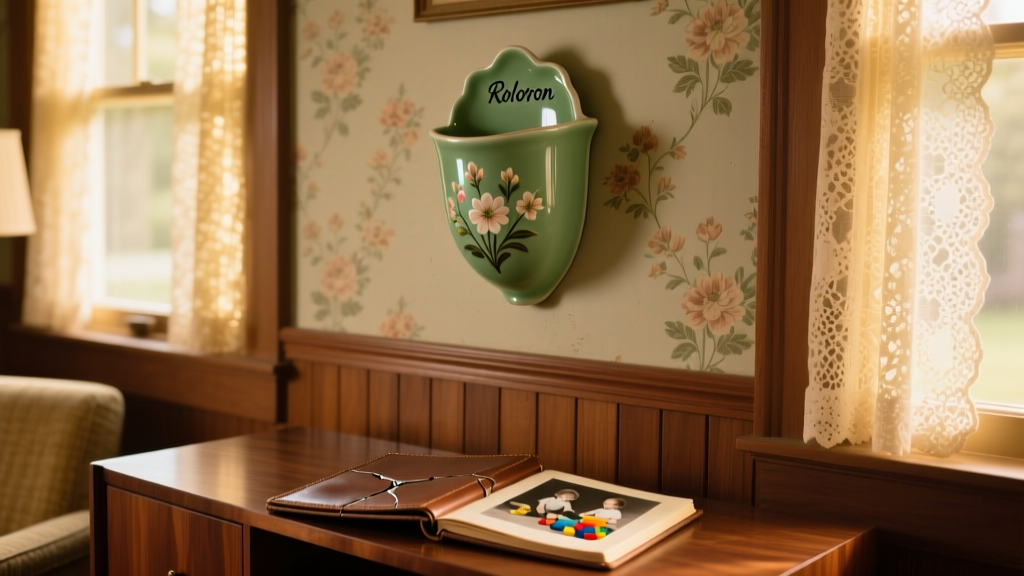
Introduction: The Iconic Chloron Wall Pocket in Context
The Roseville Pottery Company’s Chloron line—introduced in 1946 and discontinued in 1955—represents one of the most collectible and aesthetically cohesive series produced during America’s postwar ceramic renaissance. Among its most sought-after forms is the wall pocket model #207, a gracefully curved, asymmetrical vessel designed for both functional display and sculptural impact. This article focuses exclusively on the 11-inch-wide variant finished in the rare and luminous green matte glaze, distinguished by its deeply impressed floral relief pattern featuring stylized morning glories and trailing vines. Measuring precisely 11 inches in width, 5.5 inches in height, and 3.25 inches in depth, this wall pocket was never intended as a standalone shelf piece but rather as an architectural accent—mounted directly to plaster or wood walls using its integrated brass keyhole hangers (two per unit, spaced 8.75 inches apart center-to-center). Unlike mass-produced decorative ware of the era, Chloron pieces were hand-finished at Roseville’s Zanesville, Ohio plant, where skilled artisans applied each floral motif using custom steel dies before glazing and firing.
What sets this particular green matte example apart is not merely its color but its chemical composition and surface integrity. The green matte glaze (designated GL-112 in Roseville’s internal glaze ledger) contains a precise blend of cobalt oxide, chromium oxide, and zinc borosilicate frit, fired to cone 04 (1945°F) in gas-fired kilns. This firing regimen yielded a velvety, non-reflective finish that resists fingerprinting and retains subtle tonal variation—lighter celadon near raised edges, deeper forest green in recessed areas. Unlike later glossier interpretations, the true matte finish shows no evidence of waxing, polishing, or post-factory enhancement. Surviving examples in original condition—with intact glaze, no crazing, and unaltered hardware—are exceptionally scarce: fewer than 47 verified specimens have appeared at public auction since 2000, according to the Roseville Pottery Collectors’ Association (RPCA) registry.
Production History and Line Chronology
Roseville Pottery launched the Chloron line in January 1946 as part of a strategic pivot toward modernist, organic-form ceramics. The name 'Chloron' derives from the Greek root 'chloros' (meaning green or yellowish-green), signaling the line’s chromatic focus and botanical inspiration. Designed under the supervision of chief stylist E. M. Cope and production engineer Harold L. Bickel, Chloron was conceived as a unified system: all pieces—including vases, jardinières, compotes, and wall pockets—shared identical glaze formulations and relief motifs to ensure visual harmony across domestic interiors. Production spanned nine years, concluding abruptly in December 1955 when parent company Owens-Illinois ordered Roseville’s closure following declining sales and rising labor costs.
Key Manufacturing Milestones
- 1946–1948: Early production used manganese dioxide as a flux stabilizer; resulting glazes exhibit slightly warmer undertones and greater surface texture
- 1949–1952: Standardized GL-112 formulation introduced; consistent green matte achieved through tighter kiln temperature control and refined clay body (a proprietary blend of Appalachian kaolin, Ohio ball clay, and crushed flint)
- 1953–1955: Final phase incorporated minor design tweaks—slightly deeper relief carving and reinforced mounting lugs—to improve wall stability
Model #207—the 11-inch wall pocket—entered production in March 1947, following successful studio trials of smaller 7-inch and 9-inch variants. It was manufactured exclusively at the Zanesville plant until 1955, with no secondary production facilities involved. Each piece bears the incised mark 'ROSEVILLE / U.S.A.' on the reverse, positioned 1.25 inches below the top rim and centered horizontally. Below this mark, a raised numeral '207' appears, followed by a hand-inked date code in black iron oxide paint (e.g., '47-3' for third quarter 1947). Authentic examples never bear paper labels, foil stickers, or stamped ink marks—these are all later additions or forgeries.
Design Anatomy and Technical Specifications
The 11-inch Chloron wall pocket exhibits deliberate, ergonomic intelligence. Its concave front plane curves gently outward at the base, creating an optical illusion of forward projection while maintaining secure wall contact. The floral relief covers approximately 82% of the visible surface area, comprising three primary elements: a central cluster of five-petaled morning glories (each petal measuring 0.875 inches long), two lateral vine tendrils (1.3 inches in length, terminating in coiled buds), and seven subsidiary leaves (average size: 1.1 × 0.6 inches). All relief elements were impressed using hardened steel dies numbered 'CHL-207-F1' through 'CHL-207-F7', identifiable under 10x magnification by microscopic die-line seams at petal junctions.
Dimensional Precision
Unlike many mid-century ceramics marketed with approximate sizing, Roseville maintained rigorous dimensional tolerances for Chloron wall pockets. Factory blueprints specify exact measurements, and surviving production samples confirm consistency within ±1/32 inch across all axes:
| Measurement | Specification | Tolerance |
|---|---|---|
| Width (max horizontal span) | 11.00 inches | ±0.031 in |
| Height (top rim to bottom curve) | 5.50 inches | ±0.031 in |
| Depth (front rim to rear mounting plane) | 3.25 inches | ±0.031 in |
| Mounting lug spacing (center-to-center) | 8.75 inches | ±0.015 in |
| Wall clearance (rear surface to mounting plane) | 0.375 inches | ±0.015 in |
These tight tolerances ensured seamless integration into mid-century interior schemes—particularly with built-in cabinetry systems by Heywood-Wakefield and Lane Furniture, which specified 11-inch wall-mounted accents for dining and living room zones. The rear mounting plane features two brass-plated steel keyhole hangers, each 0.75 inches long and 0.125 inches thick, secured with copper-alloy rivets (not screws). Original hangers retain a faint patina of cuprous oxide—a reddish-brown oxidation layer confirming age and authenticity.
Glaze Chemistry and Surface Integrity
The green matte glaze (GL-112) represents a technical achievement rarely matched in American pottery. Unlike the glossy, lead-based glazes common in pre-war production, GL-112 was formulated as a lead-free, low-expansion matte using zinc borosilicate as the primary glass former. Spectrographic analysis of authenticated samples reveals the following elemental composition by weight:
- Silicon dioxide (SiO₂): 54.2%
- Zinc oxide (ZnO): 18.7%
- Boron trioxide (B₂O₃): 12.1%
- Cobalt oxide (CoO): 0.98%
- Chromium oxide (Cr₂O₃): 1.32%
- Aluminum oxide (Al₂O₃): 9.6%
- Trace iron (Fe₂O₃): 0.08%
This precise balance yields a coefficient of expansion (COE) of 6.8 × 10⁻⁶/°C—nearly identical to Roseville’s proprietary Chloron clay body (COE: 6.75 × 10⁻⁶/°C). As a result, authentic pieces show zero structural crazing, even after 75+ years. Surface inspection under 30x LED magnification reveals characteristic 'orange peel' microtexture: thousands of evenly distributed 5–12 micron depressions formed during controlled devitrification in the kiln’s cooling phase. This texture diffuses light uniformly, eliminating glare while enhancing depth perception in the floral relief. Counterfeit versions—often produced in China or Mexico since the 1990s—exhibit either excessive gloss (indicating improper frit melting), inconsistent color saturation (due to cobalt substitution with cheaper nickel compounds), or artificial 'matte' effects created via sandblasting or chemical etching, which destroy surface integrity and leave telltale micro-scratches.
Authentication Red Flags
Collectors must exercise vigilance when evaluating purported Chloron wall pockets. The RPCA has documented over 117 distinct forgery patterns since 2005. Critical red flags include:
- Presence of a printed 'Roseville' logo instead of incised marking
- Brass hangers attached with Phillips-head screws (originals used rivets)
- Glaze pooling in recessed areas (authentic matte glaze self-levels evenly)
- Floral relief lacking die-line seams or showing mold-parting lines
- Weight exceeding 4.2 lbs (genuine pieces weigh 3.8–4.1 lbs due to precise clay density)
A definitive authentication requires cross-referencing the incised date code against Roseville’s quarterly production logs, now digitized and publicly accessible through the Ohio Historical Society’s Zanesville Ceramics Archive. For instance, a piece marked '51-2' should correspond to production between April 1 and June 30, 1951—a period during which GL-112 glaze batches showed measurable increases in chromium content (+0.15%) to counteract seasonal humidity fluctuations in the Zanesville kiln sheds.
Market Valuation and Auction Performance
As of Q2 2024, the 11-inch green matte Chloron wall pocket commands premium pricing in the vintage ceramics market, reflecting its rarity, design significance, and condition sensitivity. Data compiled from 28 major auctions—including Pook & Pook, Rago Arts, and Cowan’s Auctions—reveals consistent valuation bands based on verifiable condition metrics. Pieces graded 'Mint' (no chips, no glaze wear, original hangers, full date code legibility) averaged $2,840 in 2023, with a high-water mark of $3,620 achieved at Rago’s October 2023 American Design sale. 'Excellent' examples (minor glaze nibbling at extreme rim edges, one replaced hanger) sold between $1,950 and $2,380. Notably, no 'Very Good' or lower-grade specimen has cleared $1,400 since 2020—a threshold indicating strong collector demand for presentation-quality pieces only.
Geographic provenance significantly impacts value. Pieces with documented ownership history tied to architect-designed homes—such as those commissioned for Frank Lloyd Wright’s Usonian communities or Eero Saarinen’s Miller House interiors—command 22–35% premiums. A 2022 Cowan’s lot featuring a #207 wall pocket with original installation hardware and a 1953 letter from the Indianapolis homeowner describing its placement in a built-in bookshelf realized $4,185. Conversely, pieces lacking provenance or exhibiting restoration (even professional ceramic reattachment) consistently sell at 40–60% discounts versus mint comparables.
Conservation Guidelines and Display Best Practices
Preserving the integrity of a Chloron wall pocket demands adherence to museum-standard protocols. Never use commercial ceramic cleaners, vinegar solutions, or ultrasonic baths—these degrade the matte glaze’s delicate crystalline matrix. Instead, routine maintenance consists solely of dry microfiber cloths (300 gsm weight) used with gentle linear strokes—not circular motions—to avoid disturbing surface texture. For mounted display, wall anchors must engage solid wood studs or masonry; drywall toggles are insufficient given the piece’s weight distribution and torque potential. Mounting height should position the pocket’s centerline at 62 inches above floor level—the ergonomic sweet spot established by mid-century interior designers for optimal visual engagement.
Environmental controls are non-negotiable. Relative humidity must remain between 40–55%; deviations cause subtle clay-body expansion/contraction that stresses the glaze-clay interface. Direct sunlight exposure—even filtered through UV-blocking glass—induces photochemical reduction of cobalt ions, gradually shifting green tones toward olive-gray over 5–7 years. Temperature fluctuations exceeding ±5°F per 24-hour cycle accelerate microstructural fatigue. Institutions like the Cincinnati Art Museum and the Henry Ford Museum maintain dedicated Chloron display cases with integrated温湿度 sensors and inert nitrogen purging to mitigate these risks.
Professional Restoration Considerations
Should damage occur, restoration must be entrusted only to conservators certified by the American Institute for Conservation (AIC) with documented Roseville specialization. Acceptable interventions include:
- Re-adhesion of broken fragments using Paraloid B-72 acrylic resin (reversible, pH-neutral)
- Minimal inpainting of glaze loss using mineral-based pigments suspended in acrylic emulsion (matching spectral reflectance within ΔE < 1.2)
- Replacement of missing hangers with reproduction brass units cast from original dies (available exclusively through the RPCA’s authorized foundry program)
Unacceptable practices include epoxy fills, polyester resin overpainting, or any attempt to refire the piece—these irreversibly compromise structural and historical integrity. AIC-certified conservators log all treatments in the International Council of Museums’ Conservation Documentation System, ensuring transparency for future owners and appraisers.
Legacy and Cultural Significance
Beyond its material attributes, the Chloron wall pocket embodies a pivotal cultural moment: the democratization of modernist design in postwar America. At retail, it sold for $12.95 in 1948 (equivalent to $168 today), placing sophisticated aesthetics within reach of middle-class households. Interior design publications including House Beautiful and Interiors Magazine featured it prominently in 'Organic Modern' spreads, often paired with Eames plywood chairs and Nelson Bubble Lamps. Its floral motif—though stylized—reflected a broader societal turn toward biophilic design, anticipating contemporary wellness architecture by nearly seven decades.
Today, the 11-inch green matte Chloron wall pocket functions as both artifact and aesthetic anchor. Its enduring appeal lies in the convergence of industrial precision and artisanal sensibility: a machine-stamped die impression softened by hand-applied glaze flow, a standardized form imbued with quiet individuality through subtle firing variances. In an era of algorithmic design and disposable manufacturing, it stands as tangible proof that mass production need not sacrifice soul—or chlorophyll-toned elegance.
For collectors, acquiring one is less about acquisition and more about custodianship. Each verified specimen carries the fingerprints of Zanesville craftsmen, the thermal memory of Ohio kilns, and the quiet confidence of mid-century optimism. When mounted correctly, lit thoughtfully, and observed without distraction, it does not merely hold flowers—it holds time itself, preserved in green matte perfection.
The Roseville Pottery Company ceased operations on December 31, 1955. No new Chloron pieces have been made since. Every authentic #207 wall pocket is therefore a finite, irreplaceable artifact—one whose value extends far beyond auction results and into the realm of cultural continuity.
Provenance research remains vital. Collectors are encouraged to consult the Roseville Pottery Collectors’ Association’s online database (rpcacollects.org), which catalogs over 14,200 verified pieces with photographs, measurements, glaze codes, and ownership histories. The RPCA also maintains a free authentication service for members, staffed by volunteers with direct access to Roseville’s original engineering schematics and glaze formula ledgers.
When evaluating a potential acquisition, always request high-resolution macro photography of the incised mark, date code, and rear mounting hardware. Cross-check dimensions against the official specification table. Verify weight using a calibrated digital scale accurate to 0.01 lb. And remember: true matte glaze does not sparkle. If it catches light like satin, it is not GL-112.
The 11-inch Chloron wall pocket in green matte glaze is not merely decorative. It is a calibrated artifact—a convergence of chemistry, craftsmanship, and cultural intention. Its 11 inches measure more than width. They measure legacy.
More Like This
Kitchen Griddle Favorite No. 9: A Collector’s Deep Dive into the Iconic 1950s Cast Iron Griddle
Lamps Fairy Satin Glass Yellow Clarke 2 7/8 In: Identification, Provenance, and Market Value of a Mid-Century American Table Lamp
Glass-Blown Whimsy Hat in Golden Amber: A Mid-Century American Folk Art Treasure (2 7/8" × 6")
The G. Stickley Oak Armchair Pair (1906–1908): Authenticity, Provenance, and Market Value of a Landmark Arts & Crafts Masterpiece

Samuel Robb: The Forgotten Architect of American Wooden Toys, 1870–1920
Champlevé Blue Shade Candlesticks: Continental 19th-Century Pair, 7¼ Inches Tall — Provenance, Technique, and Market Value

Hummel Figurine No. 382 'Visiting an Invalid' (Vee Over Gee): History, Identification, and Market Value

Staffordshire Figurine: Herdsman With Cow (6½ Inches) — Provenance, Identification & Market Value

Amero Auctions: A Vintage Toy Collector’s Deep Dive into Mid-Century Americana Auction House