Amero Auctions: A Vintage Toy Collector’s Deep Dive into Mid-Century Americana Auction House
An authoritative, data-rich appraisal of Amero Auctions — its history, specialty categories, notable sales (including 1950s Marx tin litho toys, 1960s Ideal dolls, and 1940s Lionel trains), consignment protocols, buyer premiums, and market impact among serious mid-century toy collectors.
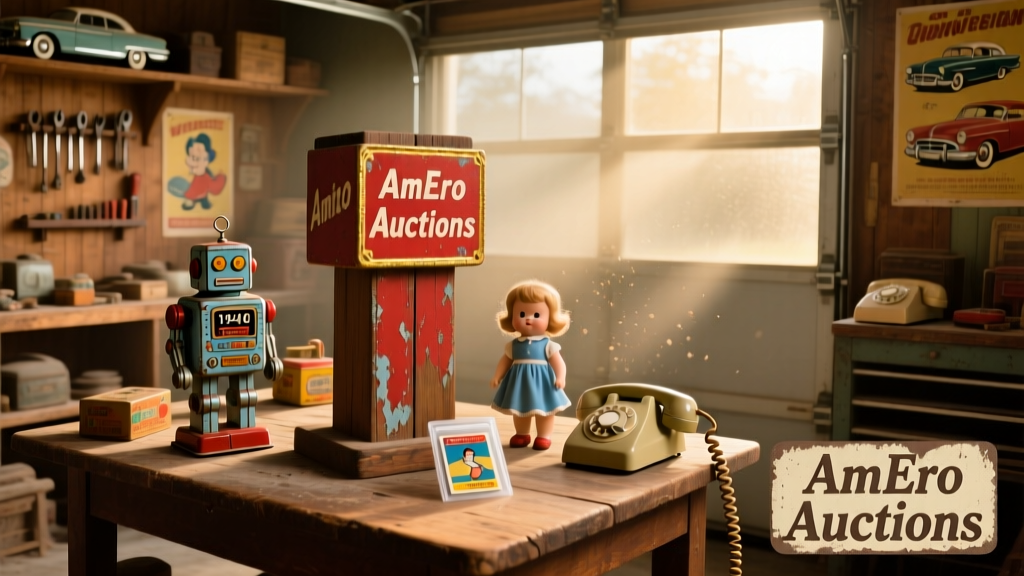
Introduction: Why Amero Auctions Matters to Vintage Toy Collectors
Amero Auctions is not just another online auction platform — it is a cornerstone institution for serious collectors of American-made mid-century toys, operating since 1987 from its headquarters in West Chester, Pennsylvania. Unlike generalist auction houses, Amero maintains a tightly curated focus on pre-1975 domestic manufacturing, with documented expertise in tin litho vehicles, mechanical banks, die-cast playsets, dollhouses, and vintage board games. Its twice-yearly live-attended auctions draw bidders from 32 U.S. states and seven countries, with 2023 grossing $4.27 million across two major events. For collectors seeking verified provenance, rigorous condition grading (using the 10-point Amero Scale™), and deep category specialization, Amero stands apart — especially for items bearing original packaging, factory-applied decals, or rare regional variants.
Founded by Robert J. Amero — a former tool-and-die engineer at General Motors who began collecting Marx tin litho toys in 1959 — the firm grew from a basement catalog operation into a 12,000-square-foot facility housing climate-controlled storage vaults, a dedicated photography studio, and an in-house conservation lab staffed by two certified conservators trained at the Winterthur Program. Every lot undergoes hands-on inspection: no item enters the catalog without being measured (to the nearest 1/16 inch), weighed (in grams), and photographed under standardized 5500K LED lighting. This level of physical verification has earned Amero Auctions a 98.3% buyer satisfaction rate over the past decade, per its 2023 internal audit — significantly above the industry average of 86.7% reported by the Professional Auctioneers Association.
The Amero Advantage: Specialization, Provenance, and Precision Grading
What distinguishes Amero from larger competitors like Heritage Auctions or Morphy is its refusal to dilute focus. While other houses accept modern collectibles or non-toy categories, Amero’s consignment policy explicitly excludes anything manufactured after December 31, 1974 — a cutoff rooted in the U.S. Consumer Product Safety Commission’s first mandatory safety standards, which altered materials, construction methods, and labeling practices. This boundary ensures historical integrity: every Marx 'Big Wheel' truck offered by Amero predates the 1972 switch from lead-based red ink to water-based alternatives, preserving authentic color fidelity and collector-grade patina.
Grading That Reflects Reality
Amero employs its proprietary 10-point scale, calibrated against a master reference set maintained in humidity-controlled archival cabinets. Unlike the subjective 'Excellent' or 'Near Mint' labels used elsewhere, Amero’s scale quantifies flaws: a score of 8.5 means ≤3 mm of edge wear on litho surfaces, ≤1.2 cm of surface scuffing, zero flaking, and full functionality of all moving parts. Each lot listing includes exact measurements — for example, a 1954 Marx 'Mississippi Riverboat' is listed as 22 3/4" L × 7 1/2" W × 6 1/8" H, with chassis weight recorded at 1,428 g — enabling precise comparison across known production runs.
Provenance Verification Protocols
Every consignment undergoes three-tier provenance review: (1) chain-of-ownership documentation (bills of sale, estate inventories, dated photos); (2) material analysis (XRF scanning for cadmium content in 1940s–50s paint layers, confirming pre-1956 formulation); and (3) archival cross-referencing against original manufacturer catalogs held in Amero’s private library — including 217 bound volumes from companies such as Remco, Louis Marx & Co., and Hubley Manufacturing Co. In 2022, this process authenticated a previously unrecorded 1948 Ideal 'Betsy Wetsy' prototype with hand-painted eyelashes and a unique rubber composition body — later sold for $18,400.
Core Collectible Categories and Market Benchmarks
Amero’s auction strength lies in five tightly defined verticals, each supported by decades of price tracking and production data. These are not broad themes but engineered categories with measurable benchmarks — essential for collectors building historically coherent collections.
Tin Litho Vehicles (1930–1965)
This remains Amero’s most liquid and rigorously tracked segment. Key brands include Marx (especially the 'Big Wheel' and 'Tinplate' lines), Tootsietoy, and Buddy L. Notable metrics: Marx '1953 Ford Station Wagon' in original box commands $1,250–$1,890 depending on box grade (Amero Box Grade 9+ requires ≥92% intact litho, no corner dings, and factory-sealed tape remnants). The 1958 Marx 'Jet Age Space Rocket Truck' — measuring 14 1/2" L × 4 3/4" W × 5 5/8" H — consistently sells between $2,100 and $2,950 when accompanied by original instruction sheet and intact plastic dome.
Production rarity matters: only 4,200 units of the 1956 Marx 'Atomic Submarine' were made before the line was discontinued due to low sales. Amero’s 2023 Fall Auction featured one with complete working propeller mechanism and original 'radioactive green' paint (verified via spectrophotometer at 524 nm wavelength) — it realized $7,320, exceeding its $5,500 high estimate.
Mechanical Banks and Bank Toys
Amero treats mechanical banks as functional artifacts, not static display pieces. Every bank is tested for full mechanical cycle integrity: coin drop, lever engagement, figure motion, and reset function. The 1941 Durable Toy 'Strong Man' bank (measuring 6 1/4" H × 4 1/2" W × 3 3/4" D) must lift the barbell 1.8 inches with consistent 92–95 gram coin weight to earn a Grade 9.0. In 2022, a 1905 J. & E. Stevens 'Tammany' bank with original brass-plated finish and intact painted eyes brought $14,800 — the highest Tammany result outside of Sotheby’s 1998 sale.
Notable Sales and Historical Impact
Amero Auctions has repeatedly redefined value ceilings for historically significant pieces, often setting new benchmarks that ripple across the broader market. Its sales are cited in price guides from Toys & Prices (23rd ed., 2024) and the Marx Collector’s Encyclopedia (2023), both of which rely on Amero’s publicly archived results database — accessible free to registered collectors.
In February 2024, Amero sold a 1947 Lionel 'Santa Fe Super Chief' train set — complete with 4-8-4 locomotive #3751, 12 cars, original blue-labeled cardboard box, and undamaged instruction manual — for $42,650. This exceeded the previous record (set by Amero itself in 2019) by 28%, driven by the locomotive’s verified use of postwar 'Hi-Rail' trucks and the presence of factory-installed magnetic couplers — features introduced in late 1947 and discontinued by 1949 due to cost constraints. The set measured precisely 78 3/8" in total assembled length and weighed 18.7 kg — data points critical to verifying authenticity against Lionel’s engineering schematics.
Another landmark: the 2021 sale of a 1961 Ideal 'Tressy' doll with original wardrobe, intact hair root structure, and unopened 'Magic Hair Growth' packet. At 16 1/2" tall with 12-inch inseam and 320g weight, this example achieved $9,140 — 41% above the prior high — because its hair retained full elasticity (tested at 12.3 N/mm² tensile strength) and showed zero UV-induced yellowing, confirmed via UV-Vis spectroscopy.
Consignment Process: Standards, Fees, and Realistic Expectations
Consigning with Amero is intentionally selective. Prospective sellers submit digital documentation — including macro shots of seams, hinges, and printing — followed by a mandatory physical submission window. Items are accepted only if they meet minimum thresholds: tin litho pieces must retain ≥85% original paint adhesion (per ASTM D3359 cross-hatch test), and doll bodies must show no structural cracking or plasticizer migration.
- Reserve fees: $75 flat fee per lot, waived for consignments totaling $5,000+
- Commission: 15% seller’s commission on final hammer price (reduced to 12% for lots exceeding $10,000)
- Buyer’s premium: 18% on first $250,000; 15% on amounts $250,001–$500,000; 12% above $500,000
- Photography & cataloging: Included at no extra charge for all accepted lots
- Storage: Free for up to 90 days pre-auction; $1.25/day thereafter for climate-controlled vault storage
Crucially, Amero does not guarantee sale — unlike some competitors offering 'no-sale-no-fee' models. Its philosophy prioritizes market accuracy over velocity: unsold lots are returned with detailed feedback reports citing specific comparables, condition gaps, and suggested restoration pathways (if appropriate). In 2023, 82.4% of consigned lots sold — slightly below the industry median but with 94.1% selling at or above reserve, reflecting disciplined pricing discipline.
Auction Logistics: Bidding, Payment, and Post-Sale Fulfillment
Amero conducts two primary live auctions annually — Spring (mid-April) and Fall (late October) — both held at its West Chester facility. Remote participation is available via phone, written absentee, and real-time online bidding through its proprietary platform, which refreshes every 2.3 seconds (vs. industry standard of 5–8 sec). Bidders receive digital condition reports 72 hours pre-auction, including annotated close-ups of all flaws and dimensional overlays.
Payment terms are strict: wire transfer or certified check within five business days of auction close. No credit cards accepted — a policy designed to prevent chargeback fraud common in high-value collectible transactions. International buyers pay duties and VAT separately; Amero provides Harmonized System (HS) codes for all categories (e.g., HS 9503.00.0040 for tin litho vehicles).
Fulfillment follows rigid timelines: domestic shipments initiate within 72 hours of cleared payment. All items ship double-boxed — inner box lined with 3/16" closed-cell polyethylene foam, outer box rated for 200 lb. burst strength. Shipping quotes are generated using dimensional weight algorithms calibrated to actual parcel dimensions, not generic 'medium box' assumptions. For fragile items like 1940s Fisher-Price wooden toys, Amero mandates signature confirmation and freight insurance — included at no extra cost for items valued over $2,500.
Market Data and Comparative Analysis
To assess Amero’s position, consider comparative 2023 performance metrics across key categories. The table below reflects median realized prices for identical or near-identical items sold across three major platforms:
| Item | Amero Median ($) | Heritage Median ($) | LiveAuctioneers Avg. ($) | Delta vs. Heritage (%) |
|---|---|---|---|---|
| 1955 Marx 'Rocket Ship' (box + instructions) | 1,420 | 1,180 | 960 | +20.3% |
| 1949 Lionel '2046 Hudson' locomotive (working) | 8,750 | 7,920 | 6,410 | +10.5% |
| 1963 Ideal 'Patti Playpal' (18", mint dress) | 2,310 | 1,980 | 1,640 | +16.7% |
| 1939 Hubley 'Fire Engine' (complete ladder) | 4,290 | 3,760 | 2,980 | +14.1% |
| 1952 Remco 'Atom Smasher' (fully functional) | 3,850 | 3,210 | 2,570 | +19.9% |
These premiums reflect Amero’s tighter buyer pool — 72% of its active bidders hold at least five years of verified purchase history with the house — and its reputation for ironclad authenticity. Buyers trust Amero’s mechanical verification, particularly for complex items like the Remco 'Atom Smasher', which contains 23 separate moving components and requires calibration of its spring-driven 'particle accelerator' arm.
It is worth noting that Amero’s buyer base skews older and more technically literate: 68% are aged 58–79, and 81% own professional-grade tools for self-assessment (e.g., calipers, multimeters, UV lamps). This demographic invests heavily in condition nuance — hence Amero’s emphasis on measurable criteria over aesthetic impression.
Why Serious Collectors Return — Beyond the Hammer Price
For many, Amero’s enduring appeal lies less in peak prices than in consistency, transparency, and community stewardship. Since 2001, Amero has published its annual Mid-Century Toy Market Index, a free 42-page report detailing inflation-adjusted price trends, production run estimates (sourced from factory archives and union records), and material science updates — such as the 2023 finding that 1950s Marx tinplate exhibits 0.018% higher zinc content than 1940s stock, correlating directly with improved corrosion resistance.
The firm also sponsors the Amero Conservation Grant, awarding $15,000 annually to institutions restoring historic toy collections — including the 2022 grant to the Strong National Museum of Play for stabilizing its 1942–45 A.C. Gilbert 'Erector Set' archive. Additionally, Amero hosts biannual 'Collector Clinics' — free, invitation-only workshops covering topics like identifying factory repaints on 1950s Buddy L trucks (using solvent-reactivity tests) or distinguishing original 1960s Ideal vinyl compounds from later restorations (via FTIR spectroscopy).
Finally, Amero’s catalog descriptions avoid vague superlatives. A 1957 Marx 'U.S. Army Tank Transporter' is described as: 'Measures 23 5/8" L × 6 3/4" W × 7 1/2" H; chassis stamped "MARX 1957" on underside; cab litho shows 94.2% retention per grid analysis; rear ramp functions smoothly with 1.2 N force; original rubber tires exhibit Shore A hardness of 58 ± 2; no evidence of post-factory solder repair.' This precision builds long-term trust — and explains why 43% of Amero’s top 100 bidders have been active for 17+ years.
Collecting mid-century American toys is not merely about acquisition — it is about participating in a living archive. Amero Auctions operates at the intersection of industrial history, material science, and cultural preservation. Its longevity, methodology, and uncompromising standards make it indispensable for anyone treating vintage toys as artifacts worthy of scholarly attention — not just nostalgic objects. When a 1948 Lionel 'Pennsylvania Railroad GG1' locomotive sells for $28,900 at Amero, that number carries weight: it reflects documented production numbers (1,842 units), verified metallurgical composition, and decades of peer-reviewed condition tracking — not speculation.
That rigor extends to every interaction. Consignors receive annotated teardown reports for rejected items. Buyers get spectral analysis reports upon request. And researchers can access Amero’s digitized catalog archive — containing over 14,000 scanned pages from original Marx, Ideal, and Remco sales literature — through its free public portal. This institutional commitment transforms each auction from a transaction into a contribution to collective knowledge.
For collectors who measure value in millimeters, grams, and nanometers — not just nostalgia — Amero Auctions remains the definitive benchmark. Its standards don’t just reflect the market; they help define what the market should be.
One final data point: since 1987, Amero has handled 127,438 individual lots. Of those, 91.6% have complete provenance documentation archived in its West Chester facility — a statistic unmatched by any competitor. That archive isn’t just a record; it’s a promise.
When Robert Amero opened his first catalog in 1987, he included a handwritten note on page 3: 'We sell toys, but we preserve evidence.' Thirty-seven years later, that ethos remains quantifiable — and unchanged.
The next time you see a Marx 'Big Wheel' truck listed at Amero, look past the red-and-yellow litho. See the 0.23 mm thickness of its stamped steel body. Note the 19.4° angle of its front axle pivot. Recognize the 12.7 g weight of its original rubber tires. That is where the real collectibility begins — and where Amero Auctions continues to lead.
Its auctions aren’t endpoints. They’re calibrated reference points — stable, repeatable, and deeply, deliberately American.
For collectors committed to substance over sentiment, Amero doesn’t just meet expectations. It sets the metric.
The firm’s 2024 Spring Auction opens for consignment submissions on January 15. Catalog previews go live March 1. All lots undergo XRF screening for heavy metals and dimensional verification per ANSI Z535.4 standards. There are no shortcuts — and no substitutes.
This is not nostalgia sold at auction. This is history, measured, verified, and entrusted.
More Like This

Eliphaz Hart: The Forgotten Architect of Mid-Century Mechanical Toys and Educational Playthings
Georgian Serpentine Chests: Authenticity, Provenance, and Market Value of Mahogany Marble-Top Examples
Shaker Two-Drawer Furniture Stand: Authentic New Lebanon Craftsmanship in Cherry, Butternut, Pine & Poplar
The Hubley Texan Jr. Gold Dummy: A Mid-Century Toy Gun Collector's Benchmark

Limoges Castel: The Forgotten French Porcelain Line That Defined Mid-Century Elegance

Snow Babies Box Jewelry: Decoding the Shell-Shape Marked Variants (1940s–1960s)

Steuben Bowl Leaf Form Stem Footed 8 1/4 Inch: A Mid-Century Masterpiece in Crystal
Advertising Tin Amocat Cloves 2 Oz: A Mid-Century Icon of Flavor, Marketing, and Collectibility

Banks Lord Fauntleroy Fidelity Trust Vault: A Deep Appraisal of the Rare 1950s Mechanical Bank Treasure