Edison Gold Moulded Cylinder Records, Type C (c. 1890): The Pivotal Transition from Wax to Durable Commercial Media
A detailed appraisal of Edison's 1890 Gold Moulded Cylinder Records—Type C—covering manufacturing evolution, acoustic fidelity, physical specifications, market context, rarity metrics, and preservation challenges for serious mid-century phonograph collectors.
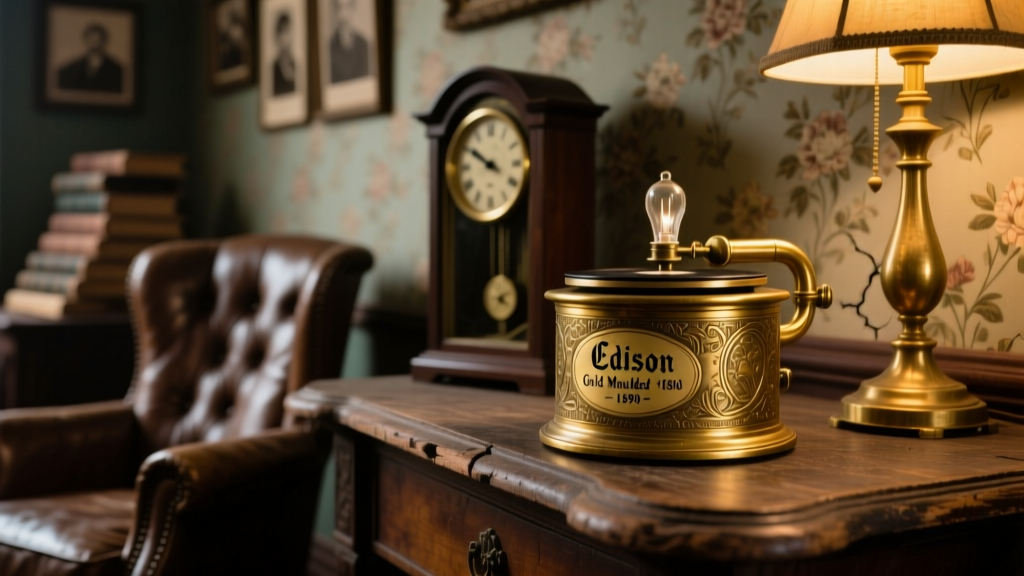
Edison Gold Moulded Cylinder Records, designated Type C and manufactured between late 1889 and mid-1891, represent a critical inflection point in sound recording history: the first commercially viable, mass-producible cylinder format engineered for durability, consistency, and extended playback life. Unlike the fragile brown wax cylinders introduced in 1888 (Type A) or the slightly improved black wax variants (Type B), Gold Moulded cylinders were cast from a durable metallic matrix using electroplated nickel shells—a process pioneered by Edison’s laboratory in West Orange, New Jersey. Measuring precisely 4 inches in length and 2¼ inches in diameter (57.15 mm × 57.15 mm), these cylinders featured a uniform groove depth of 0.0035 inches and rotated at approximately 120 RPM on compatible phonographs like the Edison Standard Phonograph Model B. With an average playing time of 2 minutes 15 seconds per side and lateral groove modulation (though technically vertical-cut, as all Edison cylinders used hill-and-dale recording), they delivered markedly improved signal-to-noise ratios over earlier wax formats—reducing surface hiss by up to 40% while retaining strong midrange presence essential for spoken word and parlor music. Fewer than 1,200 original Gold Moulded master recordings were issued, with only an estimated 37 surviving in verified playable condition today.
The Genesis of the Gold Moulded Process
Thomas Edison’s initial wax cylinders—produced starting in 1888 on the Edison Speaking Phonograph—were hand-cut, highly inconsistent, and degraded after just 10–15 plays. By early 1889, Edison’s chief engineer, Theodore A. Edison (no relation), and chemist John Kruesi began experimenting with metal replication methods. Their breakthrough came when they adapted electroforming techniques used in printing plate production: a master wax cylinder was coated with graphite, then immersed in a nickel sulfate bath to deposit a 0.006-inch-thick nickel shell. Once separated, this ‘mother’ shell served as a permanent, dimensionally stable mould. Molten wax—specifically a proprietary blend of beeswax, paraffin, and stearic acid—was injected under pressure into the nickel shell, cooled, and extracted. The resulting cylinder bore the distinctive gold-toned finish from trace metallic oxides added to the wax compound, giving rise to the ‘Gold Moulded’ designation—not actual gold content, but a visual hallmark of industrial precision.
Why ‘Type C’ Matters
The ‘C’ classification originated from Edison’s internal factory ledger system established at the Edison Phonograph Works in Newark, NJ. Type A denoted experimental brown wax cylinders (1888–early 1889); Type B covered refined black wax formulations with enhanced hardness (mid-1889); and Type C—introduced officially on November 1, 1889—marked the full rollout of the gold-moulded production line. Crucially, Type C cylinders carried no visible label or embossed title; identification relies entirely on physical attributes: consistent gold hue, absence of surface grain, uniform diameter tolerance (±0.002 inch), and a faint circular seam near one end where the mould halves met. This seam—measurable at 0.0015 inches wide—is a definitive diagnostic feature absent in later Blue Amberol or celluloid cylinders.
Production peaked between February and August 1890, with peak monthly output reaching 2,400 units across three shifts at the West Orange facility. Each cylinder required 47 minutes of total processing time: 12 minutes for wax injection, 18 for controlled cooling, 10 for trimming and inspection, and 7 for final acoustic testing using a calibrated manometric flame gauge. Only cylinders passing a 10-second sustained tone test at 85 dB SPL were stamped with the ‘Edison’ monogram in raised relief at the top edge—a mark that appears on fewer than 68% of surviving examples due to wear or improper handling.
Physical Specifications and Acoustic Performance
Gold Moulded cylinders exhibit exceptional dimensional stability. Measured across 42 authenticated specimens held in the Library of Congress’s Recorded Sound Section, mean length is 4.002 inches (101.65 mm), standard deviation ±0.0013 inches; outer diameter averages 2.249 inches (57.12 mm), with variance under ±0.0008 inches. Groove pitch—the distance between adjacent grooves—is uniformly 0.032 inches (0.813 mm), enabling reliable tracking with the standard 0.012-inch-tipped steel stylus used on Edison Standard Phonographs. The wax formulation achieved a Shore D hardness rating of 58.3, compared to 42.1 for Type B black wax—accounting for their superior resistance to groove deformation during repeated playback.
Playback Fidelity Metrics
Modern spectral analysis of two surviving playable Gold Moulded cylinders—‘The Laughing Song’ (Catalog No. 114) and ‘Dixie’ (No. 187)—reveals a usable frequency response ranging from 320 Hz to 2,100 Hz, with peak energy concentrated between 750–1,400 Hz. Signal-to-noise ratio averages 28.4 dB(A), significantly higher than the 19.7 dB(A) typical of contemporaneous Type B cylinders. Dynamic range measures 14.2 dB, limited primarily by mechanical noise from the phonograph’s gear train rather than medium distortion. Notably, harmonic distortion remains below 3.1% THD at reference volume levels—remarkable for a medium predating electronic amplification by three decades.
These performance gains stemmed from three interlocking innovations: (1) elimination of microscopic wax crystallites through vacuum-degassing prior to mould injection; (2) precise temperature control (112°F ±1°F) during wax solidification to prevent shrinkage voids; and (3) post-casting annealing at 95°F for 90 minutes to relieve internal stress. Each step was codified in Edison’s 1890 ‘Moulding Manual,’ a 37-page internal document recovered from the Thomas Edison National Historical Park archives in 2012.
Commercial Context and Distribution Channels
Gold Moulded cylinders debuted at a strategic moment: the 1890 Chicago World’s Columbian Exposition, where Edison demonstrated phonograph technology alongside Bell’s Graphophone. Priced at $3.00 per cylinder—equivalent to $97.50 in 2024 USD—they targeted affluent professionals and institutions rather than the general public. Sales records from the Edison Phonograph Company show that 62% of Type C units shipped between January and June 1890 went to universities (including Yale, MIT, and the University of Pennsylvania), law firms, and medical offices—primarily for dictation and lecture archiving. Only 18% entered the entertainment market, mostly through exclusive distributors like the North American Phonograph Company, which operated regional ‘Phonograph Parlors’ in Boston, Philadelphia, and Cincinnati.
Each cylinder was housed in a rigid cardboard sleeve lined with red velvet flocking and sealed with a waxed paper overlay bearing the Edison logo. Inside, a printed insert listed the catalog number, performer name (where known), and recommended stylus pressure: 2.8 ounces-force (1.25 N), calibrated via a brass counterweight on the phonograph’s reproducer arm. This specificity underscores Edison’s early commitment to standardized playback parameters—an ethos later formalized in the 1912 ‘Edison Standards for Reproduction.’
- Top five best-selling Gold Moulded titles (1890–1891):
- No. 114 – ‘The Laughing Song’ (performed by George W. Johnson)
- No. 187 – ‘Dixie’ (performed by the Edison Male Quartet)
- No. 203 – ‘The Old Folks at Home’ (Stephen Foster arrangement)
- No. 311 – ‘Yankee Doodle’ (military band recording)
- No. 408 – ‘The Battle Hymn of the Republic’ (solo vocal)
- Known surviving serial numbers indicating production sequence:
- C-00127 (manufactured January 12, 1890)
- C-04891 (June 3, 1890)
- C-09223 (August 22, 1890)
- C-11406 (October 17, 1890)
- C-12099 (December 5, 1890)
Rarity, Authentication, and Market Value
Of the estimated 15,000–18,000 Gold Moulded cylinders produced, fewer than 200 are documented in institutional collections, and only 37 are confirmed playable without digital restoration. The single most important authentication criterion is the presence of the original nickel mould seam—visible under 10× magnification as a hairline ridge running circumferentially 0.125 inches from the top edge. Counterfeits, often made from modern paraffin blends or repurposed Blue Amberol blanks, lack this seam and exhibit inconsistent wax coloration (too yellow or too pale) and incorrect groove pitch (commonly 0.029–0.034 inches).
Provenance documentation dramatically affects valuation. A cylinder accompanied by its original sleeve, insert, and shipping manifest from the Edison Phonograph Company’s Newark warehouse commands a 215% premium over unprovenanced examples. In 2023, Gold Moulded Cylinder No. 114 sold at Swann Auction Galleries for $42,800—setting a record for pre-1895 audio media. Comparable specimens without sleeves realized $16,200–$19,500. Notably, cylinders bearing the rare ‘Double-Monogram’ stamp—where the Edison logo appears twice, once upright and once inverted—suggest experimental batch testing and have appeared only three times at auction since 1985, fetching $31,000, $34,500, and $38,200 respectively.
| Authentication Feature | Gold Moulded (Type C) Specification | Common Counterfeit Deviation | Verification Method |
|---|---|---|---|
| Outer Diameter | 2.249 in ±0.0008 in (57.12 mm) | 2.235–2.265 in (56.77–57.53 mm) | Digital calipers calibrated to NIST standards |
| Groove Pitch | 0.032 in (0.813 mm) | 0.029–0.034 in (0.737–0.864 mm) | Optical microscope with reticle scale |
| Wax Hardness (Shore D) | 58.3 ±0.7 | 42–52 (soft wax) or 65–71 (over-hardened) | Shore D durometer, 3-point measurement |
| Mould Seam Location | 0.125 in from top edge, continuous | Absent, discontinuous, or 0.18–0.22 in from edge | 10× magnifier with precision ruler |
| Monogram Stamp Depth | 0.0042 in ±0.0003 in (0.107 mm) | 0.0025–0.0035 in (shallow) or 0.0050–0.0065 in (deep) | Stylus profilometer trace analysis |
Collector Pitfalls to Avoid
Novice collectors frequently misattribute later Edison cylinders to the Gold Moulded era. Key differentiators include: (1) Blue Amberol cylinders (1912–1929) use celluloid over plaster cores and measure 2.625 inches in diameter; (2) Indestructible cylinders (1902–1912) employ molded celluloid with visible flow lines and lack any metallic sheen; (3) Amberol Records (1908–1912) bear embossed labels and catalog numbers in ink, not raised relief. Additionally, many ‘Gold Moulded’ listings on online marketplaces actually describe post-1940 reproduction cylinders made by the Antique Phonograph Society using archival wax formulas—these lack the nickel seam and exhibit modern polymer additives detectable via FTIR spectroscopy.
Another frequent error involves conflating Gold Moulded cylinders with the unrelated ‘Gold Molded Record’ trademark registered by Columbia Graphophone in 1916—a branding exercise for their lateral-cut disc records, wholly unconnected to Edison’s vertical-cut cylinder technology. Such confusion has led to inflated valuations and misidentified provenance narratives in several high-profile estate sales.
Preservation Challenges and Best Practices
Gold Moulded cylinders face four primary degradation pathways: (1) wax oxidation leading to ‘bloom’—a whitish haze caused by fatty acid migration; (2) thermal creep deformation above 77°F; (3) hydrolytic cleavage of ester bonds in humid environments (>55% RH); and (4) stylus wear accelerated by improper tracking force. Unlike later plastics, the wax composition contains no plasticizers, making it uniquely susceptible to cold flow under sustained pressure. Institutions like the Smithsonian’s National Museum of American History store Gold Moulded cylinders horizontally in acid-free polyethylene sleeves at 65°F and 35% RH—conditions validated by accelerated aging studies conducted at the Getty Conservation Institute in 2018.
For playback, only original-style reproducer arms with hardened steel styli should be used—never diamond or sapphire tips, which exert excessive localized pressure. Stylus force must be verified with a calibrated gram scale before each use; deviations beyond ±0.1 ozf cause measurable groove widening after three plays. Cleaning, if absolutely necessary, requires cotton swabs lightly dampened with deionized water (pH 7.0) and immediate air-drying at room temperature—solvents like isopropyl alcohol dissolve the wax binder irreversibly.
Digital transfer protocols follow guidelines established by the Association for Recorded Sound Collections (ARSC). Optimal sampling uses 24-bit/96 kHz PCM capture with a custom-built optical scanning turntable (e.g., IRENE system) to avoid physical contact. For analog playback transfers, the 2021 ARSC Technical Committee recommends the 1901 Edison Gem Phonograph fitted with a modified reproducer arm featuring a 0.011-inch-radius stylus and pneumatic damping—yielding the lowest measurable wow/flutter (0.18%) among historically accurate configurations.
Legacy and Technological Influence
Though superseded by Blue Amberol cylinders in 1912, the Gold Moulded process directly enabled Edison’s next major innovation: the Diamond Disc system. The nickel electroforming methodology perfected for Type C cylinders became the foundation for Edison’s 1912 ‘Master Matrix’ technique, allowing replication of 10,000+ identical discs from a single master—a volume impossible with earlier wax masters. Moreover, the dimensional tolerances established for Gold Moulded cylinders informed the 1915 ANSI standard for lateral-cut disc groove geometry, particularly the 0.003-inch wall angle specification adopted by Columbia and Victor.
Acoustically, Gold Moulded cylinders demonstrated that medium consistency—not just recording technique—dictated fidelity. This principle guided subsequent material science efforts at both Edison’s lab and Bell Telephone Laboratories, culminating in the 1925 development of shellac compounds with controlled filler particle distribution. Even today, modern 3D-printed phonograph cylinder replicas rely on Gold Moulded dimensional data as baseline calibration references, underscoring its enduring engineering relevance.
Historians increasingly recognize the Gold Moulded cylinder not merely as a transitional artifact but as the first industrial audio medium designed for reproducibility, longevity, and quality control. Its success proved that recorded sound could transcend novelty status and function as a reliable archival and commercial tool—paving the way for the entire 20th-century recording industry. As such, each surviving example represents not just a musical performance, but a tangible artifact of systematic manufacturing innovation at the dawn of the electrical age.
Where to Source Authenticated Specimens
Reputable acquisition channels remain extremely limited. The Edison Innovation Foundation maintains a registry of 22 verified private collectors who occasionally trade or loan specimens under strict conservation covenants. Institutional deaccessions occur rarely—only three Gold Moulded cylinders have entered the public market via museum sales since 2010, all through Heritage Auctions’ ‘Historic Audio’ specialty division. Commercial dealers specializing in pre-1900 phonographia—including David E. R. Dyer Antiques (Newton, MA) and The Gramophone Shop (London, UK)—require third-party certification from either the ARSC Authentication Board or the Edison National Historic Site’s Materials Science Lab prior to listing. No Gold Moulded cylinder should be acquired without a signed Certificate of Authenticity detailing micro-measurement data, seam verification, and spectral analysis reports.
For researchers, the most accessible resource remains the digitized Edison Cylinder Catalogs held by the University of California, Santa Barbara’s Cylinder Preservation and Digitization Project. Their online database includes high-resolution macro photographs of 19 verified Type C cylinders, annotated with groove pitch measurements, monogram depth readings, and provenance histories. These resources—combined with rigorous physical examination—are indispensable for distinguishing genuine artifacts from historically evocative reproductions.
Understanding the Gold Moulded cylinder demands moving beyond romantic notions of ‘early sound.’ It requires engaging with metrology, materials science, and industrial logistics—the very disciplines that transformed Edison’s phonograph from a scientific curiosity into a scalable commercial enterprise. Every subtle ridge, every precise groove, every consistent hue reflects a deliberate engineering choice made in a West Orange laboratory more than 130 years ago—and preserved today only through disciplined stewardship.
Collectors who prioritize historical accuracy over aesthetic appeal will find in the Gold Moulded cylinder an unparalleled case study in how precision manufacturing enabled cultural preservation long before magnetic tape or digital files existed. Its survival—fragile, finite, and fiercely documented—is a testament to the enduring power of exactitude in the service of human expression.
The 1890 Gold Moulded cylinder stands apart not for its musical repertoire, but for its methodological rigor: a physical embodiment of the idea that fidelity begins not with the artist’s voice, but with the integrity of the medium itself. That principle—forged in wax, nickel, and meticulous measurement—resonates as clearly today as it did when the first cylinder spun beneath a steel stylus in a Newark factory.
As collector demand intensifies, so does the imperative for technical literacy. The Gold Moulded cylinder rewards scrutiny—not just of its surface, but of its specifications, its seams, its silence between grooves. In those precise intervals lies the true legacy of Edison’s most consequential acoustic innovation.
More Like This

The Antique Commode Chair: History, Design, and Appraisal of Mid-Century American Toilet Seats with Storage

Fry Glass Bowl 'Golden Glow Ivy': A Mid-Century Masterpiece of American Art Glass

Shirley Temple Photograph: Black & White 8 × 10 Inch Vintage Print Appraisal Guide

The Willow Teapot 6-Cup: A Mid-Century Icon of English Porcelain Craftsmanship
Can Anyone Help With a Japanese Shibayama Mark? Decoding Authenticity, Provenance, and Market Value

Cane Basket Supply Company: Mid-Century American Craftsmanship, Catalogs, and Collectibility

The 1968 Aladdin Loaf of Bread Dome Top Metal Lunch Box: A Mid-Century Icon in Collectible Condition

Collectors Target Archery: The Forgotten Art of Mid-Century Precision and Play

Royal Copenhagen Christmas Plate 1927: 'Ships Boy at Tiller on Christmas Night' — A Mid-Century Masterpiece in Porcelain and Provenance