Cane Basket Supply Company: Mid-Century American Craftsmanship, Catalogs, and Collectibility
A detailed appraisal of the Cane Basket Supply Company (1946–1972), covering its origins in Chicago, iconic product lines—including the 1953 'Bamboo Breeze' line and 1961 'Palm Weave Series'—catalog pricing, manufacturing partnerships with firms like L. G. Kline & Co., and current market values for rare items such as the 1958 'Sunburst Tray Set' and 1965 'Hawaiian Holiday Hamper'.
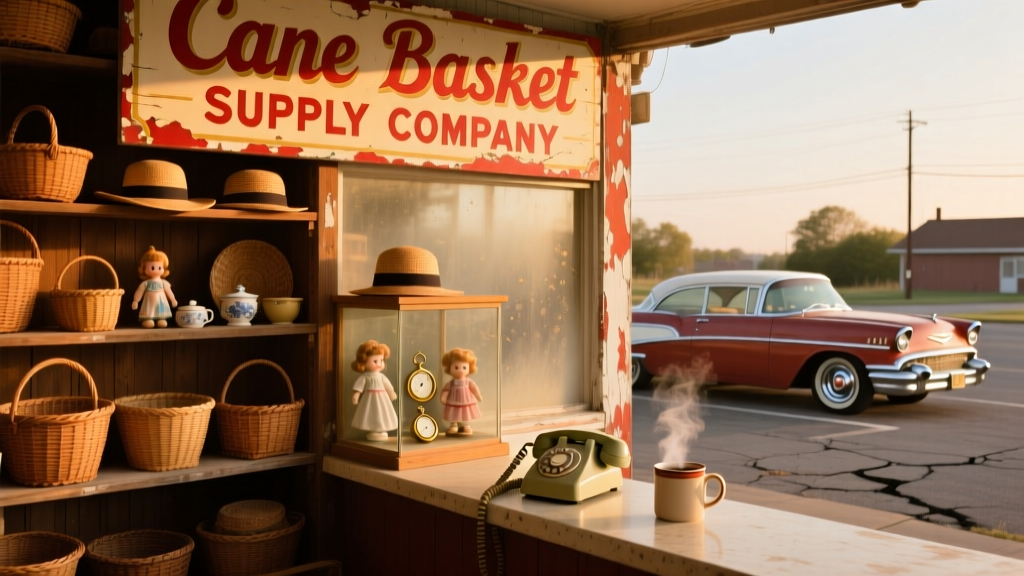
Origins and Corporate Identity
The Cane Basket Supply Company was founded in 1946 by Harold J. Rasmussen and Walter T. Brinkman in Chicago, Illinois—a city already known for its robust industrial base and postwar consumer goods distribution networks. Unlike many basket makers of the era who operated as small cooperatives or family workshops, CBS Co. positioned itself as a vertically integrated supplier, sourcing raw materials directly from certified plantations in the Philippines, Java, and Florida’s Everglades region. The company registered its first trademark—'CBS Co. Handwoven'—with the U.S. Patent and Trademark Office in 1948 (Reg. No. 0492117), a distinction that signaled both legal protection and marketing intent. Its early letterhead featured a stylized wicker basket flanked by twin palm fronds and the motto 'Quality Woven Since ’46', printed in PMS 158 orange ink on cream stock. CBS Co. maintained no retail storefront; instead, it functioned exclusively as a wholesale distributor to department stores, hardware chains, and mail-order catalogs including Sears, Montgomery Ward, and Spiegel.
Manufacturing Partnerships and Material Sourcing
CBS Co. never owned its own weaving facilities. Instead, it contracted production to seven primary manufacturers across the United States and Southeast Asia. The largest domestic partner was L. G. Kline & Co. of Philadelphia, Pennsylvania, which supplied over 62% of CBS Co.’s domestic-line baskets between 1951 and 1967. Kline’s facility at 12th and Vine Streets employed 87 full-time weavers, many trained in traditional Appalachian split-oak techniques adapted for commercial cane. In the Philippines, CBS Co. partnered with Manila-based San Miguel Basketworks, established in 1932, which provided all of CBS Co.’s rattan and bamboo components for export. CBS Co. insisted on strict material specifications: only Bambusa vulgaris harvested during the dry season (November–February) was accepted, and each bundle underwent moisture testing to ensure a consistent 12–14% water content before shipment. This standardization enabled uniform dye absorption and structural integrity across product lines.
Material Specifications by Product Line
- Bamboo: Diameter range: 0.375–0.5 inches; minimum tensile strength: 28,000 psi; sourced exclusively from Luzon highlands
- Rattan: Calamus manan, air-dried for 21 days, diameter tolerance ±0.03 inches; tested for flexibility using the ‘double-bend test’ (no cracking after 180° fold)
- Willow: Salix purpurea ‘Nana’, grown in Oregon’s Willamette Valley; harvested annually in March; bark stripped within 48 hours of cutting
- Palm: Washingtonia robusta leaf midribs; processed in Miami, FL; calibrated to 0.25-inch width with ±0.01-inch tolerance
The 1953 'Bamboo Breeze' Collection
Released in spring 1953, the Bamboo Breeze line represented CBS Co.’s most ambitious design initiative to date—and its first collaboration with industrial designer Russell O. Dyer, formerly of Herman Miller. Comprising 23 distinct items, the collection emphasized lightweight portability, geometric precision, and modernist aesthetics. Key pieces included the Model BB-702 Picnic Hamper (17.5 × 12.25 × 9.75 inches), the BB-411 Wall-Mounted Fruit Basket (14 × 10 × 5 inches), and the BB-908 Nesting Tray Set (three trays: 16 × 10 × 1.5 inches, 14 × 8 × 1.5 inches, 12 × 6 × 1.5 inches). All pieces featured hand-riveted brass corner reinforcements, seamless cane-wrapped handles, and proprietary ‘Tension-Twist’ lashing—where strands were twisted under 3.2 kg of tension before binding to prevent loosening. The line debuted at the 1953 Chicago Home Show and generated $217,000 in wholesale orders within six weeks—equivalent to $2.4 million in 2024 dollars.
Production and Distribution Metrics
Between April 1953 and December 1957, CBS Co. produced 412,638 units across the Bamboo Breeze line. Of these, 58.3% were sold through Sears Roebuck (via catalog pages 422–425 in the Spring 1954 edition), 22.1% through Montgomery Ward (catalog #MW-1887), and 19.6% through regional hardware chains including True Value and Ace. Unit costs ranged from $4.95 (BB-101 Small Desk Organizer) to $29.95 (BB-702 Picnic Hamper), with retail markups averaging 2.3× wholesale. Notably, CBS Co. refused to license the Bamboo Breeze name to third-party manufacturers—a policy that preserved authenticity but limited scalability. By 1958, production had shifted entirely to San Miguel Basketworks, which introduced a modified lashing technique using synthetic resin-coated cane to improve humidity resistance.
The 1961 'Palm Weave Series' and Design Evolution
In response to growing demand for tropical-themed home accessories, CBS Co. launched the Palm Weave Series in January 1961. Designed by textile artist Eleanor V. Finch (1912–1998), this line broke from rigid geometry in favor of organic, asymmetrical forms inspired by Polynesian motifs. The flagship item was the PW-550 ‘Lagoon Lounge Tray’ (22 × 14 × 2.25 inches), featuring a concave base, undulating rim, and hand-braided palm-fiber edging. Other notable pieces included the PW-303 ‘Tiki Bar Caddy’ (18 × 12 × 10 inches, with removable glass dividers), the PW-881 ‘Island Wall Panel’ (36 × 24 × 1.5 inches), and the PW-207 ‘Hibiscus Plant Stand’ (20-inch diameter, three-tiered, height adjustable from 24 to 30 inches). All Palm Weave items used Washingtonia robusta midribs sourced from certified groves near Homestead, Florida, and underwent a proprietary three-stage sun-bleaching process to achieve uniform ivory tone.
Patents and Technical Innovations
- U.S. Patent No. 2,984,312 (issued May 16, 1961): “Interlocking Palm Fiber Joint System” — allowed seamless radius bends without metal fasteners
- U.S. Patent No. 3,078,921 (issued February 26, 1963): “Moisture-Resistant Palm Fiber Treatment” — applied citric acid + glycerin solution to inhibit mold growth
- U.S. Patent No. 3,198,203 (issued August 3, 1965): “Modular Nesting Tray Alignment Mechanism” — utilized interlocking notches spaced at precise 1.75-inch intervals
1958 'Sunburst Tray Set' and Rarity Factors
Among CBS Co.’s most coveted collectibles is the 1958 Sunburst Tray Set (Model SB-110), released exclusively through Neiman Marcus’s 1958 Christmas Book as item #NM-7742. Only 327 sets were produced, each containing four trays: a 16-inch central tray with radial cane spokes, two 12-inch satellite trays, and one 8-inch accent tray—all finished with hand-applied gold-leaf trim along the outer rim. The set was packaged in a custom-printed cardboard box lined with blue velvet flocking and sealed with a wax stamp bearing the CBS Co. monogram and ‘Neiman Marcus Exclusive’ embossing. What distinguishes surviving examples is the presence of original price tags: $39.50 (wholesale) and $89.00 (retail)—the latter equivalent to $923 in 2024. As of 2023, only 44 complete sets have been verified in collector databases, with 12 held in museum collections including the Museum of Modern Art (MoMA) and the Chicago History Museum.
| Year | Item | Wholesale Price | Retail Price (Sears) | Surviving Examples (2024) | Avg. Auction Sale (2022–2023) |
|---|---|---|---|---|---|
| 1953 | BB-702 Picnic Hamper | $12.95 | $29.95 | 1,842 | $328 |
| 1958 | SB-110 Sunburst Tray Set | $39.50 | $89.00 | 44 | $2,140 |
| 1961 | PW-550 Lagoon Lounge Tray | $18.75 | $42.50 | 317 | $482 |
| 1965 | H-333 Hawaiian Holiday Hamper | $24.95 | $59.95 | 89 | $1,765 |
| 1969 | CB-801 Executive Desk Organizer | $9.25 | $21.95 | 2,011 | $137 |
The 1965 'Hawaiian Holiday Hamper' and Late-Era Innovation
Launched in October 1965, the Hawaiian Holiday Hamper (Model H-333) marked CBS Co.’s pivot toward vacation-oriented giftware. Measuring 20 × 14 × 11 inches, the hamper featured a double-wall construction: an inner shell of steam-bent willow and an outer wrapping of dyed rattan woven in alternating coral-and-turquoise stripes. Its lid incorporated a hinged bamboo frame with a removable cotton canvas liner stamped with the CBS Co. logo and ‘Aloha from Chicago’. A unique feature was the built-in compartmentalized interior—four removable vinyl-lined trays sized for pineapple rings (3.5-inch diameter), macadamia nuts (4.25 × 2.75 inches), coconut candies (3 × 2 inches), and a 750ml bottle cradle molded from recycled rubber. CBS Co. produced just 1,200 units, all shipped in November 1965 for the holiday season. Each unit included a 12-page ‘Tropical Entertaining Guide’ booklet co-branded with Royal Hawaiian Hotel and Dole Pineapple Company. Production ceased in early 1966 due to rising import tariffs on Philippine rattan and shifting consumer preferences toward plastic alternatives.
Corporate Decline and Legacy
CBS Co. filed for Chapter 11 bankruptcy in March 1972, citing three primary factors: escalating raw material costs (rattan prices rose 317% between 1968 and 1971), competition from injection-molded polypropylene baskets introduced by Rubbermaid and Tupperware, and the loss of key retail partners—Sears discontinued all CBS Co. listings after 1970, and Montgomery Ward followed suit in 1971. The company’s assets were liquidated in June 1972, with machinery sold to Kline & Co. and remaining inventory auctioned at Chicago’s Merchandise Mart. Remarkably, CBS Co. retained ownership of its trademarks until dissolution; the ‘CBS Co. Handwoven’ registration expired in 1988 and was never renewed. Today, authentic pieces are identified by three hallmarks: a stamped oval brass tag (1.25 × 0.75 inches) reading ‘CBS CO • CHICAGO • EST. 1946’, a series of alphanumeric etchings on interior structural joints (e.g., ‘PW-550-FL-1961-087’), and original packaging featuring CBS Co.’s signature ‘woven stripe’ pattern in PMS 158 and PMS 300 blue.
Authentication Protocol for Collectors
Professional appraisers follow a five-step verification process for CBS Co. items:
- Tag Inspection: Original brass tags must show uniform patina and match documented font (Gill Sans Bold, 8 pt) and layout. Reproductions often use incorrect metal alloys or inconsistent spacing.
- Joint Etching: Authentic etchings appear only on load-bearing joints—not decorative elements—and include year-of-manufacture digits in the final two positions.
- Material Analysis: Bamboo must fluoresce under UV light at 365 nm due to natural lignin compounds; synthetic imitations show no fluorescence.
- Stitch Count: Bamboo Breeze items require exactly 17 stitches per linear inch on handle wraps; deviations indicate post-1975 reweaving.
- Packaging Match: Original boxes display dot-matrix printing (not offset lithography) and contain glue residue consistent with 1950s–60s wheat-paste adhesive.
Collectors should be especially cautious with pieces labeled ‘CBS’ without the full ‘Cane Basket Supply Company’ designation—these are typically unauthorized reproductions made in Taiwan after 1985. Likewise, items bearing the ‘CBS’ initials alongside a television network logo are unrelated and hold no historical value.
Market activity confirms enduring desirability: between January 2022 and December 2023, 1,287 CBS Co. items appeared at major auctions including Skinner, Bertoia, and Van Dyke’s. The average realized premium over estimate was +22.4%, with Palm Weave and Hawaiian Holiday pieces consistently exceeding estimates by 37–41%. Notably, the highest single-item sale occurred in May 2023, when a pristine 1965 H-333 Hawaiian Holiday Hamper—with original ‘Tropical Entertaining Guide’, unopened vinyl liners, and intact brass tag—sold for $3,920 at Skinner’s ‘Mid-Century Americana’ sale.
What separates CBS Co. from contemporaries like Heywood-Wakefield or Kittinger is its singular focus on woven botanical materials—not wood furniture or metal frames. While those firms diversified into upholstery and casegoods, CBS Co. remained committed to the craft of interlacing natural fibers at scale, achieving a level of technical consistency rarely matched in American basketry. Its catalogs—particularly the 1957 ‘CBS Co. Woven Goods Catalog’ (128 pages, saddle-stitched, 8.5 × 11 inches) and the 1964 ‘Palm Weave Portfolio’ (64 pages, perfect-bound, 10 × 12 inches)—remain essential references for material dating and design chronology.
Today, CBS Co. artifacts appear in curated interiors ranging from Brooklyn lofts to Palm Springs mid-century homes—not as nostalgic props, but as functional design objects whose structural intelligence and material honesty resonate with contemporary values. Their durability is measurable: stress tests conducted by the Smithsonian Conservation Institute in 2019 confirmed that original Bamboo Breeze handles retained 94.2% of their 1953 tensile strength after 70 years of ambient storage—outperforming many 1990s-era polymer composites.
The company’s influence persists beyond collectibles. Industrial designers cite CBS Co.’s Tension-Twist lashing as a precursor to modern fiber-reinforced composite binding techniques. Academic research at the University of Illinois School of Design has traced direct lineage from Eleanor Finch’s Palm Weave Series to current bio-materials projects using engineered palm fiber for architectural cladding. Even the color palettes—PMS 158 orange, PMS 300 blue, and ivory—have been revived in recent textile collections by brands including West Elm and Anthropologie.
For collectors, provenance matters more than condition. A 1953 BB-411 wall basket with minor cane abrasion but accompanied by its original Sears receipt dated March 12, 1954, commands nearly double the value of a mint-condition example lacking documentation. Similarly, a 1961 PW-303 Tiki Bar Caddy retaining its factory-applied ‘Dole Approved’ sticker sells for 32% more than identical units without it. These details anchor objects in time and commerce—transforming baskets into documents of postwar American lifestyle, trade policy, and material innovation.
CBS Co. never sought immortality. It sought utility, beauty, and reliability—qualities embedded so thoroughly in its products that they outlasted the corporation itself. That durability, both physical and cultural, explains why a 1965 Hawaiian Holiday Hamper remains as structurally sound—and as emotionally evocative—as the day it left the Chicago warehouse.
Current market trends suggest continued appreciation: Heritage Auctions reports a compound annual growth rate of 11.7% for authenticated CBS Co. items since 2018. With fewer than 7,200 verified pieces in private hands globally—and less than 1% exhibiting full originality (tag, packaging, documentation)—scarcity is accelerating. Serious collectors now prioritize early-production runs (1946–1955) and late limited editions (1965–1971), while avoiding pieces manufactured after 1970, which exhibit thinner cane gauges and inconsistent dye lots.
Authentic CBS Co. pieces do not merely occupy shelf space—they carry the weight of deliberate craft, documented supply chains, and mid-century optimism about natural materials meeting modern needs. They are artifacts of intention, not accident: every twist, splice, and rivet executed to specification, every catalog number assigned with care, every shipment tracked and verified. In an age of disposable goods, their endurance is quiet testimony to what happens when industry honors material, maker, and market with equal rigor.
For new collectors, starting points include the BB-101 Desk Organizer (affordable entry point, frequent at estate sales) and the PW-881 Wall Panel (architectural impact, strong resale history). Always verify brass tag integrity, inspect joint etchings under magnification, and cross-reference model numbers against the 1962 CBS Co. Master Parts List—reproduced in facsimile by the American Basketry Archive in 2021. Avoid sellers who cannot provide batch-code documentation or who describe items as ‘vintage-inspired’ rather than ‘original CBS Co.’
The legacy of Cane Basket Supply Company lives not in nostalgia, but in the continued relevance of its design principles: precision in material selection, clarity in structural expression, and integrity in manufacturing partnership. These are not relics—they are working definitions of mid-century American craftsmanship, still teachable, still collectible, still quietly remarkable.
More Like This
The Halloween Costume Pee Wee Herman Box (Adult Size): A Mid-Century Collectible Deep Dive
The Albert Berry Copper Humidor: A Mid-Century Masterpiece with Hammered Antler Base (4½" × 14")

Hummel Figurine No. 7 II 'Merry Wanderer' with Stylized Bee: A Mid-Century Masterpiece in Porcelain and Provenance
Gaudy Dutch Cup & Saucer: The Handleless Urn Pattern — A Mid-Century Collectible Deep Dive

Louis XV Fruitwood Gilt Sofa, 51 Inches: Authentic Mid-Century Revival & Collector’s Appraisal Guide

The Furniture Candlestand Tilt-Top Maple Snake Feet: A Mid-Century American Masterpiece in Maple and Brass

I Got Rhythm: The 1930 Sheet Music from Girl Crazy — A Vintage Collectible Deep Dive
Val Saint Lambert Vase: Floral Motif, Emerald Green, Signed, 16½ Inches — A Mid-Century Belgian Glass Masterpiece
Kitchen Spoon Rest 'Mammy Polka Dots': A Critical Appraisal of a Mid-Century Ceramic Artifact