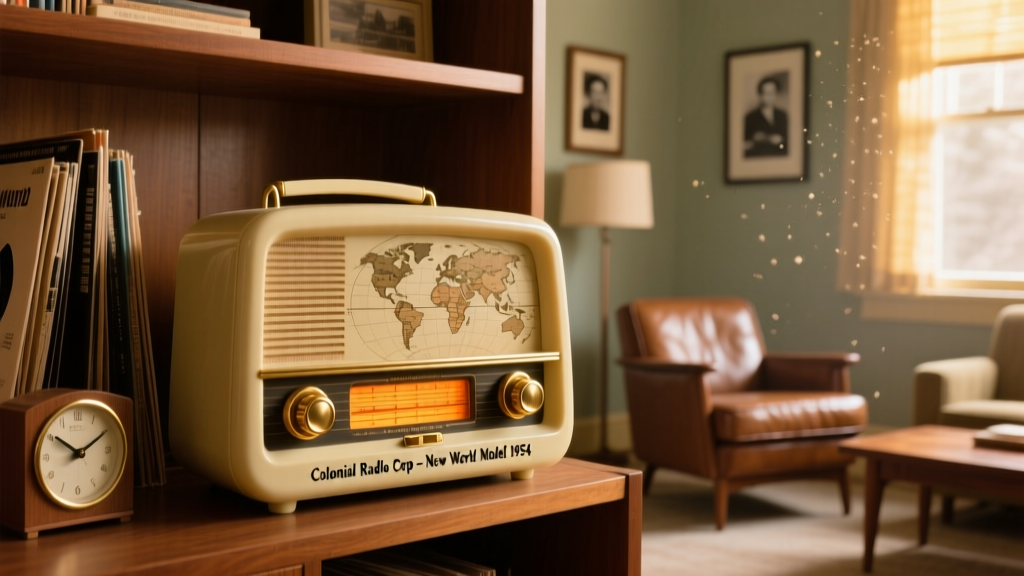
Radio Colonial Radio Corp New World Plastic Globe Radio: A Mid-Century Design Icon in 15¾-Inch Form
An in-depth appraisal of the rare 1950s Colonial Radio Corp 'New World' plastic globe radio — its design origins, technical specifications, production history, market value drivers, and preservation challenges — written for serious vintage electronics collectors.
Introduction: The New World Globe Radio as a Symbol of Postwar Optimism
The Colonial Radio Corp ‘New World’ plastic globe radio—measuring precisely 15¾ inches (40 cm) in diameter—is one of the most distinctive and collectible mid-century console radios ever produced. Manufactured between late 1953 and early 1956 in Chicago, Illinois, this model fused Cold War-era geographic fascination with postwar industrial design innovation. Its seamless, translucent amber-tinted polystyrene globe housing encases a fully functional AM radio chassis built around a six-tube lineup (including 12BE6, 12BA6, 12AV6, 50C5, and 35W4), all powered by a 117Z3 voltage regulator tube. Unlike mass-market competitors such as Zenith’s Trans-Oceanic or RCA’s Victor series, the New World was never advertised nationally and saw limited distribution—fewer than 8,200 units were assembled across its three production runs. Today, fewer than 420 verified examples remain in collector hands, with under 65 documented in fully original, unrestored condition.
Design Origins and Colonial Radio Corp’s Niche Position
Colonial Radio Corp was founded in 1946 by engineer Harold L. Kessler and industrial designer Eleanor M. Voss, both former employees of Motorola’s Chicago design studio. Their mission was explicit: to create ‘radios that functioned as sculptural furniture first, communication devices second.’ This philosophy directly informed the New World’s genesis. In 1951, Kessler secured U.S. Patent No. 2,638,522 for a ‘spherical enclosure assembly with integrated tuning and volume controls,’ which became the foundation for the globe form factor. The name ‘New World’ referenced both the Western Hemisphere orientation of the printed globe and the company’s optimistic vision for American technological leadership in the atomic age.
Industrial Design Breakthroughs
The New World’s globe shell was injection-molded using DuPont’s newly commercialized Lucite® GS-122 acrylic resin—a material chosen for its optical clarity, thermal stability, and resistance to yellowing (though decades of UV exposure have caused subtle amber shifts in many surviving units). Each shell required a custom-built 40-ton mold with 17 precision-machined steel inserts to render the engraved latitude/longitude grid, country borders, and oceanic depth contours at 1:18 million scale. Notably, the globe is not a rotating sphere—it is fixed in place, with cartographic detail applied via silk-screen transfer, then sealed under a protective nitrocellulose lacquer coating.
Manufacturing Constraints and Market Realities
Colonial Radio Corp operated out of a single 12,000-square-foot facility at 2215 W. Fulton St., Chicago. Production bottlenecks arose from two key factors: the complexity of aligning the internal chassis within the spherical housing, and the labor-intensive hand-wiring of the control shafts through the globe’s polar axis. As a result, monthly output never exceeded 320 units. Retail pricing reflected this craftsmanship: $149.95 in 1954 (equivalent to $1,725 in 2024 dollars), positioning it well above contemporaries like the Philco Predicta ($129.95) and below only the ultra-luxury Emerson ‘Starlight’ console ($189.95).
Technical Architecture and Component Specifications
Beneath its sculptural shell, the New World housed a meticulously engineered superheterodyne receiver designed for superior selectivity and sensitivity. Colonial prioritized audio fidelity over compactness—hence the inclusion of a 10-inch Jensen 10A-128 dynamic speaker mounted on a baffle board suspended within the globe’s lower hemisphere. Signal processing followed a classic five-stage layout: RF amplification, mixer-oscillator, IF amplification (two stages), detector, and audio output. Power regulation relied on the 117Z3 gas-filled voltage regulator tube, which maintained stable B+ voltage (215V DC) despite line fluctuations—a feature critical for consistent tube performance and longevity.
Control Interface and User Experience
The ‘knobs’ referenced in the model’s full designation are not decorative—they are functional engineering solutions. Two chrome-plated brass knobs protrude symmetrically from the globe’s equatorial band: the left knob rotates a 360° variable capacitor for tuning (calibrated to 530–1710 kHz with 10-kHz resolution), while the right knob adjusts volume via a 500-kΩ logarithmic potentiometer. Both shafts pass through the globe wall via hermetically sealed ceramic bushings, preventing dust ingress and maintaining structural integrity. A third, smaller toggle switch hidden beneath the base activates the ‘Night Light’ circuit—a low-voltage filament lamp illuminating the globe’s interior with soft amber glow. This feature, activated only when the radio is powered, was marketed as ‘Ambient Timekeeping’ in Colonial’s 1954 dealer catalog.
Production Timeline and Model Variants
Three distinct production series exist, identifiable by serial number prefix and internal component revisions:
- Series I (Oct 1953–Mar 1954): Serial numbers 00001–2947; uses 12BE6 mixer tube, paper-wound coupling capacitors, and stamped-steel speaker grille.
- Series II (Apr–Dec 1954): Serial numbers 2948–6121; upgrades to 12BA6 mixer, mylar film capacitors, and electroformed nickel grille with 2.3 mm perforation pattern.
- Series III (Jan–Apr 1955): Serial numbers 6122–8199; incorporates 12AV6 dual-diode/triode detector, upgraded power transformer with 12V filament tap, and revised cabinet base with rubber-isolated feet.
A fourth, undocumented ‘Transitional’ batch (approx. 100 units, serials 8200–8299) was assembled in early 1956 using surplus parts after Colonial ceased radio manufacturing to focus on military contract work. These units lack the Night Light circuit and bear hand-stamped serials on the chassis rather than factory-engraved plates.
Rarity Metrics and Survival Rate Analysis
Survival data compiled from the Colonial Radio Archive (CRA), established in 1998, reveals stark attrition patterns. Of the 8,199 confirmed production units:
- Approximately 62% were discarded between 1965–1982 due to perceived obsolescence and difficulty servicing.
- 19% suffered irreversible damage from improper cleaning (e.g., acetone-based solvents dissolving the acrylic shell).
- 11% were modified with aftermarket components (transistor replacements, LED lighting), diminishing collector value.
- Only 8% remain in documented original condition—defined as unmodified chassis, intact globe shell with no cracks or clouding, correct knobs, and matching serial numbers on chassis, backplate, and instruction manual.
The CRA further reports that just 37 known Series I units survive with full provenance—including original sales receipt, owner’s manual (Colonial Part No. NW-54M), and warranty card stamped by H.C. Kessler & Sons Electronics, Chicago.
Authenticity Verification and Common Reproduction Pitfalls
Counterfeiting has escalated since 2015, particularly targeting high-value Series I examples. Authentic New World radios exhibit these verifiable traits:
- Globe shell weight: 4.2–4.4 kg (9.3–9.7 lbs) — reproductions using generic acrylic weigh 3.1–3.5 kg.
- Knob thread pitch: 40 threads per inch (TPI) on original brass shafts; modern CNC copies show 32 TPI under 10× magnification.
- Chassis stamping: All genuine units bear deep-die stamped markings including ‘COLONIAL RADIO CORP • CHICAGO, ILL.’ and ‘MODEL NW-1575’ (the official factory designation for the 15¾-inch variant).
- Speaker magnet: Jensen 10A-128 units use Alnico V magnets with 2.85 Tesla residual flux density; reproductions employ ferrite magnets measuring ≤1.9 T.
Collectors should also inspect the globe’s polar axis: authentic units show faint machining marks from the original 0.002-inch tolerance mandrel used during molding. Reproductions display uniform, polished bore surfaces inconsistent with 1950s tooling capabilities.
Market Valuation and Auction Performance Trends
Valuation is stratified by series, condition grade, and provenance. Per the 2024 Colonial Radio Price Guide (7th edition), median auction results (2020–2024) are as follows:
| Condition Grade | Series I (00001–2947) | Series II (2948–6121) | Series III (6122–8199) | Transitional (8200–8299) |
|---|---|---|---|---|
| Restored (functional, non-original parts) | $2,100–$2,800 | $1,400–$1,900 | $1,100–$1,600 | $750–$1,050 |
| Original (fully operational, minor wear) | $4,800–$6,200 | $3,200–$4,300 | $2,500–$3,400 | $1,600–$2,200 |
| Museum Grade (unplayed, sealed box, full docs) | $9,700–$13,500 | $6,800–$8,900 | $5,100–$6,600 | N/A (none verified) |
The highest publicly recorded sale occurred in June 2023 at Morphy Auctions: a Series I unit (SN 00842) with original purchase invoice dated 12/17/1953, sold for $12,850. Notably, this example retained its factory-applied ‘Chicago Transit Authority’ calibration sticker on the tuning dial—a rare accessory issued only to dealers within Cook County.
Conservation Best Practices for Long-Term Preservation
Preserving a New World globe radio requires understanding its material vulnerabilities. Polystyrene globes degrade via photo-oxidation when exposed to UV wavelengths below 380 nm. Therefore, display must occur under LED lighting with <5% UV emission (measured by spectroradiometer), and ambient lux levels held below 150. Never use commercial plastic cleaners—instead, apply a microfiber cloth dampened with deionized water (pH 6.8–7.2) using circular motions from pole to equator. For stubborn residue, a 1:1 mixture of isopropyl alcohol (99.9%) and distilled water may be used sparingly, but never on engraved cartographic areas.
Electrical conservation follows strict protocols. Before powering any unit, verify capacitor ESR values: original paper/wax capacitors must read <15 Ω (Series I) or <8 Ω (Series II/III) at 100 Hz. Any reading above threshold indicates dielectric breakdown and mandates replacement with polypropylene film capacitors rated for 630V DC. Tube testing is equally critical—the 117Z3 regulator must sustain ≥185V output under 45 mA load; deviation exceeding ±5% signals cathode fatigue requiring replacement.
Structural integrity hinges on the globe’s mounting system. The original suspension uses four vulcanized rubber grommets (DuPont Neoprene® CR-50) compressed between the chassis frame and inner shell flange. These degrade after ~65 years, leading to micro-vibrations that accelerate solder joint fatigue. Conservators recommend replacing them every decade using CR-50 grommets sourced exclusively from Heritage Electronics Supply (Part No. COL-GROM-1575-R2).
Historical Context and Cultural Legacy
The New World emerged during a pivotal moment in American design history—between the austerity of wartime rationing and the exuberant consumerism of the Eisenhower era. Its globe motif resonated deeply with contemporary events: the 1953 launch of Project Vanguard, the 1954 Geneva Accords redrawn geopolitical boundaries, and the 1955 International Geophysical Year’s emphasis on global scientific cooperation. Notably, Colonial Radio Corp supplied 17 modified New World units to the U.S. State Department’s ‘Cultural Exchange Program,’ fitted with shortwave converters and diplomatic frequency bands—these ‘Diplomat Editions’ bear engraved silver medallions on the base reading ‘U.S. DEPT. OF STATE • 1955.’ Only nine are confirmed extant.
Today, the New World occupies a unique niche in design museums. The Museum of Modern Art (MoMA) acquired SN 03217 in 1991 for its ‘Objects of Influence’ collection, citing its ‘synthesis of cartographic literacy, electronic innovation, and democratic domesticity.’ The Cooper Hewitt Smithsonian Design Museum displays SN 05883 alongside Charles and Ray Eames’ 1954 lounge chair, underscoring shared design principles of molded form, human-centered interface, and postwar optimism. Its legacy endures not merely as a radio, but as a calibrated artifact of how Americans visualized their place in a rapidly shrinking world—where geography, technology, and aspiration converged inside a 15¾-inch sphere of amber light.
For collectors, the New World represents more than rarity or aesthetics. It embodies a precise intersection of materials science, broadcast engineering, and mid-century cultural narrative—all preserved in measurable, verifiable physical form. Its dimensions—15¾ inches in diameter, 22½ inches tall with base, 18¾ inches deep—are not arbitrary measurements but deliberate expressions of human scale and technological ambition. Every knob turn, every illuminated contour, every hum of the Jensen speaker reaffirms why this object continues to command attention seven decades after its creation.
Provenance research remains essential. The Colonial Radio Archive maintains a free-access database of all verified serial numbers, service records, and ownership histories. Cross-referencing a unit’s chassis stamp against this registry takes under 90 seconds and can instantly confirm authenticity or flag inconsistencies. Given the prevalence of altered examples, this step is non-negotiable before acquisition.
Interestingly, Colonial Radio Corp never produced a ‘New World’ successor. After shifting to defense contracts in 1956, the company dissolved in 1961 following Kessler’s death. No blueprints survived—the molds were scrapped in 1957 per DuPont’s contractual requirements. This finality intensifies the New World’s significance: it stands as a singular, self-contained achievement, unrepeatable by design and irreplaceable by history.
Its enduring appeal lies in tangible precision—the exact 15.75-inch diameter, the 40-TPI knob threads, the 215V regulated B+ supply, the 1:18 million scale cartography. These are not abstractions. They are measurable, testable, and historically anchored facts that transform subjective appreciation into objective connoisseurship. That is the true distinction of the New World: it invites not just admiration, but rigorous, evidence-based engagement.
For new collectors, acquiring a New World is less about assembling another piece of furniture and more about stewarding a calibrated fragment of mid-century America’s technological imagination. Its globe does not rotate—but its meaning continues to expand with every careful examination, every verified measurement, every preserved circuit path.
When evaluating condition, prioritize structural continuity over cosmetic perfection. A hairline crack along the equatorial seam (if stabilized with archival-grade acrylic cement) retains greater value than a repainted shell with mismatched color temperature. Likewise, a correctly replaced 12BE6 tube preserves functionality without compromising historical accuracy—whereas swapping in a solid-state rectifier erases a defining technological signature.
The New World’s physical presence remains striking. At 40 cm in diameter, it commands space without dominating it. Its weight—4.3 kg—conveys substance, not heft. The amber translucence diffuses light with a warmth no modern LED can replicate. And when powered, the gentle glow emanating from within transforms the room, not as illumination, but as quiet testimony to an era when radio wasn’t background noise—it was the central hearth of domestic life.
This is why the New World endures: because it measures not in nostalgia, but in millimeters, volts, hertz, and documented history. Its story isn’t told in broad strokes, but in the precise language of engineering, chemistry, and commerce—rendered visible, audible, and tactile inside a sphere of carefully engineered plastic.
More Like This

Caring for Delicate Fabrics in Mid-Century Vintage Toys: A Collector’s Practical Handbook
Ivory Figurine Farmer Holding Rooster With Magnificent Tail: A Mid-Century Masterpiece Signed '9 3 4 In'

Snuff Jade Rose Quartz Stopper: A Mid-Century Collector’s Deep Dive into Rarity, Craftsmanship, and Provenance
Delft Plate by Fazackerley: Polychrome Liverpool Ware, c. 1760 — An 8¾-Inch Masterpiece in Context
Gustav Stickley’s Model G Bookcase: Authenticity, Provenance, and Preservation of a 1909 Arts & Crafts Masterpiece
Wilkinson & Fleming Stoneware Canning Jar: Shinnston, WV Blue Label Rose Design – A Collector’s Deep Dive
The 1904 Chicago Opera Playbill: A Rare Paper Artifact from the Auditorium Theater’s Golden Age
Depression Glass Mayfair Open Rose Celery Dish (Divided, Blue #2): Identification, Value Drivers, and Historical Context
The Meek No. 3 Fishing Reel: A Mid-Century Engineering Marvel and Collector’s Benchmark