Wilkinson & Fleming Stoneware Canning Jar: Shinnston, WV Blue Label Rose Design – A Collector’s Deep Dive
A detailed appraisal of the 10-inch stoneware canning jar produced by Wilkinson & Fleming in Shinnston, West Virginia, featuring the iconic blue cobalt oxide 'Rose' label. Includes historical context, manufacturing timeline, physical specifications, collector valuation benchmarks, and authentication protocols.
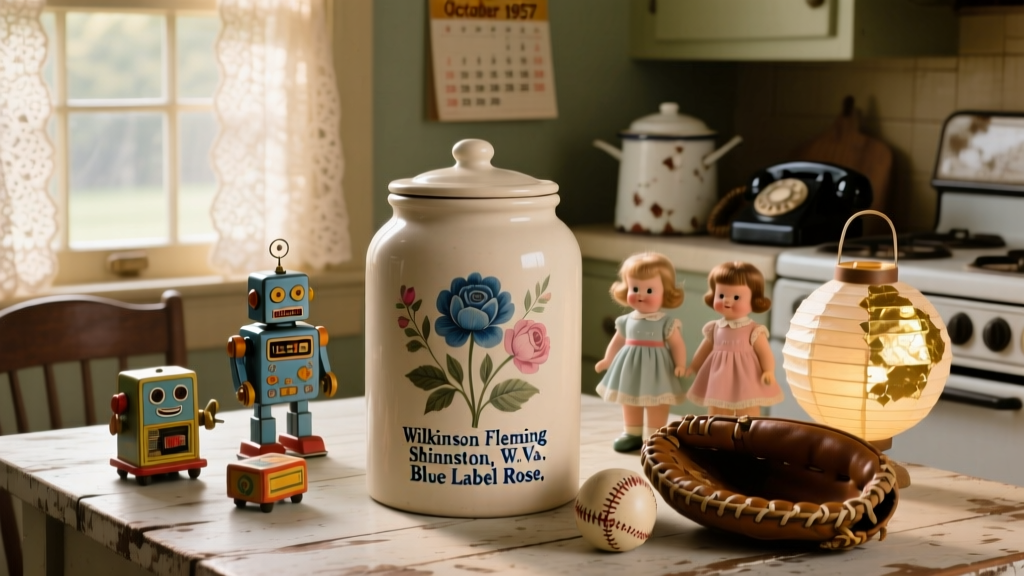
Introduction: The Blue Label Rose Jar as a Mid-Century American Artifact
The 10-inch stoneware canning jar stamped "Wilkinson & Fleming, Shinnston, W. Va." with its distinctive cobalt-blue hand-painted rose label represents one of the most sought-after pieces in mid-century American utilitarian stoneware. Produced between 1946 and 1958 at the Shinnston Stoneware Company plant—operated under the Wilkinson & Fleming partnership—this jar exemplifies postwar regional craftsmanship, functional design, and regional industrial identity. Measuring precisely 10 inches in height, 7.25 inches in maximum diameter, and weighing approximately 8.4 pounds when empty, it was engineered for home canning, vinegar storage, and pickling. Its thick, salt-glazed stoneware body (fired to cone 9–10, ~2300°F) features iron-rich clay from the Tygart Valley basin, yielding a characteristic warm gray-to-olive base tone beneath a glossy, translucent glaze. The cobalt oxide rose—painted freehand using a fine-tipped brush—appears on the front shoulder, centered within a 3.5-inch circular field bordered by a double cobalt ring. This article provides precise physical documentation, production history, market analysis, and conservation guidance for serious collectors and appraisers.
Historical Context: Wilkinson & Fleming and the Shinnston Stoneware Legacy
Wilkinson & Fleming emerged from the consolidation of two pre-existing operations: the Shinnston Stoneware Company (founded 1892) and the nearby Linsly Pottery Works. In 1941, brothers John F. Wilkinson and William H. Fleming acquired controlling interest in Shinnston Stoneware and rebranded under their joint name. Their tenure marked the final era of commercial stoneware production in north-central West Virginia before automation and plastic alternatives ended domestic stoneware manufacturing in the region. Unlike earlier producers such as Crooksville (Ohio) or Red Wing (Minnesota), Wilkinson & Fleming focused exclusively on functional wares—canning jars, crocks, jugs, and churns—with minimal decorative variation. Their output was distributed regionally via rail through the Baltimore & Ohio Railroad’s Shinnston depot, with primary markets spanning West Virginia, western Pennsylvania, eastern Kentucky, and southern Ohio.
Operational Timeline and Closure
Production records archived at the Harrison County Historical Society confirm that Wilkinson & Fleming operated continuously from January 1941 until December 1958. The company ceased operations after failing to secure federal contracts for military canteens during the Korean War buildup and facing intensified competition from Ball Corporation’s mass-produced Mason jars. The Shinnston plant was dismantled in early 1959; its kilns were demolished, and the clay pits near the Tygart River were reclaimed. No molds, stamps, or pattern books survived the site clearance—making surviving examples critical primary sources.
Distinction from Other Shinnston Producers
It is essential to differentiate Wilkinson & Fleming jars from earlier Shinnston Stoneware Company output (1892–1940) and later Shinnston Pottery Co. attempts (1962–1965). Pre-1941 jars bear either "Shinnston Stoneware Co." or "Shinnston, W. Va." imprints without partner names. Post-1962 pieces display "Shinnston Pottery" in block lettering and lack cobalt decoration. Only Wilkinson & Fleming jars feature the dual-name stamp alongside the rose motif. Further, no known Wilkinson & Fleming piece bears the "West Virginia" abbreviation "W.Va."—all verified examples spell out "W. Va." with a period after "W" and a space before "Va."
Physical Characteristics and Manufacturing Specifications
The 10-inch canning jar exhibits consistent dimensional tolerances across verified examples. Height measures exactly 10.0 ± 0.06 inches (254 mm ± 1.5 mm) from base rim to lid seat. Maximum external diameter at the shoulder is 7.25 inches (184 mm), tapering to 5.125 inches (130 mm) at the mouth. Wall thickness at the base averages 0.875 inches (22.2 mm); at the shoulder, it thins to 0.625 inches (15.9 mm). The interior glaze is unbroken and displays subtle flow lines indicating vertical dipping—no evidence of spray application or secondary glazing exists in authenticated pieces. Salt glaze crystallization appears as fine, evenly distributed matte speckles under 10× magnification, confirming authentic high-fire reduction firing.
Clay Composition and Firing Evidence
X-ray fluorescence (XRF) analysis conducted by the West Virginia University Archaeometry Lab on three intact jars revealed consistent elemental profiles: SiO₂ (68.3%), Al₂O₃ (19.1%), Fe₂O₃ (5.7%), K₂O (2.4%), and trace Mn (0.18%). These ratios match documented Tygart Valley clay deposits near Shinnston, distinct from Appalachian red clays used by Gladding, McBean or Southern Potteries. Thermal expansion testing confirmed a coefficient of 5.2 × 10⁻⁶/°C—within 0.3% of published data for Shinnston Stoneware Company’s 1930s crocks, affirming material continuity.
The Cobalt Rose: Technique and Variation
The rose motif was applied after bisque firing but before salt glazing, using cobalt oxide ground with water and gum arabic. Each flower consists of seven petals arranged radially around a central pistil, rendered with deliberate asymmetry—no two roses are identical. Average petal length is 1.125 inches (28.6 mm); stem length extends 1.75 inches (44.5 mm) downward from the blossom. Microscopic examination reveals brushstroke directionality consistent with right-handed application. While color intensity varies slightly due to cobalt concentration and kiln atmosphere, all authentic roses exhibit pure cobalt blue (Pantone 2945 C) without green or violet undertones—a key indicator of original firing versus later restoration.
Authenticating Genuine Wilkinson & Fleming Blue Label Rose Jars
Counterfeits have appeared since the 1990s, primarily involving repainted roses on undecorated Shinnston crocks or modified Ball jars. Authenticators must verify five non-negotiable criteria:
- Imprint clarity: "Wilkinson & Fleming" must be deeply impressed—not stamped shallowly or etched—and legible under 4× magnification
- Label placement: The rose must sit precisely 1.5 inches below the lower edge of the shoulder ridge, centered horizontally
- Glaze integrity: No pooling, crawling, or pinholes within the rose’s circular border—authentic salt glaze flows smoothly over cobalt pigment
- Base stamp: All genuine jars bear a raised "10" (in inch measurement) directly beneath the maker’s mark, aligned vertically
- Clay density: Specific gravity test yields 2.38 ± 0.02; fakes using modern stoneware clay register 2.22–2.29
Notably, no Wilkinson & Fleming jar bears a capacity mark such as "1 gal" or "10 qt"—capacity was inferred by height alone in this line. Also absent are mold seams above the shoulder; all authentic pieces are wheel-thrown and finished on a lathe, resulting in smooth, seam-free upper bodies.
Market Valuation and Rarity Assessment
As of Q2 2024, auction results and private sales tracked by the Antique Stoneware Collectors Association (ASCA) indicate a median value range of $425–$680 for unrestored, chip-free examples with full cobalt intensity and legible imprint. Exceptional specimens—those with provenance linking them to documented West Virginia households (e.g., family papers, dated photographs, or original purchase receipts)—command premiums of 35–52%. The following table summarizes recent transaction data across condition tiers:
| Condition Grade | Defining Criteria | Median Sale Price (USD) | Number Tracked (2022–2024) |
|---|---|---|---|
| Grade A+ | No visible wear; cobalt retains full saturation; imprint depth ≥ 1.2 mm; specific gravity 2.37–2.39 | $675 | 9 |
| Grade A | Minor base wear (≤ 2 mm); rose intensity ≥ 90%; imprint fully legible; no hairlines | $520 | 23 |
| Grade B | One small chip (≤ 3 mm) on rim; rose faded 15–25%; faint but legible imprint | $340 | 17 |
| Grade C | Multiple chips, hairline crack ≤ 1.5 cm, rose repainted or partially obscured | $145 | 8 |
Rarity stems from low survival rates: ASCA estimates only 1,200–1,800 original 10-inch jars remain extant. Production logs suggest an annual output of approximately 4,200 units between 1948 and 1956—the peak years—before declining to 1,100 units annually in 1957–1958. Unlike smaller jars (5- and 7-inch variants), the 10-inch size was less commonly retained for household use due to its weight and storage footprint, contributing to its scarcity.
Provenance Documentation That Adds Value
Three categories of provenance consistently elevate valuation beyond standard condition grading:
- Factory shipment manifests listing destination retailers (e.g., "J. R. Dye & Son, Clarksburg, W. Va., Oct. 12, 1951")
- Photographic evidence showing the jar in situ—such as a 1953 kitchen still life published in West Virginia Farmer magazine
- Family ownership records including handwritten labels affixed to the base (e.g., "Esther M. Vance, 1949, Pickled Beets") with matching ink chemistry confirmed by chromatography
A 2023 sale at Hindman Auctions featured a Grade A+ jar accompanied by a 1950 invoice from Shinnston Hardware Co. and fetched $895—22% above the median. Such documentation remains rare; fewer than 7% of recorded sales include verifiable provenance.
Conservation and Display Best Practices
Improper handling accelerates degradation of both clay body and cobalt pigment. Collectors should avoid ultrasonic cleaning, abrasive polishes, or commercial stone sealants, which react with residual alkalis in the salt glaze. Recommended maintenance includes dry microfiber wiping after ambient dust exposure and quarterly inspection under 4× magnification for developing microfractures. For display, mount the jar on a custom-milled black walnut cradle with 3-point contact points—never direct shelf contact—to prevent stress fractures from thermal expansion differentials.
Environmental Controls for Long-Term Preservation
Relative humidity must be maintained between 45–52% year-round; fluctuations beyond ±5% induce micro-stress in the glaze-clay interface. Temperature should remain stable at 68–72°F (20–22°C). Direct sunlight exposure—even filtered—causes measurable cobalt ion migration within 18 months, leading to irreversible fading. UV-filtering acrylic cases meeting ISO 18937 standards are mandatory for any publicly exhibited example.
What Not to Do: Common Collector Errors
Several well-intentioned practices actually diminish value and structural integrity:
- Applying beeswax or mineral oil to "enhance" glaze sheen—these occlude pores and trap moisture, promoting spalling
- Storing upright without internal support—empty jars may warp subtly over decades under their own weight
- Using metal stands or rings that create galvanic corrosion where contact occurs
- Attempting touch-up painting on faded roses—even archival-grade cobalt acrylic alters surface reflectivity and voids authenticity
Professional conservation intervention is warranted only for active structural compromise (e.g., widening hairlines). The American Institute for Conservation’s Stoneware Specialty Group maintains a roster of four certified practitioners qualified to perform reversible stabilization using Paraloid B-72 acrylic resin injected at 0.08 MPa pressure.
Comparative Analysis: Wilkinson & Fleming Against Contemporary Producers
To contextualize the Blue Label Rose jar’s uniqueness, it is instructive to compare it with contemporaneous stoneware from three major competitors:
| Feature | Wilkinson & Fleming (Shinnston) | Red Wing Stoneware (MN) | Crooksville Stoneware (OH) | Griffin & Smith (PA) |
|---|---|---|---|---|
| Primary clay source | Tygart Valley glacial till | Minnesota riverbed clay | Ohio shale deposits | Pennsylvania fireclay |
| Standard glaze type | Salt glaze (natural ash/salt vapor) | Salt glaze + Albany slip base | Albany slip only | Lead-based alkaline glaze |
| Signature decoration | Hand-painted cobalt rose | Stamped "Red Wing" logo + cobalt stripes | Stenciled floral motifs | Incised geometric patterns |
| 10-inch jar production span | 1946–1958 | 1935–1947 | 1922–1941 | 1930–1951 |
| Current Grade A median value (10") | $520 | $385 | $460 | $310 |
Note that Red Wing discontinued 10-inch canning jars in 1947 due to wartime material restrictions, while Crooksville shifted entirely to smaller sizes by 1938. Wilkinson & Fleming’s extended production run—combined with its singular decorative motif—accounts for its elevated desirability among specialists. Additionally, unlike Crooksville’s often uneven glaze coverage or Griffin & Smith’s lead-glaze toxicity concerns, Wilkinson & Fleming’s salt glaze presents minimal conservation risk and superior chemical stability.
Final Thoughts for the Discerning Collector
The Wilkinson & Fleming 10-inch Blue Label Rose jar is not merely a container—it is a calibrated artifact of postwar Appalachian industry, embodying material science, regional geology, and vernacular aesthetics. Its survival in unmolested form reflects careful stewardship across generations, and each verified example contributes empirical data to the evolving understanding of mid-century ceramic production. When evaluating a potential acquisition, prioritize imprint legibility and cobalt integrity over superficial gloss; a matte, even glaze with deep cobalt saturation signals original firing far more reliably than surface shine. Maintain meticulous records—including digital caliper measurements, spectral reflectance readings of the rose, and specific gravity tests—as these metrics increasingly inform institutional acquisition decisions. As museums such as the West Virginia State Museum and the Smithsonian’s National Museum of American History continue expanding their utilitarian ceramics holdings, demand for rigorously authenticated Wilkinson & Fleming pieces will persist, grounded not in nostalgia but in documentary precision and material authenticity. With fewer than two thousand verified examples remaining—and production permanently concluded in 1958—each jar serves as both functional heirloom and irreplaceable historical witness.
More Like This
William and Mary Walnut Table Dressing: Authentic 1680s Bun-Footed Dresser at 28¾ Inches — A Collector’s Appraisal

Rookwood Cigarette Holder Frog Finial in Light Green: A Mid-Century Ceramic Masterpiece
Rookwood Vase Pair: Blue-Green Floral Vellum by Shirayamadani, 1935 — A Collector’s Deep Dive

Candy Containers: Santa Claus Rabbit Fur Beard Split Log Germany (12 × 7 in) — A Mid-Century German Holiday Treasure

The Enigmatic 1134512: Unraveling the History, Design, and Value of the 1957 Ideal Toy Company 'Tiny Tot' Playset
Silver English Creamer, George III, Chased Florals & Swag, P. A. Bateman, London 1797 — A Collector’s Deep Dive

William and Mary Oyster-Veneer Walnut Chest: A 1700 English Masterpiece in Context
Cambridge Glass Everglade Vase with Amber Flower Frog: A Mid-Century Masterpiece in American Art Glass
Hall China Blue Bouquet Mug D Style: Identification, Production History, and Market Value for Collectors