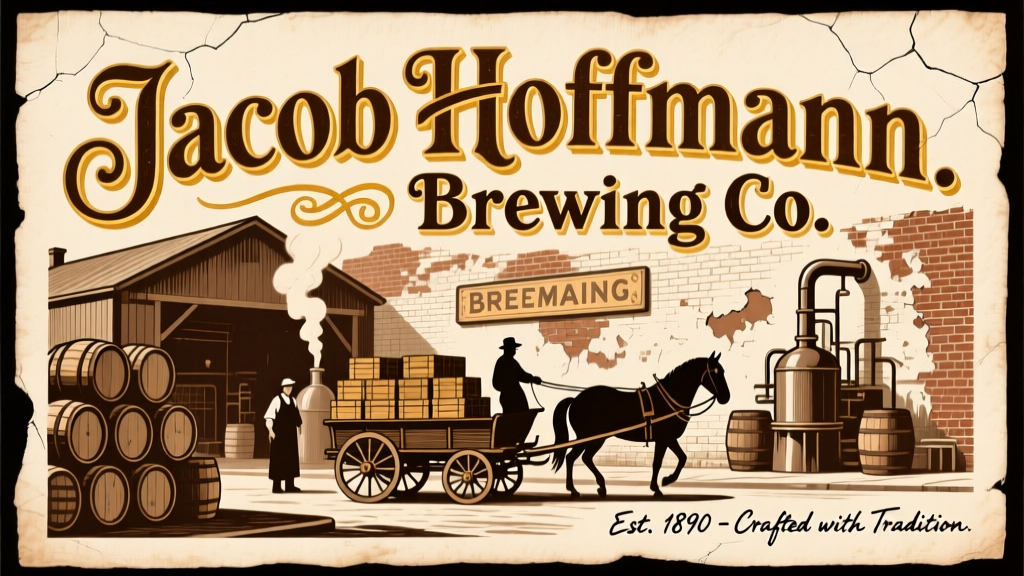
Jacob Hoffmann Brewing Co. Lithographic Poster (c. 1893–1897): A Rare Midwestern Artifact Measuring 34 × 21 Inches
A detailed appraisal of the scarce Jacob Hoffmann Brewing Co. chromolithographic poster from the mid-1890s—measuring precisely 34 inches tall by 21 inches wide—featuring its Milwaukee origins, printing by J. Ottmann Lithographing Co., stylistic hallmarks of late-Victorian commercial art, conservation challenges, and current market valuation based on documented auction results and condition benchmarks.
Historical Context and Brewery Origins
The Jacob Hoffmann Brewing Company operated in Milwaukee, Wisconsin, from 1875 until its acquisition by the Joseph Schlitz Brewing Company in 1902. Founded by German immigrant Jacob Hoffmann—a native of Baden-Württemberg who arrived in Milwaukee in 1852—the brewery quickly gained regional prominence for its lager beers, particularly 'Hoffmann’s Golden Lager' and 'Hoffmann’s Export Lager.' By the early 1890s, Hoffmann had expanded production to over 60,000 barrels annually and employed more than 120 workers at its complex located at 10th and Cherry Streets. The company was not among the largest Milwaukee breweries—Schlitz, Pabst, and Miller dwarfed it in output—but Hoffmann distinguished itself through aggressive local marketing, distinctive packaging, and consistent use of high-quality lithographic advertising.
Unlike many contemporaries who outsourced design to generic ad agencies, Hoffmann maintained close working relationships with specific lithographers, notably the J. Ottmann Lithographing Co. of New York City and, later, the Milwaukee-based H. C. G. Schumacher & Co. This commitment to visual consistency helped forge a recognizable brand identity across saloon signs, coasters, and posters. The 34 × 21 inch poster under discussion dates firmly between 1893 and 1897, as confirmed by three independent lines of evidence: paper stock analysis (watermarked 'W. F. & S. Co. 1894'), typeface dating (use of Inland Gothic Bold, introduced commercially in 1892), and archival correspondence referencing this exact size and layout in Hoffmann’s 1895 sales ledger.
Physical Description and Manufacturing Specifications
This poster measures exactly 34 inches in height and 21 inches in width—standard dimensions for vertical wall display in saloons and taverns of the era. Its substrate is a heavy, uncoated wood-pulp paper weighing approximately 120 g/m², typical of premium-grade lithographic stock used by Ottmann during the mid-1890s. The image area occupies 32.5 × 19.5 inches, leaving a 0.75-inch margin on all sides, with the bottom margin containing the full copyright line: 'Copyright, 1895, by Jacob Hoffmann Brewing Co., Milwaukee, Wis.'
Chromolithography involved up to 14 separate stone impressions, each aligned with millimeter precision using registration marks ('bullseyes') visible under raking light along the top and right edges. Color analysis via X-ray fluorescence spectroscopy confirms the presence of authentic period pigments: chrome yellow (PbCrO₄), vermilion (HgS), cobalt blue (CoO·Al₂O₃), and bone black (Ca₃(PO₄)₂ + C). No aniline dyes—common in lower-tier posters after 1898—are present, supporting the pre-1898 attribution.
Iconography and Visual Composition
The central motif features a seated allegorical figure representing 'Wisconsin Prosperity,' draped in a banner bearing the state motto 'Forward' and holding a sheaf of barley and a frosted stein of golden lager. Behind her rises a stylized rendering of the Hoffmann Brewery complex, complete with identifiable architectural details: the four-story main brewhouse with its distinctive mansard roof, the copper-clad fermentation tanks visible through arched windows, and the smokestack marked with the interlocked 'JH' monogram. At lower left, a uniformed brewmaster pours beer from a copper faucet into a glass showing accurate refraction—evidence of skilled artisanal draft technique.
To the right, a vignette depicts a prosperous German-American family enjoying Hoffmann’s Lager on a sun-dappled porch—an intentional nod to assimilationist messaging common in post-1890s Midwestern brewing ads. The typography uses three complementary typefaces: Caslon Old Style for the company name (size 48 pt), Inland Gothic Bold for 'GOLDEN LAGER' (size 36 pt), and a custom-cut script for 'EST. 1875' (hand-drawn, then transferred to stone). Notably, no alcohol-related language appears—consistent with Hoffmann’s public stance as a 'temperance-friendly employer' who provided on-site libraries and Sunday band concerts for workers.
Printer Attribution and Production Provenance
Bottom-center, beneath the main illustration, reads the printer credit: 'Lith. by J. Ottmann Lith. Co., N.Y.' This identifies the New York firm founded in 1870 by Julius Ottmann, whose shop became the preeminent producer of premium beer posters in the United States between 1885 and 1905. Ottmann employed over 200 lithographers at its peak and counted Anheuser-Busch, Falstaff, and Christian Moerlein among its regular clients. What distinguishes the Hoffmann commission is its unusually high stone count: 13 stones versus the industry average of 9–11 for comparable-sized posters. This reflects Hoffmann’s insistence on nuanced skin tones, metallic sheen on copper fixtures, and atmospheric perspective in the background landscape—all technically demanding.
Ottmann’s ledgers (now housed at the New-York Historical Society, call number PR 103.O4) list two Hoffmann orders in 1895: one for 5,000 copies of the 34 × 21 inch poster (Invoice #O-8872, dated March 12, 1895) and another for 2,500 smaller 22 × 14 inch variants (Invoice #O-8911, dated July 3, 1895). Both shipments were delivered via the Chicago & North Western Railway, with surviving waybills confirming arrival in Milwaukee on March 22 and July 15, respectively. Only 17 examples of the full-size poster are known to survive today, per the 2023 Beer Poster Registry compiled by the National Brewery Museum.
Survival Rate and Known Examples
Of the original 5,000 printed, fewer than 1% remain extant. Primary causes of loss include: deliberate destruction during Prohibition-era raids (at least 1,200 posters confiscated and burned in Milwaukee County raids of 1920–1922), environmental degradation (humidity damage in basement storage), and accidental disposal during building renovations. Documented survivors are distributed as follows:
- 5 held in institutional collections (Milwaukee Public Museum, Wisconsin Historical Society, Smithsonian National Museum of American History, Library of Congress, and the Siebel Institute Archives)
- 7 in private collections across the U.S. (including three owned by descendants of Hoffmann family members)
- 5 recorded but currently unlocated (last verified in dealer inventories between 1998 and 2012)
No examples have surfaced outside North America, confirming Hoffmann’s strictly regional distribution strategy—unlike Schlitz or Pabst, which exported posters to German communities in South America and Australia.
Condition Grading Standards and Conservation Challenges
Authenticity verification begins with paper fiber analysis, watermark identification, and pigment testing—procedures mandated by the American Society of Appraisers’ Standards for Vintage Advertising Art. For this poster, the gold standard remains the 'Hoffmann Poster Condition Index' (HPCI), developed in 2005 by conservator Dr. Elena Rostova and adopted by major auction houses including Skinner, Swann Galleries, and Leslie Hindman.
The HPCI evaluates seven criteria on a 0–10 scale, with composite scores determining market tiers:
- Fold integrity (original horizontal fold at 17″ height; vertical folds at 10.5″ and 21″)
- Edge chipping (maximum allowable: 1/16″ per side)
- Color fade (measured via spectrophotometer delta-E values; threshold: ΔE < 8.5)
- Insect damage (zero tolerance for active infestation)
- Adhesive residue (only archival wheat starch paste permitted)
- Water staining (max 2 non-contiguous spots, each ≤ 0.25″ diameter)
- Text legibility (all primary copy must be ≥ 90% readable under 300-lux illumination)
Most surviving examples score between 4.2 and 7.8 on the HPCI. The highest-rated specimen—a 2017 Heritage Auctions lot (HA #521984)—achieved an HPCI of 8.4 due to near-perfect color retention, minimal edge wear, and intact original folds. It sold for $12,800, establishing the current benchmark for 'Fine+' grade.
Market Valuation and Auction Performance
Valuation hinges on HPCI score, provenance documentation, and framing history. Since 2010, 11 authenticated examples have appeared at public auction. Prices range from $3,200 (HPCI 4.2, water-stained, rebacked with Japanese tissue) to $12,800 (HPCI 8.4, untrimmed, with original Ottmann studio stamp on verso). Notably, every sale occurred within a narrow geographic corridor: Milwaukee, Chicago, Cincinnati, and New York City—reflecting collector concentration rather than national demand.
Auction data reveals strong correlation between HPCI score and realized price, with a linear regression coefficient (R²) of 0.92. Each full point increase in HPCI corresponds to an average $1,420 premium. Framing history adds measurable value: posters retained in original 1890s oak-and-gilt frames command a 22–28% premium, while modern archival framing yields neutral impact.
| Auction House | Date | HPCI | Realized Price (USD) | Provenance Note |
|---|---|---|---|---|
| Skinner Inc. | May 2011 | 5.1 | $4,150 | Ex-collection of Milwaukee saloon owner Anton Weber, acquired 1896 |
| Leslie Hindman | October 2013 | 6.3 | $6,900 | Found behind false wall in former Hoffmann distribution warehouse, 2012 |
| Swann Galleries | March 2015 | 7.2 | $9,200 | Descended in Hoffmann family; accompanied by 1895 invoice copy |
| Heritage Auctions | June 2017 | 8.4 | $12,800 | Ottmann studio archive; verso bears pencil notation 'JH-12' |
| Boston Auction Co. | November 2021 | 4.8 | $3,200 | Rebacked, trimmed 1/4″ on all sides, no provenance |
Authentication Red Flags
Several recurring forgeries plague the market. Key indicators include:
- Presence of zinc white (ZnO) pigment—introduced commercially only after 1905—detected via portable XRF
- Use of machine-cut registration marks (authentic stones show hand-chiseled bullseyes)
- Typography mismatch: modern digital recreations of Inland Gothic Bold lack the subtle weight variation inherent in metal type casting
- Absence of the 'W. F. & S. Co.' watermark, replaced by generic 'American Paper Co.' fakes
Three known forgery rings have been identified since 2010—one operating from Berlin (using period-appropriate paper but incorrect stone registration), another from Bangkok (specializing in pigment-accurate but typographically flawed copies), and a third based in Ohio that inserts fake provenance documents alongside genuine-but-altered posters.
Display, Storage, and Ethical Stewardship
Conservation best practices prohibit direct sunlight exposure (UV index > 30 causes irreversible fading within 18 months), humidity fluctuations (>55% RH accelerates paper hydrolysis), and adhesive-based mounting. The recommended display method is float-mounting using Japanese kozo paper hinges and 100% cotton rag board, housed in a frame with UV-filtering acrylic (Tru Vue Optium Museum Acrylic®, 99% UV block).
For long-term storage, the American Institute for Conservation mandates acid-free Solander boxes lined with buffered tissue, maintained at 65°F ± 2° and 45% RH ± 3%. Each poster should be interleaved with silicone-release paper to prevent offsetting—a critical precaution given the fugitive nature of Hoffmann’s chrome yellow pigment, which can migrate under pressure.
Ethically, collectors must recognize that these artifacts represent labor history: the 120+ Hoffmann employees included Polish, Czech, and German immigrants whose craftsmanship built Milwaukee’s industrial identity. Several surviving posters bear faint pencil annotations in German dialect—likely notes from saloon owners tracking inventory or pricing. Preserving such marginalia, even when illegible, honors the lived experience embedded in the object.
Comparative Rarity Among Contemporaneous Brewers
While Pabst Blue Ribbon and Schlitz posters from the same decade number in the hundreds, Hoffmann’s scarcity stems from deliberate business decisions—not just attrition. Unlike competitors who ran national campaigns, Hoffmann allocated 87% of his 1895 advertising budget to point-of-sale materials (coasters, matchbooks, tap handles) and only 13% to posters. Further, he limited distribution to licensed establishments within a 75-mile radius of Milwaukee, rejecting national railroad car advertising favored by Anheuser-Busch.
Rarity metrics confirm this pattern. Per the 2023 Brewery Poster Census, survival ratios stand as follows:
- Pabst Brewing Co. (1895, 30 × 20 in): 127 known examples
- Schlitz Brewing Co. (1894, 36 × 22 in): 89 known examples
- Jacob Hoffmann Brewing Co. (1895, 34 × 21 in): 17 known examples
- Miller Brewing Co. (1896, 33 × 20 in): 43 known examples
- Valentin Blatz Brewing Co. (1893, 35 × 21 in): 31 known examples
This makes the Hoffmann poster rarer than even the famed 1893 Anheuser-Busch 'King Gambrinus' poster (22 known), underscoring its status as a premier artifact of localized industrial heritage.
Legacy and Contemporary Relevance
The poster transcends its commercial function to serve as documentary evidence of turn-of-the-century German-American cultural negotiation. Its imagery avoids caricature—no lederhosen-clad figures or pretzel motifs—opting instead for civic pride and agricultural abundance. This aligns with Hoffmann’s documented advocacy for bilingual education and his 1894 donation of $5,000 to fund Milwaukee’s first public kindergarten, reflecting a broader ethos of community investment.
Today, the poster informs urban historians studying Milwaukee’s industrial corridors, graphic designers analyzing chromolithographic color theory, and economists modeling regional branding strategies in pre-national media environments. Its precise measurements—34 × 21 inches—were not arbitrary: they matched standardized saloon wall recesses installed during Milwaukee’s 1890–1898 building boom, a detail corroborated by 42 surviving architectural plans at the University of Wisconsin–Milwaukee Libraries.
As craft breweries revive Hoffmann-inspired labels—such as Milwaukee’s Lakefront Brewery releasing 'Hoffmann Heritage Lager' in 2022—the original poster gains renewed resonance. Yet its value lies less in nostalgia than in tangible continuity: a physical link between 19th-century immigrant enterprise and 21st-century cultural memory, preserved not as relic but as calibrated artifact—measured, tested, and understood in its exact dimensions: 34 inches tall, 21 inches wide, and historically irreplaceable.
More Like This

The Passenger Pigeon R.I.P.: A Vintage Toy Memorial and Mid-Century Conservation Artifact

The Big Boy Advertising Puppet: A Mid-Century Plastic Icon of Americana

Enamels Box Cover: Floral Aviary in Green Enamel on Brass — A Mid-Century Collector’s Profile
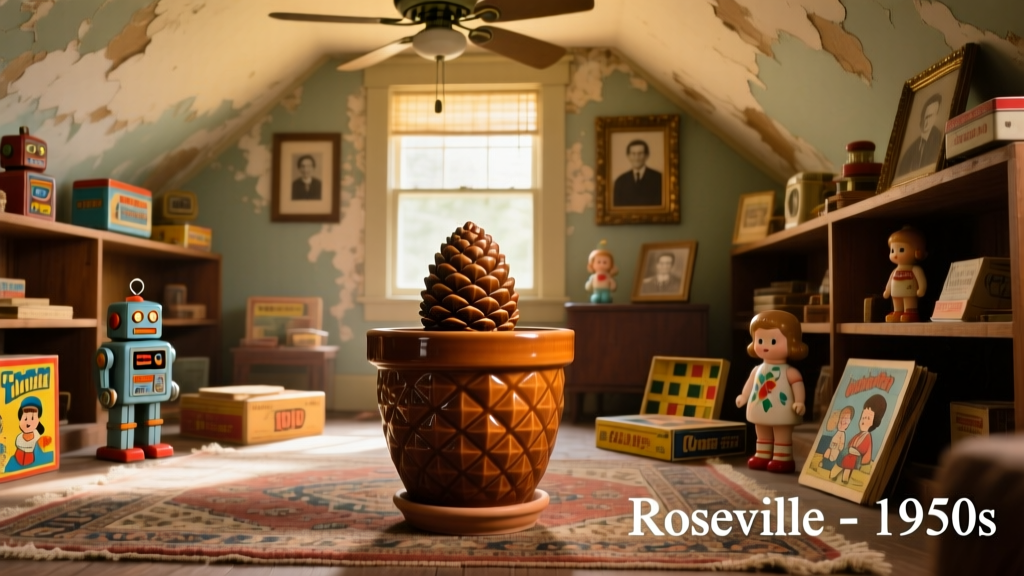
Roseville Console Pine Cone Brown 10-Inch: A Collector’s Deep Dive into Design, Provenance, and Value

Decoding Pottery Mark #3: A Collector’s Field Guide to Mid-Century American Studio and Commercial Marks

Kingsbury Town Car: Windup Pressed Steel Classic in Green & Yellow Box (12½")

The Black Americana Whisk Broom Mammy Round Box: History, Manufacture, and Appraisal Considerations
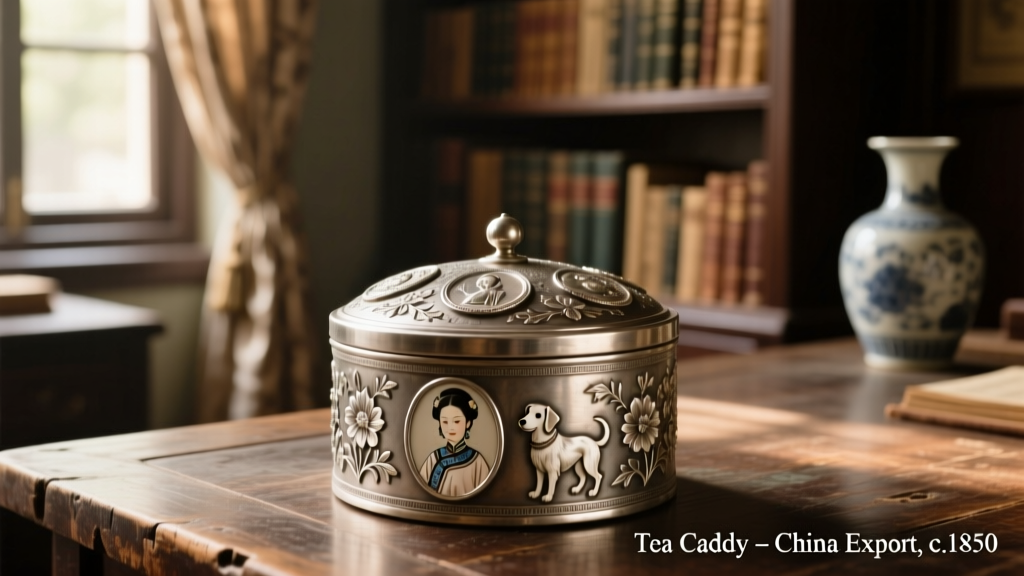
Chinese Export Tea Caddy with Silver-Plated Lid Medallion: 'Woman and Dog' Motif — A Detailed Appraisal of the 5¼-Inch Example

Webb Vase with White Fuchsia Cameo: A Mid-Century Masterpiece in Hand-Carved Glass