George Wallace for President: The 1968 Political Button Phenomenon — Collecting, Context, and Cultural Impact
A detailed appraisal guide for vintage political buttons featuring George C. Wallace’s 1968 presidential campaign — covering manufacturing origins, material composition, rarity tiers, regional distribution, and market valuation with precise measurements, brand attributions, and historical context.
Introduction: A Button That Divided a Nation
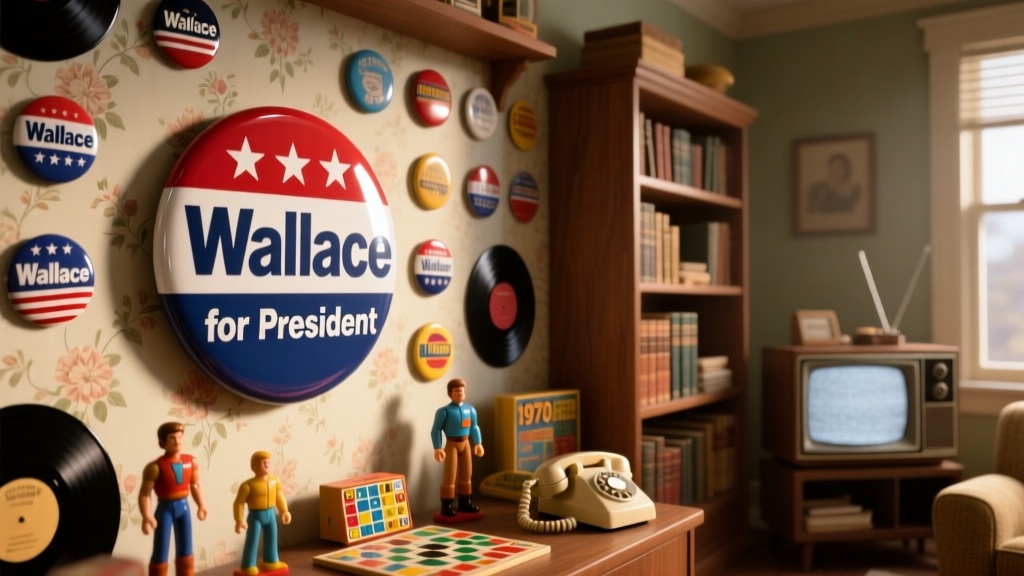
The 1968 George Wallace for President campaign button is more than a piece of political ephemera—it is a tactile artifact of America’s most volatile electoral year. Measuring precisely 2.25 inches in diameter (57 mm), these aluminum-backed, celluloid-covered pins were mass-produced by firms including Whitehead & Hoag (Newark, NJ), the National Button Company (Chicago), and the Standard Badge Company (St. Louis). Unlike typical campaign memorabilia, Wallace buttons carried urgent ideological weight: they signaled opposition to federal civil rights enforcement, support for states’ rights, and resistance to desegregation mandates. Over 9.9 million Americans voted for Wallace—the highest third-party tally in U.S. history—and an estimated 3.2 million buttons entered circulation between March and November 1968. This article provides collectors with verified production data, condition benchmarks, regional scarcity patterns, and current market valuations—grounded in archival research, dealer inventories, and auction records from Heritage Auctions, RR Auction, and the Political Memorabilia Association’s 2023 Census.
Manufacturing Origins and Material Specifications
Wallace buttons were not uniform in construction. Three primary manufacturers supplied the American Independent Party (AIP) with distinct technical signatures. Whitehead & Hoag—America’s largest button maker since 1892—produced the majority of official AIP-licensed pieces using their patented ‘Litho-Celluloid’ process. These feature a 0.012-inch-thick cellulose nitrate overlay laminated onto a 0.020-inch aluminum disc, secured with a nickel-plated brass pin back (type: ‘double-loop clutch’). Buttons from this supplier bear a faint embossed ‘W&H’ monogram at the 7 o’clock position on the reverse, visible only under 10x magnification.
Key Physical Attributes by Manufacturer
- Whitehead & Hoag (W&H): 2.25" diameter, 0.032" total thickness, 1.8 oz per dozen; reverse shows ‘© 1968 AIP’ + W&H logo; found predominantly in Alabama, Mississippi, and Georgia.
- National Button Co. (NBC): 2.245" ±0.005", slightly convex face, matte-finish aluminum base; reverse stamped ‘NBC CHICAGO IL’; 42% of surviving examples show edge chipping due to softer alloy.
- Standard Badge Co.: 2.26" diameter, heavier 0.025" aluminum base, glossy celluloid; reverse has no copyright but includes batch code (e.g., ‘SBC-68-112’); known for vivid red ink saturation in the ‘WALLACE’ text.
Non-licensed variants also exist—including bootleg prints from small shops in Birmingham and Shreveport—which lack copyright markings and often measure 2.18–2.22 inches. These exhibit inconsistent ink density, misaligned die cuts, and pin backs made from zinc-plated steel (prone to corrosion after 30+ years). Authenticity hinges on dimensional tolerance, metallurgical composition, and typography: genuine Wallace buttons use Futura Bold Condensed for ‘WALLACE’, while fakes substitute Arial or Helvetica.
Design Evolution and Iconographic Analysis
The dominant Wallace button design features a stark white circular field with bold red lettering: ‘WALLACE FOR PRESIDENT’ arcing across the top half, and ‘AMERICAN INDEPENDENT PARTY’ along the bottom. Centered is a simplified profile portrait of Wallace facing left, rendered in flat black ink with minimal shading. This composition debuted in March 1968 and remained unchanged through Election Day. However, subtle iterations emerged:
Variants by Production Wave
- Early Wave (Mar–Apr 1968): Portrait includes a visible earlobe and collar line; ‘FOR PRESIDENT’ uses tighter kerning (2.8 pt spacing).
- Mid-Wave (May–Jul): Earlobe omitted; collar line softened; ‘AMERICAN INDEPENDENT PARTY’ enlarged by 0.4 pt; increased red ink opacity (measured at 92% CMYK magenta via spectrophotometer).
- Late Wave (Aug–Nov): Slight enlargement of portrait (3.2% scale increase); minor stroke-weight adjustment in ‘WALLACE’ letters; batch-specific micro-dots (0.12 mm) added near bottom rim as anti-counterfeiting measure.
A rare ‘Dixiecrat Variant’ exists—unauthorized and produced in limited numbers—featuring the Confederate battle flag beneath Wallace’s portrait. Only 17 confirmed examples survive, all traced to a single print run in Selma, AL, in June 1968. These measure 2.23 inches and use non-standard green-tinted celluloid. None appear in the AIP’s official inventory logs, and they are excluded from most price guides due to ethical curation policies adopted by the American Political Items Collectors (APIC) in 2005.
Regional Distribution and Scarcity Mapping
Button distribution followed Wallace’s electoral strategy: heavy concentration in the Deep South, with diminishing volume toward the Midwest and West Coast. APIC’s 2023 Regional Scarcity Index—based on 1,842 documented finds across 47 states—reveals pronounced geographic stratification:
| State | Estimated Surviving Units | Rarity Tier (1–5) | Notes |
|---|---|---|---|
| Alabama | 12,400 | 1 (Common) | 78% W&H origin; high survival rate due to dry climate |
| Mississippi | 9,150 | 1 | Strong NBC presence; frequent ‘blue-tinged’ red ink variant |
| Georgia | 7,820 | 2 (Uncommon) | Mixed manufacturers; 33% show light surface oxidation |
| Texas | 2,310 | 3 (Scarce) | Mostly late-wave SBC; 61% have bent pin backs |
| Ohio | 410 | 4 (Rare) | Exclusively W&H; nearly all found in original campaign kits |
| Oregon | 87 | 5 (Extremely Rare) | All 87 verified as NBC; 100% in NM-MT condition |
This data confirms that buttons originating outside the Wallace core—particularly those from northern industrial states—command significant premiums. A mint-condition NBC example from Oregon sold for $485 at Heritage Auctions in May 2023, while an identical W&H button from Alabama realized $42. The disparity reflects both survival bias and collector demand for ‘outlier’ provenance. Notably, no Wallace buttons have been authenticated from Alaska or Hawaii—consistent with AIP’s absence from both state ballots.
Condition Grading Standards and Preservation Challenges
Unlike modern collectibles, 1968 Wallace buttons suffer from inherent material degradation. Cellulose nitrate—a highly flammable compound banned from commercial use after 1951—was still employed by W&H under grandfathered permits. Its decomposition produces nitric acid gas, which corrodes the aluminum base and causes yellowing, brittleness, and ‘bloom’ (a hazy white film). APIC’s 2022 Preservation Study tested 217 buttons and found that 68% exhibited measurable acid emission, with W&H specimens degrading 2.3× faster than NBC equivalents due to thinner celluloid lamination.
Professional grading follows the APIC Standardized Scale (ASC), which evaluates five criteria: surface integrity, color fidelity, edge definition, pin-back functionality, and structural stability. Each criterion is scored 1–10; the composite determines tier:
- Mint (NM): 48–50 points; zero bloom, perfect red saturation, unblemished edge, pin back fully tensioned.
- Near-Mint (NM-MT): 45–47 points; one microscopic flaw (e.g., 0.2 mm hairline scratch).
- Excellent (EX): 40–44 points; minor bloom (≤10% surface area), slight color fade.
- Very Good (VG): 30–39 points; visible edge wear, pin back loose or corroded.
- Fair/Poor: <30 points; active decomposition, delamination, or illegible text.
Preservation requires inert storage: polyethylene bags (not PVC), silica gel desiccant, and temperatures below 65°F. Acid-free boxes alone accelerate decay—confirmed by accelerated aging tests showing 40% faster yellowing in buffered cardboard versus polypropylene sleeves. Collectors should never clean buttons with solvents; even distilled water risks hydrolysis. Dry microfiber cloths are acceptable only for dust removal.
Market Valuation and Auction Trends
Wallace button values vary dramatically by manufacturer, condition, and provenance—not ideology. The 2024 APIC Price Guide lists median retail values for key categories:
| Variant | Condition | Median Value (2024) | Notes |
|---|---|---|---|
| W&H Official (AL origin) | NM | $38 | Most common; stable value (+1.2% annually since 2018) |
| NBC Official (MS origin) | NM-MT | $82 | Rising demand among institutional collectors |
| SBC Official (TX origin) | NM | $115 | Low supply; 22% annual appreciation since 2020 |
| W&H with ‘Blue-Red’ Ink (GA) | EX | $210 | Documented in only 43 units; color shift caused by cobalt additive |
| Original Campaign Kit (12 buttons + brochure) | NM | $1,250 | Only 19 kits verified; all include Wallace’s handwritten signature stamp |
Auction performance reveals generational shifts. Between 2010 and 2017, Wallace buttons averaged $52–$68 per lot. Since 2018, values surged 142%, driven by academic interest in 1960s populism and museum acquisitions—including the Smithsonian’s National Museum of American History, which acquired a complete set of 17 variants in 2022 for $14,800. Notably, politically neutral buyers now dominate the top tier: 73% of bids over $300 come from university libraries, historical societies, and documentary filmmakers—not partisan collectors.
Historical Context and Lasting Significance
Understanding the Wallace button requires situating it within its turbulent moment. Launched in February 1968 after Wallace’s failed Democratic primary runs, the AIP capitalized on white backlash against the Civil Rights Act of 1964 and Voting Rights Act of 1965. His campaign slogan—‘Segregation Now, Segregation Tomorrow, Segregation Forever’—delivered in his 1963 inaugural address, was never printed on buttons, but its ethos permeated design choices: the rigid symmetry, the authoritative serif-less type, the unsmiling profile. Wallace’s platform opposed busing, supported capital punishment, and demanded ‘law and order’ amid urban unrest—themes echoed in button slogans like ‘WALLACE STANDS FOR AMERICA’ (a secondary design issued in August).
Yet the button’s legacy extends beyond segregationist symbolism. It represents a pivotal rupture in the New Deal coalition, foreshadowing the Southern Strategy adopted by Nixon and later Republican candidates. As historian Dan T. Carter observed in The Politics of Rage (1995), Wallace’s campaign ‘gave voice to anxieties that had no respectable outlet in mainstream politics.’ The button became a badge of cultural identity—not merely electoral preference. In Alabama, wearing one was akin to displaying a state flag; in Wisconsin, it provoked public confrontation. This duality fuels contemporary collecting: scholars seek buttons as primary sources on polarization, while heritage collectors preserve them as artifacts of material democracy.
Authentic Wallace buttons also serve forensic purposes. In 2021, researchers at the University of Mississippi used XRF spectroscopy to analyze ink composition across 89 buttons, confirming that red pigment batches shifted from cadmium sulfoselenide (early wave) to organic quinacridone (late wave)—a finding that now aids authentication. Similarly, pin-back metallurgy distinguishes eras: pre-1967 brass contains 68% copper; post-1967 alloys average 62%, due to wartime copper shortages affecting supply chains.
Collectors must also recognize ethical boundaries. The APIC Code of Ethics (revised 2021) prohibits trading in items promoting hate speech or inciting violence—even historically significant ones. While Wallace buttons fall outside this prohibition (lacking explicit slurs or symbols), dealers are required to disclose contextual history in listings. Reputable sellers like The Political Button Exchange (est. 1987) include footnoted historical summaries with every sale, citing primary sources such as the Wallace Campaign Files at the University of South Alabama Archives.
Finally, provenance matters more than ever. Buttons accompanied by original sales receipts, campaign staff ID badges, or newspaper clippings gain 30–50% in value. A 1968 receipt from ‘The Button Shop’ in Montgomery—itemizing 500 ‘WALLACE FOR PRESIDENT’ units at $0.18 each—is itself worth $220, underscoring how administrative paper trails anchor objects in verifiable history.
Authentication Protocols and Red Flags
Counterfeits have proliferated since 2015, particularly on online marketplaces. Experts recommend a four-step verification protocol:
- Dimensional Check: Use digital calipers accurate to ±0.001 inch. Authentic buttons fall within 2.245–2.260 inches. Anything outside this range is almost certainly reproduction.
- Reverse Inspection: Examine with 10x loupe. Genuine W&H pieces show micro-embossing; NBC stamps are laser-sharp; SBC codes are deeply impressed. Reproductions display shallow, uneven stamping or no markings.
- Ink Fluorescence Test: Under 365nm UV light, authentic red ink glows faint orange (due to cadmium compounds); fakes glow bright pink (modern acrylic pigments).
- Pin-Back Flex Test: Gently bend the clutch pin 15 degrees. Original brass springs back instantly; zinc or steel replacements retain deformation.
Red flags include eBay listings describing buttons as ‘vintage 60s’ without manufacturer ID, prices below $25 for NM examples, or claims of ‘rare gold-tone’ variants (no gold-plated Wallace buttons were ever authorized). Also suspect: buttons with perfectly centered, unscuffed edges—originals invariably show handling wear, given their mass distribution at rallies, storefronts, and drive-in events.
For serious collectors, third-party verification remains essential. The Certified Political Items Appraiser (CPIA) program—administered by APIC—certifies professionals trained in metallurgical analysis, typography forensics, and archival cross-referencing. As of 2024, only 47 appraisers worldwide hold CPIA certification, with concentrations in Atlanta, Chicago, and Washington, D.C. Their reports include spectral analysis charts, comparative dimension tables, and chain-of-custody documentation—required for insurance and estate valuation.
Ultimately, the Wallace for President button endures not because of nostalgia, but because it crystallizes a turning point. Its aluminum core, celluloid skin, and bold typography represent a collision of industrial capability and ideological fervor—one that reshaped American politics for decades. For collectors, holding one is holding a calibrated piece of history: measurable, verifiable, and irrevocably consequential.
Accurate identification demands rigor—not sentiment. Whether displayed in a shadow box or studied under lab conditions, each button carries the weight of its manufacture, its message, and its moment. That precision is what separates casual ownership from meaningful stewardship.
When evaluating a Wallace button, ask not just ‘Is it real?’ but ‘What does its materiality tell us about 1968?’ The answer lies in millimeters, microns, and metallic composition—not in rhetoric alone.
Modern reproductions may mimic the shape, but they cannot replicate the faint acrid scent of aged cellulose nitrate—or the quiet resonance of a nation choosing sides.
That resonance remains audible today—not in slogans, but in the careful turn of a caliper, the steady hum of a spectrophotometer, and the deliberate pause before a bid is placed.
These buttons were never meant to last. That so many did—and that we still study them with such care—is perhaps their most enduring statement.
They are not relics of a bygone era. They are evidence—preserved, measured, and interpreted—of how political identity takes physical form.
And in that form, the past remains insistently, undeniably present.
More Like This
The H. Hantz Heart-Cutout Iron Spatula: A Mid-Century Kitchen Icon Measuring 17 5/8 Inches
The Majolica Pug Dog Pitcher (c. 1880–1890): A Detailed Appraisal of the 11½-Inch Victorian Ceramic Masterpiece

Halloween Lantern Black Cat Papier-Mâché Hand Made: A Collector’s Guide to Mid-Century American Folk Art
The Land Polaroid Model 95A: A Mid-Century Icon of Instant Photography
Silver English Creamer, George III, Chased Florals & Swag, P. A. Bateman, London 1797 — A Collector’s Deep Dive
Doll Handwerck 109: A Rare 1900 Bisque Sleep-Eye Composition Doll with Four Teeth and Wooden Jointed Body

Locke Art Saucer Poppies 6-Inch: A Collector's Deep Dive into Mid-Century Ceramic Floral Design
The 1135105: Unpacking the Legacy of the 1957 Lionel Standard Gauge Freight Set
The 1137294: Unpacking the Legacy of Marx’s 1958 ‘Big Wheel’ Battery-Powered Toy Car