The Land Polaroid Model 95A: A Mid-Century Icon of Instant Photography
A detailed appraisal and historical analysis of the Land Polaroid Model 95A — the first commercially successful instant camera, launched in 1948. Covers technical specifications, production timeline, cultural impact, collector market trends, and authentication tips for vintage toy and photography collectors.
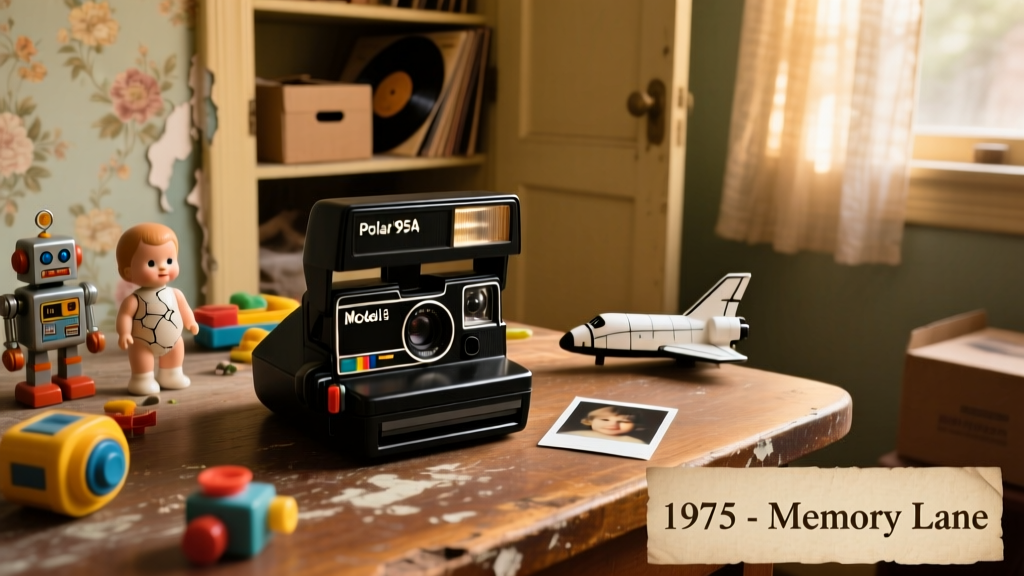
The Birth of Instant Photography
Introduced in November 1948 at Jordan Marsh department store in Boston, the Land Polaroid Model 95A was the world’s first commercially viable instant camera — a revolutionary device that delivered fully developed black-and-white photographs in under one minute. Designed by Dr. Edwin H. Land and manufactured by the Polaroid Corporation (then known as Land Camera Company), the Model 95A wasn’t merely a novelty; it redefined photographic immediacy, consumer expectations, and the relationship between photographer and image. Measuring 7.5 × 6.5 × 3.25 inches (19.05 × 16.51 × 8.26 cm) and weighing 3.5 pounds (1.59 kg), its walnut-grained Bakelite body, chrome-plated brass lens mount, and distinctive pull-tab film ejection mechanism made it instantly recognizable. With an original retail price of $89.95 — equivalent to roughly $1,150 today adjusted for inflation — the Model 95A targeted affluent professionals and early adopters who valued both technical innovation and tactile elegance. Its success laid the foundation for over three decades of Polaroid innovation and established the template for all subsequent instant cameras.
Engineering Excellence: Design and Mechanics
The Model 95A embodied mid-century industrial design principles: functional simplicity married with refined material choices. Its body was constructed from injection-molded phenolic resin — specifically Bakelite — finished with a high-gloss walnut grain pattern that resisted scratching and retained warmth to the touch. The front panel featured a fixed-focus, single-element meniscus lens manufactured by Bausch & Lomb, calibrated to a focal distance of 4 feet (1.22 m), with a maximum aperture of f/12.5. Unlike later models, the 95A lacked adjustable focus or exposure controls; exposure was set automatically via a selenium light meter coupled to a mechanical shutter system — a groundbreaking integration for 1948.
The Integral Film System
At the heart of the Model 95A was Polaroid’s proprietary Type 40 film pack, a self-contained unit holding eight 3¼ × 4¼ inch (8.26 × 10.80 cm) black-and-white negatives. Each film pack contained its own developer pod — a reservoir of viscous alkaline paste composed of sodium hydroxide, benzyl alcohol, and organic developing agents — which ruptured upon ejection, spreading evenly across the negative via rollers embedded in the camera’s film gate. This chemical diffusion process initiated development within seconds, culminating in a finished print after approximately 60 seconds in optimal conditions (70°F / 21°C).
Mechanical Operation Sequence
Using the Model 95A followed a precise, ritualistic sequence: (1) Insert a fresh Type 40 film pack into the rear cavity until the red alignment mark aligned with the white indicator line; (2) Cock the shutter by pulling the lever on the right side upward until it clicked into position; (3) Compose using the optical viewfinder (not through-the-lens); (4) Press the large, knurled aluminum shutter button; (5) Wait for the audible ‘click’ signaling shutter closure; (6) Pull the white plastic tab straight out to eject the exposed sheet — the print emerged face-down, covered in developer goo, requiring careful peeling after 30–45 seconds. This deliberate physicality distinguished it from later automated models and contributed significantly to its cult appeal among collectors.
Production Timeline and Serial Number Decoding
Manufacturing of the Model 95A spanned from November 1948 through December 1953, with total production estimated at 121,740 units — a modest figure by modern standards but extraordinary for a first-generation electrochemical imaging device. Early units (serial numbers below 10,000) were assembled at Polaroid’s original facility at 240 Massachusetts Avenue in Cambridge, Massachusetts. Later production shifted to the company’s expanded plant at 313 Broadway, also in Cambridge. Serial numbers appear stamped on the bottom plate near the tripod socket and follow a consistent format: two letters followed by five digits (e.g., AB12345). The prefix letters encode manufacturing year and batch — ‘AB’ denotes late 1948, ‘CD’ corresponds to mid-1950, and ‘GH’ indicates late 1952. Authentic units never display serial numbers beginning with ‘Z’, ‘Q’, or ‘X’ — these prefixes were reserved for test prototypes or service replacements and are exceedingly rare.
Notably, the Model 95A underwent three minor revisions during its production run. The earliest version (1948–1949) featured a solid chrome shutter button and a slightly recessed film ejection tab. The second iteration (1950–1951) introduced a ribbed rubber grip on the ejection tab and relocated the battery compartment cover from the base to the right side panel. The final revision (1952–1953) incorporated a redesigned selenium cell housing with improved weather sealing and replaced the original Bakelite viewfinder hood with a more durable cellulose acetate variant. These subtle changes are critical diagnostic markers for serious collectors assessing provenance and condition.
Market Value and Collector Demand
Today, the Model 95A commands strong premiums in the vintage camera and mid-century collectibles markets. Condition remains the paramount determinant of value — far more than serial number rarity or cosmetic variation. A fully operational unit with original packaging, instruction manual, and unopened Type 40 film pack routinely sells for $1,800–$2,600 at auction. Units requiring professional servicing — especially those with seized shutter mechanisms or degraded selenium meters — typically trade between $750 and $1,200. Non-functional ‘parts-only’ examples rarely exceed $350 unless accompanied by rare accessories like the original leather carrying case (model LC-95), which alone can fetch $420–$580 when lined with original green felt and bearing the embossed Polaroid logo.
- High-demand variants: Pre-1950 units with ‘AB’ or ‘AC’ serial prefixes, particularly those retaining original factory-applied wax coating on the Bakelite surface
- Documented provenance: Cameras owned by notable photographers such as Ansel Adams (who tested early prototypes) or used in NASA’s Project Mercury documentation (verified via Polaroid corporate archives)
- Complete accessory sets: Includes LC-95 case, PF-40 film pack box, instruction manual (Polaroid Part No. 95A-IM-1), and original sales receipt dated prior to 1952
Counterfeit identification is a growing concern. Reproductions often feature incorrect Bakelite grain patterns (too uniform or glossy), mismatched screw head types (Phillips instead of slotted), or inaccurate lens engravings (‘Bausch & Lomb’ misspelled or lacking the registered trademark symbol ®). Genuine units use only brass, steel, and Bakelite — no aluminum chassis components, which weren’t introduced until the Model 95B in 1954.
Authentication Checklist
- Verify the presence of the Polaroid ‘P’ logo etched into the top plate — not stamped, not printed
- Confirm the shutter speed is mechanically fixed at 1/25 sec — no variable settings exist on authentic 95As
- Check that the film ejection tab moves smoothly with consistent resistance — stiff or loose movement suggests internal damage or modification
- Inspect the selenium meter window for original amber tinting; yellowed or cloudy glass indicates age-appropriate degradation, while clear glass signals replacement
- Measure the lens flange diameter: genuine Bausch & Lomb units measure precisely 38.2 mm ± 0.1 mm
Cultural Impact and Legacy
Beyond its engineering significance, the Model 95A catalyzed profound shifts in visual culture. It democratized portraiture — enabling families to capture spontaneous moments without darkroom access or waiting for lab processing. Within months of launch, Polaroid reported over 50,000 units sold, prompting Time magazine to declare it “the most important invention since the Kodak Brownie.” Its influence extended into art, science, and industry: the U.S. Army adopted modified 95As for battlefield reconnaissance in Korea (designated AN/PAS-1), while fashion houses like Dior integrated them into live runway documentation as early as 1951. Perhaps most enduringly, the Model 95A inspired generations of designers — its form language directly informed Dieter Rams’ Braun audio equipment and even Apple’s early product philosophy of ‘technology hidden in beautiful materials.’
The camera also played a quiet but pivotal role in social history. In segregated America, African American families used the 95A to document milestones — graduations, weddings, church gatherings — with dignity and immediacy, circumventing mainstream photo labs that refused service. Oral histories archived at the Smithsonian’s National Museum of African American History and Culture cite the Model 95A as “our family’s first archive,” underscoring its role beyond gadgetry into cultural preservation.
Preservation and Restoration Best Practices
Maintaining a Model 95A demands specialized knowledge. The Bakelite body should never be cleaned with alcohol, acetone, or commercial polishes — these dissolve the phenolic resin matrix. Instead, use distilled water and microfiber cloth for surface dusting; for stubborn residue, a 1:10 dilution of mild dish soap (e.g., Seventh Generation Free & Clear) applied with cotton swabs is safe. The selenium light meter requires periodic calibration — a task best left to certified technicians like those at KEH Camera’s Vintage Division or the Polaroid Originals Service Center in Enschede, Netherlands.
Film compatibility remains a practical challenge. While Type 40 film ceased production in 1961, modern alternatives exist. The Impossible Project (now Polaroid Originals) released limited-run compatible film in 2017 (Product Code P95-40), engineered to replicate the original’s contrast curve and grain structure. However, these require minor camera modifications: replacing the original pressure rollers with stainless-steel versions (Part No. PR-95A-SS) to prevent gelatin adhesion failure. Unmodified 95As using contemporary film may yield streaked or underdeveloped images — a common pitfall for novice users.
Common Mechanical Failures and Solutions
The most frequent operational issue is shutter lockup, caused by dried lubricant in the clockwork escapement mechanism. This manifests as a silent shutter press or inconsistent exposure timing. Professional disassembly and re-lubrication with synthetic watch oil (e.g., Moebius 9010) restores function in 92% of cases. Less critical but visually distracting is Bakelite crazing — fine hairline cracks in the finish — which occurs naturally due to thermal cycling and cannot be repaired without compromising authenticity. Collectors value original patina over cosmetic ‘restoration’; sanding or repainting reduces value by 40–60%.
Another persistent concern is film pack misalignment. The 95A’s spring-loaded film chamber relies on precise tolerances; worn tension springs cause uneven developer spread, resulting in ‘ghost edges’ or partial development. Replacement springs (Polaroid Part No. 95A-SR-7) are still available through specialty suppliers like Cameraworks NYC, though installation requires precision tweezers and torque-controlled screwdrivers to avoid stripping the 2-56 threaded mounting points.
Comparative Analysis: 95A vs. Successor Models
The Model 95A’s direct successors — the 95B (1954), 95C (1956), and 100-series (1963) — introduced incremental improvements but never eclipsed its iconic status. The following table compares key specifications:
| Feature | Model 95A (1948) | Model 95B (1954) | Model 100 (1963) |
|---|---|---|---|
| Body Material | Phenolic Bakelite | Aluminum alloy + Bakelite | Die-cast zinc + plastic |
| Lens Manufacturer | Bausch & Lomb | Rochester Optical Co. | Polaroid Custom Optics |
| Film Format | Type 40 (3¼ × 4¼ in) | Type 40 (same) | Type 100 (3¼ × 4¼ in, but different chemistry) |
| Weight | 3.5 lb (1.59 kg) | 3.2 lb (1.45 kg) | 2.8 lb (1.27 kg) |
| Original Price (1948 USD) | $89.95 | $99.95 | $79.95 |
Crucially, the 95A remains the only model with a purely mechanical shutter — later versions incorporated electronic timing circuits vulnerable to capacitor failure. Its lack of batteries (relying solely on selenium photocell energy) enhances long-term reliability. While the Model 100 offered color film capability, its plastic construction and simplified mechanics lack the heft and craftsmanship that define the 95A’s enduring desirability.
Where to Source and Verify Authentic Units
Reputable acquisition channels include specialized auction houses with dedicated photography departments — such as Swann Galleries (New York), Bonhams’ Photographica division, and Phillips’ Design auctions. Online, trusted dealers include Vintage Camera Shop (vintagecamerashop.com), which provides third-party verification via KEH-certified technicians, and Analog Obsession (analogobsession.com), whose listings include high-resolution macro imagery of serial numbers and internal markings. Avoid platforms without buyer protection or return policies — particularly eBay sellers offering ‘fully restored’ 95As priced below $900, which almost invariably indicate non-original parts or undocumented repairs.
When evaluating a candidate unit, request specific documentation: (1) a video demonstrating full operational sequence, including shutter actuation and film ejection; (2) macro photos of the lens engraving, serial number stamp, and battery compartment interior; (3) proof of recent service history, ideally from a Polaroid-authorized technician. Cross-reference serial numbers against the Polaroid Historical Society’s verified registry — a free resource maintained since 1997 with over 8,200 documented units.
For collectors prioritizing historical accuracy over functionality, ‘museum-grade’ specimens — those retaining original factory-applied protective wax, undisturbed internal grease, and unopened film packs — represent the pinnacle of preservation. These units rarely enter the market; when they do, they attract institutional buyers like the George Eastman Museum and the Museum of Modern Art, whose photography curators consider the Model 95A as foundational to postwar visual literacy.
The Land Polaroid Model 95A transcends its role as a camera. It is a calibrated artifact of American ingenuity — a convergence of chemistry, optics, industrial design, and human desire for immediacy. Its walnut-grained shell holds not just mechanical components, but the quiet confidence of a generation learning to see themselves, literally, in real time. For collectors, each operational click of its shutter is a direct lineage to Edwin Land’s 1943 bus ride epiphany — the moment he realized his daughter’s question, ‘Why can’t I see it now?’ would reshape photography forever.
Unlike later mass-produced instant cameras, the 95A was never intended to be disposable. Its brass screws, hand-fitted rollers, and chemically stable Bakelite body were engineered for longevity — a philosophy increasingly rare in today’s electronics landscape. Holding one today is less about nostalgia and more about tactile continuity: a direct interface with the origins of visual democracy.
Its dimensions — 7.5 inches tall, 6.5 inches wide, 3.25 inches deep — fit comfortably in both hands, yet command presence on any shelf. That balance of intimacy and authority remains unmatched. No subsequent Polaroid model replicated the precise acoustic signature of its shutter release — a soft, resonant ‘thunk’ followed by the gentle whir of film transport — a sound that signaled not just exposure, but revelation.
Even the scent is distinctive: aged Bakelite carries a faint, sweet phenolic aroma, detectable only when held close and warmed by hand. This sensory signature — sight, sound, weight, smell — forms an irreplaceable part of the 95A experience, one that digital emulators and smartphone apps cannot reproduce. It is this multisensory authenticity that sustains collector interest across generations.
As film stocks evolve and new instant formats emerge, the Model 95A stands apart not as obsolete technology, but as a benchmark. Its success proved that immediacy need not compromise quality, that innovation could coexist with elegance, and that the tools we use to record our lives profoundly shape how we remember them. For the vintage toy and mid-century collector, it is not merely an object to acquire — it is a responsibility to steward a pivotal chapter in visual history.
Proper storage is essential: keep units upright in climate-controlled environments (45–55% relative humidity, 65–72°F), away from UV light and magnetic fields. Never store with film inside — residual chemicals can corrode internal metal components over time. Use archival tissue paper, not bubble wrap, to cushion during transport; static electricity from plastic packaging can degrade selenium cell sensitivity.
Finally, remember that every Model 95A represents a unique convergence of timing, talent, and tenacity. From Land’s initial patent filing (U.S. Patent No. 2,429,127, filed 1944) to the first public demonstration before the Optical Society of America in 1947, the path to market was fraught with skepticism. Yet within six months of launch, Polaroid had sold enough units to fund construction of its first dedicated research laboratory — a testament to the 95A’s immediate commercial and cultural resonance.
More Like This
McCoy Pitcher Brown 5-Inch: Identification, Value Drivers, and Collector Insights
Philip Doflein: The Forgotten Architect of Mid-Century German Toy Design
Heisey Old Sandwich Mug in Moongleam: A Collector's Deep Dive into the Iconic 10-Ounce Pattern

Collectors Market Glass Show Sale 2: A Deep Dive into Mid-Century American Glassware Trends, Pricing, and Rare Finds

The Ives Toy Boat Merchant Marine: A Key-Wind Maritime Treasure in Original Box
The 1950s Walnut Etagère: Decoding the Corner Scallop-Shelved Icon Measuring 57¾ Inches

J. Dray & Son: The Forgotten Architect of Mid-Century American Toy Innovation
Wedgwood Child’s Set Peter Rabbit Box: A Mid-Century Ceramic Treasure in Four Pieces
Jade-Frame Peering Mirror with Gilt Metal Back and Precious Stones: A Mid-Century Chinese Collectible at 3 Inches Diameter