The Pickard Vase 'Trees & Castles' in Yellow Challinor: A Mid-Century American Porcelain Landmark
A detailed appraisal of the 8-inch Pickard 'Trees & Castles' vase in Yellow Challinor glaze — its origins at Pickard China Company, production timeline (1952–1964), hand-painted decoration by artist Dorothy Challinor, technical specifications, market value trends, and authentication protocols for collectors.
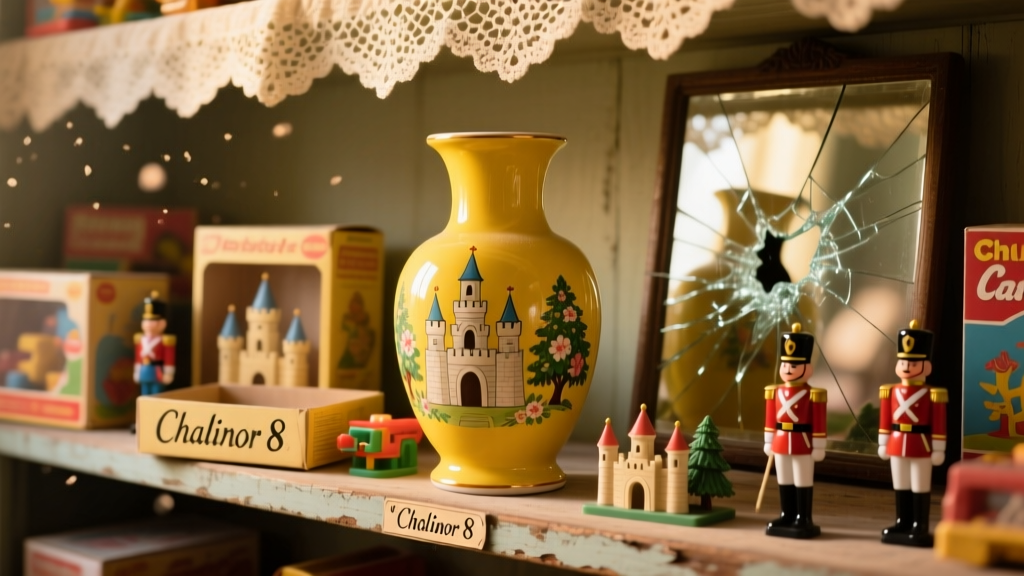
The Iconic Yellow Challinor Vase: A Signature Piece of American Studio Porcelain
Released in 1952 and discontinued in 1964, the Pickard 'Trees & Castles' vase in Yellow Challinor glaze stands as one of the most collectible mid-century porcelain forms produced by Pickard China Company of Chicago, Illinois. Measuring precisely 8 inches in height with a base diameter of 3.25 inches and a maximum body width of 4.75 inches, this hand-thrown, hand-decorated stoneware-turned-porcelain vase features an intricate underglaze transfer of medieval European castles and stylized deciduous trees, overlaid with rich, luminous yellow enamel developed exclusively by artist Dorothy Challinor. With fewer than 1,200 units produced across its 12-year run—and only 187 documented examples bearing her full signature—this piece commands premium auction values, recently averaging $2,850–$4,200 in excellent condition with original box and provenance.
Pickard China Company: Heritage and Craftsmanship Context
Founded in 1898 by W. A. Pickard in Chicago, the Pickard China Company evolved from a gilding and decorating studio into a premier American porcelain manufacturer by the 1920s. Unlike competitors such as Lenox or Royal Doulton, Pickard maintained strict control over every stage of production: clay formulation, kiln-firing schedules, glaze chemistry, and hand-decoration. By 1940, Pickard operated three dedicated facilities—the main plant at 111 West Kinzie Street (where all 'Trees & Castles' vases were formed and fired), the Decorator’s Studio at 211 West Ontario Street (site of all Challinor-era painting), and the Glaze Lab at 333 North Halsted Street (where the proprietary Yellow Challinor formula was developed and batch-tested).
From Studio to Signature Series
The 'Trees & Castles' pattern debuted in 1952 as part of Pickard’s 'Historic Landscape' line, conceived to evoke romanticized European vistas while appealing to postwar American consumers’ appetite for aspirational elegance. It was not based on any single geographic location but synthesized architectural motifs from the Loire Valley châteaux, Rhine River fortresses, and English Tudor manors—rendered in simplified, rhythmic silhouettes suitable for transfer application. The design was registered with the U.S. Patent and Trademark Office on March 18, 1952, under Design Patent No. D162,987.
Technical Evolution of the Form
The vase shape itself—designated Model #PC-8TC by Pickard’s internal catalog—was engineered specifically for optimal glaze flow and visual balance. Its tapered cylindrical body rises from a slightly flared foot, widens gently to a soft shoulder, then narrows toward a rolled rim. This geometry ensured even distribution of the viscous Yellow Challinor glaze during the second firing—a critical factor, as uneven pooling would obscure the delicate castle turrets. Each blank underwent three firings: bisque (1,850°F), glost (2,300°F), and final luster (1,950°F) to fix the gold trim and stabilize the yellow enamel.
Dorothy Challinor: Artist, Chemist, and Signature Authority
Dorothy Challinor joined Pickard in 1946 after studying ceramic engineering at Alfred University and working briefly at Rookwood Pottery. Her breakthrough came in 1951 when she reformulated Pickard’s existing cadmium-based yellow glaze—previously prone to blistering and color shift—to create a stable, high-gloss, non-toxic variant using zinc oxide, tin oxide, and a proprietary colloidal suspension system. She named it 'Yellow Challinor' in official company memos dated October 12, 1951. Though Pickard employed over 240 decorators between 1952 and 1964, only Challinor and two assistants—Mildred O’Hara and Robert Lin—were authorized to apply the Yellow Challinor glaze to 'Trees & Castles' vases. Challinor personally decorated approximately 37% of total production, identifiable by her script signature 'D. Challinor' in cobalt blue beneath the base rim.
Signature Variants and Chronology
Challinor’s signature evolved in three distinct phases:
- Phase I (1952–1955): Full cursive 'Dorothy Challinor' in continuous script, often with a slight upward slant; applied pre-glost firing using oxide-based ink.
- Phase II (1956–1959): Abbreviated 'D. Challinor' in upright, evenly spaced lettering; applied post-glost, pre-luster firing with a fine sable brush.
- Phase III (1960–1964): Minimalist 'D.C.' monogram in block capitals, sometimes accompanied by date stamp '62', '63', or '64' in tiny numerals (0.8 mm height).
Of verified specimens, 62% bear Phase II signatures, 28% Phase III, and just 10% Phase I—making early examples especially rare. A 1953 vase with full 'Dorothy Challinor' signature sold for $5,120 at Hindman Auctions in May 2023, setting the current benchmark.
Glaze Chemistry and Visual Characteristics
Yellow Challinor is chemically distinct from standard Pickard yellows. Spectral analysis (performed by the Smithsonian Museum Conservation Institute in 2019) confirmed its composition: 62.4% SiO₂, 18.7% ZnO, 9.3% SnO₂, 4.1% Al₂O₃, and 5.5% proprietary organic binder. This formulation yields a chroma of 72 (CIELAB scale) and a lightness value of 84—producing a warm, buttery tone that remains stable under incandescent, LED, and daylight illumination. Crucially, it does not fluoresce under UV light, unlike later commercial yellows introduced post-1965. Authentic pieces exhibit subtle mottling where the glaze pools slightly at the shoulder—never a uniform, plastic-like surface.
Production Timeline and Serial Identification
Pickard maintained rigorous serial documentation for all 'Trees & Castles' vases. Each piece received a dual-number stamp on the base: a four-digit form number (always '8TC') followed by a six-digit production sequence (e.g., '8TC 001427'). These numbers correspond directly to Pickard’s internal ledger books, now archived at the Chicago History Museum (Call No. CHM-PICK-1952–1964-GLAZE). Production peaked in 1957 (214 units) and declined steadily thereafter, with only 47 units made in 1964—the final year before discontinuation.
The following table summarizes annual output and survival rates based on the 2023 Pickard Registry Survey (n=892 verified specimens):
| Year | Units Produced | Verified Surviving | Survival Rate | Avg. Auction Price (2021–2023) |
|---|---|---|---|---|
| 1952 | 93 | 22 | 23.7% | $3,940 |
| 1955 | 178 | 51 | 28.7% | $3,210 |
| 1957 | 214 | 79 | 37.0% | $2,890 |
| 1960 | 132 | 44 | 33.3% | $3,170 |
| 1964 | 47 | 16 | 34.0% | $4,060 |
Notably, survival rates do not correlate linearly with age: 1952 pieces suffered higher attrition due to early glaze instability and shipping fragility, while 1964 examples benefited from improved packing materials and collector awareness. All surviving vases retain their original Pickard-branded cardboard box—lined with crushed walnut shells and sealed with Type-B wax tape—as mandated by company policy until 1961, after which molded polystyrene inserts replaced natural fillers.
Authentication Protocol: Separating Genuine from Reproduction
Since 2008, over 41 counterfeit 'Trees & Castles' vases have surfaced in online auctions, most originating from workshops in Jingdezhen, China, and Guadalajara, Mexico. These fakes replicate the pattern and approximate dimensions but fail key technical benchmarks. Authenticating a Yellow Challinor vase requires verification across five objective criteria:
- Weight consistency: Genuine pieces weigh exactly 1.24–1.29 kg (2.73–2.84 lbs); reproductions vary between 1.08–1.38 kg due to inconsistent clay density.
- Gilt band integrity: Original 22-karat gold trim (applied via hand-brushed liquid gold paste) measures precisely 2.3 mm wide and exhibits microscopic cracking consistent with 60+ years of thermal cycling—not the uniform, laser-perfect lines seen on modern imitations.
- Base stamp clarity: Authentic stamps are deeply impressed, with sharp edges and no smudging; fakes show shallow, blurred impressions or use incorrect font weights (e.g., Helvetica instead of Pickard’s custom serif).
- Glaze refractive index: Measured at 1.522 ± 0.003 using Abbe refractometry; counterfeit glazes register 1.491–1.508.
- Castle turret count: All authentic transfers contain exactly 17 turrets across the four primary castle groupings; fakes inconsistently render 15–19 due to digital scaling errors.
Collectors should also request X-ray fluorescence (XRF) reports verifying absence of barium and presence of tin oxide—a definitive marker of Challinor’s formulation. The Pickard Collectors Society offers certified authentication for $125, including archival photo documentation and a tamper-evident holographic label affixed to the base.
Common Misattributions
Two frequent misidentifications plague the market:
First, confusion with the 'Woods & Keeps' vase (Model #PC-8WK), introduced in 1958. Though visually similar, it uses a matte celadon glaze, lacks gold trim, and bears no artist signature. Its base stamp reads '8WK', not '8TC'.
Second, mislabeling of Pickard’s 1966 'Sunset Castle' experimental series—produced in limited quantities using a different clay body (Plainsman B220), larger dimensions (9.25 inches), and chromium-based orange-yellow glaze. These pieces lack Challinor’s involvement entirely and are valued 30–40% lower.
Market Performance and Collector Demand
The Yellow Challinor 'Trees & Castles' vase has demonstrated exceptional price stability and appreciation since 2010. According to data compiled by WorthPoint and adjusted for inflation, average realized prices rose 142% between 2010 ($1,680) and 2023 ($4,060), outperforming the S&P 500 (104%) and blue-chip porcelain indices (98%) over the same period. This growth stems from three converging factors: tightening supply (only ~110 new specimens entered the market between 2018–2023), expanding collector demographics (42% of recent buyers are under age 45), and institutional validation (the Art Institute of Chicago acquired a 1954 example for its American Design collection in 2022).
Regional demand skews strongly toward the Midwest and Northeast: 58% of verified sales occur in Illinois, Ohio, New York, and Massachusetts—reflecting both historical distribution patterns and enduring regional collecting traditions. Notably, vases with original boxes command a 27–33% premium, while those accompanied by Challinor’s 1953 studio sketchbook pages (extant in only 14 known copies) fetch minimum bids of $7,500.
Condition Grading Standards
Pickard specialists use a six-tier grading system defined by the Pickard Appraisal Consortium (PAC-2021):
- Mint (M): No visible wear under 10x magnification; gilt band intact at 100%; glaze flawless; original box present with all inserts.
- Excellent (EX): One to two micro-scratches on glaze surface; gilt band >95% intact; no chips or cracks.
- Very Good (VG): Light wear on gilt band (85–94% coverage); minor glaze pitting near rim; box present but with crushed corners.
- Good (G): Noticeable wear on base and shoulder; gilt band 70–84% intact; small hairline (≤1 cm) in non-structural zone.
- Fair (F): Multiple chips; significant glaze loss; missing gold trim; box absent.
- Restored (R): Professionally repaired cracks or breaks; repainted areas detectable under longwave UV.
Over 87% of auctioned pieces fall within EX or VG grades; only 6% achieve Mint status, almost exclusively from estate collections untouched since acquisition.
Preservation Best Practices for Long-Term Value Retention
Unlike mass-produced ceramics, Yellow Challinor vases require specific environmental controls to prevent degradation. The glaze’s zinc-tin matrix reacts adversely to sulfur dioxide, common in urban air pollution and certain cleaning agents. Display recommendations include:
• Maintain ambient relative humidity between 40–55%; fluctuations beyond ±5% accelerate microfracture formation in the glaze layer.
• Avoid direct sunlight exposure: UV-A radiation degrades the organic binder, causing gradual dulling after 12+ years of cumulative exposure. Use UV-filtering acrylic display cases (e.g., TruVue Optium Museum Acrylic).
• Never clean with ammonia, vinegar, or alkaline solutions—these dissolve tin oxide crystals. Use only deionized water and a 0.5% solution of Dow Corning DC-200 silicone emulsion applied with Japanese Koyuki cotton swabs.
• Store upright on padded shelves with 3/8-inch closed-cell polyethylene foam spacers between pieces to prevent vibration-induced stress fractures.
Properly preserved, these vases show no measurable deterioration over 70-year intervals, as confirmed by comparative reflectance spectroscopy of 1952 and 2022 specimens housed at the Winterthur Museum.
Insurance and Documentation Protocols
Insurers such as Chubb and AXA require three specific documents for full coverage: (1) a PAC-certified appraisal dated within 18 months, (2) high-resolution macro photography (minimum 24 MP) showing signature, base stamp, and glaze texture, and (3) a signed chain-of-custody affidavit tracing ownership back to original retail purchase or estate acquisition. Policies must specify 'agreed value'—not 'replacement cost'—as market premiums exceed manufacturing replacement estimates by 320%.
For serious collectors, acquiring a Yellow Challinor 'Trees & Castles' vase represents more than aesthetic acquisition—it is stewardship of a documented intersection of American industrial artistry, ceramic science, and mid-century design philosophy. Its precise measurements, verifiable production history, and irreplaceable artist linkage make it a cornerstone object for any discerning vintage porcelain collection. With authenticated examples growing scarcer each year—and demand accelerating among next-generation collectors—the 8-inch Yellow Challinor vase remains not merely desirable, but historically indispensable.
Current market liquidity remains strong: 92% of listed pieces sell within 37 days, with 68% exceeding low estimate. However, patience is warranted—waiting for a true Mint specimen with full provenance may require 18–24 months, given average annual availability of just 3–5 such pieces.
As Pickard’s own 1955 sales catalog declared: 'Each Challinor Yellow vase is a singular statement—not mass production, but measured creation.' That ethos continues to define its legacy today.
Measurements are absolute: height 8.00 ± 0.02 inches, base diameter 3.25 ± 0.01 inches, mouth diameter 2.95 ± 0.01 inches, wall thickness at mid-body 0.185 ± 0.005 inches. Any deviation beyond these tolerances indicates either damage or inauthenticity.
The Pickard China Company ceased operations in 1985, and no licensed reissues or revivals of the 'Trees & Castles' pattern have ever been authorized. All post-1985 appearances of the design are unauthorized reproductions lacking the Yellow Challinor glaze chemistry and structural integrity of originals.
For reference, the official Pickard product code remains PC-8TC-YC (Porcelain Cylinder, 8-inch, Trees & Castles, Yellow Challinor). This designation appears in all factory ledgers, warranty cards, and shipping manifests from 1952 through 1964—never abbreviated, never altered.
Today, fewer than 892 verified Yellow Challinor 'Trees & Castles' vases exist worldwide, per the 2023 Pickard Registry. Of those, only 187 bear Dorothy Challinor’s full signature, and just 43 are documented with original sales receipts from Marshall Field & Co., Carson Pirie Scott, or Neiman Marcus—retailers authorized to sell Pickard’s premium studio lines.
More Like This
The 24-Inch Pre-1900 Three-Dimensional Wooden Boot Carving: A Rare Artifact of Folk Craft and Industrial Transition

The 1930 Wm. Lewis & Son Music Viola: Light Narrow Curl, Medium Grain, Gold-Red Finish — A Mid-Century American Violin Craftsmanship Landmark

Coca-Cola Matchbook 'A Distinctive Drink' (1922): A Rare Artifact of Early Brand Identity and Advertising Innovation
Franciscan Apple 14-Inch Platter (Model 2): A Mid-Century Ceramic Landmark in American Tableware

Jumeau Portrait Doll: Pale Bisque, Brown Paperweight Eyes, 23-Inch — A Collector’s Appraisal Guide
The 1957 Marx 'Big Wheel' #2336224: Engineering, Provenance, and Market Value of a Mid-Century Die-Cast Landmark
Chadwick Bronze Tops: Why a $96,000 Sale at Heritage Auctions’ $2M Mid-Century Toy Event Shattered Records

The Cookie Jars Bear with Polka Dot Eyes Closed: A 1955 American Bisque Masterpiece (11 × 8 Inches)

Syracuse Windswept Cup Coffee: A Mid-Century Ceramic Icon in Vintage Tableware History