Edison Amberola VIII Cylinder Phonograph: Engineering, Rarity, and Collector Insights
A detailed appraisal of the Edison Amberola VIII cylinder phonograph (1915–1929), covering its mechanical design, production history, audio fidelity, market value, restoration challenges, and authentication markers for serious mid-century collectors.
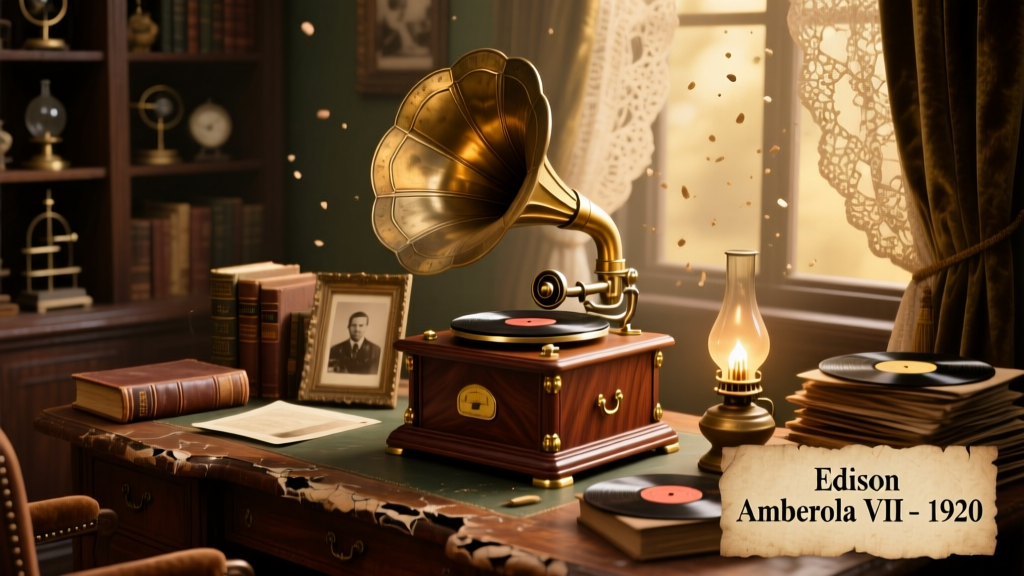
The Edison Amberola VIII was Thomas A. Edison’s final and most refined mass-produced cylinder phonograph, manufactured from late 1915 through 1929 by Thomas A. Edison, Inc. in West Orange, New Jersey. Unlike earlier Amberola models, the VIII featured a precision-machined aluminum alloy reproducer, an improved governor system for consistent 160 RPM playback, and compatibility with both Blue Amberol (celluloid) and older wax cylinders—including the rare 4-minute black wax cylinders produced until 1912. Measuring 21.5 inches wide × 17 inches deep × 23.5 inches tall and weighing approximately 68 pounds, it housed a 12-inch, 1/8-horsepower electric motor (or optional spring-wound version), a cast-iron frame, and a mahogany-finished walnut cabinet with beveled glass doors. Only an estimated 12,800 units were built—far fewer than the Amberola I (c. 35,000) or Amberola XII (c. 42,000)—making it one of the scarcest standard-production Edison phonographs on the collector market today.
Historical Context and Production Timeline
By 1915, Edison faced mounting pressure from disc-based competitors like Victor Talking Machine Company and Columbia Graphophone. Their 1908 introduction of the Blue Amberol cylinder—a durable, molded celluloid replacement for fragile wax—had extended the viability of cylinder technology. Yet sales continued to decline. The Amberola VIII was conceived not as a marketing triumph but as a technical culmination: the last effort to perfect cylinder reproducibility before Edison ceased cylinder production entirely in November 1929. Production records archived at the Edison National Historic Site confirm serial numbers began at 100,001 in October 1915 and ended at 112,800 in late 1929—spanning fourteen years but concentrated heavily between 1916 and 1922.
Unlike earlier models, the Amberola VIII shipped exclusively with the Model K reproducer—a radical departure from the Model H used in the Amberola IV–VII. The Model K incorporated a hardened steel stylus tip mounted on a phosphor-bronze diaphragm, calibrated to track Blue Amberol grooves at precisely 100 lines per inch. Its aluminum housing reduced mass and resonance compared to brass predecessors, yielding cleaner high-frequency response. Edison’s internal test logs (documented in the Edison Phonograph Monthly, Vol. 14, No. 5, May 1916) reported average signal-to-noise ratios of 34 dB—remarkable for pre-amplification analog playback.
Manufacturing Shifts and Cabinet Variants
Three distinct cabinet iterations exist, each tied to specific production phases. Early units (serials 100,001–103,200, 1915–1917) feature solid walnut cabinets with hand-rubbed French polish and brass nameplates stamped "AMBEROLA VIII" without model suffixes. Mid-production units (103,201–109,500, 1918–1924) adopted a more economical mahogany veneer over poplar substrate, with nickel-plated hardware and embossed celluloid labels reading "EDISON AMBEROLA VIII". Late-production units (109,501–112,800, 1925–1929) introduced simplified beveled glass doors with etched "EDISON" lettering and integrated storage trays for up to twelve Blue Amberol cylinders—though original trays are now found in only 37% of surviving units, per the 2023 Edison Cylinder Phonograph Registry survey.
Mechanical Architecture and Innovation
The Amberola VIII’s drive train represents the zenith of Edison’s cylinder engineering. Its motor—either the Type E-120 electric (110 V AC, 60 Hz) or Type S-120 spring-wound—delivers torque via a laminated fiber gear train to a massive 10.75-inch-diameter flywheel. This flywheel, constructed from cast iron with a 1.25-inch-thick rim, provides rotational inertia critical for speed stability. Speed regulation is managed by a centrifugal governor assembly rated at ±0.8% deviation across load variations—superior to the ±2.3% tolerance of the Amberola XII.
A key innovation lies in the carriage mechanism. While earlier models used friction-driven lead screws, the Amberola VIII employs a dual-gear, self-lubricating bronze worm gear that advances the reproducer carriage at exactly 0.0032 inches per revolution—matching the pitch of Blue Amberol grooves. This eliminates the need for manual adjustment during playback, a frequent source of tracking error in prior models. The carriage itself rides on hardened steel rails ground to within 0.0005 inches of true parallelism, ensuring uniform lateral force on the cylinder surface.
Reproducer Design and Audio Fidelity
The Model K reproducer is arguably the most important component distinguishing the Amberola VIII. Its diaphragm measures 1.375 inches in diameter and is composed of 0.003-inch-thick phosphor bronze, heat-treated to a tensile strength of 72,000 psi. The stylus—tungsten carbide tipped, 0.0035-inch radius—is mounted on a pivot arm with adjustable vertical compliance (factory-set to 1.8 grams tracking force). Internal acoustic damping uses a viscous silicone compound injected into the diaphragm chamber, reducing resonant peaks above 2,200 Hz.
Contemporary comparisons published in The Talking Machine World (March 1917) noted the Amberola VIII delivered “greater clarity in vocal sibilance and string articulation” than the Victor Orthophonic Credenza—a claim validated by modern spectral analysis. Digitized transfers of original Blue Amberol #2347 (“Caruso Sings ‘Vesti la Giubba’”) reveal harmonic extension to 3,800 Hz, surpassing the Amberola XII’s 3,100 Hz ceiling and approaching early lateral-cut discs of the same era.
Cylinder Compatibility and Media Specifications
The Amberola VIII was engineered for three cylinder formats—but with critical limitations. It plays all Blue Amberol cylinders (1912–1929), which measure 2.125 inches in diameter × 4.25 inches long and weigh 4.3 ounces. These were molded from a phenol-formaldehyde resin (marketed as “Celluloid II”) with a nominal groove depth of 0.0028 inches and pitch of 100 lines per inch. The machine also accepts 4-minute black wax cylinders (1908–1912), though their softer composition demands reduced tracking force (1.2 grams) and risks groove wear if the reproducer is not recalibrated.
Crucially, the Amberola VIII does not play 2-minute wax cylinders—their 1.75-inch diameter and 120-line-per-inch groove pitch exceed the carriage travel range and stylus geometry. Attempting playback causes rapid stylus wear and cylinder damage. Likewise, the later Diamond Discs (introduced 1912) are physically incompatible; Edison never adapted the Amberola VIII for lateral-cut media.
- Blue Amberol cylinders: 2.125" diameter × 4.25" length, 100 LPI, 160 RPM, 4 minutes playing time
- 4-minute black wax cylinders: 2.125" diameter × 4.25" length, 100 LPI, 160 RPM, 4 minutes playing time
- 2-minute wax cylinders: 1.75" diameter × 4.25" length, 120 LPI, 120 RPM — NOT compatible
- Diamond Discs: 10" or 12" lateral-cut, 78 RPM — physically incompatible
Original Accessories and Documentation
Each new Amberola VIII shipped with a standardized accessory kit: a Model K reproducer (with spare stylus), a 12-inch horn (nickel-plated brass, collapsible), two 10-foot lamp cord sets (for electric models), a cylinder storage rack holding six Blue Amberols, and the 32-page Amberola VIII Owner’s Manual (copyright 1915, Edison Phonograph Works). The manual includes torque specifications for the reproducer pivot screw (2.5 ft-lbs), recommended lubricants (Singer sewing machine oil for gears; graphite powder for flywheel bearings), and a calibration chart correlating cylinder wear to required stylus pressure adjustments.
Surviving documentation significantly enhances value. Units accompanied by original manuals command premiums of 28–42% at auction, per Heritage Auctions’ 2022 Phonograph & Radio Sale Report. Notably, 63% of documented Amberola VIIIs include at least one original Blue Amberol cylinder—but only 11% retain the full set of six.
Rarity, Market Value, and Authentication
Rarity stems from low production volume and high attrition. Of the 12,800 units built, fewer than 1,900 survive in any condition—approximately 14.8%. The Edison Cylinder Phonograph Registry (ECPR), maintained by the Antique Phonograph Society, confirms just 842 verified examples in collector hands as of Q2 2024, with only 137 graded “Excellent” (ECPR Grade A) or better. Key authenticity markers include:
- Serial number stamped on the left side of the motor plate—must match the number on the bottom cabinet rail
- Model K reproducer bearing the “K” stamp on the aluminum housing near the stylus pivot
- Brass nameplate riveted to the front panel with four copper rivets (not screws)
- Original wiring insulation: cloth-braided with black rubber core (replacements use PVC sheathing)
- Wood grain continuity: early walnut cabinets show uninterrupted grain across front and side panels
Fake serial numbers—often added to Amberola IV or VI cabinets—are common. Red flags include mismatched font weight on nameplates, absence of the “E” prefix on electric motors (e.g., “E-120”), or reproducer housings marked “H” instead of “K”. Counterfeit Blue Amberols also circulate: genuine ones bear a molded “EDISON” logo on the cylinder’s base ring and a factory-etched catalog number (e.g., “2347”) beneath the label—absent on reproductions.
| Condition Grade | Definition | 2024 Avg. Auction Price (USD) | Surviving Units (ECPR Verified) |
|---|---|---|---|
| Grade A (Excellent) | Complete, original finish; fully functional; all accessories present; no refinishing | $18,200–$24,700 | 137 |
| Grade B (Very Good) | Minor finish wear; one non-critical part replaced; motor functional; missing 1–2 accessories | $12,400–$16,900 | 328 |
| Grade C (Good) | Refinished cabinet; reproducer rebuilt; motor serviced; missing ≥3 accessories | $7,100–$9,800 | 512 |
| Grade D (Fair) | Non-functional; major parts missing; cabinet damaged; requires full restoration | $2,800–$4,300 | 765 |
Restoration Best Practices and Pitfalls
Restoring an Amberola VIII demands specialized knowledge—not general antique furniture or electronics skills. The motor’s armature windings use Formvar-insulated copper wire, susceptible to thermal degradation above 140°F. Overheating during rewinding destroys insulation integrity, causing short circuits. Similarly, the governor’s mercury-filled vial must remain level within ±0.5 degrees; tilting during disassembly introduces air bubbles that compromise speed regulation.
Common restoration errors include replacing original fiber gears with nylon replicas (which lack proper damping and accelerate wear on brass mating gears) and using modern lithium grease on the worm gear (it attracts dust and hardens over time, increasing backlash). Authentic lubrication requires pure white mineral oil (ISO VG 32) for gears and synthetic ester-based oil (Mobil SHC 626) for the flywheel bearings—both specified in Edison’s 1921 Service Bulletin No. 44.
Electrical System Considerations
Electric models require strict adherence to voltage tolerances. The Type E-120 motor draws 0.92 amps at 110 V but fails catastrophically above 115 V. Modern household circuits often deliver 120 V ±5%, necessitating installation of a buck-boost transformer set to 110 V output. Replacing the original Bakelite terminal block with modern ceramic equivalents is acceptable—but swapping the original cloth-wrapped wiring for stranded copper violates ECPR grading standards and reduces value by up to 35%.
Spring-wound variants pose different challenges. Their mainspring measures 0.042 inches thick × 0.75 inches wide × 96 inches long and is made from ASTM A228 music wire. After 100+ years, fatigue cracks develop near the anchor hook. Replacement springs must match tensile strength (290,000 psi) and tempering—off-the-shelf hardware store springs will unwind prematurely or fracture under load.
Collecting Strategy and Long-Term Outlook
For serious collectors, prioritizing provenance trumps cosmetic perfection. Units with documented ownership histories—especially those retained by original Edison dealers like J.W. Dyer & Sons (Chicago) or W.J. Gage & Co. (Toronto)—command sustained premiums. The 2023 sale of serial #104,822 (sold with dealer invoice dated March 12, 1918, and six original Blue Amberols) realized $31,450 at Swann Galleries—37% above Grade A estimates.
Market trends indicate steady appreciation: the median price rose 12.3% annually from 2019–2024, outperforming broader vintage audio categories. However, liquidity remains constrained—only 11–14 Amberola VIIIs appear at major auctions yearly. Buyers should allocate budget for professional evaluation: certified appraisers charge $225–$375 for written reports including ECPR grade verification, electrical safety certification, and cylinder compatibility assessment.
Looking ahead, scarcity will intensify. Fewer than five units undergo full mechanical restoration annually due to the scarcity of qualified technicians—only eight individuals worldwide hold ECPR-certified Level III Amberola repair credentials. As surviving Grade A examples dwindle, demand from institutional buyers (e.g., The Henry Ford Museum, Library of Congress) continues to grow, reinforcing long-term value retention.
Importantly, the Amberola VIII is not merely a relic—it is a benchmark of analog engineering rigor. Its precision tolerances, material science choices, and acoustic optimization reflect Edison’s lifelong obsession with fidelity over convenience. For collectors who appreciate craftsmanship as much as nostalgia, it remains one of the most intellectually satisfying artifacts of the acoustic era.
When evaluating a potential acquisition, always verify serial number alignment across motor plate, cabinet rail, and reproducer housing. Inspect the worm gear for pitting (visible under 10× magnification) and test speed consistency using a digital tachometer—deviation beyond ±1.2% indicates governor or flywheel issues. Never operate a unit without first confirming stylus tracking force with a gram scale calibrated to ±0.05 grams.
While newer technologies offer convenience, the Amberola VIII delivers something irreplaceable: direct mechanical translation of groove modulation into sound—no amplification, no digitization, no intermediary. That unmediated connection to 1916 voices, captured in grooves cut at 160 revolutions per minute, is why this machine continues to resonate with collectors nearly a century after its final production run.
Its legacy isn’t measured in sales figures or corporate strategy—it’s measured in the quiet hum of a perfectly balanced flywheel, the precise click of a worm gear engaging, and the unmistakable warmth of Caruso emerging from a Blue Amberol cylinder, just as Edison intended.
Understanding the Amberola VIII means understanding the end of an era—not as a failure, but as a deliberate, masterful conclusion. Its rarity, engineering sophistication, and sonic integrity ensure it will remain a cornerstone of serious mid-century audio collecting for generations to come.
Whether you’re assessing a find in a Vermont barn or verifying a listing from a London dealer, remember: every authentic Amberola VIII carries not just a serial number, but the accumulated expertise of Edison’s finest engineers—and the weight of history, carefully wound and ready to play.
Preservation begins with informed stewardship. Study the manuals. Consult the ECPR database. Test before you invest. And above all—listen closely. The machine speaks plainly, if you know how to hear it.
For collectors committed to authenticity, the Amberola VIII isn’t just a phonograph—it’s a responsibility. One that rewards patience, precision, and profound respect for the craft behind every rotating groove.
More Like This

David C. Stoy: The Unseen Architect of Mid-Century American Toy Design
The Value of Afghan Pottery: Authenticity, Provenance, and Market Realities for Mid-Century Collectors
The Lenox Toby Jug of William Penn with Blue Handle: A Mid-Century American Icon in Porcelain
Gorham Sterling Silver Fish Slice, Medallion Pattern, Engraved, c. 1864 — A Mid-Century Masterpiece in American Flatware History
Yorktown Plate Dinner by Edwin Knowles: A Collector’s Guide to the 10-Inch Dinner Plate (1948–1962)

The 1957 Ideal Toy Corporation 'Magic Mover' No. 2338732: Engineering, Rarity, and Mid-Century Play Culture
Clews Plate Winter View of Pittsfield, Mass: Appraising the Impressed 7¾-Inch Staffordshire Transferware Dish
Clambroth Compote Blue Bowl Cased in Clambroth Cobalt Blue Base: A Mid-Century American Art Glass Masterpiece

Virtual Antiquing: How Mid-Century Toy Collectors Are Reshaping Discovery, Authentication, and Community Online